

Dissertation Data Analysis Help for Nursing Research
If you are searching for dissertation data analysis help, you are already at one of the most technically demanding stages of the research process. Data analysis is the point where your study either gains analytical credibility or begins to weaken under methodological inconsistency, inappropriate statistical testing, poor coding, or vague interpretation. At NursingDissertationHelp.com, we provide dissertation data analysis support tailored to nursing and healthcare research, with a strong emphasis on methodological alignment, statistical accuracy, interpretive clarity, and academic presentation.
Many students assume that dissertation analysis simply means running figures through software and pasting outputs into a chapter. In reality, rigorous analysis demands much more. First, the analytical method must match the research design. Next, the variables must be defined correctly. Then, the dataset must be prepared, cleaned, and assessed for assumptions. After that, the chosen tests must be applied accurately. Finally, the outputs must be translated into clear academic language and connected back to the research questions, literature, and implications for practice. Because nursing dissertations often involve patient outcomes, clinical interventions, perceptions of care, service quality, safety indicators, or education outcomes, the interpretation must also remain relevant to healthcare realities.
Our service is built for that exact challenge. We do not treat analysis as an isolated technical task. Instead, we approach it as a central academic function within the dissertation. Consequently, our support covers quantitative analysis, qualitative analysis, mixed-methods integration, result interpretation, results chapter writing, discussion support, presentation of tables and figures, and alignment with institutional expectations.
Why dissertation data analysis matters so much
A dissertation can have a strong topic, a thoughtful literature review, and a carefully written methodology, yet still fall apart if the data analysis is weak. That happens because analysis is the bridge between the design of the study and the conclusions drawn from it. When that bridge is unstable, every later section becomes vulnerable. Results become unclear. Discussion becomes speculative. Recommendations lose force. Examiners begin to question the logic of the entire project.
For nursing students, this stage is even more sensitive. Nursing research often deals with measurable outcomes such as medication adherence, patient satisfaction, readmission rates, burnout, clinical competencies, intervention effectiveness, infection prevention, leadership outcomes, or educational improvement. Therefore, dissertation data analysis must not only be technically correct; it must also be meaningful in a healthcare context. A regression output, for example, is not enough on its own. You must explain what the relationship means, why it matters, whether it is statistically significant, whether it is clinically meaningful, and how it compares with the existing literature.
That is why students often seek professional data analysis support. The issue is not always lack of effort. In many cases, the problem is that dissertation analysis requires a combination of skills that are rarely mastered at once: statistics, software use, methodological thinking, academic writing, and subject-specific interpretation. Our service brings those components together in one place.
What our dissertation data analysis help includes
Our dissertation data analysis help is designed to support students at different points in the process. Some students already have a dataset and need help choosing the correct tests. Others have run analyses but cannot interpret the output. Some are working with interviews or focus groups and need help coding themes. Others need support from data cleaning to final chapter writing.
We therefore provide assistance with the following:
- Quantitative dissertation analysis, including descriptive and inferential statistics.
- Qualitative dissertation analysis, including coding, thematic development, interpretation, and presentation.
- Mixed-methods dissertation analysis, including integration of numerical and narrative findings.
- SPSS data analysis help, including variable coding, data entry review, assumption testing, and output interpretation.
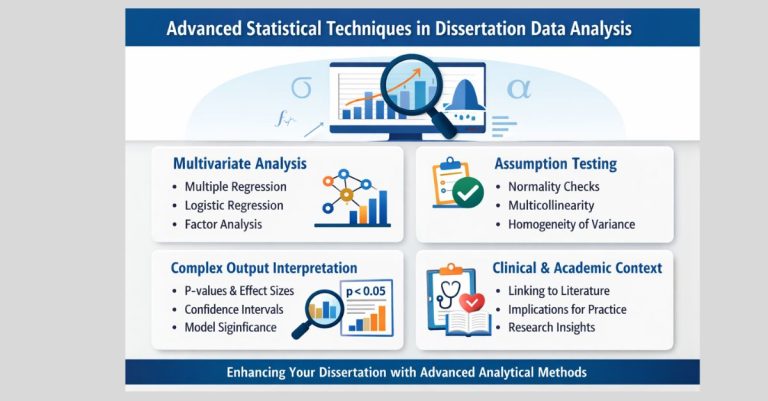
- Regression analysis support, including linear regression, multiple regression, and logistic regression where appropriate.
- Results chapter support, including the writing of statistically accurate and academically coherent results.
- Discussion chapter support, especially where students need help linking findings to literature and nursing practice.
- Data visualization support, including tables, charts, and presentation structures suitable for dissertations.
- Methodological alignment checks to ensure the analysis matches the stated design, objectives, and hypotheses or research questions.
- Because different projects require different levels of intervention, we can support a full analysis workflow or only the part where you are stuck.
Dissertation data analysis help for quantitative research
Quantitative research remains common in nursing, public health, and healthcare management. Students frequently use surveys, questionnaires, structured assessments, audit data, observational measures, and intervention outcomes. However, quantitative analysis becomes difficult when students are unsure about variable types, scale levels, test selection, assumption testing, or interpretation.
Our quantitative dissertation support begins with the logic of the study. We first examine the research questions, hypotheses, variables, data structure, and sample characteristics. From there, we identify the most suitable analytical pathway. This matters because many weak dissertations fail not from poor data, but from wrong test selection. For instance, a student may apply multiple t-tests where ANOVA would be more appropriate, or use Pearson correlation where ordinal variables call for Spearman’s rho. Likewise, some students run regression models without first checking linearity, multicollinearity, or homoscedasticity, which weakens the credibility of the findings.
We help prevent those errors. Our support commonly includes descriptive statistics such as frequencies, percentages, means, medians, standard deviations, and range. We then support inferential procedures where relevant, including t-tests, paired-samples tests, chi-square tests, ANOVA, correlation analysis, and regression models. In each case, the output must be interpreted in context. A p-value alone is not a discussion. A mean difference is not automatically meaningful. Statistical significance must be read alongside practical meaning, effect size where possible, and relevance to nursing practice.
Dissertation data analysis help with descriptive statistics
Descriptive statistics often look simple, yet many dissertations weaken at this stage because students present numbers without explanation or choose summaries that do not match the data type. We help structure this stage properly by distinguishing between categorical and continuous variables, choosing suitable summary measures, and ensuring that demographic or baseline characteristics are presented clearly.
For example, if your study investigates nurses’ perceptions of staffing adequacy, we can help organize respondent demographics, summarize scale items, and structure a results section that clearly shows patterns before inferential testing begins. This early clarity is important because it frames the later analysis and helps examiners understand the dataset before more complex procedures appear.
Dissertation data analysis help with inferential statistics
Inferential statistics allow you to move beyond description and examine relationships, differences, associations, and predictors. Yet this is also where technical errors become more frequent. We help ensure that the statistical test answers the question you are actually asking.
If you want to compare two groups, we consider whether the data supports an independent-samples or paired-samples design. If you want to compare more than two groups, we examine whether ANOVA is suitable and whether post hoc analysis is needed. If you want to test association between categorical variables, we assess whether chi-square assumptions are met. If you want to explore relationships between variables measured on a scale, we determine whether Pearson or Spearman correlation fits best.
More importantly, we help translate the numbers into academic narrative. Many students paste outputs from software and hope the tables will speak for themselves. They rarely do. Examiners expect interpretation, not just extraction.
Need expert guidance on your dataset, tests, or results chapter? Request a custom quote for dissertation data analysis help tailored to your nursing research design.
Dissertation data analysis help with SPSS
SPSS remains one of the most widely used tools in nursing and social science research because it offers a manageable interface for quantitative analysis. However, SPSS does not remove the need for methodological judgment. A student can click through menus and still produce invalid analysis.
Our SPSS data analysis help supports students through each of the major stages. First, we review the dataset structure. Variables must be named, coded, labeled, and assigned the correct measurement levels. Then, we examine missing values, entry errors, outliers, and inconsistent coding. If items belong to a scale, we assess whether reverse coding is required. If composite scores are needed, we help compute them correctly. If reliability is relevant, we support Cronbach’s alpha analysis and explain what the result means for the credibility of the scale.
Next, we support assumption testing before inferential analysis proceeds. For parametric tests, we assess normality, homogeneity of variance, linearity where relevant, and other assumptions depending on the method. If assumptions fail, we help determine whether a transformation, robust approach, or non-parametric alternative is more appropriate.
Once the analysis is run, the real challenge begins: interpretation. Students often struggle to read the SPSS output tables efficiently. They may not know which table matters most, how to identify significance correctly, how to interpret coefficients, or how to summarize the result in prose. We help students move from raw output to dissertation-ready interpretation. That includes helping write sentences that are concise, accurate, and properly aligned with APA or institutional style expectations.
Dissertation data analysis help with regression analysis
Regression analysis is especially valuable in nursing research because many studies seek to examine predictors of outcomes. Students may want to know whether work environment predicts burnout, whether patient education predicts medication adherence, whether staffing ratios predict patient satisfaction, or whether training predicts infection control compliance. Regression can address such questions, but it must be handled with care.
We support different forms of regression analysis depending on the design and outcome variable. Linear regression may be appropriate where the dependent variable is continuous. Multiple regression becomes useful when several predictors are included. Logistic regression may be appropriate where the outcome is binary, such as presence or absence of an event. In each case, the analysis should not be used simply because it appears advanced. It should be used because the research question justifies it.
Our regression support includes model specification, variable preparation, collinearity checks, interpretation of coefficients, significance testing, and explanation of model fit. We also help students explain what the regression tells them in practical terms. A statistically significant predictor must be explained in plain academic language. If one variable has a stronger predictive effect than another, that difference should be contextualized. If the model explains only part of the variation in the outcome, that limitation should also be acknowledged.
Assumption testing in regression models
Regression analysis becomes weak when the assumptions are ignored. Therefore, we support careful examination of linearity, independence of errors, normality of residuals, homoscedasticity, and multicollinearity where appropriate. These checks matter because a dissertation is judged not just by whether the analysis produced a result, but by whether the method was used responsibly.
Interpreting regression output for dissertation chapters
Students often struggle to convert regression output into meaningful dissertation prose. We support that process by helping explain coefficients, direction of association, statistical significance, model strength, and implications. We also help make sure the interpretation does not overstate causation when the design supports only association.
Dissertation data analysis help for qualitative research
Not all dissertations use numbers. Many nursing studies investigate lived experiences, perceptions, barriers, leadership practices, communication issues, patient narratives, care quality experiences, and professional identity. These topics are often best explored using qualitative methods. However, qualitative analysis has its own technical demands. It is not informal reading and summarizing. Strong qualitative analysis requires systematic coding, pattern recognition, theme development, interpretive rigor, and transparency of procedure.
Our qualitative dissertation data analysis help supports students working with interviews, focus groups, reflective narratives, open-ended survey responses, policy texts, and observational notes. We help structure the analytic approach according to the methodology used. If your study uses thematic analysis, we help organize coding, category development, and theme construction. If grounded theory principles are involved, we help with constant comparison and conceptual refinement. If content analysis is more suitable, we help distinguish manifest and latent content where relevant.
Most importantly, we help students avoid one of the most common mistakes in qualitative dissertations: confusing summary with analysis. Good qualitative work goes beyond what participants said. It identifies patterns, contrasts, meanings, tensions, and implications. That depth is what we help produce.
Dissertation data analysis help with thematic analysis
Thematic analysis is especially common in nursing and healthcare research because it offers a structured way to interpret interviews and narratives. However, students often stop too early at the coding stage. Codes alone are not themes. A theme must capture a meaningful patterned response related to the research focus.
We help students move from transcripts to defensible themes. That includes transcript familiarization, initial coding, code refinement, category grouping, theme generation, and theme definition. We also help ensure that themes are supported by evidence, clearly named, analytically distinct, and presented in a coherent structure. Where suitable, we help integrate participant quotations to support interpretive claims without allowing quotations to substitute for analysis.
Dissertation data analysis help for mixed-methods research
Mixed-methods dissertations combine quantitative and qualitative evidence, often to strengthen explanatory depth. This can be powerful, but it is also methodologically demanding. Students must not only analyze two types of data; they must also integrate them meaningfully. If the strands remain separate and never inform one another, the mixed-methods design loses much of its value.
Our mixed-methods support helps students clarify the design logic, whether explanatory sequential, exploratory sequential, or convergent. We then help analyze each strand on its own terms before addressing integration. Integration may involve comparing findings, using one strand to explain the other, identifying convergence or divergence, or building a broader interpretation. In nursing research, this can be especially useful where numerical outcomes need experiential explanation.
For example, survey results might show moderate adherence to a hand hygiene policy, while interviews reveal deeper barriers related to staffing pressure, resource limitations, or leadership inconsistency. That integrated insight is often more persuasive than either strand alone.
Need help with SPSS, regression, qualitative coding, or mixed methods integration? Get dissertation data analysis help that connects your methods, findings, and academic writing.
Data cleaning and preparation before analysis
A strong analysis starts before any formal test or coding process begins. Data preparation is often overlooked, yet it is one of the most important stages. A dataset with inconsistent coding, duplicate entries, missing values, outliers, or unclear variable labels can distort the analysis and damage the credibility of the dissertation.
We therefore support detailed data preparation. For quantitative projects, this may involve checking coding consistency, cleaning entries, defining missing values properly, computing derived variables, reviewing scale structures, and identifying outliers. For qualitative work, data preparation may involve transcript formatting, anonymization, familiarization, and document organization.
This stage also matters because it affects the transparency of the dissertation. A student should be able to explain how data moved from collection to analysis. That methodological clarity signals rigor. It also makes the results easier to defend during examination or review.
Dissertation data analysis help with validity, reliability, and rigor
Technical analysis is not enough on its own. Examiners often look for broader signs of methodological soundness. In quantitative work, reliability and validity are critical. In qualitative work, rigor, trustworthiness, and transparency play a similar role.
We support students in addressing these issues appropriately. For quantitative studies, this may involve reliability testing for survey scales, discussion of content validity, construct validity, or limitations related to measurement. For qualitative studies, we help address credibility, dependability, confirmability, reflexivity, and transparency of coding.
This matters because even a correctly run analysis can appear weak if the student cannot explain why the instruments, procedures, and interpretive framework were sound.
Writing the results chapter
Many students can obtain some kind of output but still struggle to write the results chapter. That is because dissertation writing at this stage demands both discipline and restraint. The results chapter should report the findings clearly, accurately, and without drifting prematurely into full discussion. At the same time, it must not be so bare that the findings become opaque.
Our service helps structure the results chapter logically. We organize findings according to research questions, hypotheses, variables, or thematic structure depending on the methodology. We help present tables and figures in a readable way. We also help write interpretive commentary that is accurate without becoming repetitive or speculative.
A well-written results chapter shows analytical confidence. It guides the reader through the evidence. It does not overwhelm them with unexplained software printouts. It does not bury key findings in excessive description. Instead, it presents the analytical story with order and precision.
Writing the discussion chapter from your analysis
The discussion chapter is where your analysis becomes argument. Here, you do more than state what the data showed. You explain what the findings mean, how they compare with prior studies, why certain patterns may have emerged, what implications arise for nursing practice, and what limitations remain.
Students often struggle because they move too quickly from results to claims, or because they repeat the findings without deeper interpretation. Our support helps bridge that gap. We help link results to literature, identify points of agreement and divergence, and explain what the findings suggest in a healthcare context. We also help students avoid exaggerated claims, especially where the design does not justify causal language.
For nursing dissertations, discussion quality is crucial because the field values practical application. A result that remains abstract feels incomplete. The discussion should explain whether the findings support better care, leadership, education, policy, workforce planning, patient safety, or service delivery.
Technical depth without unnecessary complexity
Many students believe that the best dissertation is the one with the most complex analysis. That is not true. A strong dissertation uses the right level of complexity for the research question. Overcomplicated analysis can weaken a project if the student cannot justify or interpret it. At the same time, oversimplified analysis can make a serious project look underdeveloped.
Our approach is to match technical depth to research need. If your study requires straightforward descriptive and comparative tests, we support that cleanly. If it calls for regression modeling, scale reliability assessment, or mixed-methods integration, we support that as well. The aim is not complexity for its own sake. The aim is defensible, academically strong analysis.
Why students seek dissertation data analysis help
Students come to this stage with different problems. Some have limited confidence in statistics. Some have not used SPSS or coding frameworks before. Others understand the software but struggle with interpretation. Some have supervisors who expect a high level of methodological sophistication but provide limited practical guidance. Others are balancing study with employment, clinical work, or family commitments and do not have the time to troubleshoot analytic problems alone.
That is why dissertation data analysis help has become such an important academic support area. Students are not only seeking a technical service. They are seeking clarity, efficiency, and analytical confidence. They want to know that the test they are running makes sense, that the coding process is defensible, and that the chapter they submit will read like serious academic work rather than improvised software output.
Our approach to dissertation data analysis help for nursing students
We specialize in nursing and healthcare research. That focus matters because subject context changes interpretation. A statistically significant finding in a business dissertation is not discussed the same way as a statistically significant finding in a nursing dissertation. Healthcare outcomes, patient safety, professional practice, ethics, and evidence-based care all shape how the analysis should be read and presented.
We therefore support not only technical execution but also disciplinary relevance. Whether your study concerns nurse burnout, patient satisfaction, infection control, leadership styles, digital health adoption, medication safety, maternal health, or educational interventions, the analysis should connect to the realities of nursing research.
Ready to strengthen your dissertation with rigorous analysis, clear results, and academically defensible interpretation? Request quote now for expert dissertation data analysis help today.
Frequently asked questions
What does dissertation data analysis help usually include?
It usually includes support with data cleaning, choosing suitable analytical methods, running quantitative or qualitative analysis, interpreting outputs, writing the results section, and connecting findings to the discussion chapter.
Can you help with SPSS outputs I already have?
Yes. If you have already run the analysis but do not understand the output, we can help interpret the tables, identify the key findings, and convert the results into dissertation-ready academic writing.
Do you support qualitative dissertations too?
Yes. We support thematic analysis, content analysis, coding frameworks, and broader qualitative interpretation for interviews, focus groups, open-ended responses, and related materials.
Can you help with regression analysis?
Yes. We can support linear regression, multiple regression, and, where appropriate, logistic regression. We also help with assumption testing and interpretation so the model is explained correctly in the dissertation.
Is dissertation data analysis help only for nursing students?
This page is designed for nursing and healthcare research, so the examples and interpretation focus on that area. That subject-specific approach is one of the strengths of the service.
Can you help write the results and discussion chapters?
Yes. We can support not just the analysis itself but also the writing of the results chapter and the interpretation needed for the discussion chapter.
What if my supervisor asked for more technical depth?
That is one of the most common reasons students seek support. We can help strengthen the analysis by improving methodological alignment, adding assumption checks, refining interpretation, and deepening the analytical rationale.
Do you handle mixed-methods dissertations?
Yes. We support both strands separately and then help with meaningful integration so the mixed-methods design functions as a coherent whole.
How do I know whether I need quantitative or qualitative analysis support?
That depends on your research design, research questions, and data type. If your study uses numerical datasets, quantitative analysis is likely appropriate. If it uses interviews or narratives, qualitative analysis may be more suitable. Some studies use both.
Can dissertation data analysis help improve my overall dissertation quality?
Yes. Strong analysis often improves the entire dissertation because it sharpens the results, strengthens the discussion, and makes the final conclusions more credible.
Final thoughts
Dissertation data analysis is not a side task. It is one of the central intellectual stages of the entire project. It is where your methodology proves its value, where your data begins to answer your research questions, and where your dissertation either gains analytical authority or starts to lose it. For nursing students, this stage demands even more because the findings must often carry both academic and practice-based significance.
That is why our dissertation data analysis help is designed to be deeper than routine software support. We focus on methodological fit, technical precision, interpretive strength, disciplinary relevance, and chapter-level clarity. Whether you need help with SPSS, regression, qualitative coding, mixed-methods integration, results writing, or discussion development, the aim remains the same: to help you produce analysis that is academically credible, technically sound, and persuasive within nursing research.