

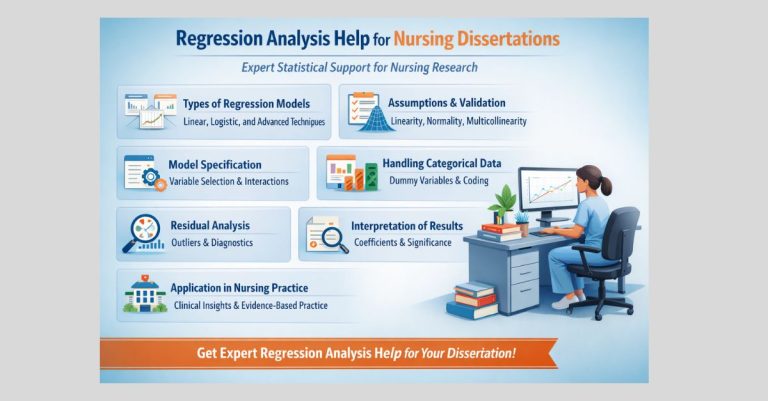
Expert Regression Analysis Help for Nursing & Healthcare Research
Welcome to your ultimate guide on accessing professional regression analysis help. If you’re a nursing student, DNP candidate or healthcare researcher wrestling with statistical models, you’re not alone. Modern research demands rigorous data analysis, yet many scholars struggle with complex assumptions, multicollinearity, and confounding variables. Without expert support, it’s easy to mis-specify a model, violate key assumptions or misinterpret results, jeopardizing the reliability of your findings. This article explains why you need expert guidance, demystifies regression analysis, and shows how our service can support your academic journey.
Understanding the Real Challenges Students Face
Regression analysis is a cornerstone of modern research because it quantifies relationships between variables and makes predictions. The MIT OpenCourseWare notes define linear regression as modelling the relationship between an independent predictor (x) and a dependent response (y) with some random error[1]. In health sciences, regression analysis is widely used to determine how multiple variables influence outcomes[2]. However, applying these techniques correctly is far from straightforward.
Common Methodological Problems
Researchers frequently encounter methodological pitfalls that undermine the validity of their models. A 2025 paper on regression analysis in psychological research highlights several critical issues: incorrect model specification, violations of assumptions (linearity, independence, homoscedasticity and normality), multicollinearity, overfitting and inadequate interpretation[3]. These problems are not unique to psychology; they plague nursing and healthcare research as well. Penn State’s applied regression course warns that including irrelevant predictors can overcomplicate a model and increase uncertainty, while excluding important predictors, often called confounding variables, can lead to meaningless or misleading associations[4]. Missing data, extrapolation beyond the scope of the model and small sample sizes further complicate analysis[5].
The Burden of Assumptions
Regression models rest on four key assumptions: linearity and additivity, independence of errors, homoscedasticity (constant variance) and normality of residuals[6]. Violating these assumptions can produce biased estimates or misleading confidence intervals. Diagnostics such as residual plots, variance inflation factors (for multicollinearity) and tests for autocorrelation require statistical expertise. Unfortunately, many students lack the training or time to perform these checks rigorously.
Controlling Confounding Variables
Observational studies are especially vulnerable to confounding, where an unmeasured factor influences both the predictor and outcome. An article in Kidney International notes that a major purpose of multivariate modelling is to control for confounding so that the true effect of a risk factor can emerge[7]. Sociological research warns that regression coefficients cannot be interpreted causally when relationships may be explained by alternative mechanisms; researchers must either randomize participants or measure and adjust for confounders[8]. Failing to address confounding may lead to incorrect conclusions and flawed healthcare policies.
Why Regression Analysis Help Matters
Enhancing Validity and Accuracy
A 2026 review underscores the versatility of regression analysis across disciplines, from engineering and finance to health sciences, and lists common methods such as linear, multiple, logistic and Cox regression[2]. In health research, regression enables scholars to examine correlations, identify risk factors and forecast outcomes while controlling for confounding variables[2]. Properly executed regression analysis improves the validity and accuracy of results and translates data into actionable insights[2]. Yet the technique’s power rests on meeting assumptions, selecting appropriate models and interpreting results correctly, all areas where expert help can make a difference.
Navigating Complex Models and Data
Healthcare datasets often include numerous variables, nonlinear relationships and categorical outcomes. The World Neurosurgery tutorial emphasises that data preparation, univariable and multivariable analysis, choosing suitable models and checking assumptions are essential prerequisites for any regression analysis[9]. The same tutorial identifies four main types of regression, linear, logistic, multinomial logistic and proportional odds models[10]each requiring different techniques and interpretive skills. Selecting the right model without oversimplifying or overfitting demands experience.
Protecting Ethical Standards and Academic Integrity
Using regression analysis ethically means recognizing its limitations. Scholars caution that one cannot draw causal conclusions from regression alone unless confounding is addressed or randomization is used[8]. Overfitting, extrapolation beyond the data’s range and ignoring missing values can all lead to misleading results[11]. Consulting with statisticians or methodologists is recommended to ensure analyses meet the highest scientific and ethical standards[12].
Benefits of Professional Regression Analysis Help
Turning to professional regression analysis help offers multiple advantages:
- Expertise in complex models: Our team includes statisticians familiar with linear, logistic and advanced regression techniques. We know how to select appropriate models, handle interaction terms and apply transformation or non-linear adjustments when necessary[9].
- Assumption checking and diagnostics: We conduct thorough diagnostic tests, such as residual plots, Durbin–Watson tests and variance inflation factor analyses, to verify that assumptions like linearity, independence and homoscedasticity are met[6].
- Confounding control: Our analysts identify and adjust for confounding variables to ensure that associations reflect genuine relationships rather than hidden biases[7]. When confounders cannot be measured, we advise on sensitivity analyses and robust modelling strategies[8].
- Interpretation and reporting: We translate statistical output into clear, actionable language. This includes explaining coefficients, p-values, confidence intervals and effect sizes so that researchers can confidently discuss their findings.
- Time and stress reduction: By partnering with experts, you avoid hours of frustration, reduce the risk of errors and free up time for literature review, clinical work or writing.
- Alignment with academic standards: Our services emphasize ethical support and learning. We provide guidance and model examples; we do not conduct research on behalf of clients. The goal is to improve understanding and academic performance rather than facilitate plagiarism.
Additionally, we offer integrated support across your program. If you need broader assistance, we can connect you with specialists in nursing research paper support or DNP dissertation help. Our case studies highlight successful collaborations, while our transparent pricing options ensure there are no hidden fees.
How Our Regression Analysis Process Works
We believe in a collaborative, step-by-step approach tailored to your research questions. Here’s an overview of how our regression analysis help process unfolds:
- Initial consultation: During a free consultation, we discuss your research objectives, data structure, and any concerns. You can explore our about us page to learn more about our team and mission.
- Data review and cleaning: Our experts examine the dataset for missing values, outliers and measurement errors. When missing data are unavoidable, we advise on imputation techniques and sensitivity analyses[13].
- Model selection: We help identify the appropriate regression technique. Linear models are ideal for continuous outcomes, logistic regression for binary outcomes and proportional-odds or multinomial models for ordinal or multi-category responses[10]. For time-to-event data, we may recommend Cox proportional hazards models[2].
- Assumption diagnostics: Before fitting models, we assess linearity and additivity, independence of errors, homoscedasticity and normality[6]. We may apply transformations or include interaction terms to address deviations.
- Model estimation and validation: We compute parameter estimates using statistical software, then evaluate goodness-of-fit and potential overfitting. Techniques such as cross-validation, bootstrapping or penalized regression help ensure robustness[3].
- Interpretation and reporting: We prepare comprehensive reports summarizing findings with tables, graphs and plain-language explanations. We link results back to your research questions and theoretical framework. If needed, we advise on integrating results into your dissertation data analysis
- Ongoing support: Our commitment doesn’t end with a single analysis. We offer revisions, clarify reviewer comments and provide follow-up guidance. For general academic tasks, we also support coursework for nursing students and nursing assignment help.
Our how it works page outlines these steps in detail and explains how to get started. When you’re ready, simply visit our order page to initiate your project.
Choosing the Best Regression Analysis Help Service
Selecting the right partner for regression analysis help is crucial. Consider the following factors:
- Expert qualifications: Look for statisticians with experience in health sciences. Our team includes PhD-level professionals who understand the nuances of nursing research and evidence-based practice.
- Range of services: Ensure that the service offers comprehensive support, from data cleaning and model selection to interpretation and revision. We integrate with related services like inferential statistics help for nursing research and qualitative data analysis.
- Transparency: Reliable services provide clear pricing, deadlines and deliverables. Our pricing page outlines options, and our refund policy ensures peace of mind.
- Ethical approach: Avoid companies that promise to “write your dissertation.” The goal should be to empower you to learn and complete your work ethically. We emphasize education and adherence to academic standards.
- Client feedback: Explore testimonials and case studies. Our case studies showcase successful collaborations across diverse nursing specialties.
By considering these criteria, you can choose a service that not only solves statistical problems but also enhances your research skills.
Key Components and Steps in Regression Analysis
To illustrate what professional regression analysis help involves, this section outlines the key steps and types of regression models. Proper execution of these stages ensures robust and reliable findings.
Step-by-Step Workflow
- Define the research question. Specify the dependent variable and independent predictors. Ensure that the question aligns with your theoretical framework and nursing practice.
- Acquire and inspect data. Identify data sources (e.g., clinical trials, surveys, electronic health records), check for completeness and understand variable types (continuous, binary, ordinal, nominal).
- Choose the appropriate model. Determine whether a linear, logistic or other regression method fits the outcome and research design[10].
- Check assumptions. Use diagnostic tests to assess linearity, independence, homoscedasticity and normality[6]. Address violations via transformations or alternative models.
- Estimate and validate the model. Fit the model using least squares, maximum likelihood or other estimation methods. Validate using cross-validation or bootstrapping to avoid overfitting[3].
- Interpret coefficients and evaluate fit. Examine parameter estimates, standard errors and p-values. Consider effect sizes and confidence intervals. Evaluate R-squared, AIC/BIC and residual plots for goodness-of-fit.
- Report results and discuss implications. Present findings in a clear narrative supported by tables and figures. Relate results back to clinical practice or public health policy.
Comparison of Regression Types
| Regression type | Description | Typical application |
| Linear regression | Models a continuous dependent variable as a linear function of one or more predictors[1]. Assumes linearity, independence, homoscedasticity and normality[6]. | Predicting blood pressure from age and weight; estimating nursing hours required based on patient acuity. |
| Multiple regression | Extension of linear regression with multiple independent variables. Useful for controlling confounding and examining interaction effects[7]. | Evaluating how education level, shift length and nurse-to-patient ratio jointly affect medication errors. |
| Logistic regression | Models the log odds of a binary outcome (e.g., success/failure) as a linear combination of predictors[10]. | Assessing whether smoking status, BMI and family history predict the presence of diabetes. |
| Multinomial & proportional-odds regression | Multinomial regression handles outcomes with more than two unordered categories; proportional-odds regression is used for ordered categories[10]. | Modelling patient satisfaction ratings (poor, fair, good, excellent) based on wait time and communication quality. |
| Cox proportional hazards regression | Models time-to-event data by estimating hazard ratios while allowing for censored observations[2]. | Studying time to readmission based on discharge planning and comorbidities. |
Ethical Considerations
Academic integrity is paramount when seeking regression analysis help. Here are principles to uphold:
- Avoid ghostwriting. Assistance should enhance your understanding and guide your work, not replace it. We provide consultations, examples and explanations so you remain the author.
- Respect confidentiality. Data used in health research often involve sensitive patient information. Ensure your service adheres to data protection regulations and ethical guidelines.
- Transparent reporting. Properly disclose methods, assumptions and limitations. Recognise that regression models identify associations, not necessarily causation[8]. Be cautious when interpreting coefficients, especially in observational studies[14].
- Handle confounding responsibly. Recognise that controlling for all possible confounders is challenging and sometimes impossible[15]. Acknowledge residual confounding and consider sensitivity analyses or advanced causal inference methods.
Ethical practices ensure that your work contributes to nursing knowledge without compromising scientific integrity.
Frequently Asked Questions
1. What is regression analysis, and how does it work?
Regression analysis models the relationship between a predictor (x) and response (y). According to MIT’s introductory notes, linear regression assumes that y_i is a function of x_i plus random noise and classifies x as the independent variable and y as the dependent variable[1]. Regression techniques estimate coefficients that describe how changes in predictors affect the response.
2. Why do I need regression analysis help for my dissertation or research project?
Many researchers struggle with choosing the right model, checking assumptions, handling missing data and controlling confounding variables. A 2025 study notes that model specification errors, assumption violations, multicollinearity and overfitting can undermine results[3]. Expert help ensures that your analysis is robust and that conclusions are valid[4].
3. What are the main assumptions of linear regression?
There are four principal assumptions: linearity and additivity of relationships, independence of errors, homoscedasticity (constant variance of errors) and normality of residuals[6]. Violating these assumptions can produce biased estimates and misleading confidence intervals.
4. How do you control for confounding variables?
Controlling confounding involves including measured confounders as covariates in your regression model or using design methods like randomization. Multivariate modelling helps isolate the effect of the predictor of interest[7]. However, researchers must recognise that unmeasured confounders can still bias results and that causal interpretation requires caution[8].
5. Is regression analysis enough to establish causality?
No. Regression analysis can suggest associations but cannot confirm causal relationships in the absence of randomization or strong assumptions about confounding[15]. Researchers should use caution when making causal claims and consider complementary methods such as randomized trials or quasi-experimental designs.
6. How can I get started with your regression analysis service?
Visit our how it works page to learn about our process or go directly to the order page. We’ll arrange a consultation to discuss your project, provide a quote and begin collaborating.
Get Started Today: Empower Your Research with Expert Regression Analysis Help
Navigating complex datasets, controlling for confounders and meeting stringent assumptions are daunting tasks, but you don’t have to face them alone. Our professional regression analysis help service empowers nursing and healthcare researchers to produce reliable, meaningful results. We combine statistical expertise with an ethical, educational approach to ensure that you understand every step of your analysis.
Explore our about us page to learn about our mission, review case studies to see how we’ve supported other researchers and check our pricing to find a plan that fits your budget. With our transparent refund policy, there’s no risk to getting started. Whether you need help with a single model or comprehensive dissertation data analysis, we are here to guide you.
Ready to enhance your research with professional support? Contact us today through our order page and experience the confidence that comes from working with experts who care about your success.
[1] 18.05 S22 Reading 26: Linear regression
[2] (PDF) The Importance and Application of Regression Analysis in Advanced Health Sciences Research
[3] (PDF) REGRESSION ANALYSIS IN PSYCHOLOGICAL RESEARCH: METHODOLOGICAL CHALLENGES AND CONTEMPORARY ISSUES
[4] [5] [11] [13] 10.10 – Other Regression Pitfalls | STAT 462
https://online.stat.psu.edu/stat462/node/185/
[6] Testing the assumptions of linear regression
https://people.duke.edu/~rnau/testing.htm
[7] Linear and logistic regression analysis – ScienceDirect
https://www.sciencedirect.com/science/article/pii/S0085253815530895
https://people.duke.edu/~jmoody77/205a/ecp/frank_smr_2000.pdf
[9] [10] [12] Tenets of Good Practice in Regression Analysis. A Brief Tutorial – ScienceDirect
https://www.sciencedirect.com/science/article/pii/S1878875022002595