

Writing a dissertation is one of the most demanding tasks in graduate education. Students invest months or years designing a study, collecting data and reviewing literature, yet many discover that the hardest part comes later – analysing and interpreting the results. In nursing and other health disciplines, sophisticated quantitative and qualitative methods are often required, and missteps in analysis can undermine an otherwise sound project. Dissertation data analysis help exists to bridge this gap. Whether you are wrestling with SPSS output, coding qualitative interviews or deciding which statistical tests to run, expert guidance ensures that your findings are valid, reliable and ready for publication. Without it, you risk wasting time, misinterpreting results or even having a thesis rejected for methodological errors. This article explores the challenges of dissertation data analysis and how ethical, expert assistance can support you from initial cleaning to final write‑up.
Challenges students face during dissertation data analysis
Graduate students often underestimate the complexity of data analysis. Findings from an exploratory case study of 156 doctoral dissertations at Georgia State University illustrate the magnitude of the need: researchers reported that graduate students accounted for the majority of data consultations and workshops across several years; 70 % of consultations and 45 % of workshop attendees in 2018 were graduate students, and similar proportions persisted in later years[1]. Focus groups revealed that students needed substantial assistance with specific tools, particularly NVivo for qualitative analysis and SPSS for statistical analysis[2]. Faculty members acknowledged that time and resource constraints limited their ability to support students, leaving many to acquire data analysis skills on their own[3].
Technical hurdles
- Choosing the right tests: Statistical tests must align with the research design, sample size and data distribution. A cross‑sectional review of PhD theses found that 93 % contained at least one statistical mistake; frequent errors included insufficient power due to small sample sizes, inappropriate presentation of results and incorrect choice of tests[4]. When tests such as chi‑square or Mann–Whitney are used incorrectly, findings may be invalid.
- Software complexity: Many students use SPSS or Excel because of their user‑friendly interfaces. Yet SPSS allows activation of numerous tests regardless of appropriateness; inexperienced researchers may obtain outputs they do not understand and then misinterpret them[5]. Alternatives such as R and SAS are powerful but require substantial learning; R is free and capable of advanced analyses but demands mastery of the scripting language[6].
- Qualitative analysis nuances: Coding interviews, focus group transcripts or open‑ended survey responses requires rigorous methods to ensure validity. Software such as NVivo can assist, but knowing how to develop a coding schema, establish inter‑rater reliability and draw meaningful themes remains challenging. In the Georgia State University study, NVivo help was one of the top requests among graduate students[2].
Limited support and training
For many students, formal training in statistics and data analysis is limited. Surveys of biostatistics training in U.S. physiology PhD programmes found that only about two thirds offered a statistics course and many considered it an elective[7]. When courses were available, content was often generic rather than tailored to student needs[8]. Consequently, doctoral candidates often rely on ad‑hoc guidance from peers or mentors who themselves may lack expertise. Focus groups at Georgia State University noted that faculty time and resource constraints prevent them from adequately assisting students[9]. Library‑based data services fill some gaps, yet 56–70 % of consultations still involve graduate students[1].
Pressure and stakes
Dissertations are high‑stakes projects. Mistakes in analysis not only jeopardise degree completion but can lead to incorrect scientific conclusions. Researchers warn that statistical errors lead to invalid conclusions, wasting resources, labour and time[10]. In disciplines like nursing where patient care and policy decisions rely on empirical evidence, misinterpretation can have real‑world consequences. The fear of criticism from reviewers or supervisors adds emotional pressure, and many students struggle to maintain objectivity when analysing their own data.
Ethical and confidentiality concerns
Proper data analysis must also respect participant privacy and ethical obligations. Institutions such as Iowa State University emphasise that research data should be collected, stored, processed and shared ethically[11]. Identifying and protecting research stakeholders – participants, funding institutions and communities – ensures that data collection and analysis do not cause harm[12]. Students must consider which data can be collected, how it will be used, and how sensitive information will be managed[13]. These considerations can be overwhelming without experienced guidance.
Why dissertation data analysis help is crucial
Given the challenges above, professional assistance is not a luxury but a strategic investment. Expert analysts provide the methodological rigour needed for credible research. They help students match statistical techniques to research questions, interpret software output correctly and navigate qualitative coding. Below are key reasons to seek dissertation data analysis help.
Ensuring validity and reliability
Statistical mistakes, such as using the wrong test or misreporting results, lead to invalid conclusions and wasted resources[10]. Professional analysts check assumptions, verify sample sizes and select appropriate tests, enhancing the reliability of findings. For instance, they can determine whether your data meet normality assumptions needed for parametric tests or advise when to use non‑parametric alternatives. They also recommend power analyses to ensure your sample size is adequate.
Saving time and reducing stress
Learning complex software and statistical methods can divert focus from the substantive aspects of your research. With guidance, you avoid trial‑and‑error and expedite the analysis process. Consultants can clean and structure your data, produce descriptive statistics and visualisations, and perform inferential tests while explaining each step. This support reduces the anxiety associated with deadlines and high stakes.
Enhancing methodological transparency
External examiners and journal reviewers scrutinise the methods section of a dissertation. Clear, transparent reporting of how data were analysed is essential for reproducibility. Experts ensure that you document every step – from data cleaning procedures to software versions – and present results in appropriate tables and figures. This transparency builds trust with your audience and facilitates future replication.
Ethical compliance and data security
Ethical data analysis involves more than anonymising names. You must identify and protect stakeholders, determine what data can be collected and how it will be used, and decide what can be shared and with whom[14]. Consultants knowledgeable in research ethics help you adhere to institutional review board (IRB) requirements, handle sensitive data securely and respect community norms. They can advise on de‑identification techniques and controlled‑access repositories for sensitive datasets[15].
Confidence in interpretation and presentation
Even when students run the correct analyses, interpreting coefficients, p‑values or thematic codes can be tricky. Consultants assist in translating numbers into plain language, connecting results to research questions and explaining implications for practice or theory. They also help format tables and charts and prepare visuals for publication.
Benefits of using our dissertation data analysis service
At NursingDissertationHelp.com, we specialise in guiding nursing and health sciences students through every stage of data analysis. We are transparent about our processes and committed to ethical academic support. Using our service provides several advantages:
- Expertise across methodologies: Our team includes statisticians, qualitative researchers and subject‑matter experts. Whether you need help with regression, survival analysis or thematic coding, we have specialists who understand the nuances of health research. Learn more about our team on our About Us
- Customised analysis plans: We tailor our approach to your research design rather than using a one‑size‑fits‑all template. This addresses the gap observed in graduate programmes where statistical courses are rarely tailored to student needs[8].
- Comprehensive support: From cleaning data to interpreting final results, we accompany you at every step. This includes assistance with software selection (SPSS, R, NVivo, STATA), running descriptive and inferential statistics, and creating publication‑ready tables and figures.
- Time efficiency: By delegating complex analyses to our experts, you free up time to refine your literature review, discussion and implications. We deliver timely results so you can meet submission deadlines.
- Confidentiality and ethics: We prioritise privacy and follow institutional guidelines on data handling. We help identify stakeholders and protect sensitive information in line with ethical best practices[14]. Our clear refund policy ensures you can trust us to deliver quality work.
How our dissertation data analysis service works
Understanding how a service operates alleviates concerns about transparency and quality. We follow a structured process designed to collaborate closely with clients while maintaining academic integrity. For a detailed visual overview, see our How It Works page.
Step 1: Initial consultation
We begin with an in‑depth discussion to understand your research questions, hypotheses, methodology and timelines. This allows us to identify the type of data (quantitative, qualitative or mixed) and the appropriate analysis techniques. It also helps us estimate project scope and provide a personalised quote. Our nursing dissertation pricing page outlines general pricing tiers, but the consultation ensures you pay only for services you need.
Step 2: Data review and cleaning
Next, we review your dataset for completeness, accuracy and consistency. Data cleaning includes handling missing values, checking for outliers, and formatting variables correctly. We ensure that data align with the assumptions of subsequent analyses and that measurement scales are appropriate. For qualitative data, we assess transcription quality and prepare files for software like NVivo.
Step 3: Analysis plan development
We craft a detailed analysis plan that aligns with your study design and research questions. This may involve selecting descriptive statistics (means, medians, standard deviations), inferential tests (t‑tests, ANOVA, regression), or qualitative approaches (grounded theory, thematic analysis). We consider sample size, distribution and measurement levels to ensure valid test selection. You review and approve this plan before we proceed.
Step 4: Conducting the analysis
Our experts execute the analysis using appropriate software. For quantitative data, we run descriptive statistics, check assumptions, perform the selected tests and generate visualisations. For regression models, we assess multicollinearity, residuals and goodness‑of‑fit. In qualitative projects, we develop a coding schema, apply codes, establish inter‑coder reliability and extract themes. Throughout, we maintain a detailed log of procedures for transparency.
Step 5: Interpretation and reporting
We interpret results in plain language and prepare clear tables, charts and narratives. Our reports explain what the numbers mean, how they answer your research questions and what the practical implications are. We can also help you integrate findings into your discussion chapter and align them with existing literature. For examples of successful projects, see our case studies.
Step 6: Revisions and support
After delivering the initial report, we remain available for revisions and clarifications. Whether your supervisor requests changes or reviewers ask for additional analyses, we collaborate with you to address feedback. Our goal is to ensure your dissertation is methodologically sound and defensible. When you are ready to move forward, you can order your data analysis package directly on our website.
How to choose the best dissertation data analysis service
Selecting a support service is a critical decision. Here are factors to consider when evaluating providers:
- Expertise and credentials: Look for a team with advanced degrees in statistics, epidemiology, psychology or your field. Check their publication record and experience with the software you need. Our DNP dissertation help page highlights our experience with doctoral projects in nursing.
- Transparency and process: Reputable services explain how they work, what you can expect and how they maintain confidentiality. They should provide a clear contract and a fair pricing
- Ethical stance: Academic support should be about guidance, not cheating. Services should emphasise ethical collaboration—helping you learn rather than doing the work without your involvement. Our approach supports you in understanding your data and making informed decisions.
- Confidentiality: Ensure the service adheres to institutional ethics guidelines and will safeguard sensitive data. This includes anonymising datasets, using secure storage and following data sharing agreements[15].
- Reviews and case studies: Look for testimonials, ratings and examples of previous work. Our case studies demonstrate how we have helped students overcome complex analysis challenges.
- Additional resources: A good service offers complementary support, such as qualitative data analysis, regression analysis help, inferential statistics help for nursing research, or nursing research paper help. This breadth of services indicates a comprehensive understanding of academic research.
Key components and steps in dissertation data analysis
Successful data analysis follows a systematic process. Below is an overview of the major components and steps involved. Use it as a checklist to ensure no critical element is overlooked.
Data preparation
- Cleaning: Remove or correct inaccurate entries, handle missing values, and verify that variable coding aligns with your instruments. Without clean data, advanced analyses will yield misleading results.
- Exploratory data analysis (EDA): Calculate summary statistics (mean, median, mode) and visualise distributions (histograms, boxplots). EDA helps identify outliers, skewness and patterns that inform test selection.
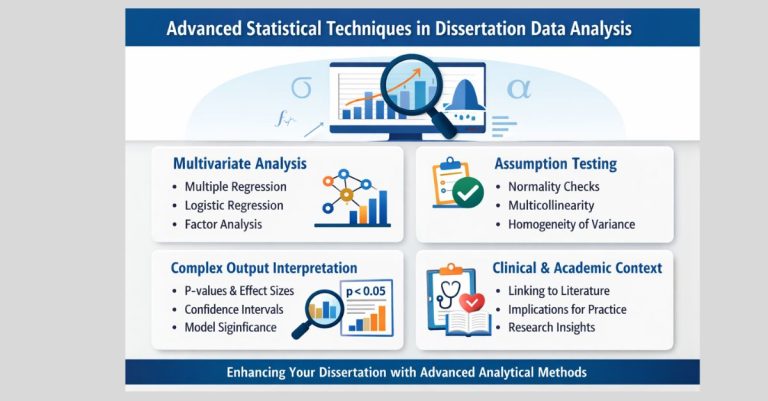
- Assumption checking: Test for normality, homoscedasticity and independence, depending on your chosen statistical methods. If assumptions are violated, consider transformations or non‑parametric tests.
Selecting and applying statistical techniques
| Step | Purpose | Examples |
| Descriptive statistics | Summarise the data to understand central tendency and variability | Means, medians, standard deviations, proportions |
| Comparative tests | Compare groups or conditions to test hypotheses | t‑tests, ANOVA, Mann–Whitney U, chi‑square |
| Correlation and association | Assess relationships between variables | Pearson’s r, Spearman’s rho, contingency coefficients |
| Regression models | Predict outcomes or test relationships while controlling for covariates | Linear regression, logistic regression, Cox proportional hazards |
| Advanced analyses | Explore complex patterns or longitudinal changes | Mixed‑effects models, structural equation modelling, survival analysis |
These steps should be aligned with the research design and the level of measurement (nominal, ordinal, interval, ratio). Support from our regression analysis and inferential statistics specialists ensures you select the right model and interpret coefficients correctly.
Qualitative data analysis
Qualitative projects require a different set of tools and techniques:
- Familiarisation: Read transcripts or notes repeatedly to become immersed in the data.
- Coding: Develop a coding framework based on your research questions and theoretical perspective. Codes may emerge inductively or be derived from existing literature.
- Grouping codes into categories: Cluster similar codes into broader categories or themes.
- Interpretation: Relate themes to your research questions and context, noting patterns, contradictions and surprising findings. Use memos and diagrams to track your thinking.
- Validation: Establish trustworthiness through techniques such as member checking, triangulation and inter‑coder reliability. A consultant can guide you through these steps using NVivo or other software.
Interpretation and integration
After running analyses, the next step is to interpret results in the context of your research questions. For quantitative studies, this includes examining p‑values, effect sizes and confidence intervals, and determining whether your hypotheses are supported. For qualitative studies, interpretation involves weaving themes into a coherent narrative that connects findings to existing theory and literature. Mixed‑methods projects require integrating numeric and thematic findings, highlighting how they complement or contradict each other.
Visualisation and presentation
High‑quality tables and figures make complex results accessible. For quantitative studies, this may involve bar charts, scatterplots or Kaplan–Meier curves. For qualitative projects, concept maps or thematic diagrams can illustrate relationships among themes. Clear presentation is essential for dissertations and peer‑reviewed publications. Our experts ensure your visuals meet journal standards and emphasise key findings.
Ethical considerations in data analysis
Ethical practice underpins every stage of data analysis. Universities emphasise that research data should be collected, stored, processed and shared responsibly[11]. Below are key ethical considerations to incorporate into your analysis and reporting.
Protecting participants and stakeholders
- Identify stakeholders: Consider who could be affected by your research – participants, funding bodies, institutions and communities[16]. Understanding their interests helps you protect sensitive information.
- Discuss data use: Engage stakeholders in discussions about what data will be collected, how it will be used and managed securely, and what can be shared[13].
- Anonymise and secure data: Remove personally identifiable information and store data in secure, password‑protected repositories. For sensitive datasets, use controlled‑access repositories or data‑use agreements[15].
Adhering to academic integrity
Academic support services must avoid plagiarism and ensure that the work remains your own. When consultants assist with analysis, they should guide your understanding and help you learn rather than completing assignments without your involvement. Our service emphasises collaboration: you remain the author of your dissertation, while we serve as mentors and advisors.
Transparent reporting
Ethical research requires transparent documentation of methods, data cleaning procedures, software used, and decisions made. This transparency allows other researchers to replicate your study and evaluate the credibility of your findings. It also protects you against accusations of misconduct or “p‑hacking.” Working with experts who maintain detailed logs supports ethical reporting.
Respecting cultural and community norms
Research often involves communities with unique cultural expectations. Always consult community guidelines and ensure that your analysis and dissemination respect local norms and do not perpetuate harm. This is particularly important in nursing research, where studies may involve vulnerable populations.
Frequently asked questions about dissertation data analysis help
1. Do I need professional help if I already took a statistics course?
Statistics courses provide foundational knowledge but often cannot cover every scenario. Studies show that many programmes offer only generic courses, and even these are optional in some departments[7]. Professional consultants tailor their advice to your specific research design and data type. They help you navigate software nuances, verify assumptions and interpret results. Seeking help is not a sign of weakness; it is a strategic decision to enhance the quality of your work.
2. Will using a data analysis service compromise my academic integrity?
No. Ethical services focus on guidance and learning rather than ghost‑writing or cheating. You remain responsible for your dissertation, while consultants explain methods, run analyses and help you interpret results. You approve every step and incorporate findings into your work. Our nursing assignment help and coursework help for nursing students operate under the same principles: they support learning and compliance with academic policies.
3. How do you ensure confidentiality and data security?
We follow best practices for data security. Sensitive data are stored in encrypted environments, and personal identifiers are removed. Our procedures align with institutional guidelines that emphasise identifying stakeholders, discussing data usage and securing information[14]. We also draft data transfer agreements when necessary to limit how data are used and shared[15]. You can request a non‑disclosure agreement for additional peace of mind.
4. Can you help with qualitative data as well as quantitative?
Absolutely. Our team includes qualitative experts skilled in grounded theory, phenomenology, thematic analysis and content analysis. We provide qualitative data analysis support, from developing a coding frame to establishing inter‑coder reliability and drawing themes. We also help integrate qualitative findings with quantitative results in mixed‑methods dissertations.
5. What if my supervisor disagrees with your analysis?
We collaborate with you to ensure our analysis aligns with your supervisor’s expectations. If your supervisor requests changes, we will revise the analysis accordingly and explain the rationale behind each method. Our role is to provide options and guidance, not to override academic authority. Communication is key: share our reports with your supervisor early and invite feedback.
Final call to action
Data analysis is the heart of your dissertation. Mistakes can invalidate your findings and waste months of effort[10]. With dissertation data analysis help, you gain access to specialists who understand both statistical rigor and nursing practice. We ensure your methods are appropriate, your results are accurate, and your ethical obligations are met[11]. Our customisable services, transparent pricing and commitment to confidentiality make us a trusted partner for graduate students worldwide.
Ready to elevate your research? Explore our how it works page, review our case studies and order your personalised data analysis package today. Whether you need help with regression, qualitative coding or mixed‑methods integration, our experts are here to guide you. Don’t let statistical hurdles derail your dissertation – invest in yourself and deliver results that advance nursing science.
[1] [2] [3] [9] Diving Deep into Dissertations: Analyzing Graduate Students’ Methodology and Data Practices to Inform Research Data Services and Subject Liaison Librarian Support | Swygart-Hobaugh | College & Research Libraries
https://crl.acrl.org/index.php/crl/article/view/24702/33591
[4] [5] [6] [7] [8] [10] (PDF) PhD Students and the Most Frequent Mistakes During Data Interpretation by Statistical Analysis Software
[11] [12] [13] [14] [15] [16] Research data ethics – Research Data – Iowa State University