

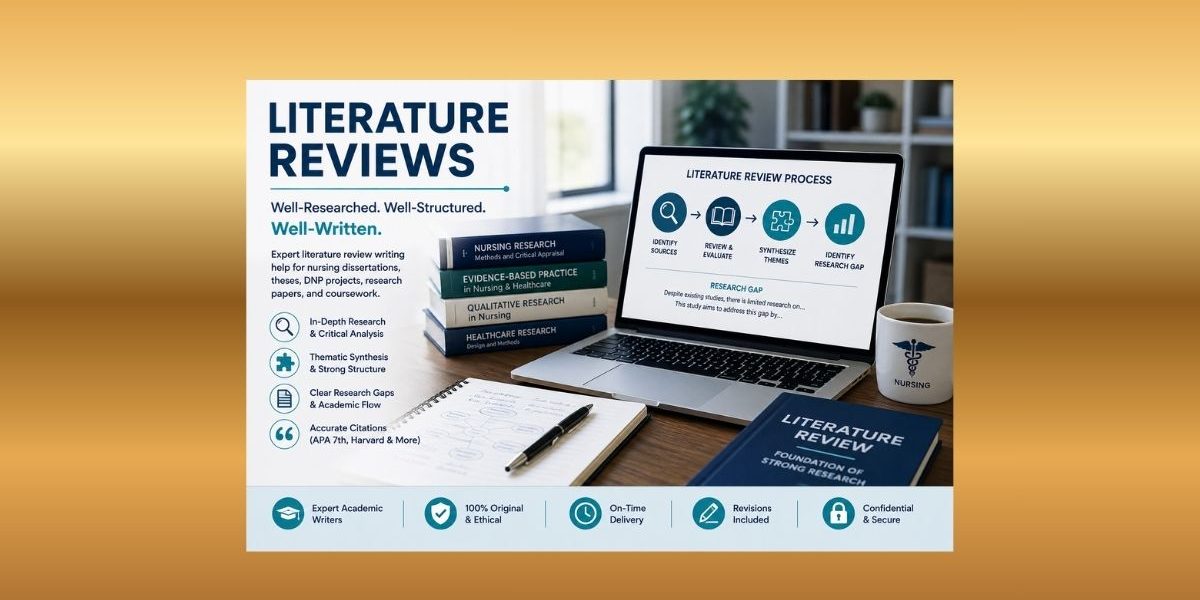
Weak literature reviews can make an otherwise strong nursing dissertation, thesis, proposal, DNP project, research paper, or evidence-based practice assignment look unfocused. If your sources feel scattered, your themes are unclear, or your supervisor says your review is too descriptive, our literature review help can support you in building a clearer, more critical, and better-structured review.
Our literature review writing help supports nursing and healthcare students who need assistance developing, organizing, editing, or improving literature reviews for dissertations, theses, proposals, capstone projects, DNP projects, coursework, nursing research papers, and journal-style manuscripts. We help you move beyond article-by-article summaries by organizing sources into themes, strengthening synthesis, identifying research gaps, improving academic flow, and correcting citation issues.
A strong literature review is not simply a collection of summaries. It should show what current research says, where scholars agree or disagree, which methods have been used, what gaps remain, and how your own study or assignment fits into the wider nursing or healthcare evidence base.
Our support is ethical, research-focused, and tailored to your institution’s requirements. You remain responsible for reviewing, learning from, and using the support according to your university’s academic integrity policies.
Request Literature Review Help: Send your topic, instructions, rubric, available sources, citation style, deadline, and current draft if available. We will review your requirements and recommend the right level of support.
Literature Review Writing Help for Nursing and Healthcare Students
Our literature review writing help is designed for students and researchers who need practical support with planning, writing, editing, restructuring, or improving a literature review. Whether you are starting with only a topic or already have a full draft with supervisor feedback, we can help you strengthen the structure, source synthesis, academic tone, research gap, and citation accuracy of your work.
We support literature reviews for:
- Nursing dissertations
- DNP projects
- Master’s theses
- Research proposals
- Capstone projects
- Evidence-based practice assignments
- Nursing coursework
- Nursing research papers
- Healthcare research projects
- Systematic reviews
- Scoping reviews
- Narrative reviews
- Integrative reviews
- Thematic literature reviews
A strong literature review should guide the reader from the broad topic to the specific research problem or assignment focus. It should show how studies relate to each other, where evidence is strong, where findings conflict, and where more research is needed.
If your current draft reads like “Author A said,” “Author B found,” and “Author C argued,” we can help reorganize it into themes that compare studies and build a stronger academic argument.
For broader support beyond the literature review, you may also need nursing dissertation writing help, DNP dissertation help, nursing research paper help, or nursing coursework help.
What Is a Literature Review?
A literature review is a critical, organized synthesis of existing research on a topic, theory, population, intervention, method, variable, clinical issue, evidence-based practice question, or research problem. It explains what researchers already know, how existing studies relate to each other, and what gaps remain.
A literature review is not just a summary of sources. A simple summary tells the reader what each article says. A strong literature review compares, evaluates, organizes, and connects the literature. It explains why the evidence matters and how it supports the current dissertation, thesis, proposal, DNP project, research paper, or coursework assignment.
A strong literature review should:
- Introduce the research topic clearly.
- Summarize relevant scholarship.
- Compare and contrast findings.
- Evaluate theories, methods, populations, interventions, and evidence.
- Identify patterns, debates, and contradictions.
- Show gaps in the existing research.
- Connect the literature to the research problem or assignment focus.
- Support the need for the current study, project, or discussion.
For dissertation and thesis students, the literature review often becomes the foundation for the entire study. It should connect directly to the problem statement, purpose statement, research questions, theoretical or conceptual framework, methodology, and research gap.
Why Literature Reviews Are Difficult to Write
Literature reviews are difficult because they require several academic skills at once. You need to find credible sources, read critically, organize evidence, compare findings, identify gaps, and write in a clear scholarly tone.
One common problem is weak source selection. Some students use sources that are outdated, too general, not peer-reviewed, or not closely connected to the research question. Others collect many articles but struggle to decide which studies should be included and which should be excluded.
Another major challenge is synthesis. Many literature reviews become article-by-article summaries. This makes the review feel disconnected and descriptive. A strong literature review should group sources by themes, theories, variables, interventions, populations, methods, findings, or debates.
Students also struggle with research gaps. A research gap should not be invented or forced. It should come from careful analysis of what the literature actually shows. Gaps may appear through limited populations, outdated evidence, methodological weaknesses, theoretical limitations, inconsistent findings, underexplored settings, or practice problems that remain unresolved.
Citation formatting is another challenge. APA 7th edition, Harvard, Vancouver, MLA, Chicago, IEEE, and university-specific styles all have detailed rules for in-text citations and reference lists. Inconsistent citations can make the work look careless even when the content is strong.
Professional literature review support helps you move from scattered notes and disconnected summaries to a structured, critical, and academically credible review.
Our Literature Review Writing Service for Nursing Research Projects
Our literature review writing service helps students and researchers develop, organize, edit, and improve literature reviews based on their exact academic requirements. The support is customized to your topic, level of study, discipline, rubric, citation style, deadline, and current draft status.
We can help with:
- Understanding assignment instructions
- Refining the literature review topic
- Aligning the review with research questions
- Organizing sources into themes
- Creating or improving a literature matrix
- Developing a clear structure
- Synthesizing findings across studies
- Identifying research gaps
- Improving critical analysis
- Strengthening paragraph flow
- Improving transitions between sections
- Editing and proofreading
- Formatting in-text citations and references
- Aligning the review with dissertation, thesis, DNP, proposal, or coursework requirements
Our role is to help you understand, organize, and improve your literature review. You remain responsible for reviewing the work, learning from the support provided, and following your university’s academic integrity policy.
Need help choosing the right service? Review how our process works or send your instructions and deadline for guidance.
Who Our Literature Review Help Is For
Undergraduate Nursing Students
Undergraduate nursing students often need help with shorter literature review assignments, evidence-based practice papers, research summaries, and coursework projects. We can help you understand the purpose of a literature review, organize sources into themes, improve academic tone, and format citations correctly.
Master’s Students
Master’s students may need support for thesis literature reviews, capstone projects, research proposals, graduate coursework, and advanced nursing papers. At this level, the literature review usually requires stronger synthesis, clearer source evaluation, and better connection to the research problem.
DNP Students
DNP students often need literature review support for evidence-based practice projects, quality improvement projects, implementation projects, program evaluations, and clinical practice change proposals. We can help organize evidence, clarify practice gaps, connect sources to the project purpose, and strengthen the scholarly foundation of the DNP project.
For wider project support, see our DNP dissertation help page.
PhD and Doctoral Students
PhD and doctoral students often need advanced literature review support for dissertation Chapter 2, theoretical alignment, conceptual framework development, research gap explanation, and supervisor feedback revisions. We help improve the scholarly argument, strengthen source synthesis, and connect the literature review to the study’s purpose, research questions, and methodology.
Healthcare and Public Health Students
Healthcare and public health students may need literature review help for clinical research topics, healthcare management projects, public health interventions, patient education studies, policy analysis, and evidence-based practice assignments. We help organize evidence and improve academic writing without providing clinical advice.
Researchers and Professionals
Researchers and professionals may need literature review support for manuscripts, policy reports, white papers, research proposals, and applied healthcare projects. We can help improve structure, clarity, source integration, and the flow of evidence.
Types of Literature Reviews We Can Help With
Dissertation Literature Reviews
A dissertation literature review, often Chapter 2, must do more than describe previous studies. It should connect the existing literature to the problem statement, purpose statement, research questions, hypotheses if applicable, theoretical framework, conceptual framework, methodology, and research gap.
We help dissertation students organize sources by themes, concepts, theories, methods, variables, populations, interventions, and findings. We also help ensure that the review builds a scholarly argument instead of presenting disconnected summaries.
If your literature review is part of a larger dissertation, start with our nursing dissertation writing help page for broader chapter support.
Thesis Literature Reviews
Thesis literature reviews require clear organization, critical analysis, and direct connection to the research focus. We can help master’s and doctoral students organize theories, variables, concepts, methods, and findings so the thesis literature review supports the overall study.
If your thesis needs support beyond the literature review, visit our thesis support page.
DNP Literature Reviews
DNP literature reviews often focus on practice gaps, clinical problems, quality improvement, implementation, program evaluation, and evidence-based interventions. The review should explain why the practice issue matters and how current evidence supports the proposed project.
We can help DNP students organize studies by intervention, population, clinical setting, outcome, implementation barrier, or practice recommendation.
Systematic Literature Reviews
Systematic literature reviews require a structured and transparent approach. We can help with research question refinement, database search terms, inclusion and exclusion criteria, screening process description, PRISMA-style organization if required, quality appraisal guidance, and synthesis of findings.
Our support focuses on academic organization, writing, editing, and methodological clarity. We do not make unsupported clinical claims or replace discipline-specific judgment.
Scoping Reviews
Scoping reviews are useful when the topic is broad and the goal is to map existing research. We can help identify key concepts, clarify definitions, summarize evidence gaps, and organize findings by themes, populations, methods, settings, or contexts.
Narrative Literature Reviews
Narrative literature reviews organize scholarship around broad themes, theories, debates, or trends. We help make narrative reviews more focused, analytical, and coherent so they do not become loose summaries of unrelated sources.
Integrative Literature Reviews
Integrative literature reviews combine theoretical, empirical, and methodological literature. They are common in nursing and healthcare because they can bring together different types of evidence. We help organize the evidence into a balanced discussion that supports the research purpose.
Thematic Literature Reviews
Thematic literature reviews group sources by ideas, patterns, findings, interventions, theories, methods, or debates. We help identify strong themes and develop paragraphs that compare studies instead of summarizing each source separately.
Coursework Literature Reviews
Coursework literature reviews are usually shorter than thesis or dissertation reviews, but they still require structure, synthesis, citations, and clarity. We help students meet assignment expectations while keeping the review focused and readable.
From Scattered Sources to a Strong Literature Review
| Common Problem | How We Help |
|---|---|
| Your review summarizes one article at a time | We reorganize sources into themes and compare findings across studies. |
| Your research gap is unclear | We identify gaps based on limitations, contradictions, underexplored areas, and evidence patterns. |
| Your supervisor says the review lacks critical analysis | We strengthen evaluation, comparison, and scholarly argument. |
| Your sources do not connect to your research questions | We align the review with your problem, purpose, questions, and framework. |
| Your paragraphs feel disconnected | We improve topic sentences, transitions, and section flow. |
| Your citations are inconsistent | We correct in-text citations and reference list formatting. |
| Your review is too broad | We narrow the focus to the most relevant themes and evidence. |
| Your literature review does not support the methodology | We improve alignment between the literature, framework, and research design. |
This transformation matters because a literature review should not simply prove that you found sources. It should show that you understand the field, can evaluate evidence, and can explain why your topic deserves attention.
Literature Review Support by Nursing and Healthcare Subject Area
Our literature review support covers many nursing and healthcare fields, including adult nursing, mental health nursing, pediatric nursing, maternal health, public health, nursing education, healthcare leadership, evidence-based practice, quality improvement, patient safety, infection prevention, chronic disease management, telehealth, health promotion, healthcare management, clinical practice change, and DNP project topics.
Each field has different expectations. A nursing literature review may focus on evidence-based practice, care outcomes, healthcare systems, clinical education, patient safety, or patient education. A public health review may focus on interventions, populations, prevention strategies, policy, and health outcomes. A DNP review may focus on a practice gap and the evidence supporting a quality improvement or implementation project.
We adapt the structure, tone, source use, and level of analysis to your discipline and academic requirements.
What Makes a Strong Literature Review?
A strong literature review has a clear scope. It does not try to cover everything about a broad topic. Instead, it focuses on the sources, themes, theories, concepts, methods, and findings most relevant to the research question or assignment.
It uses relevant and current sources. Foundational theories may still be important, but most academic literature reviews should also include recent peer-reviewed research where appropriate.
It includes critical analysis. A strong review does not simply state what each author found. It evaluates methods, compares findings, identifies limitations, and explains how studies relate to one another.
It also connects clearly to the research problem. Each major section should help move the reader closer to understanding why the current study, proposal, thesis, dissertation, DNP project, or assignment focus is necessary.
A strong literature review should also avoid unsupported gaps. The research gap must match the reviewed evidence. If the literature does not support a claimed gap, the argument becomes weak.
How We Improve Your Literature Review
| Area of Support | How It Improves Your Literature Review |
|---|---|
| Topic alignment | Keeps the review focused on your research problem, purpose, and questions. |
| Source organization | Groups studies by theme, theory, variable, method, population, intervention, or finding. |
| Literature matrix support | Helps track authors, years, methods, samples, findings, limitations, and gaps. |
| Critical synthesis | Moves the review beyond article-by-article summaries. |
| Research gap development | Shows what is missing, underexplored, outdated, or unresolved in the literature. |
| Theoretical alignment | Connects theories or frameworks to the study focus. |
| Evidence appraisal | Helps explain the strength, relevance, and limitations of selected studies. |
| Structure improvement | Creates a logical flow from broad background to specific gap. |
| Editing and proofreading | Improves grammar, clarity, tone, transitions, and readability. |
| Citation formatting | Improves APA 7th edition, Harvard, Vancouver, MLA, Chicago, IEEE, or university-specific formatting. |
These improvements make your review easier to read, more academically credible, and more closely aligned with your assignment, thesis, dissertation, proposal, DNP project, or manuscript requirements.
Literature Review Structure We Can Help You Build
The exact structure of a literature review depends on your university guidelines, rubric, discipline, academic level, and research design. However, many strong literature reviews include the following sections.
Introduction to the Review
This section introduces the focus, scope, and purpose of the literature review. It may also preview the major themes or explain how the review is organized.
Background of the Topic
This section provides enough context for the reader to understand the research problem, population, intervention, theory, clinical issue, or evidence-based practice question being reviewed.
Search Strategy, If Required
Some literature reviews, especially systematic and scoping reviews, require a description of databases, keywords, date ranges, inclusion criteria, exclusion criteria, and screening steps.
Theoretical or Conceptual Framework
This section explains the theory, model, or conceptual lens guiding the study. The framework should not feel isolated. It should connect naturally to the literature being reviewed.
Major Themes
The main body of the literature review is often organized by themes. Each theme should synthesize several sources and show how the evidence connects.
Methodological Trends
This section may discuss common research designs, samples, instruments, data collection methods, interventions, outcomes, or analysis approaches used in existing studies.
Debates and Contradictions
Strong literature reviews acknowledge disagreement, mixed findings, limitations, and unresolved questions.
Gaps in the Literature
This section explains what is missing, underexplored, outdated, inconsistent, or unresolved in the existing research.
Summary and Transition
The final section summarizes what the literature shows and transitions to the current study, methodology, proposal, DNP project, or conclusion.
Literature Review Editing and Proofreading for Existing Drafts
If you already have a draft, literature review editing and proofreading can help improve clarity, structure, flow, and academic quality. Many students have useful content but need help organizing paragraphs, improving synthesis, reducing repetition, and correcting citation problems.
Editing can help with:
- Grammar and sentence clarity
- Academic tone
- Paragraph structure
- Transitions
- Repetition
- Citation consistency
- Reference list formatting
- Source integration
- Stronger synthesis
- Alignment with supervisor feedback
- APA 7th edition formatting
- University template formatting
Proofreading focuses on grammar, punctuation, spelling, formatting, and consistency. Editing is deeper because it may involve restructuring paragraphs, improving flow, clarifying arguments, and strengthening analysis.
Already have a draft? Send it with your supervisor’s comments, rubric, and citation style. We will help improve structure, synthesis, citations, and academic flow.
For broader document polishing, visit our editing and proofreading service page.
Research Gap Identification Support for Literature Reviews
Research gap identification is one of the most important parts of a strong literature review. A research gap explains what is missing, unclear, unresolved, outdated, underexplored, or inconsistent in existing scholarship.
A research gap should come from the literature. It should not be forced. For example, a gap may appear when recent studies focus on hospital nurses but few examine nursing students, when most studies use quantitative surveys but little qualitative insight exists, or when findings are inconsistent across populations.
Common types of research gaps include:
- Population gap: Existing studies focus on one group, but another relevant group is underexamined.
- Methodological gap: Most studies use one method, leaving another useful method underused.
- Theoretical gap: Existing research does not adequately apply, test, or compare relevant theories.
- Geographic or contextual gap: Research exists in some settings but not in the specific context relevant to the study.
- Evidence gap: There is limited empirical evidence on a specific issue.
- Practice gap: Research identifies a clinical or healthcare problem that remains unresolved in practice.
- Time gap: Older studies may not reflect current conditions, technologies, practices, or populations.
- Contradiction in findings: Studies report mixed or conflicting results that need further investigation.
We help students identify and explain research gaps by reviewing patterns, limitations, recommendations for future research, contradictions, and underdeveloped areas in the literature.
A clear research gap strengthens your literature review because it shows why your study, proposal, thesis, dissertation, DNP project, or assignment focus matters.
Literature Review Help for Dissertations, Theses, and DNP Projects
Dissertation, thesis, and DNP literature reviews must support the larger research project. They should connect clearly to the topic, problem statement, purpose statement, research questions, theoretical or conceptual framework, methodology, and research gap.
Weak reviews often fail because they summarize sources without building a scholarly argument. A strong review should show how existing research leads logically to the current study or practice project.
We can help you:
- Organize Chapter 2 or the thesis literature review.
- Strengthen synthesis across sources.
- Align the review with the research problem.
- Improve the connection between the framework and literature.
- Clarify the research or practice gap.
- Revise based on supervisor feedback.
- Improve citation formatting and reference consistency.
- Prepare the review to support the methodology chapter or project design.
If your project later requires data support, you can also review our dissertation data analysis help and qualitative data analysis pages.
Request help before submitting your draft to your supervisor so you can improve clarity, structure, synthesis, and citation accuracy.
Citation Styles We Support
We support several citation styles depending on your institution, discipline, journal, or assignment requirements. These include:
- APA 7th edition
- Harvard
- Vancouver
- MLA
- Chicago
- IEEE
- University-specific formatting styles
Citation support includes in-text citation formatting, reference list formatting, citation consistency checks, source integration, and correction of common referencing errors.
Accurate citation formatting helps your work look professional and credible. It also ensures that your in-text citations and reference list entries match correctly.
How Our Literature Review Writing Process Works
1. Send Your Requirements
Send your topic, academic level, instructions, rubric, word count, citation style, deadline, available sources, current draft, and supervisor feedback if available.
2. We Review the Scope
We assess whether you need writing, editing, proofreading, restructuring, source synthesis, research gap support, citation formatting, or literature matrix support.
3. We Organize the Literature
Your sources are grouped by themes, theories, variables, methods, interventions, findings, populations, or debates. This creates a logical structure instead of a source-by-source summary.
4. We Develop or Improve the Draft
The literature review is written, edited, restructured, or improved based on the agreed scope. The focus remains on clarity, synthesis, academic tone, and alignment with your requirements.
5. We Check Flow, Synthesis, and Citations
The draft is reviewed for paragraph flow, source integration, transitions, critical analysis, research gap clarity, and citation consistency.
6. You Review and Request Adjustments
You review the support provided and request adjustments where needed. This helps ensure the final work aligns with your rubric, supervisor comments, and academic expectations.
You can also visit how it works to learn more about the general order process.
How Much Does Literature Review Writing Help Cost?
The cost of literature review writing help depends on the exact support you need. A short coursework literature review usually costs less than a doctoral dissertation Chapter 2, DNP project literature review, systematic review, or thesis literature review with extensive supervisor feedback.
Pricing may depend on:
- Academic level
- Word count or number of pages
- Deadline
- Number of sources
- Type of literature review
- Citation style
- Topic complexity
- Whether you need writing, editing, restructuring, or proofreading
- Whether source searching or literature matrix support is needed
- Whether the review requires an evidence-based practice framework
- Whether supervisor feedback requires major revisions
Custom pricing helps ensure that you only pay for the support you actually need. Editing a complete draft is different from developing a full literature review using sources, supervisor feedback, and a research framework.
For current pricing guidance, visit our nursing dissertation help pricing page. You can also send your literature review instructions, topic, deadline, citation style, and draft if available to request a custom quote.
Why Choose Our Literature Review Help?
Students choose our literature review help because we focus on structure, synthesis, research gaps, and academic credibility. We do not simply polish sentences. We help improve how the literature review works as an academic argument.
Our support can help you:
- Turn article summaries into thematic synthesis.
- Check whether each section links back to the research problem.
- Identify research gaps from actual study limitations and patterns.
- Improve the connection between the literature review, framework, and methodology.
- Revise supervisor feedback without changing your study direction.
- Strengthen paragraph flow and academic tone.
- Correct citation and reference formatting issues.
- Improve clarity while keeping your review focused.
- Maintain confidentiality throughout the support process.
- Meet agreed deadlines based on the approved scope.
- Request revisions based on the original instructions.
We also provide clear communication, ethical academic guidance, and transparent pricing. We avoid exaggerated promises, fake guarantees, and unsupported claims.
Academic Integrity and Responsible Literature Review Support
Our literature review support is designed to help students learn, improve, and complete research tasks responsibly. You should always follow your institution’s academic integrity policies and use any guidance, editing, feedback, or model drafting appropriately.
Our role is to help you understand, organize, and improve your literature review. You remain responsible for reviewing the work, learning from the support provided, and ensuring that your final submission follows your university’s policies.
Responsible support can help you improve your academic writing, strengthen your understanding of the literature, and submit work that reflects your own learning and review.
Request Literature Review Help Today
Get literature review help tailored to your topic, academic level, deadline, and instructions. Whether you need help writing, editing, restructuring, proofreading, organizing sources, identifying research gaps, or formatting citations, we can support your project professionally and responsibly.
To get started, send:
- Your topic
- Academic level
- Assignment instructions
- Rubric
- Word count
- Deadline
- Citation style
- Available sources
- Current draft, if any
- Supervisor feedback, if any
Request Literature Review Help Today: Share your requirements and request a custom quote for literature review support that matches your exact project.
Frequently Asked Questions About Literature Reviews
What is a literature review?
A literature review is a critical synthesis of existing research on a topic, theory, population, variable, intervention, method, or research question. It is not just a summary of sources. A strong literature review compares findings, evaluates evidence, identifies themes, explains debates, and shows gaps in existing research.
Can you help me write my literature review?
Yes. We provide ethical literature review writing help, including structure development, source synthesis, editing, research gap support, citation formatting, and model draft support. The support is designed to help you understand, organize, and improve your work according to your institution’s academic integrity requirements.
Do you help with nursing dissertation literature reviews?
Yes. We help with nursing dissertation literature reviews, including Chapter 2 organization, theoretical alignment, source synthesis, research gap development, and supervisor feedback revisions. We can also help connect the literature review to the problem statement, purpose statement, research questions, framework, and methodology.
Do you help with DNP literature reviews?
Yes. We help DNP students organize evidence for practice-focused projects, quality improvement projects, implementation projects, and program evaluations. We can help connect the literature review to the practice gap, project purpose, intervention, outcomes, and evidence-based framework.
Can you help identify research gaps?
Yes. We help identify research gaps through careful review of existing studies, limitations, contradictions, underexplored areas, outdated evidence, population issues, methodological weaknesses, practice gaps, and recommendations for future research.
Can you edit my existing literature review?
Yes. We can edit your current literature review for clarity, grammar, academic tone, paragraph structure, transitions, repetition, citation consistency, reference formatting, source integration, synthesis, and supervisor feedback alignment.
Do you help with systematic literature reviews?
Yes. We can help with systematic literature review planning, writing, and editing. Support may include research question refinement, search strategy organization, inclusion and exclusion criteria, PRISMA-style organization if required, appraisal guidance, and synthesis of findings.
What citation styles do you support?
We support APA 7th edition, Harvard, Vancouver, MLA, Chicago, IEEE, and university-specific formatting requirements. Citation support may include in-text citations, reference list formatting, consistency checks, and source integration.
Can you help organize my sources into themes?
Yes. We can help group your sources into themes based on concepts, variables, theories, methods, findings, interventions, populations, or debates. Thematic organization improves synthesis and helps the literature review flow more logically.
How long should a literature review be?
The length of a literature review depends on your academic level, assignment brief, research scope, discipline, and university guidelines. A coursework literature review may be short, while a thesis, DNP, or dissertation literature review may require several thousand words or a full chapter.
How much does literature review help cost?
The cost depends on your academic level, word count, deadline, number of sources, review type, citation style, and whether you need writing, editing, restructuring, or proofreading. For current pricing guidance, visit the nursing dissertation help pricing page.
What should I send to get started?
Send your topic, instructions, rubric, academic level, deadline, citation style, available sources, current draft if available, and supervisor feedback if you have it. These details help determine the exact support you need.
