

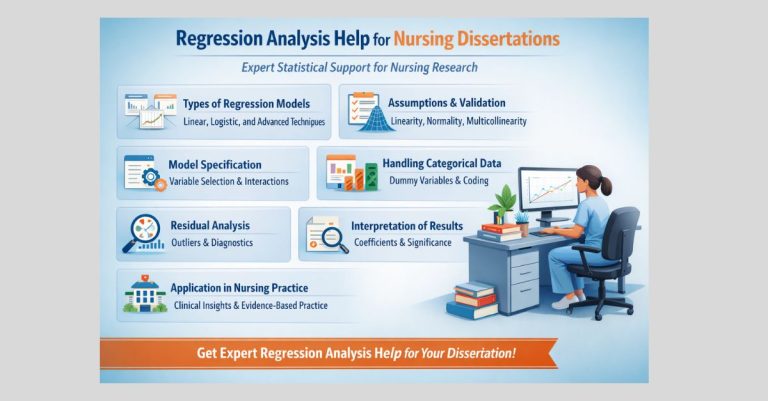
Regression Analysis Help for Nursing Dissertations
If you are working on a nursing dissertation and require advanced statistical support, regression analysis is often one of the most critical components of your study. At this stage, your research moves beyond description and into explanation, prediction, and analytical justification. Therefore, accurate regression modeling becomes essential for producing results that are not only statistically valid but also academically defensible.
At NursingDissertationHelp.com, we provide specialized regression analysis help tailored specifically for nursing and healthcare research. Our approach focuses on methodological alignment, statistical precision, and interpretation grounded in clinical relevance. Rather than treating regression as a mechanical process, we ensure that your model reflects the logic of your research design and answers your research questions effectively.
Regression analysis plays a central role in evidence-based nursing research because it allows investigators to examine how different variables influence outcomes. For instance, a study may aim to understand how nurse-to-patient ratios affect patient satisfaction, or how training influences adherence to infection control protocols. In such cases, regression models provide a structured framework for identifying significant predictors while controlling for confounding variables.
Conceptual Foundations of Regression Analysis in Nursing Research
Regression analysis is fundamentally concerned with relationships between variables. More specifically, it examines how one or more independent variables influence a dependent variable. In nursing research, this often involves complex interactions between clinical, behavioral, and organizational factors.
Unlike simpler statistical tests that only compare groups or measure association, regression analysis allows researchers to:
- Quantify the strength and direction of relationships
- Control for multiple influencing factors simultaneously
- Identify key predictors among several variables
- Estimate outcomes based on specific inputs
Because healthcare environments involve multiple interacting variables, regression analysis becomes particularly valuable. For example, patient outcomes are rarely influenced by a single factor. Instead, they may depend on staffing levels, experience, hospital resources, patient demographics, and clinical interventions. Regression models allow researchers to isolate these influences and assess their relative importance.
Types of Regression Analysis Relevant to Nursing Dissertations
Different types of regression models are used depending on the nature of the data and the research objectives. Selecting the correct model is critical because inappropriate choices can compromise the validity of the results.
Simple Linear Regression
Simple linear regression examines the relationship between one independent variable and one continuous dependent variable. It is often used in preliminary analyses or when exploring straightforward relationships.
For example:
- Relationship between hours worked and fatigue levels
- Association between training duration and test scores
Although simple in structure, this model still requires careful interpretation. The slope coefficient must be understood in context, and the assumptions must be verified.
Multiple Linear Regression
Multiple regression extends the basic model by including several independent variables. This is particularly useful in nursing research, where outcomes are influenced by multiple factors.
Examples include:
- Predicting patient satisfaction using staffing, communication, and facility conditions
- Examining factors influencing nurse burnout
Multiple regression allows researchers to control for confounding variables, which improves the credibility of the findings.
Logistic Regression
Logistic regression is used when the dependent variable is categorical, typically binary. This makes it highly relevant in clinical research.
Examples:
- Whether a patient is readmitted (yes/no)
- Presence of infection (present/absent)
This model estimates probabilities rather than direct values, making interpretation slightly different from linear regression.
Hierarchical and Stepwise Regression
Advanced dissertations may require hierarchical or stepwise regression models.
- Hierarchical regression introduces variables in stages to assess their incremental contribution
- Stepwise regression selects predictors based on statistical criteria
While these methods add depth, they must be used carefully to avoid overfitting or misinterpretation.
Request Advanced Regression Analysis Help. Get a tailored statistical approach designed specifically for your nursing dissertation.
Assumptions Underlying Regression Analysis
Regression models rely on specific assumptions. Ignoring these assumptions can lead to biased or invalid results. Therefore, assumption testing is a critical step in the analytical process.
Key assumptions include:
- Linearity: The relationship between variables should be linear
- Independence: Observations must be independent
- Normality: Residuals should follow a normal distribution
- Homoscedasticity: Variance of residuals should remain constant
- No multicollinearity: Independent variables should not be highly correlated
Each assumption must be evaluated before interpreting the results. If violations occur, adjustments or alternative methods may be necessary.
Data Preparation and Variable Structuring for Regression Analysis
Before running any regression model, the dataset must be carefully prepared. Data preparation is often overlooked, yet it significantly affects the accuracy of the analysis.
We support:
- Cleaning datasets to remove inconsistencies
- Handling missing data appropriately
- Coding categorical variables correctly
- Transforming variables when necessary
- Identifying and addressing outliers
Proper data preparation ensures that the regression model reflects the true structure of the data rather than errors or inconsistencies.
Multicollinearity and Its Impact on Regression Models
Multicollinearity occurs when independent variables are highly correlated with each other. This can distort regression coefficients and make it difficult to interpret results.
To address this, we:
- Evaluate Variance Inflation Factor (VIF)
- Examine correlation matrices
- Adjust variable selection when necessary
By reducing multicollinearity, we ensure that each variable contributes meaningfully to the model.
Interpretation of Regression Outputs
One of the most challenging aspects of regression analysis is interpretation. Many students can run models but struggle to explain what the results mean.
We assist with interpreting:
- Coefficients and direction of relationships
- Statistical significance (p-values)
- Confidence intervals
- Model fit indicators such as R²
More importantly, we translate these findings into academic language that aligns with your dissertation requirements. Get Help Interpreting Regression Results. Turn complex statistical outputs into clear, well-structured academic writing.
SPSS and Software-Based Regression Analysis
SPSS is widely used in nursing research for regression analysis. However, correct use requires both technical and conceptual understanding.
We support:
- Running regression models in SPSS
- Selecting appropriate variables
- Interpreting output tables
- Presenting results clearly
In addition, we ensure that your analysis follows academic formatting standards.
Model Specification in Regression Analysis
A critical but often overlooked stage in regression analysis is model specification. Many students focus on running the model without carefully defining how variables should be included. However, incorrect specification can lead to biased estimates, omitted variable bias, or misleading conclusions.
Model specification involves deciding:
- Which variables should be included in the model
- How variables should be measured (continuous, categorical, transformed)
- Whether interaction effects should be considered
- Whether nonlinear relationships should be modeled
In nursing research, this step is particularly important because variables often represent complex constructs such as patient satisfaction, workload stress, or clinical competence. These constructs may not behave linearly, and therefore require careful treatment.
For example, the relationship between workload and burnout may not be strictly linear. At lower levels, increases in workload may have minimal effect. However, beyond a threshold, burnout may increase sharply. In such cases, polynomial terms or transformations may be required.
We assist in refining model specification to ensure that your regression analysis reflects the real structure of your data rather than an oversimplified assumption.
Handling Categorical Variables in Regression Models
In many nursing dissertations, independent variables are not purely numerical. Instead, they often include categorical data such as:
- Gender
- Department
- Education level
- Clinical unit type
Regression models cannot directly interpret categorical variables unless they are properly coded. Therefore, dummy variable creation becomes essential.
For instance, if a variable has three categories, it must be converted into multiple binary variables before inclusion in the model. Failure to do this correctly leads to incorrect results.
We guide you through:
- Dummy variable creation
- Reference category selection
- Interpretation of categorical coefficients
This ensures that categorical predictors are meaningfully incorporated into your regression model.
Interaction Effects in Regression Analysis
In many cases, the effect of one variable depends on another variable. This is known as an interaction effect, and it is a powerful way to deepen your analysis.
For example:
- The effect of training on performance may differ based on experience level
- The impact of workload on burnout may vary depending on support systems
Ignoring such interactions can lead to incomplete conclusions. Therefore, we help identify and model interaction terms where appropriate.
However, interaction models must be interpreted carefully. The meaning of coefficients changes, and graphical representation is often required to explain the findings clearly.
Nonlinear Relationships and Transformations
Not all relationships in healthcare data are linear. In fact, many clinical and behavioral phenomena follow nonlinear patterns.
Examples include:
- Diminishing returns in training effectiveness
- Threshold effects in stress and performance
- Curvilinear relationships in patient outcomes
To address this, regression models may require:
- Log transformations
- Polynomial terms
- Exponential adjustments
We evaluate whether such transformations are necessary and apply them correctly. This improves model fit and ensures that your findings reflect real-world patterns.
Residual Analysis in Regression Models
Residuals represent the difference between observed values and predicted values. Analyzing residuals is essential for validating regression models.
We assess:
- Distribution of residuals
- Patterns indicating model misspecification
- Presence of outliers or influential cases
Residual plots provide insight into whether assumptions hold and whether the model captures the underlying data structure.
Ignoring residual diagnostics is one of the most common weaknesses in student dissertations. By incorporating this step, your analysis becomes more rigorous and defensible.
Goodness-of-Fit and Model Evaluation
A regression model must be evaluated not only for statistical significance but also for how well it explains the data.
We examine:
- R-squared and Adjusted R-squared
- Akaike Information Criterion (AIC) where relevant
- Model comparison techniques
- Predictive accuracy
In nursing research, high explanatory power is not always expected due to the complexity of human behavior and healthcare systems. However, the model must still demonstrate meaningful explanatory value.
We help interpret these metrics realistically, avoiding overstatement while maintaining academic strength.
Outliers and Influential Observations
Outliers can significantly affect regression results. In healthcare data, outliers may represent real clinical cases or data entry errors.
We identify outliers using:
- Standardized residuals
- Cook’s distance
- Leverage values
Once identified, we evaluate whether they should be retained, transformed, or excluded. This decision must be justified carefully in your dissertation.
Handling outliers correctly strengthens the credibility of your analysis and prevents distortion of results.
Regression Analysis in Longitudinal and Repeated Measures Data
Some nursing studies involve data collected over time. In such cases, standard regression models may not be sufficient.
Longitudinal data introduces additional complexity, including:
- Correlation between repeated observations
- Time-dependent effects
- Changes in variables over time
While advanced models such as mixed-effects models may be required, we help ensure that your analytical approach remains appropriate for your dataset.
Reporting Regression Analysis in Academic Writing
One of the most critical aspects of regression analysis is how it is reported. Even a well-executed model can appear weak if poorly presented.
We guide you in:
- Structuring regression tables clearly
- Reporting coefficients accurately
- Avoiding unnecessary technical jargon
- Maintaining consistency with academic style guidelines
Each result must be presented in a way that allows the reader to understand both the statistical outcome and its practical meaning.
Integrating Regression Findings into the Discussion Chapter
Regression results must not remain isolated within the results section. Instead, they must be integrated into the broader discussion.
This involves:
- Comparing findings with existing literature
- Explaining unexpected results
- Discussing implications for nursing practice
- Identifying limitations
For example, if regression shows that staffing levels significantly predict patient satisfaction, the discussion should explore why this relationship exists and how it aligns with prior studies.
Limitations of Regression Analysis in Nursing Research
While regression analysis is powerful, it also has limitations. Recognizing these limitations strengthens your dissertation.
Common limitations include:
- Inability to establish causation in non-experimental studies
- Sensitivity to model specification
- Dependence on data quality
- Potential for omitted variable bias
We help articulate these limitations clearly without undermining the value of your research.
Ethical Considerations in Regression Analysis
Ethical reporting is essential in academic research. Regression results must be presented honestly and transparently.
We ensure:
- No manipulation of data to achieve significance
- Accurate reporting of all findings
- Clear explanation of methodology
Ethical rigor enhances the credibility of your dissertation and aligns with academic standards.
Practical Examples of Regression Analysis in Nursing Dissertations
To strengthen understanding, consider the following applications:
- Examining how nurse staffing levels influence patient mortality rates
- Analyzing predictors of job satisfaction among healthcare workers
- Investigating factors affecting adherence to clinical guidelines
- Evaluating determinants of patient recovery time
These examples illustrate how regression analysis contributes to meaningful healthcare insights.
Strengthening Your Dissertation Through Advanced Regression Analysis
A well-executed regression model does more than satisfy a methodological requirement. It demonstrates analytical competence, strengthens your argument, and enhances the overall quality of your dissertation.
By incorporating advanced techniques such as interaction effects, nonlinear modeling, and robust diagnostics, your research achieves a higher level of sophistication.
Linking Regression Analysis to Research Questions
Regression analysis must directly address your research questions. Without this alignment, the analysis becomes disconnected from the study’s purpose.
We ensure:
- Clear connection between variables and objectives
- Logical interpretation of findings
- Consistency with research hypotheses
This strengthens the overall coherence of your dissertation.
Application of Regression Analysis in Nursing Practice
Regression analysis is not only an academic exercise. It has practical implications in healthcare.
For example, it can be used to:
- Identify risk factors for patient complications
- Evaluate effectiveness of interventions
- Inform healthcare policy decisions
By connecting your findings to real-world applications, your dissertation gains both academic and practical relevance.
Common Challenges in Regression Analysis
Students often encounter several challenges when working with regression models.
These include:
- Selecting incorrect models
- Misinterpreting coefficients
- Ignoring assumptions
- Overstating results
We help address these challenges through structured support and detailed guidance.
Academic Writing for Regression-Based Results
Writing regression results requires clarity and precision. The goal is to communicate findings without overwhelming the reader.
We help:
- Structure results logically
- Present tables and figures effectively
- Maintain academic tone
- Avoid unnecessary repetition
This ensures that your dissertation meets institutional expectations.
Start Your Regression Analysis Today. Work with experts to produce accurate, high-quality results for your dissertation.
Frequently Asked Questions (FAQ)
What is regression analysis in nursing research?
It is a statistical method used to examine relationships between variables and predict outcomes.
Can you help with SPSS regression analysis?
Yes, we provide full support including model execution and interpretation.
What types of regression do you support?
We support linear, multiple, logistic, and advanced regression techniques.
Is regression analysis difficult?
It can be complex, especially when dealing with multiple variables and assumptions.
Can regression analysis improve my dissertation?
Yes, it strengthens your findings and overall research quality.
Final Note
Regression analysis is a powerful tool in nursing research. When applied correctly, it allows you to uncover meaningful relationships and produce evidence-based conclusions.
With expert regression analysis help, your dissertation becomes more accurate, structured, and academically strong.