

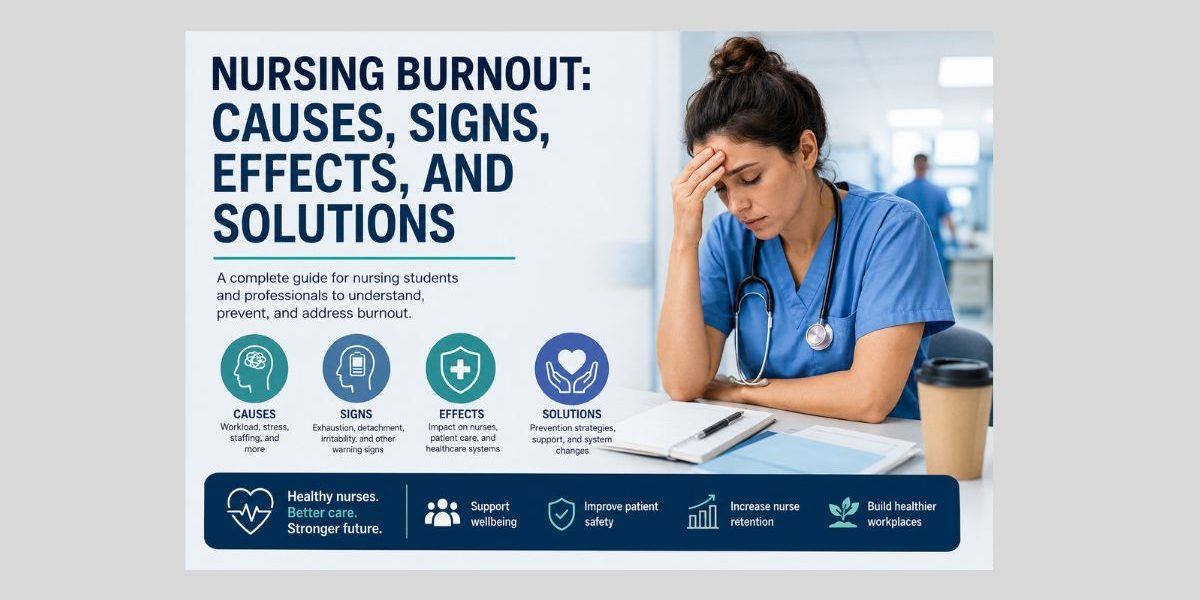
Nursing burnout is a work-related concern that many nursing students and nurses hear about but may not fully understand. It is more than feeling tired after a hard shift. Burnout can affect how nurses feel about work, how they communicate, how they recover, and how they think about staying in the profession.
This article explains what burnout means, common signs, causes, effects on nurses and patient care, related concepts, prevention strategies, organizational solutions, and ways students can write about burnout in essays, research papers, clinical reflections, EBP assignments, and DNP projects.
Quick Answer: What Is Nursing Burnout?
- Nursing burnout is a work-related state linked to chronic workplace stress.
- It may involve emotional exhaustion, cynicism or detachment, and reduced professional efficacy.
- It can affect nurse wellbeing, job satisfaction, patient care, teamwork, and nurse retention.
- Burnout is not just an individual weakness; workload, staffing, leadership, safety culture, and work environment matter.
- It differs from ordinary stress, compassion fatigue, moral distress, moral injury, and secondary traumatic stress, although these concepts may overlap.
- Prevention requires both individual support and organizational change.
- Nursing students can write about burnout using evidence from occupational health, nursing workforce research, patient safety literature, ethics, leadership studies, and nursing education.
What Is Nursing Burnout?
Nursing burnout is a work-related response to chronic occupational stress. The World Health Organization describes burnout as an occupational phenomenon, not a medical diagnosis, and links it to chronic workplace stress that has not been successfully managed. It includes three main dimensions: energy depletion or exhaustion, increased mental distance or cynicism toward work, and reduced professional efficacy (World Health Organization, 2019).
In nursing, burnout may appear as emotional exhaustion, detachment from patients or colleagues, reduced motivation, and a lower sense of accomplishment. These experiences matter because nursing requires attention, communication, ethical judgment, compassion, teamwork, and safe clinical decision-making.
Burnout should not be used casually to describe every difficult clinical day. Nursing is demanding, and stress can happen even in healthy work environments. Burnout becomes more concerning when work-related strain becomes persistent, affects functioning, or is linked to chronic organizational pressures.
This article treats burnout as an educational and occupational health concept. It does not diagnose any reader with burnout, depression, anxiety, PTSD, or any other condition.
Nursing Burnout Signs and Common Experiences
Nursing burnout signs can vary from one person to another. Some nurses may feel emotionally drained. Others may feel detached, less motivated, or less confident in their work.
Common experiences linked to burnout may include:
- Emotional exhaustion
- Feeling detached from work
- Irritability
- Loss of motivation
- Difficulty concentrating
- Sleep problems
- Physical fatigue
- Feeling ineffective
- Dread before shifts
- Reduced empathy or emotional numbness
- Increased errors or near misses
- Absenteeism
- Thoughts of leaving the job or profession
These signs can overlap with other health or mental health concerns. They should not be used for self-diagnosis. A nurse, student, or healthcare worker who feels persistently overwhelmed, severely distressed, unsafe, or at risk of self-harm should seek support from a licensed professional, crisis service, school counselor, workplace support service, or emergency service where appropriate.
Causes of Nursing Burnout
The causes of nursing burnout are rarely limited to one person’s coping skills. Burnout often develops when job demands remain high while support, control, recovery time, staffing, and resources remain limited.
Common causes and risk factors include:
- Heavy workload
- Staffing shortages
- Long shifts
- High patient acuity
- Emotional demands
- Repeated exposure to suffering, trauma, or death
- Moral distress
- Lack of support
- Poor leadership
- Workplace violence or incivility
- Documentation burden
- Limited autonomy
- Role conflict
- Inadequate rest
- Rotating or night shifts
- Lack of supplies or resources
The National Academies of Sciences, Engineering, and Medicine emphasizes that clinician burnout is shaped by work systems, leadership, organizational culture, administrative demands, and care delivery pressures, not only by individual resilience (National Academies of Sciences, Engineering, and Medicine, 2019).
This is why burnout prevention in nursing must address both individual wellbeing and work environment conditions.
Nursing Burnout vs Stress, Compassion Fatigue, Moral Distress, Moral Injury, and Secondary Traumatic Stress
Burnout in nursing can overlap with other forms of distress, but these terms are not identical. Students should define each concept carefully before using it in an essay, care reflection, leadership paper, or research project.
| Concept | What it means | Common trigger | How it may appear | Key difference |
|---|---|---|---|---|
| Ordinary stress | A response to pressure, demands, or challenges | Exams, busy shifts, deadlines, unfamiliar tasks | Worry, tension, urgency, fatigue | Stress may improve when the demand passes or support improves. |
| Nursing burnout | A work-related state linked to chronic workplace stress | Persistent workload, poor staffing, low support, limited recovery | Emotional exhaustion, detachment, reduced professional efficacy | Burnout is specifically tied to occupational stress and work conditions. |
| Compassion fatigue | Reduced capacity to empathize after repeated exposure to suffering | Ongoing emotional caregiving | Emotional numbness, reduced empathy, withdrawal | It focuses more on the cost of caring and repeated exposure to suffering. |
| Moral distress | Distress when a nurse recognizes the ethically appropriate action but faces barriers to acting | Unsafe staffing, policy limits, resource shortages, team conflict | Frustration, guilt, powerlessness, ethical tension | It centers on blocked ethical action. |
| Moral injury | Lasting distress after involvement in, witnessing, or being unable to prevent events that conflict with moral values | Perceived ethical betrayal, preventable harm, impossible choices | Shame, guilt, anger, loss of trust, spiritual or moral conflict | It involves deeper harm connected to violated moral beliefs. |
| Secondary traumatic stress | Stress reactions from indirect exposure to another person’s trauma | Caring for trauma survivors or hearing traumatic stories | Intrusive thoughts, hyperarousal, avoidance, distress | It is trauma-related and may resemble post-traumatic stress responses. |
Moral distress has been widely discussed in nursing ethics literature as the distress that occurs when nurses know the ethically appropriate action but cannot carry it out because of constraints (Morley et al., 2019; Salari et al., 2022). Moral injury is related but broader and may involve persistent distress after morally injurious events (Rabin et al., 2023).
For student writing, the safest approach is to explain where these concepts overlap and where they differ.
How Nursing Burnout Is Studied and Measured
Researchers study burnout using validated tools that assess dimensions such as emotional exhaustion, depersonalization or cynicism, professional efficacy, work environment, wellbeing, or occupational stress. One widely known framework is associated with the Maslach Burnout Inventory, which describes burnout through emotional exhaustion, depersonalization, and reduced personal accomplishment (Soares et al., 2023).
Students may discuss burnout inventories or occupational wellbeing scales in research papers, but they should not reproduce copyrighted survey items. They should also avoid using these tools casually to diagnose themselves or classmates.
Burnout measurement can be used in:
- Nursing workforce research
- Quality improvement projects
- Occupational health assessments
- Leadership studies
- DNP or capstone projects
- Studies on nurse retention, patient safety, or work environment
For example, a DNP student might measure burnout before and after a peer-support intervention. A qualitative researcher might interview nurses about lived experiences of moral distress and burnout. If you are analyzing burnout project results, academic support such as dissertation data analysis help may be useful when the project involves surveys, pre/post comparisons, or outcome measures.
How Nursing Burnout Affects Nurses
Burnout may affect nurses emotionally, physically, professionally, and socially. It can influence job satisfaction, confidence, concentration, communication, and professional identity.
Possible effects include:
- Lower job satisfaction
- Emotional exhaustion
- Reduced sense of accomplishment
- Physical fatigue
- Difficulty concentrating
- Less confidence at work
- Strained relationships with colleagues
- Absenteeism
- Reduced engagement
- Intention to leave a unit, organization, or profession
Burnout among nurses has been linked in research to quality of life concerns and workforce outcomes, including intention to leave (Khatatbeh et al., 2022; National Academies of Sciences, Engineering, and Medicine, 2019).
Students should use cautious wording. Instead of writing “burnout destroys nursing careers,” write “burnout may contribute to reduced job satisfaction, absenteeism, and turnover intention.”
How Nursing Burnout Can Affect Patient Care
Burnout does not mean a nurse is careless or unsafe. However, research suggests that burnout can increase risks in clinical environments, especially when it affects attention, communication, teamwork, and consistency of care.
Burnout may contribute to:
- Communication problems
- Reduced attention
- Missed care
- Near misses
- Lower patient satisfaction
- Less consistent care
- Teamwork problems
- Weaker safety culture
- Lower perceived quality of care
A 2024 systematic review and meta-analysis found that nurse burnout was associated with lower patient safety, lower quality of care, and lower patient satisfaction (Li et al., 2024).
In academic writing, avoid saying burnout always causes patient harm. Use careful phrases such as “is associated with,” “may contribute to,” or “can increase risk.”
Nursing Burnout and the Nursing Shortage
Nursing burnout and the nursing shortage can create a difficult workforce cycle. When burnout contributes to turnover intention, nurses may leave a unit, reduce hours, or consider leaving the profession. When staffing becomes tighter, remaining nurses may experience heavier workloads, less recovery time, and more pressure.
This cycle can affect nurse retention, patient care continuity, team stability, and organizational costs. Retention therefore requires workplace-level solutions, not only advice for nurses to “be more resilient.”
A strong paper on this topic could examine how staffing, leadership, workload, and organizational culture influence nurse retention.
Nursing Student Burnout
Nursing student burnout is different from occupational nurse burnout, but students can still experience academic and clinical stress that resembles burnout-related strain.
Common pressures include:
- Academic workload
- Clinical expectations
- Exams
- Care plans
- Financial stress
- Family and work responsibilities
- Fear of making mistakes
- Lack of rest
- Transition shock during early clinical experiences
- Pressure to perform emotionally and academically
A systematic review on nursing student burnout reported that emotional exhaustion is a major concern among nursing students, although prevalence estimates vary by study, setting, and measurement method (Gómez-Urquiza et al., 2023).
Students should not assume that every stressful semester equals burnout. Still, studying burnout helps students understand wellbeing, workload, professional identity, healthcare systems, and safe learning environments.
Burnout Risk Factors by Nursing Setting
Burnout risk can vary by specialty, patient population, staffing, acuity, leadership, violence risk, resources, and support. One setting is not automatically “worse” than another.
| Setting | Burnout risk factors | Example stressors |
|---|---|---|
| Emergency department | High acuity, crowding, violence risk, rapid decisions | Overcrowding, trauma cases, unpredictable workload |
| Intensive care unit | High acuity, complex technology, frequent ethical decisions | End-of-life care, moral distress, family conflict |
| Medical-surgical unit | High patient volume, broad care needs, documentation burden | Multiple admissions, discharges, medications, competing priorities |
| Long-term care | Staffing pressures, chronic care needs, family communication | High resident needs, limited resources, retention challenges |
| Mental health nursing | Emotional intensity, safety risks, therapeutic communication demands | Aggression risk, crisis care, compassion fatigue |
| Oncology or palliative care | Repeated exposure to suffering, grief, and loss | End-of-life care, symptom burden, family distress |
| Community health | Resource gaps, social determinants of health, travel demands | Home visits, limited access, complex family needs |
| Home health | Autonomy, travel, safety concerns, documentation | Working alone, time pressure, patient environment risks |
| Nursing school/clinical placements | Academic pressure, clinical evaluation, limited confidence | Exams, care plans, fear of errors, transition stress |
Coping Strategies vs Burnout Prevention
Coping and prevention are related, but they are not the same. The Coping strategies help nurses manage stress, recover, reflect, and seek support. Prevention addresses the causes of burnout, including workload, staffing, leadership, safety culture, violence prevention, and resources.
| Coping strategy | What it may help with | What it cannot fix alone |
|---|---|---|
| Rest and recovery | Fatigue, emotional reset, concentration | Chronic understaffing or unsafe workloads |
| Peer support | Isolation, emotional processing, team connection | Poor leadership or lack of resources |
| Reflective practice | Learning from difficult experiences | System-level ethical barriers |
| Debriefing | Processing stressful clinical events | Repeated exposure without staffing support |
| Counseling or employee assistance resources | Persistent distress, coping support, emotional wellbeing | Unsafe work systems |
| Boundaries | Recovery time, role clarity, emotional protection | Excessive workload expectations |
| Asking for support | Task prioritization, emotional support, learning | A culture that punishes help-seeking |
| Reporting unsafe conditions | Documentation of safety concerns | Leadership inaction or resource shortages |
Self-care can be useful, but it should never be presented as the only solution to systemic burnout.
Organizational Strategies to Prevent Nursing Burnout
Burnout prevention in nursing is a system responsibility. Organizations, leaders, educators, and policy stakeholders all influence the conditions in which nurses work.
Workplace-level strategies may include:
- Safe staffing approaches
- Supportive leadership
- Manageable workload
- Adequate supplies and resources
- Violence prevention
- Shared governance
- Mentorship programs
- Debriefing support
- Mental health resources
- Reducing unnecessary documentation burden
- Flexible scheduling where possible
- Recognition and professional development
- Psychological safety
- Reporting systems without retaliation
NIOSH and occupational health approaches emphasize that worker wellbeing depends on job conditions, organizational practices, safety climate, and prevention strategies, not only individual behavior (National Institute for Occupational Safety and Health, n.d.).
For leadership papers, this section can support an argument that burnout prevention requires both structural changes and supportive management.
Evidence-Based Interventions for Nursing Burnout
Burnout interventions may target individuals, teams, organizations, or all three. Evidence suggests that many interventions focus on individual strategies, but organizational causes require organizational responses (Lee et al., 2023; Yildirim et al., 2023).
| Intervention type | Example | What it may help with | Limitation |
|---|---|---|---|
| Mindfulness or stress-management programs | Brief mindfulness sessions, stress education | Emotional regulation, stress awareness | Does not fix workload or staffing |
| Peer support | Peer listening groups, buddy systems | Isolation, emotional support, team connection | Requires trust and protected time |
| Resilience training | Skills for coping, reflection, communication | Adaptation and confidence | Can be misused if systems ignore unsafe conditions |
| Workload/staffing interventions | Staffing review, acuity-based assignment | Fatigue, missed care, safety concerns | May require budget and policy changes |
| Leadership interventions | Leader rounding, communication training | Trust, responsiveness, psychological safety | Depends on consistent follow-through |
| Debriefing programs | Post-event debriefing after traumatic cases | Emotional processing, team learning | Should not replace staffing or mental health resources |
| Schedule improvements | Reduced excessive overtime, fair rotation | Recovery, fatigue reduction | May be difficult during shortages |
| Mental health resources | Counseling, EAP, crisis pathways | Persistent distress, support access | Staff must trust confidentiality and access |
| Team communication interventions | Huddles, escalation pathways, structured handoff | Teamwork, safety, role clarity | Needs consistent use and leadership support |
No single intervention is guaranteed. Burnout prevention works best when the intervention matches the cause.
What Nurse Leaders Can Do About Burnout
Nurse leaders play a major role in how staff experience work. They cannot control every system problem, but they can influence communication, trust, staffing advocacy, safety culture, and team support.
Helpful leadership actions include:
- Listening to staff concerns
- Monitoring workload and acuity
- Improving communication
- Responding to safety concerns
- Reducing avoidable stressors
- Supporting new nurses
- Addressing workplace incivility
- Encouraging reporting
- Advocating for resources
- Supporting professional development
- Building trust and psychological safety
Leadership papers should avoid vague statements such as “leaders should motivate nurses.” A stronger approach is to connect leadership behavior to specific outcomes, such as retention, reporting culture, staffing advocacy, mentorship, and patient safety.
What Nursing Students Should Know About Burnout Before Clinical Practice
Burnout is important to study, but it is not inevitable. Nursing students should understand burnout early so they can develop healthy expectations about professional practice.
Students should know that:
- Exhaustion should not be romanticized as professionalism.
- Asking for support is part of safe learning.
- Patient confidentiality must be protected in clinical reflections.
- Instructors, advisors, peers, and counseling services can be important supports.
- Unsafe workload concerns should be reported through appropriate channels.
- Teamwork, communication, and mentorship matter.
- Boundaries can support long-term wellbeing.
- Burnout is not only a personal problem; systems influence wellbeing.
Students who need help organizing a burnout reflection, care-related discussion, or nursing essay can use nursing assignment help as academic guidance rather than a replacement for personal support or professional care.
Common Myths About Nursing Burnout
| Myth | Reality |
|---|---|
| Burnout means someone is weak. | Burnout is linked to chronic work stress and system conditions, not personal weakness. |
| Self-care alone fixes burnout. | Self-care may help coping, but prevention also requires staffing, leadership, workload, and safety improvements. |
| Only new nurses burn out. | Burnout can affect students, new nurses, experienced nurses, advanced practice nurses, and leaders. |
| Burnout is the same as being tired. | Fatigue may be part of burnout, but burnout also involves detachment and reduced professional efficacy. |
| Burnout always means someone should leave nursing. | Some nurses may need a change, but many benefit from support, workload changes, leadership response, or healthier work environments. |
| Burnout does not affect patient care. | Research links nurse burnout with patient safety, quality, and satisfaction concerns. |
| Good nurses never feel detached. | Emotional numbness can happen under chronic strain. It does not mean someone lacks compassion. |
| Nursing students do not need to study burnout. | Students need to understand burnout because it connects to wellbeing, ethics, leadership, workforce issues, and patient safety. |
Common Mistakes Students Make When Writing About Nursing Burnout
Students often weaken burnout papers by treating the topic too generally. A strong paper uses precise definitions, current evidence, and careful wording.
Avoid these mistakes:
- Blaming individual nurses
- Treating burnout as ordinary tiredness
- Ignoring staffing and organizational factors
- Confusing burnout with compassion fatigue, moral distress, moral injury, or secondary traumatic stress
- Making unsupported claims about patient harm
- Using outdated pandemic-only sources
- Using emotional language without evidence
- Proposing self-care as the only solution
- Failing to connect burnout to patient care, workforce retention, leadership, ethics, or systems
- Using sources that are not scholarly or current
A better paper might argue that burnout reflects a relationship between job demands, ethical strain, leadership, staffing, recovery time, and patient care outcomes.
How to Write About Nursing Burnout in Assignments
Students can approach burnout differently depending on the assignment type.
| Assignment type | How to approach nursing burnout | Example topic |
|---|---|---|
| Discussion post | Define burnout and connect it to one clinical or workforce issue. | Why burnout prevention requires both individual and organizational action |
| Reflective journal | Discuss a clinical learning experience without identifying patients. | Reflecting on workload, emotional strain, and professional boundaries |
| Nursing essay | Explain causes, signs, effects, and prevention. | Causes and effects of nurse burnout in acute care |
| Research paper | Use scholarly sources to analyze a focused question. | Nurse burnout and patient safety outcomes |
| Leadership paper | Focus on staffing, communication, safety culture, and retention. | Nurse leader strategies for reducing burnout |
| EBP project | Evaluate an intervention and outcome. | Peer-support intervention to reduce emotional exhaustion |
| DNP/capstone project | Link burnout to measurable practice outcomes. | Implementing debriefing to support ICU nurses after critical events |
| Qualitative research topic | Explore lived experiences, themes, or perceptions. | Nurses’ lived experiences of moral distress and burnout |
For longer academic projects, students may need support narrowing a research question, structuring sections, and integrating evidence. Relevant academic support pages include nursing coursework help, nursing research paper help, DNP dissertation help, and qualitative data analysis support when the project involves interviews, themes, or lived experiences.
Nursing Burnout Research Paper Topics
Useful research paper topics include:
- Nurse burnout and patient safety
- Burnout among ICU nurses
- Nursing burnout and turnover intention
- Burnout and staffing shortages
- Compassion fatigue vs burnout
- Moral distress and nurse wellbeing
- Moral injury in nursing practice
- Nurse burnout during pandemics or crisis conditions
- Burnout prevention interventions
- Leadership strategies for reducing burnout
- Nursing student burnout and academic stress
- Burnout in long-term care nursing
- Qualitative studies on nurse burnout experiences
Students should narrow broad topics by population, setting, intervention, or outcome.
For example:
- Too broad: “Nursing burnout”
- Better: “The relationship between ICU nurse burnout and turnover intention”
- More focused: “Peer-support interventions for reducing emotional exhaustion among ICU nurses”
Sample Thesis Statement and Paragraph Structure
Sample thesis statement:
“Nursing burnout is important to study because it affects nurse wellbeing, workforce stability, and patient care, while also revealing how workload, staffing, leadership, and organizational culture shape clinical practice.”
A simple paragraph structure:
- Topic sentence
- Define the burnout concept
- Present scholarly evidence
- Connect the evidence to nursing practice or patient care
- Explain the implication for nurses, leaders, students, or healthcare organizations
Example paragraph pattern:
Nursing burnout can affect patient care by weakening communication, attention, and teamwork. Burnout is commonly associated with emotional exhaustion, detachment, and reduced professional efficacy. Recent evidence links nurse burnout with lower patient safety, quality of care, and patient satisfaction. This does not mean every burned-out nurse causes harm, but it suggests that healthcare organizations should treat burnout as a patient safety and workforce issue. Nurse leaders can respond by improving staffing processes, supporting reporting, and creating healthier work environments.
Quick Checklist for Writing About Nursing Burnout
- Did I define burnout clearly?
- Did I distinguish burnout from stress, compassion fatigue, moral distress, moral injury, and secondary traumatic stress?
- Did I use current scholarly sources?
- Did I avoid blaming nurses for systemic problems?
- Did I explain both individual and organizational factors?
- Did I clearly distinguish coping from prevention?
- Did I connect burnout to patient care, workforce retention, ethics, leadership, or nursing education?
- Did I use cautious wording for clinical and workforce claims?
- Did I avoid making the whole paper only about COVID-19 unless that is the assigned focus?
- Did I cite sources in APA 7th edition if required?
FAQs About Nursing Burnout
What is nursing burnout?
Nursing burnout is a work-related state linked to chronic workplace stress. It may involve emotional exhaustion, detachment or cynicism, and reduced professional efficacy.
What are common signs of nursing burnout?
Common signs may include emotional exhaustion, irritability, loss of motivation, difficulty concentrating, physical fatigue, reduced empathy, dread before shifts, absenteeism, and thoughts of leaving the job or profession.
What causes nursing burnout?
Common causes include heavy workload, staffing shortages, long shifts, high acuity, emotional demands, moral distress, poor leadership, workplace incivility, limited autonomy, documentation burden, and inadequate resources.
How does nursing burnout affect patient care?
Burnout may contribute to communication problems, reduced attention, missed care, near misses, lower patient satisfaction, and weaker safety culture. Research links nurse burnout with patient safety and quality concerns, but students should use cautious wording.
Is nursing burnout the same as compassion fatigue?
No. Burnout is linked to chronic workplace stress. Compassion fatigue focuses more on the emotional cost of caring for people who are suffering. They can overlap, but they are not the same.
Can nursing students experience burnout?
Nursing students can experience academic burnout or burnout-related stress from coursework, clinical pressure, exams, care plans, financial strain, and fear of making mistakes. Student burnout is not always the same as occupational nurse burnout, but it is still important to study.
What helps reduce nursing burnout?
Helpful approaches may include rest, peer support, reflection, counseling resources, debriefing, supportive leadership, safer staffing, violence prevention, manageable workload, flexible scheduling where possible, and a culture that supports reporting concerns.
How do I write about nursing burnout in an assignment?
Start by defining burnout, then narrow the topic by population, setting, cause, intervention, or outcome. Use scholarly sources, distinguish burnout from related concepts, avoid blaming nurses, and connect the issue to patient care, leadership, ethics, workforce retention, or nursing education.
Final Thoughts on Nursing Burnout
Nursing burnout is not just personal tiredness. It is connected to chronic workplace stress, emotional exhaustion, work environment, patient safety, ethics, and nurse retention. Understanding it helps nursing students and nurses think critically about wellbeing, leadership, and healthcare systems.
Lastly, for students, burnout is also a strong academic topic because it can be discussed in essays, discussion posts, research papers, clinical reflections, EBP assignments, qualitative studies, and DNP projects. If students need help writing a nursing burnout essay, discussion post, research paper, clinical reflection, EBP assignment, qualitative study, or DNP project, they can upload their instructions and request academic guidance.
References
Gómez-Urquiza, J. L., Albendín-García, L., Velando-Soriano, A., Ortega-Campos, E., Ramírez-Baena, L., & Cañadas-De la Fuente, G. A. (2023). Prevalence and levels of burnout in nursing students: A systematic review. Nurse Education Today, 121, 105706. https://doi.org/10.1016/j.nedt.2022.105706
Khatatbeh, H., Pakai, A., Al-Dwaikat, T., Onchonga, D., Amer, F., Prémusz, V., & Oláh, A. (2022). Nurses’ burnout and quality of life: A systematic review and critical analysis of measures used. Nursing Open, 9(3), 1564–1574. https://doi.org/10.1002/nop2.936
Lee, M., Cha, C., & Park, J. (2023). Interventions to reduce burnout among clinical nurses: Systematic review and meta-analysis. Scientific Reports, 13, 10971. https://doi.org/10.1038/s41598-023-38169-8
Li, L. Z., Yang, P., Singer, S. J., Pfeffer, J., Mathur, M. B., & Shanafelt, T. (2024). Nurse burnout and patient safety, satisfaction, and quality of care: A systematic review and meta-analysis. JAMA Network Open, 7(11), e2443059. https://doi.org/10.1001/jamanetworkopen.2024.43059
Morley, G., Ives, J., Bradbury-Jones, C., & Irvine, F. (2019). What is “moral distress”? A narrative synthesis of the literature. Nursing Ethics, 26(3), 646–662. https://doi.org/10.1177/0969733017724354
National Academies of Sciences, Engineering, and Medicine. (2019). Taking action against clinician burnout: A systems approach to professional well-being. The National Academies Press. https://doi.org/10.17226/25521
National Institute for Occupational Safety and Health. (n.d.). Healthcare workers: Work stress and mental health. Centers for Disease Control and Prevention. https://www.cdc.gov/niosh/healthcare/workstress.html
Rabin, S., Geffen, Y., Wilf-Miron, R., & Balicer, R. D. (2023). Moral injuries in healthcare workers: What causes them and what to do about them? Israel Journal of Health Policy Research, 12, 35. https://doi.org/10.1186/s13584-023-00591-1
Soares, J. P., Lopes, R. H., Mendonça, P. B., Silva, C. R. D. V., Rodrigues, C. C. F. M., & Castro, J. L. D. (2023). Use of the Maslach Burnout Inventory among public health care professionals: Scoping review. JMIR Public Health and Surveillance, 9, e44195. https://doi.org/10.2196/44195
World Health Organization. (2019, May 28). Burn-out an “occupational phenomenon”: International Classification of Diseases. https://www.who.int/news/item/28-05-2019-burn-out-an-occupational-phenomenon-international-classification-of-diseases
