

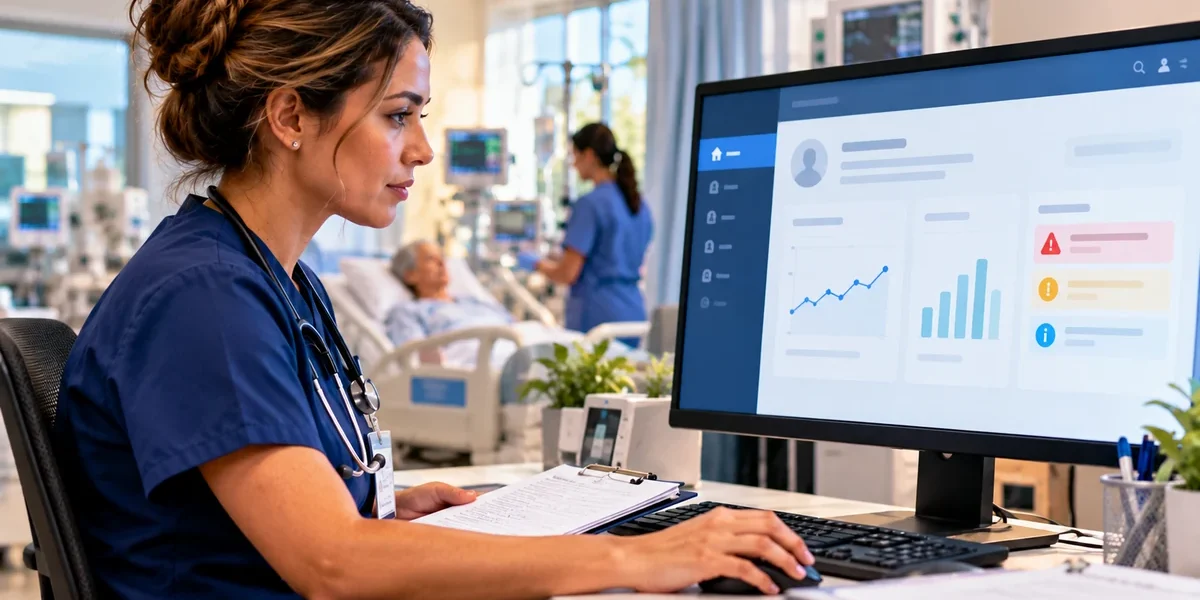
Every shift, nurses chart assessments, scan medications, answer alerts, and hand off patients. All of that creates data. Nursing informatics is the specialty that makes sure that data becomes useful information, safer decisions, and better patient outcomes.
If you are a nursing student, nursing informatics shows up in more places than you might expect. It is a full domain in the AACN Essentials, a common course in BSN, MSN, and DNP programs, and one of the richest areas for research papers, capstones, and dissertations. This guide explains the field in plain language and shows how to turn it into strong academic work.
Quick answer: what is nursing informatics?
Nursing informatics is a nursing specialty that combines nursing science with information and analytical sciences. Its goal is to identify, define, manage, and communicate data, information, knowledge, and wisdom in nursing practice.
In practice, it covers:
- Electronic health records (EHRs) and nursing documentation
- Clinical decision support, alerts, and early warning systems
- Barcode medication administration and smart pumps
- Telehealth, remote monitoring, and patient portals
- Nursing data, standardized terminologies, and analytics
- Artificial intelligence and predictive tools in nursing care
- Workflow design, usability, and staff training on new systems
The Official Definition of Nursing Informatics
The American Nurses Association (ANA) sets the standard definition used in the United States. In the current version, nursing informatics integrates nursing science with multiple information and analytical sciences to identify, define, manage, and communicate data, information, knowledge, and wisdom in nursing practice. The definition and standards are published in Nursing Informatics: Scope and Standards of Practice, 3rd Edition (ANA, 2022).
When you cite this definition in a paper, cite the ANA scope and standards book, not a secondary website. Your instructor will expect the primary source.
The DIKW framework: the core idea behind nursing informatics
The phrase “data, information, knowledge, and wisdom” is known as the DIKW framework. It describes how raw numbers become good clinical decisions. Wisdom was added to the ANA definition in the 2008 edition to reflect the push for evidence-based practice and decision support (Bickford, 2009).
| Level | What it means | Nursing example |
|---|---|---|
| Data | Raw, uninterpreted facts | Heart rate 118, temperature 38.6 °C, respiratory rate 24 |
| Information | Data organized so it has meaning | These vital signs are abnormal and rising compared with four hours ago |
| Knowledge | Information combined with evidence and experience | This pattern meets sepsis screening criteria |
| Wisdom | Knowing what to do, when, and why | The nurse escalates to the rapid response team and starts the sepsis protocol |
The DIKW framework is also one of the most common theoretical frameworks in nursing informatics research. If your paper needs a framework, DIKW is a safe and well-supported choice.
A short history of nursing informatics as a specialty
| Year | Milestone |
|---|---|
| 1992 | ANA recognizes nursing informatics as a nursing specialty |
| 1994 | ANA publishes the first scope of practice for nursing informatics |
| 1995 | ANA publishes the first standards of practice |
| 2001 | Scope and standards combined into one document with a revised definition |
| 2008 | Wisdom added to the definition (DIKW) |
| 2015 | Second edition revises the definition to its current wording |
| 2022 | Third edition released, the current standard |
What Does an Informatics Nurse Do?
Informatics nurses work where clinical care meets technology. They are not IT staff who happen to know nursing. They are nurses who make sure systems fit the way care is actually delivered.
Typical responsibilities include:
- System selection and design: helping choose and build EHR screens, flowsheets, order sets, and care plans
- Implementation and go-live support: testing, training staff, and troubleshooting when a new system launches
- Workflow analysis: mapping how nurses really work and removing duplicate or low-value documentation
- Clinical decision support: designing alerts, reminders, and early warning scores that help without causing alert fatigue
- Data and quality reporting: pulling nursing data for quality measures, dashboards, and research
- Education: teaching nurses and students to use technology safely
- Policy and governance: setting rules for data privacy, security, and documentation standards
Common nursing informatics job titles
| Role | Focus |
|---|---|
| Clinical informatics nurse / informatics nurse specialist | EHR build, workflow, training, and support at unit or hospital level |
| Clinical analyst | Configuring and testing clinical systems |
| Nursing informatics educator | Training staff and students on systems and digital competencies |
| Director of clinical informatics | Leading informatics teams and projects across a health system |
| Chief Nursing Informatics Officer (CNIO) | Executive leader for nursing technology strategy |
Where informatics nurses work
Most informatics nurses work in hospitals and health systems. In the 2022 HIMSS Nursing Informatics Workforce Survey, 62% of 1,118 respondents worked for a hospital or multifacility health system. More than half (54%) said their organization has a chief or senior nursing informatics officer role (HIMSS, 2022).
Other settings include EHR vendors, consulting firms, public health agencies, insurers, universities, and digital health startups.
Why Nursing Informatics Matters
Nursing informatics matters because nurses are the largest group of EHR users, and the quality of nursing data shapes the quality of care. Good informatics saves nurses time and catches problems early. Poor informatics buries nurses in clicks and alerts.
1. It addresses documentation burden
Nurses spend between 19% and 35% of their shift documenting in the EHR, up from about 9% when charting was on paper. That finding comes from the 25 × 5 Symposium report, which set a goal of cutting clinician documentation burden by 75% by 2025.
The problem has not gone away. In AMIA’s 2024 TrendBurden survey of 1,253 healthcare professionals, about 74% said documentation time impedes patient care. Only 38% of nurses agreed their EHR was easy to use (Healthcare Innovation, 2024). Informatics nurses lead the flowsheet redesigns and workflow changes that reduce this burden.
2. It improves patient safety
Many everyday safety tools are informatics tools: barcode medication administration, smart infusion pumps, fall-risk and pressure injury screening built into the EHR, and sepsis alerts. Informatics nurses design these tools so they fit real workflows instead of creating workarounds.
3. It turns nursing judgment into data that predicts deterioration
The CONCERN Early Warning System, developed at Columbia University, is one of the strongest recent examples. It uses machine learning on nursing documentation patterns, such as how often nurses check on a patient, to flag deterioration before vital signs change. In a multi-site trial published in Nature Medicine in April 2025, it shortened average hospital stays by more than half a day and lowered sepsis risk by 7.5% (Columbia University Irving Medical Center, 2025).
CONCERN shows a key point of nursing informatics: nurses’ clinical judgment is already recorded in the EHR. Informatics finds ways to use it.
4. It supports evidence-based practice and research
EHR data, quality dashboards, and nursing terminologies make it possible to measure outcomes at scale. That is why informatics sits at the center of many DNP projects and nursing dissertations today.
Nursing Informatics in Nursing Education
Every nursing student now studies informatics, not just future specialists. The AACN’s 2021 Essentials, which shape BSN, MSN, and DNP curricula, include Domain 8: Informatics and Healthcare Technologies. It expects nurses to use information and communication technologies to deliver care, gather data, and support decisions (AACN, 2021).
By level, that usually looks like this:
| Program | What informatics work looks like |
|---|---|
| BSN | Using the EHR safely, privacy and HIPAA, telehealth basics, evaluating health apps |
| MSN | Informatics courses, workflow analysis, system implementation, an informatics specialty track |
| DNP | Quality improvement projects built on EHR data, clinical decision support, dashboards |
| PhD | Original research on nursing data, AI, usability, and informatics theory |
How to Become an Informatics Nurse
Most informatics nurses start at the bedside. Clinical experience is what makes an informatics nurse useful, because you cannot redesign a workflow you have never done.
- Earn an RN license and a BSN.
- Gain clinical experience, usually two years or more.
- Volunteer as a “super user” for EHR updates or go-lives on your unit.
- Take informatics continuing education or a graduate certificate.
- Complete an MSN or DNP with an informatics focus (optional but common).
- Earn board certification.
Nursing informatics certification (NI-BC)
The main U.S. credential is the American Nurses Credentialing Center’s Informatics Nursing Certification (NI-BC). Eligibility generally includes:
- An active RN license and a bachelor’s degree or higher in nursing
- The equivalent of two years of full-time RN practice
- 30 hours of informatics continuing education within the last three years
- One practice route: 2,000 hours of informatics practice in three years, 1,000 hours plus 12 graduate credits in informatics, or a graduate informatics program with at least 200 supervised practicum hours
Requirements change, so always confirm the current criteria on the ANCC page before applying.
Nursing informatics salary and outlook
The Bureau of Labor Statistics does not track informatics nurses as a separate job. Survey data suggest pay is strong. In the HIMSS 2017 workforce survey, 46% of informatics nurses reported earning more than $100,000, and those with certification or a postgraduate degree tended to earn more (Becker’s Hospital Review). Pay varies with location, experience, and title.
Nursing Informatics in Your Research Paper, Capstone, or Dissertation
Nursing informatics is one of the best areas for student research. Data already exists in the EHR, the problems are current, and the outcomes are easy to measure. Most informatics studies fall into one of five groups:
| Research area | Example question | Common design |
|---|---|---|
| Documentation burden | Does a redesigned admission flowsheet reduce nurse documentation time? | Pre/post quality improvement |
| Clinical decision support | Does a nurse-driven sepsis alert reduce time to antibiotics? | Quasi-experimental |
| Alert fatigue | How do ICU nurses decide which alarms to act on? | Qualitative interviews |
| Telehealth | Does nurse-led remote monitoring reduce heart failure readmissions? | Quantitative, retrospective cohort |
| Technology acceptance and AI | What predicts nurses’ intention to use AI documentation tools? | Cross-sectional survey |
For more than 100 ideas organized by level and specialty, see our guide to nursing informatics research topics. If you are on a practice doctorate, our DNP project ideas include informatics-friendly topics with sample PICOT questions.
Tips for writing a strong nursing informatics paper
- Pick a framework early. DIKW, the Technology Acceptance Model (TAM), Diffusion of Innovations, and the Unified Theory of Acceptance and Use of Technology (UTAUT) are widely used.
- Search the right databases. CINAHL and PubMed index CIN: Computers, Informatics, Nursing, JAMIA, Applied Clinical Informatics, and JMIR Nursing.
- Keep the problem clinical. “Implementing a new EHR” is too broad. “Reducing duplicate pain documentation on a med-surg unit” is researchable.
- Plan the data before you write. Know whether you need EHR reports, audit logs, surveys, or interviews, and whether you will need IRB approval.
- Match the analysis to the question. Time comparisons often need inferential statistics, surveys start with descriptive analysis, and interview studies need qualitative data analysis. Studies that combine both use mixed methods analysis.
Need help with a nursing informatics assignment?
NursingDissertationHelp.com supports nursing students at every level with informatics papers and projects. Our nursing writers and statisticians can help you:
- Narrow an informatics topic and write a focused PICOT or research question
- Build a literature review from CINAHL and PubMed sources
- Choose a theoretical framework and study design
- Analyze EHR, survey, or interview data in SPSS, R, or NVivo
- Edit and format your paper in APA 7
Explore our nursing research paper help, DNP dissertation help, PhD dissertation help, and dissertation editing and proofreading service.
Ready to start? Send us your instructions and deadline for a free quote. We usually reply within 30 minutes.
Frequently Asked Questions About Nursing Informatics
What is nursing informatics in simple terms?
Nursing informatics is the use of data and technology to support nursing care. It makes sure systems like the EHR help nurses make good decisions instead of slowing them down.
What is an example of nursing informatics?
Barcode medication administration is a common example. The nurse scans the patient’s wristband and the medication, and the system checks the five rights before the dose is given. Other examples include sepsis alerts, telehealth monitoring, and early warning scores.
Is nursing informatics a good career?
For many nurses, yes. It offers strong pay, more regular hours than bedside roles, and a growing number of leadership positions such as the CNIO. It suits nurses who enjoy problem-solving, teaching, and technology.
Do informatics nurses need to know how to code?
No. Most roles need workflow analysis, communication, project management, and clinical knowledge. Skills in data analysis, SQL, or dashboard tools are a bonus, not a requirement.
What is the difference between nursing informatics and health informatics?
Health informatics covers all of healthcare, including medicine, pharmacy, and public health. Nursing informatics is the nursing specialty within it, focused on nursing data, nursing workflows, and nursing outcomes.
What is the DIKW model in nursing informatics?
DIKW stands for data, information, knowledge, and wisdom. It describes how raw data becomes meaningful information, then evidence-based knowledge, and finally sound clinical judgment.
What are good nursing informatics research topics?
Strong topics include documentation burden, alert fatigue, telehealth outcomes, AI in nursing, and nurses’ acceptance of new technology. See our full list of nursing informatics research topics.
References
- American Association of Colleges of Nursing. (2021). Domain 8: Informatics and healthcare technologies.
- American Nurses Association. (2022). Nursing informatics: Scope and standards of practice (3rd ed.).
- American Nurses Credentialing Center. (n.d.). Informatics nursing certification (NI-BC).
- Bickford, C. J. (2009). Nursing informatics: Scope and standards of practice. Studies in Health Technology and Informatics, 146, 855.
- Columbia University Irving Medical Center. (2025, April 2). Nurses and AI collaborate to save lives.
- HIMSS. (2022). Nursing informatics workforce survey.
- Hobensack, M., Levy, D. R., Cato, K., et al. (2022). 25 × 5 Symposium to reduce documentation burden: Report-out and call for action. Applied Clinical Informatics, 13(2), 439–446.
