

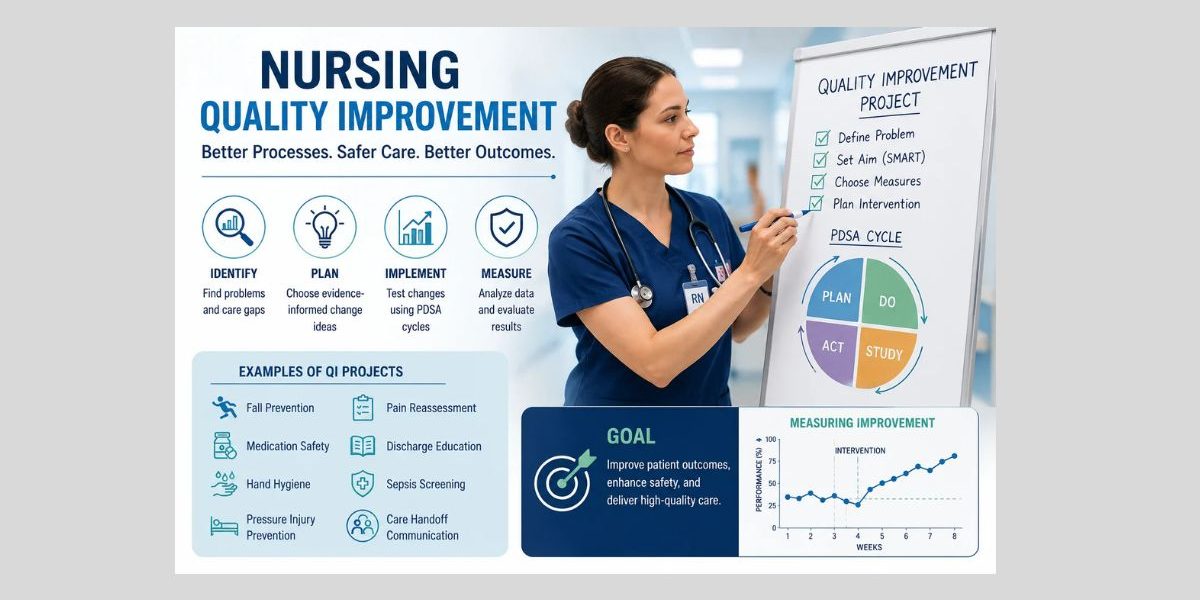
Nursing quality improvement helps nurses identify care gaps, test practice changes, measure results, and improve care processes in a structured way.
Many nursing students hear about QI but struggle to explain how it differs from evidence-based practice, nursing research, patient safety, clinical audit, or ordinary problem-solving. That confusion can make QI assignments, DNP projects, leadership papers, capstone projects, and clinical reflections harder than they need to be.
This guide explains what quality improvement means in nursing, why it matters, how QI differs from EBP and research, how to plan a nursing quality improvement project, how to write SMART aims, how to use PDSA cycles, how to choose QI measures, and how to write about QI correctly in academic assignments.
Quick Answer: What Is Nursing Quality Improvement?
- Nursing quality improvement is a structured effort to improve care processes, patient outcomes, safety, efficiency, or patient experience in a specific healthcare setting.
- QI uses data to identify care gaps, test changes, measure results, and refine practice.
- QI is different from nursing research because it usually focuses on improving a local process rather than creating generalizable knowledge.
- QI connects to evidence-based practice because evidence can guide the intervention.
- Common QI methods include PDSA cycles, root cause analysis, clinical audits, and process improvement methods.
- Nursing QI projects often focus on falls, infections, medication safety, discharge education, pressure injuries, documentation, or care coordination.
- Nursing students can use QI concepts in essays, discussion posts, leadership papers, DNP projects, capstone assignments, and clinical reflections.
What Is Nursing Quality Improvement?
Nursing quality improvement is a planned, data-informed process used to improve care delivery in a specific setting. In nursing, QI often focuses on safer care, clearer workflows, better documentation, stronger communication, reduced variation, and improved patient outcomes.
QI is not the same as simply noticing a problem and suggesting a quick fix. Casual problem-solving may rely on opinion, habit, or convenience. QI uses a more structured approach. A team identifies a care gap, reviews baseline data, selects a change idea, tests that change, measures results, and adjusts the intervention based on what the data shows.
The Institute for Healthcare Improvement’s Model for Improvement uses three guiding questions: What are we trying to accomplish? How will we know a change is an improvement? What changes can we make that will result in improvement? It then uses Plan-Do-Study-Act cycles to test changes in practice (Institute for Healthcare Improvement [IHI], n.d.-a).
Nursing students need to understand QI because many academic tasks ask them to identify a practice problem, propose an evidence-informed intervention, explain how success will be measured, and discuss implementation. That structure appears in EBP papers, leadership papers, DNP quality improvement projects, capstone projects, clinical reflections, and discussion posts.
Why Quality Improvement Matters in Nursing
Quality improvement matters because nurses work close to patient care processes. They see missed documentation, delayed reassessments, unclear handoffs, repeated medication delays, patient education gaps, preventable falls, infection risks, and workflow problems that may not appear clearly in policy documents.
QI supports patient safety by helping teams reduce preventable harm. For example, a unit may review fall data, identify when falls occur most often, test hourly rounding, and measure whether fall rates change over time. QI does not guarantee better outcomes, but it gives teams a structured way to test and evaluate improvement efforts.
QI supports quality of care by reducing unnecessary variation. If nurses document discharge education differently, patients may leave with uneven levels of understanding. A QI project can standardize discharge teaching, create a checklist, and measure completion rates.
QI can improve communication by strengthening handoff tools, escalation processes, interdisciplinary rounding, or shift reports. Poor communication can contribute to delays, missed care, and patient confusion. A QI approach helps teams identify where communication breaks down and test specific improvements.
QI also supports documentation accuracy. Nursing documentation affects continuity of care, clinical decision-making, quality reporting, reimbursement, and legal records. For students, this is important because many QI assignments focus on measurable documentation gaps, such as pain reassessment, fall-risk reassessment, care plan updates, or discharge teaching documentation.
QI encourages an accountability and learning culture. Root cause analysis, for example, focuses on underlying system issues rather than simply blaming individuals (Agency for Healthcare Research and Quality [AHRQ], 2019).
Nursing Quality Improvement vs Evidence-Based Practice, Research, and Patient Safety
Quality improvement, evidence-based practice, nursing research, patient safety, and clinical audit overlap, but they are not identical. Students often lose marks when they write a QI paper as if it were only an EBP paper or a research proposal.
| Concept | Main purpose | Main question | Typical methods | Nursing example | Student writing tip |
|---|---|---|---|---|---|
| Quality improvement | Improve a local care process or outcome | How can we improve this process in this setting? | Baseline data, SMART aim, PDSA, audits, run charts, process measures | Increasing pain reassessment documentation on one unit | Focus on setting, gap, intervention, measures, and improvement cycle. |
| Evidence-based practice | Apply best available evidence to clinical decisions | What does the evidence suggest we should do? | Literature review, guidelines, clinical expertise, patient preferences | Using evidence to choose a fall prevention bundle | Explain how evidence supports the intervention, but do not make the whole paper only a literature review. |
| Nursing research | Generate new knowledge | What new knowledge can this study produce? | Research design, sampling, data collection, statistical or qualitative analysis | Studying nurses’ experiences with alarm fatigue | Include research methods only if the assignment is truly a research proposal. |
| Patient safety | Reduce risk of harm | What risks may harm patients, and how can they be reduced? | Safety reporting, RCA, safety culture, risk reduction | Reducing medication administration errors | Link safety to QI, but do not turn every QI paper into a broad safety essay. |
| Clinical audit | Compare current practice with a standard | Are we meeting the expected standard? | Audit criteria, chart review, compliance rates | Auditing hand hygiene compliance | Use audit findings as baseline data or evaluation data in QI. |
Evidence-based practice helps nurses choose evidence-informed interventions. QI tests and measures whether a change improves a local process or outcome. Research usually aims to produce generalizable knowledge. Patient safety focuses on preventing harm. Clinical audit checks whether practice meets a standard.
For example, an EBP paper may ask, “What does the evidence say about reducing catheter-associated infection risk?” A QI project may ask, “Can a catheter removal checklist improve documentation and reduce catheter days on this unit over eight weeks?”
Students writing about EBP can connect this article naturally to a broader guide on why evidence-based practice is important in nursing where appropriate.
Common Nursing Quality Improvement Project Topics
A nursing quality improvement project should be narrow enough to measure. Broad topics such as “improve patient safety” or “reduce infections” are usually too vague. Stronger topics focus on a specific process, population, setting, intervention, and measure.
| QI topic | Possible problem | Example intervention | Possible measure |
|---|---|---|---|
| Fall prevention | Fall-risk reassessments are missed after transfers | Transfer checklist with fall-risk prompt | Percentage of transfer patients reassessed within 4 hours |
| Pressure injury prevention | Turning schedules are inconsistently documented | Repositioning reminder and skin assessment checklist | Documentation completion rate or pressure injury rate |
| Catheter-associated infection prevention | Catheters remain in place without daily review | Daily catheter necessity checklist | Catheter days or percentage of daily reviews completed |
| Medication safety | High-alert medication double-checks are missed | Double-check documentation prompt | Compliance with double-check process |
| Hand hygiene compliance | Staff miss hand hygiene before patient contact | Visual reminders and feedback reports | Observed compliance percentage |
| Discharge education | Teaching is completed but not consistently documented | Standard discharge education template | Percentage of charts with completed education documentation |
| Pain reassessment | PRN pain medication reassessment is delayed or missing | EHR reminder or medication administration checklist | Percentage reassessed within facility timeframe |
| Patient rounding | Call lights increase during evening shift | Hourly rounding script | Call light frequency or rounding documentation |
| Diabetes education | Education follow-up is inconsistent | Teach-back checklist | Percentage of patients receiving teach-back |
| Readmission reduction | Patients leave without clear follow-up instructions | Discharge follow-up call process | 7-day follow-up call completion or readmission rate |
| Sepsis screening | Screening tool is not completed consistently | Sepsis screening prompt | Screening compliance percentage |
| Care handoff communication | Important risk information is missed during shift report | SBAR handoff tool | Handoff audit score or missed information rate |
These examples are educational. Real QI projects depend on setting, baseline data, policy, patient population, stakeholder support, data access, and approval requirements.
Nursing Quality Improvement Project Steps
A strong QI project follows a logical sequence. Students do not need to make the project complicated, but they do need to show clear thinking.
1. Identify a specific problem or care gap
Start with a focused issue. Instead of writing “falls are a problem,” identify the exact gap: “Fall-risk reassessment after patient transfer is inconsistently documented on a medical-surgical unit.”
2. Gather baseline data
Baseline data shows the current state before the intervention. It may come from chart audits, incident reports, compliance data, observation, patient surveys, staff feedback, or quality dashboards. Without baseline data, it is hard to prove whether improvement occurred.
3. Write a clear SMART aim statement
A SMART aim defines what will improve, for whom, where, by how much, and by when.
4. Identify stakeholders
Stakeholders may include bedside nurses, nurse managers, patients, educators, quality officers, informatics staff, physicians, pharmacists, and students. QI works better when the people affected by the workflow help shape the change.
5. Review evidence and current policy
Evidence helps justify the intervention. Policy helps ensure the proposed change fits the organization’s requirements. Students should avoid recommending changes that conflict with scope of practice, facility rules, instructor expectations, or data governance requirements.
6. Choose an intervention or change idea
The intervention should match the root cause. If documentation is low because the form is hard to find, education alone may not solve the problem. A better intervention may include an EHR prompt, simplified template, staff reminder, or workflow redesign.
7. Select QI measures
Use process, outcome, balancing, and structure measures where appropriate. AHRQ explains that healthcare quality measures commonly include structure, process, and outcome measures (AHRQ, n.d.-a).
8. Test the change using a QI model
Many nursing QI projects use PDSA cycles. PDSA helps teams test changes on a small scale, study results, and adjust before wider implementation (IHI, n.d.-b).
9. Collect and display results
Results may be displayed using run charts, bar charts, audit tables, dashboards, or before-and-after comparisons.
10. Analyze results
Students should explain what changed, what did not change, and what may have influenced the results. Avoid overstating findings.
11. Refine, sustain, or spread the change
If the change works, the team may standardize it. If it does not work, the team may revise the intervention and test again.
12. Communicate findings
QI communication may include staff updates, leadership reports, posters, presentations, academic papers, or DNP/capstone reports.
13. Reflect on limitations and next steps
Limitations may include short timeframe, small sample size, incomplete data, staffing changes, inconsistent documentation, or limited stakeholder participation.
SMART Aim Statements in Nursing Quality Improvement
SMART means specific, measurable, achievable, relevant, and time-bound. A good SMART aim identifies the setting, population or process, target improvement, current baseline where available, and timeframe.
Vague aims weaken QI projects because they make measurement difficult.
| Weak aim | Why it is weak | Improved SMART aim |
|---|---|---|
| Improve fall prevention. | Too broad and not measurable. | Increase completion of fall-risk reassessment after patient transfer from 60% to 85% on one medical-surgical unit within 10 weeks. |
| Improve discharge teaching. | Does not identify process, population, target, or timeframe. | Increase documented discharge education using teach-back from 50% to 80% among adult heart failure patients within eight weeks. |
| Reduce medication errors. | Too broad and may require more complex safety data. | Increase documented independent double-checks for high-alert medications from 70% to 90% in one ICU within six weeks. |
A strong aim does not promise guaranteed outcomes. It states a measurable improvement target that the project will test.
PDSA Cycle in Nursing Quality Improvement
The PDSA cycle in nursing is a structured way to test a practice change.
Plan
The team defines the problem, aim, intervention, measures, timeline, and responsibilities. For example, a unit may plan to improve pain reassessment documentation after PRN pain medication.
Do
The team tests the change on a small scale. For example, nurses on one shift may use a reminder checklist for one week.
Study
The team reviews data. Did documentation improve? Were reassessments completed within the expected timeframe? Did nurses find the checklist practical?
Act
The team decides what to do next. It may adopt the change, adapt it, or abandon it and test a different strategy.
PDSA works well in nursing QI because it supports small tests of change before wider implementation. AHRQ describes PDSA as a method for testing a change, evaluating the result, improving it, and testing again.
Nursing Quality Improvement Measures
QI measurement helps answer one key question: How will we know the change led to improvement?
| Measure type | Meaning | Nursing example | Student writing tip |
|---|---|---|---|
| Process measure | Tracks whether the care process happened as intended | Percentage of patients who received discharge teaching | Use this when measuring compliance with the intervention. |
| Outcome measure | Tracks the result of care or the result of the process | Fall rate, pressure injury rate, readmission rate | Use cautious wording because outcomes may be affected by many factors. |
| Balancing measure | Tracks possible unintended consequences | Staff workload, patient wait time, documentation burden | Include this when an intervention could create new problems. |
| Structure measure | Tracks resources or system capacity | Availability of trained staff, supplies, equipment, EHR tools | Use this when the project depends on resources or infrastructure. |
For example, a pain reassessment QI project may use:
- Process measure: percentage of PRN pain medication administrations with reassessment documented within 60 minutes.
- Outcome measure: average patient-reported pain score after medication.
- Balancing measure: nurse-reported documentation burden.
- Structure measure: availability of EHR reminder tools.
Quality measures may include structure, process, outcome, and balancing measures, depending on the project design and improvement question (Jazieh, 2020).
How Nursing QI Data Is Displayed
Nursing QI data may be shown using run charts, bar charts, audit tables, dashboards, or before-and-after comparisons.
A run chart shows data over time. It is useful when a team wants to see whether a process changes across weeks or months. For example, a run chart can show weekly pain reassessment compliance before and after an EHR reminder.
A bar chart can compare categories, such as documentation completion by unit or shift.
An audit table can summarize chart review findings, such as number of charts reviewed, number meeting criteria, and compliance percentage.
A before-and-after comparison can show baseline performance compared with post-intervention performance. Students should use this carefully because a simple before-and-after design may not prove causation.
In assignments, students should explain what the data suggests, what it does not prove, and what limitations affect interpretation.
Root Cause Analysis and Problem Identification
Root cause analysis is a structured method used to understand why a problem occurred and what system factors contributed to it. In healthcare, RCA is often used to examine serious adverse events or safety problems. AHRQ emphasizes that RCA should look for underlying system problems and avoid focusing only on individual mistakes.
In QI assignments, students may discuss RCA as a problem-identification tool. Common approaches include:
Fishbone diagram
A fishbone diagram organizes possible causes into categories such as people, process, equipment, environment, policy, communication, and documentation.
Five whys
The five whys approach asks “why?” repeatedly to move beyond surface-level explanations.
Example:
- Problem: Pain reassessment documentation is missing.
- Why? Nurses forget to return to the documentation screen.
- Why? The reminder is not visible during medication administration.
- Why? The EHR does not prompt reassessment after PRN medication.
- Why? The workflow depends on memory instead of a system cue.
- Why? The documentation process was not designed around medication timing.
This section is educational only. Students and nurses should follow facility policy, reporting systems, instructor guidance, and organizational procedures for real safety events, adverse events, workplace concerns, or disciplinary issues.
Role of Nurses in Quality Improvement
Nurses contribute to quality improvement because they understand patient care workflows directly. Their role may include:
- Identifying care gaps during bedside care.
- Reporting patterns that affect safety or quality.
- Collecting audit data.
- Educating patients and families.
- Testing new workflows.
- Communicating changes to the care team.
- Documenting accurately.
- Participating in staff feedback.
- Evaluating outcomes.
- Advocating for safer systems.
For nursing students and new nurses, QI does not always mean leading a large project. It may mean recognizing a practice gap, asking how the process is measured, participating in an audit, or explaining how a proposed intervention could improve care.
Students writing about assessment-related care gaps can connect QI thinking to nursing assessment when the project depends on timely reassessment, risk screening, patient cues, or documentation accuracy.
Nursing Leadership and Quality Improvement
Nursing leadership supports QI implementation. Leaders help create the conditions for change by clarifying priorities, securing resources, engaging stakeholders, communicating expectations, and supporting staff during workflow changes.
Change management in nursing matters because QI projects often fail when staff do not understand the reason for change. A nurse leader may reduce resistance by explaining the problem, sharing baseline data, asking for staff input, providing training, and giving feedback during implementation.
Psychological safety also matters. Staff are more likely to report problems and suggest improvements when they do not fear blame for system issues. This does not remove accountability, but it supports learning and improvement.
Students who need a broader discussion of leadership styles, delegation, communication, and change can link QI implementation to a dedicated nursing leadership article instead of turning this QI article into a leadership-only essay.
Barriers to Nursing Quality Improvement
Common barriers to nursing QI include:
- Lack of time.
- Limited data access.
- Resistance to change.
- Staffing pressure.
- Unclear workflows.
- Weak leadership support.
- Poor communication.
- Lack of training.
- Competing priorities.
- Sustainability problems.
- Intervention not matched to the root cause.
For example, a hand hygiene project may fail if the real barrier is supply placement, but the intervention only uses staff education. A discharge education project may fail if the form is too long, the workflow is unclear, or nurses are not given time to complete teach-back.
A strong QI paper identifies barriers and explains how the project will respond to them.
How Nurses Can Overcome QI Barriers
Nurses and students can address QI barriers by keeping the project focused and realistic.
Start with a narrow problem. A project on “improving patient safety” is too broad. A project on “improving fall-risk reassessment after patient transfer” is easier to measure.
Use baseline data. Baseline data helps show why the project matters and prevents vague claims.
Involve stakeholders early. Nurses, patients, unit leaders, educators, and informatics staff may identify practical issues that the project team missed.
Test small changes first. PDSA cycles help teams learn before scaling an intervention.
Measure consistently. Inconsistent measurement can make results unreliable.
Use feedback. Staff feedback may reveal whether the intervention fits the workflow.
Plan for sustainability. A project is stronger when it explains how the change can continue after the initial testing period.
Nursing Quality Improvement Project Example
The following example uses clearly hypothetical data for student learning.
Problem
Pain reassessment documentation after PRN pain medication is inconsistent on a medical-surgical unit.
Background
The unit policy requires pain reassessment within 60 minutes after PRN oral pain medication. A chart audit suggests that reassessments are often completed but not consistently documented.
SMART aim statement
Increase documented pain reassessment within 60 minutes of PRN pain medication administration from 55% to 80% on one medical-surgical unit within eight weeks.
Baseline data
A two-week chart audit reviewed 100 PRN pain medication administrations. Documentation showed that 55 had reassessment recorded within 60 minutes.
Stakeholders
Stakeholders include bedside nurses, charge nurses, nurse manager, clinical educator, informatics nurse, quality improvement staff, and patients receiving PRN pain medication.
Intervention
The project tests a simple EHR reminder and a brief staff huddle reminder at the start of each shift. Nurses receive a one-page guide showing where to document reassessment.
Measures
| Measure | Example |
|---|---|
| Process measure | Percentage of PRN pain medication administrations with reassessment documented within 60 minutes |
| Outcome measure | Average documented pain score after reassessment |
| Balancing measure | Nurse-reported documentation burden |
| Structure measure | Availability of EHR reminder and staff education sheet |
PDSA cycle
Plan: Test the reminder with one shift for one week.
Do: Nurses use the EHR reminder and guide.
Study: The team audits documentation and collects staff feedback.
Act: If nurses report that the reminder appears too late, the team adjusts the reminder timing and tests again.
Data display
A run chart shows weekly documentation compliance. An audit table summarizes the number of PRN medication administrations reviewed each week.
Results discussion
If documentation increases from 55% to 78%, the project may suggest improvement, but the team should avoid claiming that the intervention caused all change. Staffing, patient volume, documentation habits, and audit consistency may also affect results.
Limitations
Limitations may include small sample size, short timeframe, reliance on documentation, and variation across shifts.
Sustainability plan
The unit may add the reminder to standard workflow, include pain reassessment documentation in orientation, review monthly audit data, and share feedback during staff meetings.
DNP and Capstone Quality Improvement Projects
DNP and capstone projects often focus on practice improvement because advanced nursing education emphasizes systems thinking, evidence-informed practice, implementation, and outcome evaluation.
A DNP quality improvement project usually starts with a practice gap. The student reviews evidence, engages stakeholders, chooses an intervention, identifies measures, implements the project in a defined setting, analyzes results, and discusses sustainability.
QI differs from a traditional dissertation or research study because the goal is usually to improve a local practice process rather than generate generalizable knowledge. However, DNP and capstone projects still require scholarly writing, evidence synthesis, ethical consideration, accurate data handling, and careful evaluation.
Students working on advanced projects may need support with project framing, evidence tables, measurement plans, or analysis. A natural internal link may fit when discussing DNP dissertation help, especially if the student needs help organizing a DNP quality improvement project. If the project includes numerical outcomes, students may also need dissertation data analysis help for interpreting QI data responsibly.
Ethical, Privacy, and Approval Considerations in Nursing QI
Nursing QI projects must handle patient information responsibly. Students should consider privacy, de-identification, data access, institutional approval, consent expectations, and reporting requirements.
QI projects may or may not require IRB or ethics review. That depends on the school, facility, purpose, data use, patient involvement, publication plans, and organizational policy. Students should not assume that a project is exempt simply because it is called QI.
SQUIRE 2.0 provides guidance for reporting healthcare improvement work and emphasizes clear reporting of the problem, context, intervention, study of the intervention, measures, results, and interpretation (Ogrinc et al., 2016).
Ethical QI writing should avoid blame. If a documentation gap exists, the paper should examine workflow, training, resources, reminders, policy clarity, staffing pressure, or communication issues rather than accusing individual nurses.
Students should follow university instructions, facility policy, instructor guidance, professional standards, scope of practice, and data governance rules.
Common Mistakes Students Make in Nursing Quality Improvement Assignments
Students often lose clarity when they choose a topic that is too broad. “Reducing hospital infections” is difficult to manage. “Improving daily catheter necessity documentation on one unit” is more focused.
Another mistake is confusing QI with research. A QI assignment should not read like a full research proposal unless the instructor specifically asks for one.
Other common mistakes include:
- Failing to define baseline data.
- Writing a vague aim statement.
- Choosing an intervention without evidence.
- Measuring the wrong outcome.
- Ignoring balancing measures.
- Failing to explain data display.
- Not discussing sustainability.
- Making unsupported claims.
- Recommending unrealistic changes.
- Forgetting ethics, privacy, or approval requirements.
- Turning the paper into an EBP essay instead of a QI assignment.
- Turning the paper into a leadership essay without measurement.
A strong QI assignment explains the problem, setting, baseline, evidence-informed intervention, QI model, measures, data display, limitations, and sustainability plan.
How to Write About Nursing Quality Improvement in Assignments
Different assignments require different levels of detail. A discussion post may need a short explanation, while a DNP project may require a full proposal, implementation plan, and evaluation section.
| Assignment type | How to approach QI | Example topic |
|---|---|---|
| Discussion post | Define the QI issue, explain why it matters, and suggest one measurable change | Improving hand hygiene compliance |
| Nursing essay | Explain QI concepts, compare QI with EBP or research, and apply one example | QI and medication safety |
| Leadership paper | Focus on stakeholder engagement, communication, change management, and feedback | Nurse leader role in reducing missed reassessments |
| EBP assignment | Use evidence to justify the proposed QI intervention | Evidence-informed fall prevention bundle |
| Research paper | Clarify whether the paper is about QI, research, or comparison between both | QI versus nursing research |
| DNP/capstone project | Include practice gap, evidence, stakeholders, implementation, measures, data analysis, and sustainability | DNP project on discharge education |
| Clinical reflection | Connect observed care gaps to QI thinking without exposing private patient information | Reflection on handoff communication |
| QI proposal | Present problem, aim, intervention, measures, PDSA, ethics, and evaluation plan | Pain reassessment documentation proposal |
Students who need help organizing a QI essay, discussion post, or proposal can use nursing assignment help as a soft academic-support option when their instructions require structured nursing writing.
Nursing Quality Improvement Essay and Project Topics
Good QI topics are specific and measurable. Students should narrow broad topics by setting, population, process, intervention, measure, or outcome.
Useful nursing quality improvement essay and project topics include:
- Fall prevention QI project.
- Pressure injury prevention QI project.
- Medication safety improvement.
- Hand hygiene compliance improvement.
- Discharge education documentation.
- Pain reassessment documentation.
- Sepsis screening compliance.
- Reducing catheter-associated infection risk.
- Improving shift handoff communication.
- Improving patient rounding.
- Reducing readmission risk.
- Improving diabetes education follow-up.
A weak topic is “improve patient care.” A stronger topic is “increase documented teach-back education for adult heart failure discharge patients from 50% to 80% within eight weeks.”
Sample Aim Statement, Thesis Statement, and Paragraph Structure
Sample QI aim statement
“The project aims to increase documented pain reassessment within 60 minutes of PRN pain medication administration from 55% to 80% on a medical-surgical unit within eight weeks.”
Sample thesis statement
“Nursing quality improvement is important because it helps nurses use data, evidence, teamwork, and structured change methods to improve care processes, patient safety, and measurable outcomes.”
Sample paragraph structure
- Start with a topic sentence.
- Define the QI concept.
- Present the practice problem.
- Support the issue with evidence or baseline data.
- Explain the proposed improvement and measurement plan.
Example paragraph:
Pain reassessment documentation is an important quality improvement issue because it affects continuity of care and evaluation of symptom management. In a QI project, the nurse would first identify the current documentation rate, then test a focused change such as an EHR reminder or reassessment checklist. The project could measure the percentage of PRN pain medication administrations with reassessment documented within 60 minutes. This approach keeps the project measurable and connects the intervention to a specific care process.
Quick Checklist for Nursing Quality Improvement Assignments
Use this checklist before submitting a QI assignment:
- Did I define the problem clearly?
- Did I identify baseline data?
- Did I write a clear SMART aim statement?
- Did I explain why the problem matters?
- Did I use evidence to support the intervention?
- Did I identify stakeholders?
- Did I include process, outcome, balancing, and structure measures where relevant?
- Did I explain the QI model?
- Did I describe how data will be displayed or reviewed?
- Did I consider ethics, privacy, and approval requirements?
- Did I discuss sustainability?
- Did I avoid confusing QI with research?
FAQs About Nursing Quality Improvement
1. What is nursing quality improvement?
Nursing quality improvement is a structured process used to improve care processes, safety, outcomes, efficiency, or patient experience in a specific healthcare setting. It uses data, measurement, teamwork, and testing to guide change.
2. What is an example of quality improvement in nursing?
An example is a project to improve pain reassessment documentation after PRN pain medication. The project may collect baseline data, test an EHR reminder, measure documentation compliance, and adjust the process based on results.
3. How is QI different from evidence-based practice?
Evidence-based practice helps nurses choose interventions supported by research, clinical expertise, and patient needs. QI tests whether a change improves a specific process or outcome in a local setting.
4. How is QI different from nursing research?
Nursing research usually aims to generate new knowledge. QI usually aims to improve a local care process. Some projects may overlap, so students should follow instructor, university, and facility guidance.
5. What is the PDSA cycle in nursing?
The PDSA cycle means Plan, Do, Study, Act. Nurses use it to plan a change, test it on a small scale, study the results, and decide whether to adopt, adapt, or abandon the change.
6. What are common nursing QI project topics?
Common topics include falls, pressure injuries, medication safety, hand hygiene, catheter-associated infection prevention, discharge education, pain reassessment, sepsis screening, handoff communication, and readmission reduction.
7. What measures are used in nursing quality improvement?
QI projects may use process measures, outcome measures, balancing measures, and structure measures. For example, a discharge education project may measure documentation completion, patient understanding, staff workload, and availability of teaching materials.
8. How do I write a nursing quality improvement assignment?
Start with a focused problem, explain baseline data, write a SMART aim, support the intervention with evidence, describe stakeholders, choose QI measures, explain the PDSA cycle or another model, discuss data display, address ethics, and include sustainability.
Final Thoughts on Nursing Quality Improvement
Nursing quality improvement helps nurses identify care gaps, test changes, measure results, and improve patient care processes in a structured way. For students, the key is to stay focused on the local practice problem, the measurable aim, the intervention, the data, and the improvement process.
A strong QI assignment does not simply say that care should improve. It explains what needs to improve, why it matters, what change will be tested, how success will be measured, what barriers may occur, and how the improvement could be sustained.
If students need help writing a nursing quality improvement essay, discussion post, research paper, EBP assignment, DNP project, capstone project, or data analysis section, they can upload their instructions and request academic guidance.
References
Agency for Healthcare Research and Quality. (n.d.-a). Types of health care quality measures. https://www.ahrq.gov/talkingquality/measures/types.html
Agency for Healthcare Research and Quality. (n.d.-b). Plan-Do-Study-Act (PDSA) directions and examples. https://www.ahrq.gov/health-literacy/improve/precautions/tool2b.html
Agency for Healthcare Research and Quality. (2019). Root cause analysis. PSNet. https://psnet.ahrq.gov/primer/root-cause-analysis
Barr, E., & Brannan, G. D. (2024). Quality improvement methods (LEAN, PDSA, SIX SIGMA). In StatPearls. StatPearls Publishing. https://www.ncbi.nlm.nih.gov/books/NBK599556/
Institute for Healthcare Improvement. (n.d.-a). Model for Improvement. https://www.ihi.org/library/model-for-improvement
Institute for Healthcare Improvement. (n.d.-b). Model for Improvement: Testing changes. https://www.ihi.org/library/model-for-improvement/testing-changes
Jazieh, A. R. (2020). Quality measures: Types, selection, and application in health care quality improvement. Global Journal on Quality and Safety in Healthcare, 3(1), 1–7. https://doi.org/10.36401/JQSH-20-X1
Ogrinc, G., Davies, L., Goodman, D., Batalden, P., Davidoff, F., & Stevens, D. (2016). SQUIRE 2.0: Standards for Quality Improvement Reporting Excellence: Revised publication guidelines from a detailed consensus process. BMJ Quality & Safety, 25(12), 986–992. https://doi.org/10.1136/bmjqs-2015-004411
