

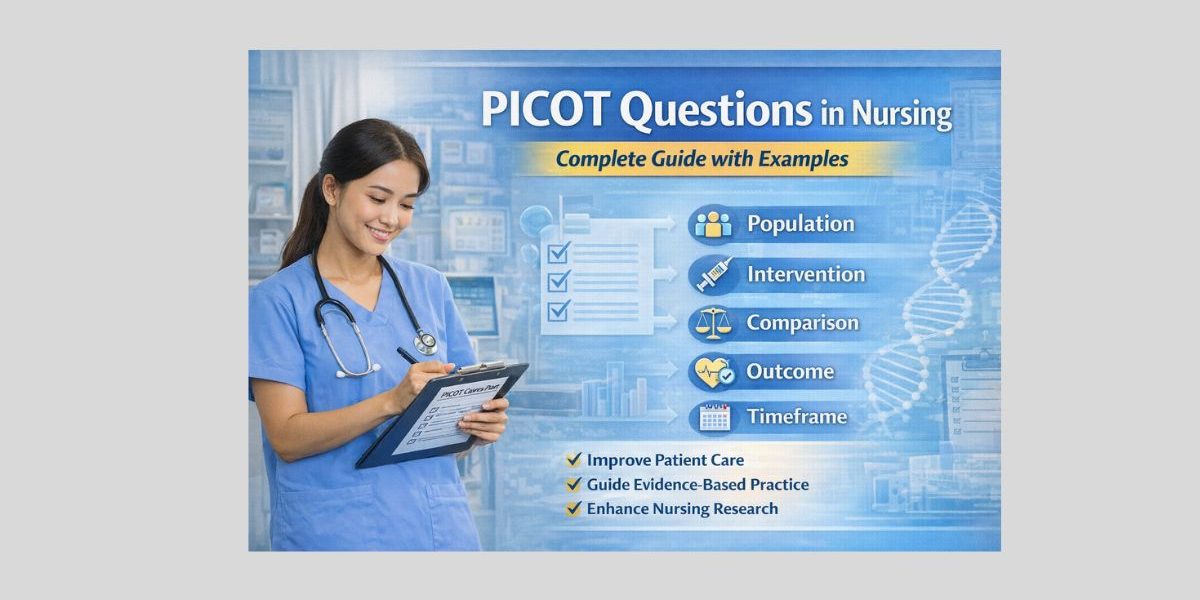
PICOT Questions in Nursing
PICOT Questions in Nursing are essential in evidence-based practice but many new nurses and students find them confusing and frustrating. Without clear guidance, these questions often end up too broad or unfocused. For example, a national study of nursing projects found that although one-third of DNP students identified using a PICOT method, only 6% of questions followed the method correctly[1]. These flaws – like missing a comparison group or a proper outcome – can lead to biased literature searches and ineffective clinical interventions[2]. Nurses facing course projects, dissertations, or clinical decision-making need clarity on formulating and analyzing PICOT questions. This comprehensive guide explains the scoring system, interpretation, and clinical use of PICOT questions in nursing, helping you overcome challenges and achieve better patient-care outcomes.
A well-phrased PICOT question sharpens your research focus. It identifies Population (P), Intervention (I), Comparison (C), Outcome (O) and Timeframe (T) to guide your evidence search[3]. For example, one StatPearls review notes: “P stands for patient/population; I refers to intervention; C stands for comparison/control; O stands for the outcome; and T refers to the time frame”[3]. By structuring a question this way, you move from a vague idea to a targeted inquiry, improving search efficiency and the applicability of findings[4]. If you struggle with formulating PICOT questions, expert [nursing research paper help] and [DNP dissertation help] can provide guidance, model questions, and feedback to sharpen your research question ethically.
Common Challenges with PICOT Questions
Many nursing students and practitioners encounter roadblocks when working with PICOT. A core challenge is simply understanding what belongs in each element. In the DNP study mentioned above, common errors included missing the Comparison (C) element in over half of questions (56%), and failing to state whether the outcome is expected to be higher or lower (directional outcome in 67%)[5]. Half the questions omitted the Timeframe (T), which, while not always needed for searching, is crucial for clear project scope[6].
These formulation errors often come from lack of training or hurried coursework. Practically, a vague PICOT question means your literature search yields hundreds of irrelevant articles. According to evidence-based practice experts, the “foundation of EBP is developing a PICOT question, which identifies the terms to search for the best evidence to answer a [clinical] question”[7]. In other words, if your PICOT is unclear, finding high-quality evidence becomes a guessing game. A poorly framed PICOT may lead to what researchers call “skewed outcomes” – biased conclusions or unhelpful recommendations[2].
Other challenges include interpreting statistical results and applying evidence to practice. Advanced statistical concepts (like p-values or confidence intervals) often confuse nurses trying to answer PICOT questions. However, interpretive skills are critical. As Giuliano and Polanowicz explain, “the ability to interpret and use quantitative findings from nursing research is an essential skill for advanced practice nurses to ensure provision of the best care possible”[8]. In summary, without proper guidance on both question formulation and data interpretation, even well-intentioned PICOT projects can fail to improve patient outcomes.
Why PICOT Questions in Nursing are Important
PICOT questions in nursing matter because they are the gateway to evidence-based practice (EBP). When nurses ask clear, structured questions, they can efficiently search medical databases and apply findings to patient care. Implementing EBP – driven by strong PICOT questions – has been shown to “lead to a higher quality of care and better patient outcomes”[9]. In contrast, vague questions or ad-hoc searches often produce misleading or non-replicable conclusions.
Using a PICOT framework has multiple benefits:
- Focused Inquiry: By explicitly defining the Population, Intervention, Comparison, Outcome, and Time, PICOT narrows down your question. This reduces irrelevant results and speeds up finding the best evidence[3][4].
- Rigorous Evidence: Well-constructed PICOT questions typically rely on measurable outcomes from robust study designs (like randomized controlled trials). The StatPearls text emphasizes that outcomes should come from “rigorous studies with statistically significant findings” for the best evidence[10]. This rigor translates to reliable conclusions for patient care.
- Consistent Terminology: Using PICOT ensures you use standardized keywords (P, I, C, O, T) when searching journals and guidelines. This consistency avoids missing relevant data and reduces confusion when communicating with colleagues or supervisors.
- Enhanced Critical Thinking: Formulating PICOT questions trains nurses to think critically about clinical problems – framing patient problems, interventions, and outcomes explicitly. This habit improves overall clinical reasoning skills (evidence-based models often start with a PICOT question as Step 1).
In practice, consider a clinical example: an ICU nurse wonders if a new sedation protocol reduces ventilation time. A structured PICOT could be: “In adult ICU patients on ventilation (P), does protocol-driven sedation (I) compared to standard care (C) reduce ventilation days (O) within the first week (T)?” This question leads to a targeted literature search on sedation protocols and ventilator outcomes. The link [fall risk assessment tools used in hospitals] provides a list of standardized tools – similarly, one could use known sedation scales in constructing such a PICOT. By contrast, asking “Can sedation protocols help?” would be too vague to yield actionable research.
Overall, a clear PICOT question drives evidence-based change. For educators and authors, teaching correct PICOT use is vital. As cited in StatPearls, “writing a good PICOT question…for an effective search and making robust, evidence-based recommendations to improve care and outcomes is critical”[11]. With our clinical medical writing service and expert coaches, you can refine PICOT questions to meet this critical standard and guide your project toward meaningful results.
Benefits of Using Our Service
Developing PICOT questions and analyzing results can be time-consuming. That’s why many nursing students and professionals turn to specialized academic services for support. Our team offers comprehensive assistance to ensure you succeed ethically and effectively:
- Expert Guidance from Education Professionals: Our writers include PhD-prepared nurses and statisticians. For instance, our DNP Dissertation Help and Medical Research Paper Writing Service specialize in formulating rigorous PICOT questions and advising on data analysis. We tailor our help to your level – from undergraduate projects to doctoral work[1].
- Statistical & Data Analysis Support: Have results from your PICOT-based study? We provide SPSS Data Analysis Help, Regression Analysis Help, and Inferential Statistics Help for Nursing Research. Our experts can run the appropriate tests and interpret findings (see Giuliano & Polanowicz on the importance of statistical understanding[8]). For qualitative inquiries, our Qualitative Data Analysis services ensure rich interpretation of survey or interview data.
- Writing and Presentation: Whether it’s a nursing research paper help request or help with your report writing, we ensure your PICOT question and findings are communicated clearly. We also offer Case Study Help, Nursing Assignment Help, and Nursing Homework Help for shorter PICOT-related tasks. All content is customized and plagiarism-free, aligning with ethical standards. You can even check our samples of nursing writing to see our quality.
- Convenience and Support: Many students juggle work, family, and clinical rotations. Our Coursework Help for Nursing Students, Do My Homework Service, and Cheap Coursework Writing Service lighten the load. We’re available to refine your PICOT question, conduct literature searches, or draft sections of your paper. We operate transparently see our pricing page and refund policy so you know what to expect.
Each of these benefits ties back to strengthening your PICOT project. For example, using our Dissertation Data Analysis Help means your PICOT outcomes (like patient fall rates or pain scores) are correctly modeled with statistics. Meanwhile, our writers ensure your final draft follows academic conventions, so the question’s relevance and context shine through. By leveraging our services, you save time and boost the quality of evidence-based recommendations in your project or publication.
How the Process Works
Getting help with your PICOT question is easy and structured:
- Initial Consultation (How It Works): First, we connect to understand your needs. Check our [How It Works] page for details. We’ll discuss your PICO(T) framework, project scope, and deadlines.
- Formulating or Refining PICOT: Our experts guide you to articulate or improve your question. We may ask clarifying questions about your population and interventions to ensure nothing is missing (for example, ensuring a clear Outcome and direction in your hypothesis).
- Research & Analysis: Once the question is set, we assist in gathering evidence. We search databases, extract relevant data, and even perform statistical analyses. This may involve using advanced techniques like regression (handled by our Regression Analysis Help specialists) or qualitative coding.
- Drafting & Feedback: We help write the sections of your paper related to the PICOT question – background, methods, results, discussion. You can submit drafts to our Report Writing team for editing. We incorporate your feedback at each stage, ensuring the final narrative highlights how the PICOT structured the research.
- Review & Finalization: We review the entire document for consistency and clarity. Your PICOT question should be prominently stated in the introduction and referenced in the conclusion (showing how the evidence answered it). We ensure the argument flows logically from question to analysis to recommendation.
- Delivery & Support: Finally, we deliver the complete work. You own the final paper, and we offer revisions if needed (subject to our Refund Policy).
Throughout this process, we integrate trust signals. All work is confidential and plagiarism-checked. We focus on support, not cheating: think of our service as academic mentoring. We might point you to relevant [fall risk assessment tools] for developing your P, or review your SPSS output, but you remain in control. Our goal is to empower you to use PICOT effectively, whether for a nursing dissertation or a quick homework question.
How to Choose the Best Service
With so many options, picking the right writing or tutoring service is crucial. Here are tips to ensure you choose wisely:
- Expertise and Academic Credentials: Look for providers whose writers have nursing or research expertise. Our team includes former nursing faculty and experienced researchers. For PICOT-related help, specialized services (like a DNP Dissertation Help team) are ideal because they understand clinical research demands.
- Transparent Pricing and Guarantees: Good services are upfront about costs and policies. We offer clear [nursing dissertation pricing] and even a cheap coursework writing service option for tight budgets, along with a satisfaction guarantee. Always check for a clear Refund Policy we stand by our work and offer revisions if the PICOT guidance is not as expected.
- Work Samples and Testimonials: Reliable companies showcase samples of prior work. Review our samples for PICOT questions, assignments, and dissertations. Also, read reviews or ask for references to verify quality and on-time delivery.
- Communication and Support: Effective help requires good communication. Our team is available to discuss your PICOT question in depth. When choosing a service, ensure they have channels for revision requests and queries.
- Ethical Approach: Finally, ensure the service emphasizes learning. We do. We will explain how we helped refine your PICOT question and often provide you with annotated sources. This educational style (not just “do my assignment” approach) ensures you grow your skills. For instance, we won’t simply write your question; we’ll guide you through why including a specific comparator or time frame improves it.
By considering these factors, you can select a provider that truly supports your evidence-based practice goals. And remember, using professional help can be ethical if it’s done right. Always use the output as a learning tool – we encourage students to understand and adapt our guidance, not just copy it.
Key Components and Steps of PICOT Questions
Understanding a PICOT question means knowing what each element contributes. Here are the key components and steps to develop them effectively:
| Component | Meaning & Tips |
| P (Population/Problem) | Define the patient group or issue. Include demographics or clinical conditions (age, gender, setting, etc.) to narrow focus. E.g., “elderly hospitalized patients with dementia.” |
| I (Intervention) | Specify the management strategy, therapy, or exposure you are interested in. This could be a treatment, procedure, or risk factor. E.g., “hourly rounding by nurses.” |
| C (Comparison) | Identify a control or alternate intervention if applicable. Sometimes there may be no direct comparison (e.g., before-and-after). Use “vs. standard care” or another intervention. E.g., “vs. standard patient care.” |
| O (Outcome) | Choose measurable results you care about (clinically relevant). Outcomes should have clear metrics. E.g., “fall rate over 6 months” or “patient-reported pain scores.” |
| T (Timeframe) | Specify a time horizon to measure the outcome. This clarifies short-term vs. long-term effects. E.g., “within one year” or “at 48 hours post-intervention.” |
As the StatPearls guide notes, a robust PICOT should have all relevant pieces[3][4]. Some projects omit T if it’s irrelevant, but clarity on time often improves the question. Always make your outcome measurable and link it to better care – for instance, tracking adverse events, symptom reduction, or knowledge gains.
Step-by-Step Development: Start with a broad topic (e.g., “fall prevention”). Use PICO to drill down. We often use iterative brainstorming: list all patient factors (P), then potential interventions (I), and outcomes (O). A quick way is to imagine the P and I first, then ask “compared to what?” and “what do we measure?” This strategic framing is something we coach clients on, using our [nursing assignment help] to list examples.
Scoring and Evidence Appraisal: Once the question is set, you’ll collect evidence and need to assess it. Many nursing programs use a scoring rubric or levels-of-evidence chart. For example, evidence levels I–VII (from systematic reviews down to expert opinion) are common[12]. High-level evidence (Level I or II) means stronger support for your interventions. Our Report Writing and Nursing Research Paper Help teams can help assign these levels and even create evidence tables. We also educate students that evidence without a solid PICOT context (or with bias) is like one witness in a trial – not enough to convict[13][2].
Interpreting Results: When you analyze data (ours or your own), interpretation is key. Suppose your PICOT question involves an intervention reducing infection rates. You run a statistical test (or obtain data) and get a p-value or confidence interval. Understanding these outputs is crucial. The nursing literature emphasizes that integrating statistics into practice requires understanding p-values and clinical significance[8]. Our Inferential Statistics Help can explain whether a result (say, p=0.04) truly means the intervention was effective, or if it could be due to chance. We also stress looking at effect sizes: a small p-value with minimal real-world impact may not be useful clinically.
Applying to Practice (Clinical Use): Finally, the ultimate goal is applying findings to patient care. After formulating and answering a PICOT question, consider how it translates. Does evidence support a new protocol? Should staffing ratios change? For example, if a PICOT study shows a certain fall prevention strategy cuts fall rates by 50%, that might change nursing rounds. Clinical guidelines often originate from aggregated PICOT-based studies. Throughout our coaching, we help you connect the dots: “Given our PICOT and results, here’s how an ICU ward might change practice.” This bridges research to real-life nursing.
By mastering these components and steps – from crafting the question to interpreting data – nurses make informed decisions. If any step seems overwhelming, remember our suite of services: from qualitative data analysis (for narrative findings) to case study help (for real-world examples), we’re here to ensure you build a solid PICOT project.
Ethical Considerations
Using writing and tutoring services raises valid ethical questions. We emphasize that our support is academic guidance, not cheating. How do we ensure integrity?
- Transparency: We encourage clients to disclose any help they receive to instructors if required (much like seeking a tutor). We do not simply ghostwrite; we often provide outlines or annotated drafts.
- Originality: All content is custom-written or appropriately cited. We never plagiarize or sell copied material. You receive unique work built from scratch or heavily rewritten to illustrate PICOT principles.
- Learning Focus: Our aim is to improve your understanding. For example, after helping form your PICOT question, we explain why adding a comparator or tightening the outcome makes the question stronger. This is similar to on-demand tutoring.
- Referencing: We help you cite sources, not fabricate them. We guide you through using references (like those in this article), reinforcing good scholarly habits.
- Use as a Model: We provide samples and model answers as references. Students should use these as learning tools, not cheat sheets. We stress the difference and often include watermarks or instructions (e.g., “for learning only”).
- Adherence to Guidelines: We follow the assignment parameters you provide. If a professor forbids outside help, we urge you to ensure our assistance doesn’t violate policies. Our [refund policy] and guarantees are there in case any misunderstanding occurs.
In short, think of our service as a mentor. We support brainstorming your PICOT and analyzing results, but the final work – especially the parts submitted for credit – should be your own. By choosing our help, you’re investing in your skills. Our commitment is to uphold the ethics of nursing and academia, just as you learn to uphold patient ethics in clinical practice.
Frequently Asked Questions (FAQs)
Q1: What exactly is a PICOT question and why use it?
A: A PICOT question is a structured clinical question format that helps focus research. It specifies Population, Intervention, Comparison, Outcome, and Time. This clarity makes literature searches efficient and ensures studies directly relate to your clinical concern[3]. For example, instead of broadly asking “Does exercise help patients?”, a PICOT approach would define who the patients are, the type of exercise, what it’s compared to, and what outcome you measure. This method is widely taught in nursing EBP courses[7][3].
Q2: How do I interpret or score the results of a PICOT-based study?
A: First, extract key data (e.g., infection rates, pain scores) from the evidence you found. Then, use statistical analysis (e.g., regression, as our SPSS Data Analysis Help can perform) to test your hypotheses. We often talk about “levels of evidence” – for example, systematic reviews and RCTs are Level I, while case reports are Level IV[14]. Scoring usually means assigning these levels or using research quality rubrics. Interpretation means looking at p-values, confidence intervals, and effect sizes. Remember, a statistically significant result (p<0.05) suggests a true difference, but you should also consider clinical significance (is the difference meaningful for patients?). The nursing literature stresses the importance of interpreting findings in context of practice[8].
Q3: Can your services help with statistical analyses for PICOT projects?
A: Yes – in fact, we specialize in it. Whether you need Regression Analysis Help, Inferential Statistics Help for Nursing Research, or SPSS output explained, our experts can assist. For instance, if your PICOT question involves predicting patient outcomes, we can run logistic or linear regression and explain the model. If you collected survey data, we perform chi-square tests or ANOVA as needed. We also help interpret qualitative data if your PICOT is exploratory; our Qualitative Data Analysis includes coding themes from interviews.
Q4: How do I ensure using a writing service is ethical?
A: Ethical use means you leverage our guidance to learn and improve your own skills. We never do your assignment secretly – instead, we offer drafts, explanations, and edits. You can compare our help to hiring a tutor: we explain sources, demonstrate proper PICOT formulation, and review your work. Use references we provide and rewrite explanations in your own words when submitting to truly learn. Check your institution’s policy on academic assistance to stay compliant.
Q5: Why is our service better for PICOT help than free online guides?
A: Free guides (like generic library pages) give the theory, but they don’t apply it to your situation. Our services combine expert knowledge with personal attention. We’ll tailor your PICOT question to your exact project and field (e.g., pediatrics, geriatrics) something a general guide can’t do. Plus, we support the entire process: searching databases, analyzing data, and writing results. We also link you to additional resources (for example, checking out our [fall risk assessment tools] page for tools when your PICOT involves elder care). Our goal is not just to inform, but to deliver a polished final product guided by your needs and credible evidence.
Q6: What guarantees do I have when ordering PICOT or dissertation help?
A: We stand by our quality. You can review pricing on our Nursing Dissertation Pricing page, and we offer a satisfaction guarantee with our nursing dissertation refund policy. If the work doesn’t meet the agreed specifications, we will revise it. All orders are secure and confidential. We encourage you to preview our [samples] to see the level of work before you commit.
Ready to Master PICOT Questions in Nursing?
Formulating and using PICOT Questions in Nursing doesn’t have to be a lonely struggle. With expert guidance, you can turn complex clinical queries into evidence-based improvements. Whether you need help drafting your question, analyzing data, or writing up results, our team is here to help.
For a custom solution, visit our [How It Works] page or [order] now to start with a free initial consultation. Don’t let unclear questions hold back your research. Improve your evidence search, score, and patient care with professional support get started today and experience why thousands of nursing students trust our clinical medical writing service.
Remember: a strong PICOT question is the first step to impactful research. With our assistance (and ethical guidance), you’ll not only learn how to craft these questions but also how to interpret outcomes for real-world nursing practice. Visit our [about us] page to learn about our experienced team, and check our [samples] for examples. We’re here to ensure your next nursing research project is rigorous, credible, and clinically meaningful.
References
[1] [2] [5] [6] (PDF) PICO: What it is and what it is not
https://www.researchgate.net/publication/354318815_PICO_What_it_is_and_what_it_is_not
[3] [4] [7] [9] [10] [11] [12] [13] [14] Nursing Professional Development Evidence-Based Practice – StatPearls – NCBI Bookshelf
https://www.ncbi.nlm.nih.gov/books/NBK589676/
[8] (PDF) Interpretation and Use of Statistics in Nursing Research
