

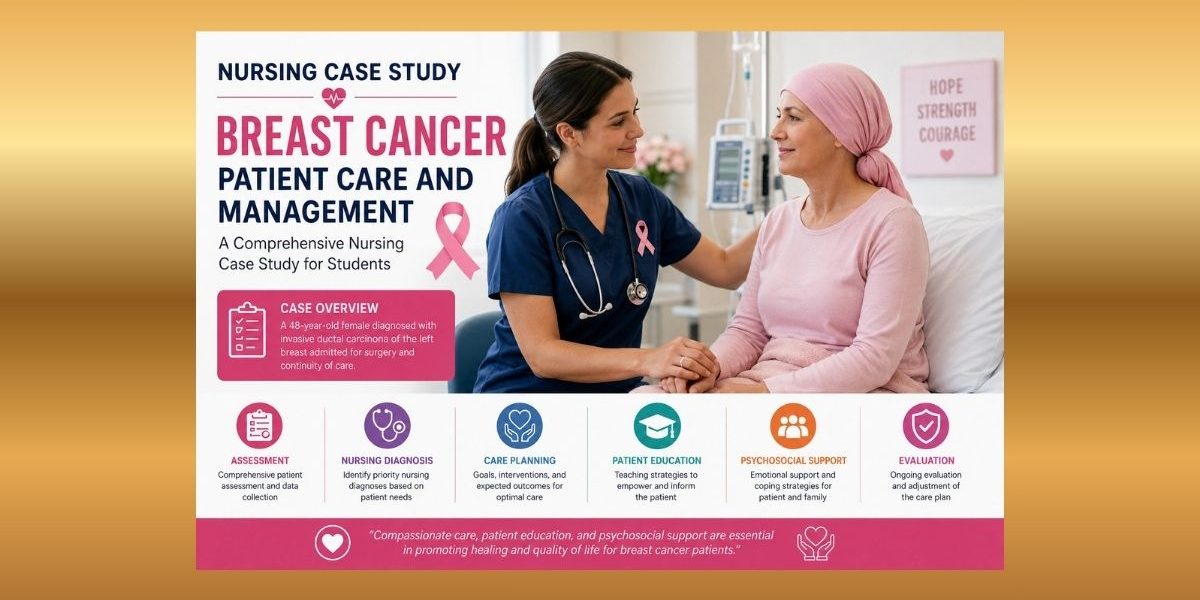
A breast cancer case study presents a fictional patient scenario that allows nursing students to apply theory to practice. By following one patient from presentation through diagnosis, treatment, and follow‑up, students develop a deeper understanding of breast cancer assessment, nursing diagnoses, care planning, communication, and patient education. Breast cancer is the most common cancer among women worldwide[1], and early detection and comprehensive care can improve survival[2]. In this case, readers will learn to identify risk factors, interpret diagnostic results, anticipate nursing problems, and provide holistic care. Phrases such as “in this case,” “the nurse should,” and “from a nursing perspective” are used throughout to emphasize a student‑centred viewpoint.
Disclaimer
This breast cancer nursing case study is fictional and created for educational purposes only. It does not replace clinical judgment, institutional policies, or medical advice. All patient details are anonymised and any resemblance to real persons is purely coincidental. Nursing students should always consult their clinical instructors and local guidelines when caring for real patients.
Patient Profile
Patient initials: Mrs. A
Age: 48 years
Gender: Female
Occupation: Elementary school teacher
Marital/family status: Married with two teenage children; primary caregiver for her elderly mother
Presenting complaint: Painless lump in the upper outer quadrant of the left breast noticed six weeks ago
Past medical history: Mild hypertension controlled with amlodipine; no previous surgeries
Medication history: Amlodipine 5 mg once daily; occasional ibuprofen for headaches
Allergies: None known
Reproductive history: Menarche at age 12, first full‑term pregnancy at 32, two children, breastfed both for six months; still menstruating regularly
Family history of cancer: Maternal aunt diagnosed with breast cancer at 55; paternal grandmother died of ovarian cancer; no known BRCA testing in family
Lifestyle factors: BMI 27 kg/m² (overweight), exercises infrequently, drinks wine socially (3–4 glasses/week), does not smoke
Cultural/social factors: Lives in an urban area but comes from a close‑knit rural community. She believes in natural remedies and initially delayed seeking care due to fear of a cancer diagnosis and responsibilities at work and home. Her husband provides emotional support but is worried about finances and the impact on family life.
Specific diagnosis: Stage II invasive ductal carcinoma (IDC) of the left breast, estrogen receptor (ER) positive, progesterone receptor (PR) positive, human epidermal growth factor receptor 2 (HER2) negative. IDC is the most common type of breast cancer, accounting for about 80 % of cases[3], and Stage II indicates either a small tumour with metastasis to one to three lymph nodes or a larger tumour without nodal involvement[4]. Hormone receptor‑positive cancers usually respond to endocrine therapies[5].
Presenting Complaint and History of Present Illness
Mrs. A reports discovering a small, painless lump in her left breast while showering. At first, she dismissed it as hormonal changes. Over the next few weeks, the lump persisted and she began to feel intermittent heaviness and mild discomfort. She experienced no nipple discharge, but noticed slight dimpling of the overlying skin. Her anxiety increased as she recalled her aunt’s experience with breast cancer. She delayed seeking medical care because of fear, busy school schedules, and responsibility for her mother. Eventually, she confided in a colleague who encouraged her to see her primary care provider. She expresses worry about the impact of a cancer diagnosis on her children and the cost of treatment.
Nursing Assessment
Subjective Data
- Pain and sensations: A reports a painless lump with occasional mild discomfort (pain 2/10). She denies burning or stabbing pain.
- Emotional response: She verbalises fear of cancer, concern for her family’s future, and embarrassment at having waited to seek care. She repeatedly asks whether the lump could be benign.
- Knowledge and beliefs: She has limited understanding of breast cancer and believes that injury or stress may have caused the lump. She is unsure what mammograms or biopsies involve and worries about disfigurement.
- Family concerns: A is anxious about her children’s reaction and the possibility of needing to stop working. She worries about who will care for her mother during treatment.
- Support system: She identifies her husband and close friend as sources of emotional support but anticipates needing help with household tasks.
Objective Data
- Vital signs: Blood pressure 136/82 mm Hg, heart rate 82 beats/min, respirations 18 breaths/min, temperature 36.8 °C, oxygen saturation 98 % on room air.
- General appearance: Alert, appropriately dressed, slightly anxious facial expression. No cachexia or visible distress.
- Breast examination: Inspection reveals a 2.5‑cm firm, non‑tender mass in the upper outer quadrant of the left breast with slight skin dimpling. The nipple is not retracted and there is no discharge. Palpation confirms a mobile mass with irregular edges. No palpable masses in the right breast. Left axillary lymph nodes are mildly enlarged and tender; right axilla is normal.
- Pain score: Rates lump discomfort as 2/10 on the numeric pain scale.
- Skin findings: Intact skin except for slight dimpling over the tumour; no rash or ulceration.
- Lymph nodes: Left axillary nodes palpable (1–1.5 cm), non‑matted; supraclavicular nodes not palpable.
- Psychological observations: Eyes tearful at times, occasionally fidgeting. Expresses worry about body image and intimacy.
- Relevant risk factors: Age > 45, overweight, late first pregnancy, limited breastfeeding, family history of breast and ovarian cancer, and physical inactivity. These factors are associated with increased breast cancer risk[6].
Psychosocial Assessment
Mrs. A shows signs of anxiety related to the diagnostic uncertainty. She worries about changes to her body image and sexual relationship with her husband. Financial stress is evident as she is uncertain about insurance coverage and time off work. She feels guilty for delaying care and fears telling her children. Cultural beliefs about natural healing make her hesitant about surgery and chemotherapy. She expresses a need for counselling and information about support groups.
Diagnostic Investigations
Early detection and accurate diagnosis are critical to reducing mortality[2]. The following investigations were ordered for Mrs. A, and the nurse plays a key role in preparing the patient, providing education, and monitoring for complications.
| Investigation | Nurse’s Role | Findings |
| Clinical breast examination (CBE) | Perform and assist with a thorough breast exam. Explain the procedure and provide privacy. | Confirmed 2.5‑cm mass in the left breast with slight skin dimpling and palpable left axillary nodes. |
| Diagnostic mammography | Explain that mammography uses X‑rays to detect abnormalities. Instruct the patient to avoid deodorant before the test. Provide support during the procedure. | Mammogram revealed a suspicious irregular mass with microcalcifications in the upper outer quadrant of the left breast and enlarged axillary nodes. |
| Breast ultrasound | Describe that ultrasound uses sound waves and is painless. Position the patient and offer reassurance. | Ultrasound confirmed a hypoechoic mass with irregular margins and identified enlarged axillary lymph nodes. |
| Core needle biopsy | Obtain informed consent, explain that local anaesthesia will be used, and provide emotional support. Monitor for bleeding and infection post‑procedure. | Biopsy specimen showed invasive ductal carcinoma (IDC). Histology grade 2 (moderately differentiated)[7]. |
| Hormone receptor testing | Explain that tissue will be tested for hormone receptors to guide treatment. | Tumour cells tested positive for estrogen receptor (ER+) and progesterone receptor (PR+) and negative for HER2. Hormone‑positive cancers often respond to endocrine therapy[5]. |
| Staging scans (chest CT and bone scan) | Explain purpose (to detect metastasis), ensure intravenous line patency, and monitor for contrast reactions. | No evidence of distant metastasis; disease staged as Stage II (tumour ≤ 5 cm with axillary nodal involvement)[4]. |
| Blood tests (CBC, liver function) | Draw blood, explain possible bruising, and monitor results. | Normal except mild anaemia (Hb 11.2 g/dL), consistent with chronic stress and possible nutritional deficiencies. |
Pathophysiology of Breast Cancer
Breast cancer occurs when genetic mutations and hormonal influences cause breast cells to grow uncontrollably, forming a tumour. Invasive ductal carcinoma starts in the milk ducts and invades surrounding tissue[8]. Cancer cells can spread via the lymphatic system or bloodstream to regional lymph nodes and distant organs[9]. Risk factors include age, female gender, obesity, alcohol consumption, family history, and certain reproductive factors[10]. Most breast cancers are hormone receptor positive (HR+), meaning the tumour cells have receptors for estrogen or progesterone[11]. These cancers grow in response to hormones but generally respond well to endocrine therapies, which block hormone effects[5]. HER2-negative status indicates the tumour does not overexpress the HER2 oncogene and therefore will not benefit from HER2‑targeted therapy[12].
Medical Diagnosis
The medical diagnosis is Stage II invasive ductal carcinoma of the left breast, ER-positive, PR-positive, HER2-negative. Stage II means the tumour is ≤ 5 cm and has spread to one to three lymph nodes or is > 5 cm without nodal involvement[4]. Invasive ductal carcinoma describes cancer arising in the milk ducts and invading surrounding tissue[8]. ER-positive and PR-positive indicate the tumour expresses estrogen and progesterone receptors, making it likely to respond to endocrine (hormonal) therapies[5]. HER2-negative means the tumour does not overexpress the HER2 protein, so HER2‑targeted therapies are not indicated[12].
Priority Nursing Problems
Based on the assessment, the following nursing problems are identified:
- Anxiety related to a recent cancer diagnosis and uncertainty about prognosis, evidenced by tearfulness, frequent questions, and expressed fear.
- Deficient knowledge related to breast cancer, diagnostic procedures, and treatment options, evidenced by misconceptions about causes and treatment, and requests for information.
- Disturbed body image related to potential breast surgery and treatment effects, evidenced by expressed concerns about scarring, femininity, and sexual intimacy.
- Acute pain related to diagnostic procedures and surgical intervention, evidenced by complaints of discomfort and pain score of 2/10 (anticipated to increase post‑surgery).
- Risk for infection related to surgical incision and possible chemotherapy‑induced immunosuppression.
- Fatigue related to cancer treatment and emotional stress.
- Ineffective coping related to fear of the unknown, family responsibilities, and financial stress.
Nursing Diagnoses for Breast Cancer
Nursing diagnoses translate assessment data into standardised statements that guide care. Five examples for this case are:
- Anxiety related to recent cancer diagnosis as evidenced by tearfulness, repeated questions about prognosis, and verbalisation of fear and uncertainty. The unexpected diagnosis and lack of information heighten Mrs. A’s anxiety.
- Deficient knowledge related to diagnostic tests and treatment plan as evidenced by misconceptions about breast cancer causes and treatments, and requests for clarification. She needs clear explanations about mammography, biopsy, surgery, and hormonal therapy.
- Disturbed body image related to anticipated breast surgery and treatment‑induced changes as evidenced by expressed concerns about scarring, femininity, and sexual intimacy. A fears losing her breast and its impact on her identity.
- Acute pain related to tissue biopsy and anticipated surgical incision as evidenced by complaints of mild discomfort, protective movement, and increased heart rate. Pain may increase after lumpectomy and needs management.
- Ineffective coping related to financial stress and multiple family responsibilities as evidenced by statements of guilt, difficulty concentrating, and indecision about treatment. A feels overwhelmed by obligations and treatment demands.
Breast Cancer Care Plan
| Nursing Diagnosis | Assessment Evidence | Goals/Expected Outcomes | Nursing Interventions | Rationale | Evaluation |
| Anxiety related to recent cancer diagnosis | Tearfulness, restlessness, repeated questions, expressed fear | Patient will verbalize decreased anxiety within 72 hours, demonstrate effective coping strategies, and participate in treatment decisions. | 1. Acknowledge feelings and provide opportunities to ask questions. 2. Explain diagnostic and treatment procedures using simple language. 3. Encourage presence of a support person during discussions. 4. Provide information on support groups and counselling services. 5. Use relaxation techniques such as deep breathing. | Acknowledging feelings validates the patient’s experience and builds trust. Clear explanations reduce uncertainty and fear. Support persons aid comprehension and emotional support. Support groups provide shared experiences. Relaxation techniques reduce physiological symptoms of anxiety. | Patient reports feeling calmer, participates in decision making, and demonstrates relaxation technique. |
| Deficient knowledge related to diagnosis and treatment | Misconceptions about causes, lack of understanding of mammography and biopsy | Patient will correctly describe her diagnosis, planned procedures, and post‑operative care by the end of the teaching session. | 1. Assess baseline knowledge and learning needs. 2. Provide written and verbal information about IDC, Stage II disease, and hormone receptor status. 3. Use visual aids to explain mammography, biopsy, and surgery. 4. Invite questions and encourage teach‑back to confirm understanding. 5. Provide resources in the patient’s preferred language and reading level. | Assessing knowledge identifies misconceptions. Tailored education increases comprehension and empowers the patient to participate in care. Teach‑back verifies understanding and reinforces learning. | Patient correctly explains her diagnosis and treatment plan and demonstrates proper wound care. |
| Disturbed body image related to anticipated breast surgery | Verbalizes concern about scarring, femininity, intimacy | Patient will express acceptance of her body and engage in discussions about reconstructive options before surgery. | 1. Encourage discussion of feelings about body image and femininity. 2. Provide information on breast‑conserving surgery vs. mastectomy and reconstructive options. 3. Refer to a breast cancer survivor or support group for shared experiences. 4. Offer referral to a counsellor specializing in oncology. 5. Involve the partner in discussions as appropriate. | Open discussion reduces isolation and helps the patient explore perceptions. Information on reconstructive surgery provides options. Peer support offers relatable experiences and hope. Counselling addresses deeper body image issues. Partner involvement fosters mutual understanding. | Patient verbalizes realistic expectations about surgery, identifies support resources, and reports feeling supported by her partner. |
| Acute pain related to biopsy and surgery | Reports pain 2/10 after biopsy, anticipates post‑operative pain | Patient will report pain at ≤ 3/10 with non‑pharmacologic and pharmacologic interventions within 24 hours post‑surgery. | 1. Assess pain location, intensity, and characteristics regularly using a numeric scale. 2. Administer prescribed analgesics before pain becomes severe. 3. Teach and encourage use of non‑pharmacologic methods (relaxation, positioning, cold/heat as appropriate). 4. Monitor for analgesic side effects. 5. Collaborate with the surgical team to adjust medications if pain is uncontrolled. | Regular assessment facilitates early intervention. Pre‑emptive analgesia prevents escalation. Non‑pharmacologic methods complement medications. Monitoring side effects ensures safety. Collaboration ensures adequate pain management. | Patient reports manageable pain and demonstrates use of relaxation techniques. |
| Ineffective coping related to stress and family responsibilities | Expresses guilt, difficulty making decisions, financial concerns | Patient will identify coping strategies and supportive resources and demonstrate improved mood within one week. | 1. Assess coping style and previous strategies. 2. Encourage expression of fears and concerns. 3. Provide information on financial assistance and social services. 4. Suggest journaling or mindfulness to process emotions. 5. Refer to a social worker and psychological counsellor. | Assessing current coping allows tailored interventions. Verbalizing concerns reduces emotional burden. Financial information alleviates stress. Mindfulness and journaling promote self‑reflection. Professional support provides structured coping strategies. | Patient identifies support resources, reports reduced stress, and demonstrates positive coping behaviours. |
Treatment Plan and Nursing Management
For Stage II ER/PR‑positive, HER2‑negative IDC, treatment often includes surgery, possible radiation, chemotherapy based on nodal involvement, and hormone therapy[13]. The nurse plays a critical role at each stage.
- Surgical management – Mrs. A is scheduled for a breast‑conserving surgery (lumpectomy) with sentinel lymph node biopsy. The nurse will:
- Explain the procedure, expected duration, and potential risks. Discuss the difference between lumpectomy and mastectomy and emphasise that sentinel node biopsy removes only a few lymph nodes[14] to reduce lymphedema risk.
- Verify informed consent and ensure the surgical site is correctly marked.
- Provide preoperative instructions on fasting, medications, and skin preparation.
- Offer emotional support and answer questions using simple language.
- Monitor vital signs, IV access, and sedation levels during the peri‑operative period.
- Post‑operatively, assess the surgical site for bleeding or hematoma, manage pain, and educate about wound care and activity restrictions. Teach arm exercises to prevent stiffness and lymphedema.
- Reinforce the importance of drain management if a drain is placed, instructing on emptying, measuring output, and infection signs.
- Radiation therapy – After lumpectomy, adjuvant radiation reduces recurrence[15]. The nurse should:
- Explain the purpose and schedule of radiation therapy. Describe that treatments are painless and given daily for several weeks.
- Assess the skin for erythema, dryness, or desquamation, and teach gentle skin care (avoid perfumes, use mild soap, and protect from sun exposure).
- Monitor fatigue, a common side effect; encourage rest and balanced activity.
- Provide emotional support and coordinate transportation if needed.
- Chemotherapy – If pathology shows extensive lymph node involvement, adjuvant chemotherapy may be recommended. The nurse should:
- Explain chemotherapy regimen, administration method (often intravenous), and expected duration.
- Assess for nausea, vomiting, mucositis, alopecia, and myelosuppression. Provide antiemetics, mouth care guidance, and strategies for hair loss (head coverings, wigs).
- Monitor laboratory values (complete blood count) and report neutropenia or anaemia. Educate about infection prevention (hand hygiene, avoiding crowds) and when to seek medical attention (fever, persistent sore throat).
Unlock the full article for USD 1.90
For just $1.9, unlock this professionally written case study sample and support the researchers behind our academic resources. These small access fees help fund the research, writing, and academic review process behind every sample we publish.
Sign in with Google, then pay to unlock on any device.
Secure checkout. You will return here automatically after payment.
