

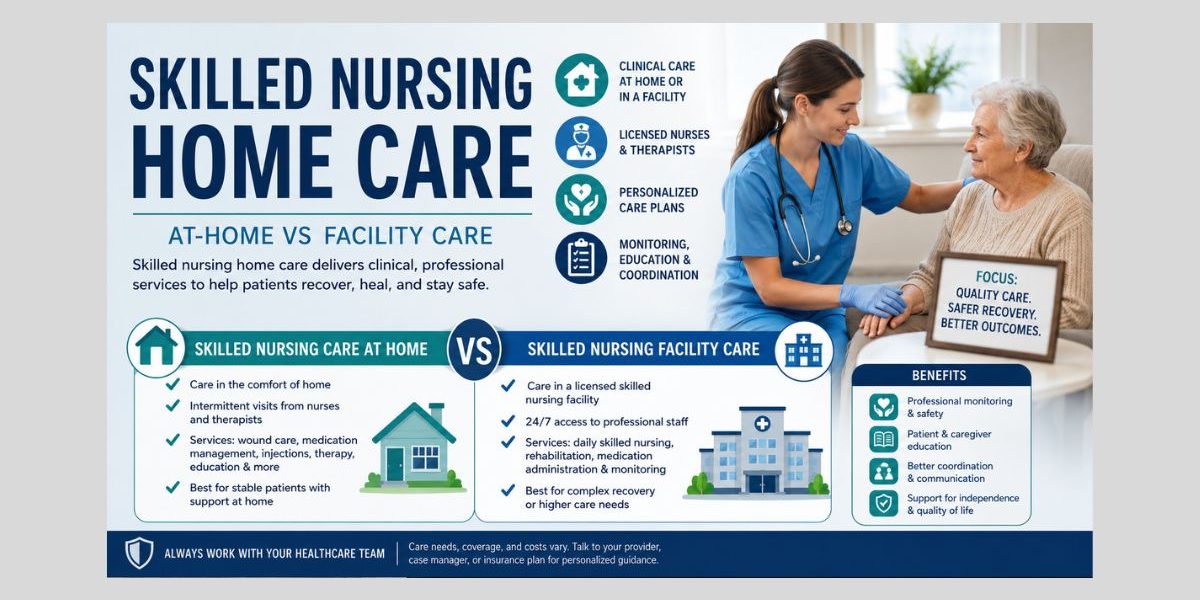
Skilled nursing home care can mean clinical care delivered at home or skilled care provided in a nursing facility. The phrase is confusing because people often use it to describe two different things: skilled nursing care at home and skilled nursing facility care.
That confusion matters. A family caregiver may want to know whether a patient needs help at home after discharge. A nursing student may need to compare home health care, skilled nursing facility care, and long-term nursing home care in an assignment. A patient’s relative may be trying to understand what services are clinical, what services are personal care, and what Medicare or insurance may cover.
This article explains both meanings of skilled nursing home care. It covers services, examples, benefits, limitations, Medicare basics, cost considerations, discharge planning, and writing tips for nursing students.
What Is Skilled Nursing Home Care?
Skilled nursing home care refers to care that requires the knowledge and judgment of licensed healthcare professionals. These professionals may include registered nurses, licensed practical nurses, licensed vocational nurses, physical therapists, occupational therapists, speech-language pathologists, and other qualified clinicians.
The word skilled is important. Skilled care is not the same as general caregiving. A family caregiver or home care aide may help with meals, bathing, dressing, companionship, or light household tasks. Those services can be important, but they are usually considered personal care or custodial support rather than skilled clinical care.
Skilled nursing services involve clinical assessment, treatment, teaching, monitoring, documentation, and communication with the wider healthcare team (Medicare.gov). Medicare describes covered home health skilled nursing as care that must require the skills of a nurse, be reasonable and necessary for treating an illness or injury, and be provided on a part-time or intermittent basis when Medicare rules are met.
Examples of skilled nursing needs include:
- wound care after surgery
- injections
- IV therapy
- catheter care
- ostomy care
- medication management
- rehabilitation monitoring
- post-hospital nursing care
- chronic disease monitoring
- patient and caregiver education
- care coordination after discharge
The setting can vary. Some patients receive skilled nursing care at home. Others receive skilled nursing facility care in a licensed facility after hospitalization, surgery, illness, or injury.
Skilled Nursing Home Care at Home vs Skilled Nursing Facility Care
Skilled nursing home care often refers to skilled nursing care at home, where nurses or therapists visit the patient in their residence. On the other hand, skilled nursing facility care refers to care provided in a facility where patients may temporarily live while receiving rehabilitation and medical treatment after hospitalization (Medicare.gov). Medicare explains that skilled nursing facilities are temporary care settings for rehabilitation and medical treatment after illness or injury, while long-term custodial nursing home care is different.
| Comparison point | Skilled nursing care at home | Skilled nursing facility care |
|---|---|---|
| Where care happens | In the patient’s home or residential setting | In a licensed skilled nursing facility or nursing home with skilled services |
| Who provides care | Home health nurses, therapists, aides, and other qualified professionals | Facility nurses, therapists, aides, physicians, and interdisciplinary staff |
| Typical patient needs | Wound care at home, medication teaching, injections, monitoring, therapy, post-discharge support | Daily skilled care, rehabilitation, complex recovery, or closer supervision |
| Duration of care | Often intermittent and based on the care plan | Often short-term after hospitalization, though needs vary |
| Common services | Skilled nursing visits, therapy, medication education, care coordination | Nursing care, rehabilitation therapy, medication administration, meals, monitoring |
| Supervision level | Intermittent visits; family may help between visits | Higher supervision because staff are present in the facility |
| Family involvement | Often high | Still important, but facility staff provide more daily support |
| Coverage/cost considerations | May depend on medical necessity, provider orders, certified agency status, and plan rules | Medicare Part A may cover limited SNF care when eligibility rules are met |
Both settings may involve licensed nurses, therapists, care plans, provider orders, documentation, patient education, and clinical monitoring. The better setting depends on the patient’s condition, safety needs, rehabilitation goals, family support, provider recommendations, and coverage rules.
Who May Need Home Care?
A person may need skilled nursing home care when their health needs require professional assessment, clinical judgment, or treatment. This does not mean that every patient with illness or disability needs skilled care. It means some needs cannot safely be handled through ordinary household help alone.
General examples include:
- older adults recovering after hospitalization
- patients recovering from surgery
- people with complex wounds
- patients needing medication management
- people needing injections or IV therapy
- patients with chronic conditions requiring monitoring
- people recovering from stroke or injury
- patients needing rehabilitation support
- people transitioning from hospital to home
- people who are not safe managing clinical needs alone
For example, a patient recovering from surgery may need wound assessment, dressing changes, pain assessment, infection monitoring, and teaching about warning signs. A patient recovering from stroke may need nursing assessment, physical therapy, occupational therapy, speech therapy, fall prevention support, and caregiver education.
Readers should not use an online article to decide what care they personally need. Personal decisions should involve a licensed healthcare provider, discharge planner, case manager, Medicare representative, Medicaid office, or insurance representative.
Common Skilled Nursing Services at Home
Skilled nursing care at home is usually arranged around a care plan. The services depend on the patient’s condition, provider orders, agency assessment, and payer rules.
| Service | What it involves | Example situation |
|---|---|---|
| Wound care | Assessing wound appearance, drainage, healing, dressing needs, and warning signs | A patient has a surgical wound after discharge |
| Medication management | Reviewing medication changes, teaching safe use, monitoring side effects, and identifying confusion | A patient has several new medications after hospitalization |
| Injections | Giving prescribed injections or teaching safe injection technique when appropriate | A patient requires injectable medication at home |
| IV therapy | Managing ordered IV fluids or medications | A patient needs prescribed IV antibiotics |
| Catheter care | Monitoring catheter function, hygiene, drainage, and complications | A patient has a urinary catheter after surgery |
| Ostomy care | Teaching pouch changes, skin care, and complication signs | A patient has a new colostomy or ileostomy |
| Vital sign monitoring | Checking blood pressure, pulse, temperature, oxygen saturation, or other signs | A patient needs monitoring after a health change |
| Chronic disease monitoring | Assessing symptoms, teaching warning signs, and coordinating care | A patient has heart failure, COPD, diabetes, or complex needs |
| Post-surgical care | Monitoring wounds, pain, mobility, medications, and complications | A patient returns home after orthopedic surgery |
| Pain assessment support | Assessing pain patterns and reporting concerns | A patient has changing pain after injury or surgery |
| Patient and family education | Teaching care steps, safety precautions, medication use, and follow-up needs | A caregiver needs to understand discharge instructions |
| Care coordination | Communicating with physicians, therapists, pharmacies, and family caregivers | A patient has multiple providers after discharge |
| Rehabilitation support | Reinforcing therapy goals and monitoring progress | A patient receives physical therapy or occupational therapy |
A skilled nurse does more than complete a task. The nurse assesses the patient before and after care, recognizes changes, documents findings, teaches the patient and caregiver, and escalates concerns when needed.
Rehabilitation Services in Skilled Nursing Home Care
Rehabilitation services may be part of skilled nursing home care when therapy is clinically appropriate and ordered as part of the care plan. Medicare home health information lists physical therapy, speech-language pathology, and occupational therapy among services that may be provided by a Medicare-certified home health agency when coverage requirements are met.
Physical therapy may focus on walking, transfers, balance, strength, mobility, and fall prevention. Occupational therapy may help patients regain or adapt activities of daily living such as bathing, dressing, toileting, eating, and safe use of equipment. Speech therapy may address swallowing, communication, cognition, or language needs after stroke, neurological illness, brain injury, or other conditions.
Nurses support rehabilitation by monitoring symptoms, checking wounds, assessing pain, teaching medication safety, identifying fall risks, and communicating changes to therapists and providers. The patient’s progress often depends on teamwork between nurses, therapists, physicians, aides, caregivers, and the patient.
Therapy is not automatically included for every patient. It depends on the patient’s condition, provider orders, functional needs, coverage rules, and care goals.
Skilled Nursing Home Care vs Home Health, Nursing Home, and Personal Care
These terms overlap, but they are not the same.
| Type of care | Main purpose | Who provides it | Common services | Typical duration | Important distinction |
|---|---|---|---|---|---|
| Skilled nursing care at home | Clinical care in the home | Licensed nurses and qualified professionals | Wound care, medication management, injections, monitoring, education | Often intermittent | Requires professional clinical skill |
| Home health care | Health services delivered at home | Nurses, therapists, aides, social workers, agencies | Skilled nursing, therapy, aide services, medical social services | Varies by need and coverage | May include skilled nursing, but not all home care is skilled |
| Personal care/home care | Help with daily living | Caregivers, aides, companions | Bathing, dressing, meals, errands, companionship | Short-term or long-term | Usually non-medical |
| Skilled nursing facility care | Facility-based skilled care and rehab | Facility nurses, therapists, physicians, aides | Daily skilled nursing, therapy, medication administration, monitoring | Often short-term after hospitalization | Provides a staffed care setting |
| Nursing home/long-term care | Residential support for ongoing daily needs | Nursing home staff and care teams | Daily assistance, meals, supervision, custodial support | Often long-term | May involve custodial care rather than Medicare-covered skilled care |
| Hospice care | Comfort-focused care for serious illness near end of life | Hospice nurses, aides, physicians, social workers, chaplains | Symptom management, comfort care, family support | Based on hospice eligibility and goals | Focuses on comfort rather than rehabilitation-centered recovery |
Home health care is a broad category. It may include skilled nursing, therapy, aide services, and medical social services. However, not all home care is skilled care. Medicare states that home health aide services are generally covered only when a patient also needs skilled care, and the aide services must be part of the care for the illness or injury.
Nursing home care is also broad. Some nursing homes provide skilled nursing facility services for short-term rehabilitation. Others provide long-term custodial support. Medicare Part A generally does not cover long-term or custodial nursing home care.
Benefits and Limits of Skilled Nursing Home Care
Skilled nursing home care can support safer recovery when patients have clinical needs after hospitalization, illness, surgery, or injury.
One benefit is professional monitoring. A skilled nurse can notice wound changes, medication side effects, worsening symptoms, mobility concerns, confusion, dehydration, pain patterns, or caregiver difficulties. This matters because patients and families may not always know which changes are expected and which need medical attention.
Another benefit is patient and caregiver education. Discharge instructions can be difficult to understand, especially when medications, wounds, diet changes, mobility restrictions, and follow-up appointments are all introduced at once. Skilled nursing visits can turn those instructions into practical teaching.
Skilled nursing can also support coordination. Nurses may communicate with physicians, therapists, pharmacies, case managers, and family caregivers. That coordination is especially important during transitions from hospital to home or from a facility back to the community.
Possible benefits include:
- care in a familiar environment when home care is appropriate
- clinical monitoring after hospitalization
- medication safety support
- wound healing support
- patient and caregiver education
- therapy coordination
- reduced confusion around discharge instructions
- support for independence where appropriate
- earlier recognition of concerning changes
There are also limits. Skilled nursing care at home is often intermittent rather than constant. Medicare explains that part-time or intermittent home health skilled nursing and aide services are generally limited by time and weekly hour rules, with possible short-term exceptions when a provider decides more frequent care is necessary.
Home may not be safe for every patient. Some patients need 24-hour supervision, complex equipment support, frequent skilled assessment, or intensive rehabilitation. In those cases, a skilled nursing facility or another level of care may be more appropriate.
Other limitations include:
- family caregivers may still have daily responsibilities
- home safety changes may be needed
- coverage may be limited
- insurance rules can be misunderstood
- care hours may not match family expectations
- complex cases may require facility-level support
- emergency planning is still necessary
Skilled nursing home care can be valuable, but it should never be presented as a guaranteed way to prevent complications or avoid hospitalization.
Medicare Skilled Nursing Care, Insurance, and Costs
Medicare skilled nursing care is one of the most confusing parts of this topic because home health coverage and skilled nursing facility coverage follow different rules.
It may cover home health services when eligibility requirements are met. Medicare’s home health information says covered services must be reasonable and necessary for treating an illness or injury and may include part-time or intermittent skilled nursing care, therapy services, and certain aide services through a Medicare-certified home health agency.
Skilled nursing facility care has different requirements. Medicare states that SNF coverage generally requires Medicare Part A, days left in the benefit period, a qualifying inpatient hospital stay, entry into the SNF within a short time after leaving the hospital, and a provider decision that daily skilled care is needed.
Medicare also states that SNF coverage is limited to up to 100 days in each benefit period when requirements are met. In 2026, Medicare.gov lists daily SNF cost-sharing amounts that change by day range within a benefit period. Because costs and rules can change, readers should verify current details directly through Medicare.gov or their plan.
| Payment source | Possible role | What to verify |
|---|---|---|
| Medicare | May cover certain home health or skilled nursing facility services when rules are met | Eligibility, provider orders, agency or facility certification, plan type, duration, cost-sharing |
| Medicaid | May help with some long-term care, home-based care, or facility care depending on state rules | State eligibility, income and asset rules, covered services, provider participation |
| Private insurance | May cover some home health, rehabilitation, or facility care | Prior authorization, network rules, visit limits, copays, deductibles |
| Out-of-pocket/private pay | May apply when services are not covered or when families choose extra help | Hourly rates, service agreements, cancellation policies, care scope |
| Veterans benefits | May help eligible veterans access certain home health, long-term care, or facility care | VA eligibility, approved providers, local availability |
This section is general information only. Readers should contact Medicare.gov, CMS.gov, their insurer, Medicaid office, veterans benefits office, discharge planner, or case manager before making personal coverage or payment decisions.
How to Choose a Skilled Nursing Home Care Provider
Choosing a skilled nursing home care provider should involve both clinical and practical questions. Families should look beyond availability and ask about licensing, qualifications, communication, safety procedures, and cost transparency.
Important factors include:
- licensing and certification
- nurse qualifications
- Medicare-certified agency status where relevant
- facility or agency reputation
- care plan process
- communication with physicians
- emergency procedures
- background checks
- after-hours support
- language and cultural fit
- patient and family communication
- cost transparency
Families comparing nursing homes or skilled nursing facilities can use Medicare’s Care Compare tool to compare Medicare-certified nursing homes based on location, quality of care, and staffing. CMS also explains that Nursing Home Care Compare includes star ratings for overall performance, health inspections, staffing, and quality measures.
Questions families can ask include:
- Who will provide the care?
- Is the agency or facility licensed and certified?
- How is the care plan created?
- How are changes in condition reported?
- What happens after hours?
- What services may not be covered?
- How often will the care plan be reviewed?
- How are family caregivers included?
- What emergency procedures are in place?
- How are nurses and aides supervised?
A good provider should explain what services are skilled, what services are personal care, how often visits may occur, and how concerns are escalated.
Role of Nurses in Skilled Nursing Home Care
Nurses are central to skilled nursing home care because they combine assessment, clinical judgment, teaching, coordination, documentation, and advocacy.
In home-based skilled nursing, a nurse may assess wounds, check vital signs, review medications, monitor symptoms, teach the patient and caregiver, document progress, and communicate with providers. The nurse also watches for changes that may require follow-up, such as increased drainage, fever, worsening pain, dizziness, medication confusion, shortness of breath, swelling, or new weakness.
In skilled nursing facility care, nurses may provide more continuous monitoring. They may administer medications, manage wound care, coordinate therapy schedules, support fall prevention, supervise aides, document progress, and communicate with physicians and family members.
For nursing students, this section is important because skilled nursing home care connects several nursing responsibilities:
- assessment
- nursing diagnosis and care planning
- medication reconciliation
- wound care
- infection prevention
- fall risk reduction
- patient education
- caregiver teaching
- interdisciplinary collaboration
- documentation
- escalation of care
- ethical respect for autonomy and dignity
- continuity of care
Fall prevention is one example. CDC’s STEADI initiative provides tools for healthcare providers to screen, assess, and intervene with older adults at risk of falling. In skilled nursing home care, this may connect to mobility assessment, home safety teaching, medication review, therapy referral, assistive devices, and caregiver education.
A strong nursing assignment should not simply say, “The nurse helps the patient at home.” It should explain what the nurse assesses, why professional judgment is needed, what risks are being managed, how education is provided, and how care supports safety and dignity.
Skilled Nursing Home Care Examples
Example 1: Post-surgical wound care at home
A patient is discharged after abdominal surgery with a wound that needs dressing changes. The skilled need includes wound assessment, dressing technique, infection monitoring, pain assessment, patient education, and documentation.
The nurse may assess wound edges, drainage, odor, redness, swelling, pain, temperature, and the patient’s ability to follow wound care instructions. The nurse may also teach the patient and caregiver when to call the provider.
This is skilled care because wound assessment requires clinical judgment. It is not the same as simply helping someone change clothes or prepare a meal.
Example 2: Medication management after hospital discharge
A patient returns home after hospitalization with several medication changes. The skilled need includes medication reconciliation, teaching, monitoring for side effects, and identifying confusion.
The nurse may compare the discharge medication list with what the patient has at home, explain timing and purpose, identify duplicate or discontinued medications, and communicate concerns to the provider.
This is skilled care because medication errors after discharge can occur when patients misunderstand new prescriptions, stopped medications, dose changes, or follow-up instructions.
Example 3: Rehabilitation support after stroke
A patient recovering from stroke receives nursing, physical therapy, occupational therapy, and speech therapy at home. The skilled need includes monitoring, mobility training, swallowing or communication support, caregiver education, and care coordination.
The nurse may monitor blood pressure, medication use, skin integrity, nutrition, swallowing concerns, and caregiver understanding. Therapists may focus on walking, transfers, self-care, communication, cognition, or swallowing safety.
This is skilled care because recovery requires professional assessment and coordinated rehabilitation support.
Example 4: Skilled nursing facility care after hip fracture
An older adult has surgery after a hip fracture and transfers to a skilled nursing facility. The skilled need includes pain management, medication administration, wound monitoring, mobility training, fall prevention, and rehabilitation therapy.
The facility setting may be appropriate when the patient needs closer supervision, daily skilled care, or more intensive rehabilitation than intermittent home visits can provide.
This is skilled nursing facility care because the patient requires ongoing clinical support and therapy after a serious injury.
Example 5: Chronic disease monitoring for complex needs
A patient with heart failure, diabetes, and a healing wound receives skilled nursing care at home. The skilled need includes symptom monitoring, wound care, medication teaching, nutrition education, and coordination with multiple providers.
The nurse may assess weight changes, swelling, shortness of breath, blood glucose concerns, wound healing, medication adherence, and follow-up appointments.
This is skilled care because the patient has multiple interacting risks that require professional monitoring and communication.
How Skilled Nursing Home Care Supports Discharge Planning
Discharge planning helps patients move safely from hospital to home, skilled nursing facility, rehabilitation setting, or another level of care. Skilled nursing home care may be part of that transition.
AHRQ’s Re-Engineered Discharge toolkit highlights important discharge activities such as arranging language assistance, making follow-up appointments, planning for pending test results, organizing post-discharge services and equipment, identifying correct medicines, and reconciling the discharge plan.
Skilled nursing can support discharge planning by helping with:
- medication reconciliation
- follow-up appointment reminders
- wound care teaching
- fall prevention
- equipment education
- family caregiver training
- symptom monitoring
- coordination with home health or facility providers
- communication with physicians
- recognition of warning signs
Discharge planning matters because patients may leave the hospital with new medications, new equipment, mobility restrictions, wound instructions, therapy needs, and follow-up appointments. Without clear teaching and coordination, families may feel overwhelmed.
Skilled nursing home care helps connect hospital instructions to daily care.
Common Myths About Skilled Nursing Home Care
| Myth | Reality |
|---|---|
| “Skilled nursing is the same as a nursing home.” | Skilled nursing is a type of clinical care. It can happen at home or in a facility. |
| “Home care always means skilled nursing.” | Some home care is personal care, not skilled clinical care. |
| “Medicare pays for everything.” | Medicare coverage has eligibility rules, limits, and cost-sharing. |
| “Only older adults need skilled nursing.” | Older adults often use skilled care, but younger patients may need it after illness, injury, surgery, or disability. |
| “A family caregiver can always replace skilled nursing.” | Family caregivers are valuable, but some tasks require licensed clinical skill. |
| “Skilled nursing means 24-hour care at home.” | Home-based skilled care is often intermittent. |
| “Skilled nursing facility care and home health care are identical.” | Facility care provides a staffed setting; home health brings services to the patient’s home. |
| “Nursing home care is always skilled care.” | Some nursing home care is long-term custodial support rather than short-term skilled rehabilitation. |
How Nursing Students Can Write About Skilled Nursing Home Care
Nursing students may write about skilled nursing home care in care plans, case studies, discharge planning assignments, gerontology papers, community health assignments, health policy papers, nursing research papers, and reflective journals.
The first step is to define the setting clearly. Do you mean skilled nursing care provided at home, or skilled nursing facility care provided in a facility? Many weak assignments lose clarity because they use “home care,” “home health,” “nursing home,” and “skilled nursing” as if they mean the same thing.
A clear paper should explain:
- the patient’s condition
- the skilled care need
- the care setting
- the nurse’s role
- the interdisciplinary team
- patient safety risks
- discharge planning needs
- ethical concerns
- expected education needs
- evidence or policy support
Possible essay topics include:
- skilled nursing care and hospital readmission prevention
- role of nurses in post-discharge home care
- skilled nursing facility care after orthopedic surgery
- home health nursing and chronic disease management
- discharge planning for older adults requiring skilled care
- ethical issues in long-term and skilled nursing care
- skilled nursing vs home health care
- skilled nursing vs nursing home care
Sample thesis statement:
“Skilled nursing home care supports safe transitions after illness, injury, or hospitalization by combining clinical monitoring, patient education, rehabilitation support, and coordinated care planning.”
A simple paragraph structure is:
- Topic sentence
- Explanation of the skilled care need
- Patient or case example
- Scholarly support
- Link to nursing responsibility or patient outcome
For example, a case study paragraph about wound care could explain that the patient’s post-surgical wound requires skilled assessment because the nurse must evaluate healing, drainage, pain, infection risk, and the patient’s ability to follow instructions.
Students should avoid common mistakes such as:
- confusing custodial care with skilled care
- treating Medicare rules as the same for home health and SNF care
- forgetting the role of therapists
- ignoring caregiver education
- writing only about tasks instead of nursing judgment
- making unsupported claims about outcomes
- using blogs instead of credible healthcare sources
If you need help structuring this type of assignment, you can review nursing assignment support for general academic guidance. If the task is based on a patient scenario, nursing case study help may fit better. For longer evidence-based papers, nursing research paper help can help with structure, source use, and argument development. For module-based work, coursework help for nursing students can support theory-to-practice writing.
FAQs
1. What is skilled nursing home care?
Skilled nursing home care is clinical care that requires licensed professional skill. It may include wound care, medication teaching, injections, IV therapy, rehabilitation monitoring, catheter care, ostomy care, or post-hospital assessment. The phrase may refer to skilled care at home or care in a skilled nursing facility.
2. Does skilled nursing home care mean the same thing as nursing home care?
No, not always. Skilled nursing describes the type of clinical care. A nursing home is a place where care may be provided. Some nursing homes provide skilled nursing facility care, while others mainly provide long-term custodial support.
3. Which skilled nursing services can patients receive at home?
Services may include wound care at home, medication management, injections, IV therapy, catheter care, ostomy care, vital sign monitoring, chronic disease monitoring, post-surgical care, rehabilitation support, patient education, and care coordination.
4. Who qualifies for skilled nursing care?
Qualification depends on the patient’s condition, medical necessity, provider orders, payer rules, agency or facility requirements, and the type of coverage involved. Patients and families should ask a healthcare provider, discharge planner, case manager, Medicare representative, Medicaid office, or insurer for personal guidance.
5. Does Medicare cover skilled nursing home care?
Medicare may cover certain skilled home health services or skilled nursing facility services if the patient meets eligibility rules. Home health coverage and skilled nursing facility coverage are different. Readers should verify current rules through Medicare.gov, CMS.gov, their Medicare plan, or a case manager.
6. What is the difference between home health care and skilled nursing care?
Healthcare providers deliver home health care as a broader category of services at home. It may include skilled nursing, physical therapy, occupational therapy, speech therapy, aide services, and medical social services. Skilled nursing care is the clinical nursing part that requires licensed professional skill.
7. How long can someone receive skilled nursing care?
The duration depends on the patient’s condition, progress, care plan, provider orders, care setting, and payer rules. Some care is short-term after hospitalization. Other needs may require reassessment, a different care plan, or a different level of care.
8. How do nursing students write about this type of care?
Students should define the term, identify the care setting, explain the skilled need, describe the nurse’s role, include a patient or case example, use credible sources, and connect the discussion to safety, education, rehabilitation, care coordination, or discharge planning.
Final Thoughts on Skilled Nursing Home Care
Skilled nursing home care involves clinically necessary support from licensed professionals. It may happen at home or in a skilled nursing facility, depending on the patient’s needs.
The main point is that skilled care is not the same as ordinary caregiving. It involves assessment, clinical judgment, treatment, teaching, monitoring, documentation, and coordination with the healthcare team.
For families, the safest next step is to ask clear questions and work with licensed professionals. For nursing students, the strongest writing explains the care setting, identifies the skilled need, and connects nursing actions to patient safety, dignity, rehabilitation, and continuity of care.
Lastly, if you are writing a care plan, case study, discharge planning assignment, or research paper on skilled nursing home care, you can upload your instructions and request academic guidance before drafting.
References
Agency for Healthcare Research and Quality. “Re-Engineered Discharge Toolkit.” AHRQ.
Centers for Disease Control and Prevention. “STEADI: Older Adult Fall Prevention.” CDC.
Centers for Medicare & Medicaid Services. “Five-Star Quality Rating System.” CMS.
Medicare.gov. “Home Health Services Coverage.” U.S. Centers for Medicare & Medicaid Services.
Medicare.gov. “Medicare’s Home Health Benefit.” U.S. Centers for Medicare & Medicaid Services.
Medicare.gov. “Medicare and Home Health Care.” U.S. Centers for Medicare & Medicaid Services.
Medicare.gov. “Skilled Nursing Facility Care.” U.S. Centers for Medicare & Medicaid Services.
Medicare.gov. “Skilled Nursing Facilities.” U.S. Centers for Medicare & Medicaid Services.
