

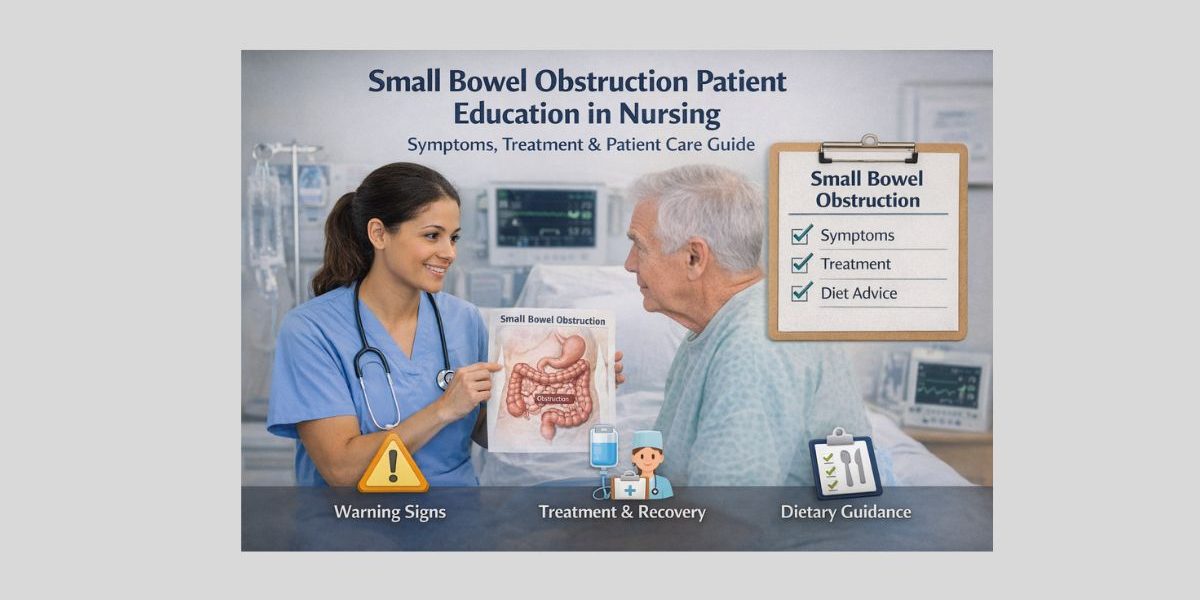
When Small Bowel Obstruction Patient Education in Nursing is inconsistent, patients go home unsure what symptoms mean danger, and delays cost bowel. Small bowel obstruction can progress from “simple” blockage to strangulation with compromised blood flow, ischaemia, and necrosis, so education is a safety intervention, not a handout. [1]
Audience & scope: Educational use only, not medical advice. This guide is for nurses, nursing students, and educators; align Small Bowel Obstruction Patient Education in Nursing with local protocols, clinician instructions, and clinical judgement. [2]
At a glance (what you will walk away with):
- A nurse-ready workflow for Small Bowel Obstruction Patient Education in Nursing you can reuse on the ward and at discharge
- A discharge medication dosing table template that reduces “I’ll just take something” errors at home
- A patient checklist table for red flags, diet progression, and follow-up planning
- Plain-language scripts backed by teach-back evidence
- A clear ethical boundary for nursing academic support (helpful ≠ contract cheating) [3]
Challenges nurses and patients face with small bowel obstruction education
Small Bowel Obstruction Patient Education in Nursing starts here: why patients delay. [4]
The real-world problem behind the diagnosis
Small bowel obstruction (SBO) is a common surgical emergency, frequently caused by postoperative adhesions, followed by hernias and tumours, and then less common causes (for example volvulus). This pattern creates a predictable education challenge: many at-risk patients have already “survived surgery” and assume new abdominal symptoms are simply part of recovery. [1]
From a patient’s perspective, the central problem is uncertainty: “Is this constipation, soreness, or something urgent?” Yet SBO often presents with a recognisable symptom cluster, abdominal pain, vomiting, distension, and obstipation (inability to pass stool or gas). If patients do not recognise the cluster, they wait until they are severely dehydrated, unstable, or in escalating pain. [5]
Why delays happen in real life
Delays are not usually “non-compliance.” They are usually pattern-matching: bowel symptoms overlap with everyday problems, and patients are understandably reluctant to “bother” urgent services. However, clinical guidance emphasizes early identification of complications like ischaemia and strangulation and the need for prompt escalation when systemic features emerge. Small Bowel Obstruction Patient Education in Nursing must teach action thresholds, not just information. [6]
Imaging misunderstandings also contribute. Many patients assume “the X-ray looked fine” means the situation cannot be serious. In reality, plain radiography has limited sensitivity and does not reliably identify the cause, extent, or complications of SBO, so clinicians may need CT to guide decisions. Therefore, Small Bowel Obstruction Patient Education in Nursing should explain why CT may follow an initial X-ray. [2]
What the evidence says about recurrence and why it changes the education plan
Recurrence is a practical reason to strengthen Small Bowel Obstruction Patient Education in Nursing. The StatPearls[7] chapter hosted on NCBI Bookshelf[8] notes that SBO, especially adhesion SBO, can recur and highlights prevention strategies such as minimally invasive surgery and adhesion barriers when surgery is required. Patients who understand recurrence risk take early symptoms more seriously and are more likely to follow follow-up plans. [9]
Education also needs to match the most likely cause. Adhesions are described as the single most common cause of SBO, and risk rises with a history of intra-abdominal procedures. That is why “surgical history” is not just a triage question, it is part of the patient’s risk narrative and should be explicitly used in Small Bowel Obstruction Patient Education in Nursing. [10]
Why Small Bowel Obstruction Patient Education in Nursing matters
Use this evidence to make Small Bowel Obstruction Patient Education in Nursing feel urgent, practical, and patient-centered without fearmongering. [11]
The “why now” for nurses and educators
Small Bowel Obstruction Patient Education in Nursing matters because deterioration can be fast, and because early symptoms are teachable. The same NCBI chapter distinguishes simple obstruction (blockage without ischaemia) from strangulated obstruction (compromised blood flow, risk of necrosis). Patients do not need the terminology, but they do need the safety meaning: “pain + vomiting + bloating after abdominal surgery is not a wait-and-see situation.” [12]
International guidance on adhesive SBO shares a core principle: if there are no signs requiring emergent exploration (peritonitis, strangulation, bowel ischaemia), non-operative management is usually appropriate first-line. That is why Small Bowel Obstruction Patient Education in Nursing must include what “watchful waiting” looks like, what monitoring means, and why “nothing by mouth” and decompression are used. [13]
Red flags patients must never ignore
A strong Small Bowel Obstruction Patient Education in Nursing bundle teaches red flags as action triggers. The NCBI chapter lists features suggesting strangulation (for example fever, tachycardia, localised tenderness, leukocytosis, acidosis) and emphasizes that peritonitis or ischaemia requires urgent surgical intervention. Patients will not interpret “leukocytosis,” but they can understand: fever, a racing heart, worsening pain, faintness, or new confusion. [6]
The World Society of Emergency Surgery[14] guideline on adhesive SBO (ASBO) highlights common medical complications during SBO admissions dehydration with kidney injury, electrolyte disturbances, malnutrition, aspiration. These are complications patients can inadvertently worsen by continuing oral intake or delaying care. Therefore, Small Bowel Obstruction Patient Education in Nursing should explicitly teach hydration strategy, when to stop oral intake, and when to return. [15]
How education supports safer diagnostics and treatment acceptance
Patients tolerate uncomfortable care (e.g., NG tubes) better when they understand purpose and timeline. Initial management described in the NCBI chapter includes fluid resuscitation, electrolyte correction, and nasogastric decompression, with CT emphasized as pivotal for diagnosis and treatment decisions. Preparing patients for this pathway makes care feel coherent instead of random an important goal of Small Bowel Obstruction Patient Education in Nursing. [16]
The WSES guideline also highlights the role of water-soluble contrast. If contrast has not reached the colon on X-ray at 24 hours, it is highly indicative of non-operative failure; evidence suggests contrast can predict need for surgery and reduce length of stay. When nurses explain the reason for repeat films and timelines, patients cooperate more reliably a practical win for Small Bowel Obstruction Patient Education in Nursing. [17]
Key components of Small Bowel Obstruction Patient Education in Nursing
These are the building blocks of Small Bowel Obstruction Patient Education in Nursing that improve safety across admission, observation, and discharge. [18]
The nurse-ready workflow
To keep Small Bowel Obstruction Patient Education in Nursing consistent across shifts, teach the same sequence every time: assess risk, explain what SBO is, clarify the plan, teach red flags, confirm understanding, and document. This mirrors clinical priorities (early recognition; early escalation) and aligns with teach-back evidence that favours simple, embedded education. [19]
Suggestion for a simple workflow diagram (copy into your slides):
flowchart TD
A[Assess: surgery history, hernias, cancer, symptoms] –> B[Explain SBO in plain language]
B –> C[Plan: tests + expected timeline]
C –> D[Teach red flags + return precautions]
D –> E[Teach-back: patient repeats plan]
E –> F[Document + follow-up]
This workflow is intentionally brief, because skipping confirmation breaks Small Bowel Obstruction Patient Education in Nursing. [20]
Explaining SBO in patient language
If you teach the concept well, everything else becomes easier. A patient-friendly definition can be:
“A small bowel obstruction means something is blocking or squeezing your small intestine, so food, fluid, and gas cannot move through normally.”
This aligns with clinical definitions of disrupted intestinal transit, often due to adhesions. Then personalise it: “Because you have had abdominal surgery / a hernia / bowel disease, your risk is higher.” Personal relevance increases vigilance, which is a core aim of Small Bowel Obstruction Patient Education in Nursing. [1]
Clarify symptom clusters plainly. Patients should know that SBO often looks like abdominal pain, vomiting, distension, and inability to pass gas or stool. Explain that partial obstruction can fluctuate, which can trick people into delaying care. Small Bowel Obstruction Patient Education in Nursing should normalise “seeking help early” as the safe choice. [12]
Teaching what happens in hospital without overwhelming the patient
Many education failures happen when clinicians say “NPO” and patients hear “I’m being punished.” Reframe it as treatment:
- Bowel rest (NPO): reduces distension and lowers aspiration risk
- NG decompression: reduces vomiting and discomfort; protects airway in ongoing emesis
- IV fluids and electrolyte correction: treats dehydration and metabolic derangements [6]
Then explain why CT is often used. The NCBI chapter describes CT as the gold standard for diagnosing SBO and differentiating simple from complicated SBO, including signs of ischaemia. The WSES guideline notes modern CT has high accuracy for predicting strangulation and urgent surgery need. A clear explanation increases cooperation and reduces anxiety an underappreciated part of Small Bowel Obstruction Patient Education in Nursing. [21]
Non-operative management education
Non-operative management is appropriate when there are no signs of ischaemia, peritonitis, or clinical deterioration. The NCBI chapter describes conservative care (NPO, serial exams, labs), and it notes water-soluble contrast can offer prognostic value and may help resolve adhesional obstruction. For patients, translate “conservative” into “active monitoring with thresholds.” That is Small Bowel Obstruction Patient Education in Nursing in action. [22]
The WSES guideline adds practical time framing: a trial of non-operative management can often continue safely for about 72 hours, though optimal duration is debated. It also highlights common harms during this period: dehydration, kidney injury, electrolyte disturbance, malnutrition, aspiration. Patients should understand why they are monitored and why they must not “test” food or fluid on their own. [15]
If you need an example of a structured pathway for teaching purposes, the University of Arkansas for Medical Sciences[23] SBO guideline illustrates an NG decompression + contrast protocol with imaging checks (e.g., 8 hours and 24 hours) and a 72-hour ceiling if no decompensation useful as a teaching scaffold, while noting local pathways vary. [24]
Surgery and postoperative education essentials
Surgery is indicated when there is evidence of strangulation, ischaemia, peritonitis, or failure to resolve with conservative measures. The NCBI chapter lists clinical signs (fever, tachycardia, localised tenderness, leukocytosis, acidosis) and describes common operations (adhesiolysis; hernia repair; resection if necrotic bowel). Small Bowel Obstruction Patient Education in Nursing should frame surgery as bowel salvage not “failure.” [10]
Postoperative care education should focus on recovery behaviours and recurrence awareness. The NCBI chapter emphasises early ambulation and gradual diet reintroduction guided by bowel function, and it notes the need for vigilance for recurrence after discharge. Discharge teaching must include “return precautions,” not vague warnings. [25]
Diet progression
Diet teaching should be conservative, time-limited, and personalised. A GI nutrition review from the University of Virginia[26] (hosted on a university site) explains that “low residue” and “low fibre” are often used interchangeably despite being distinct, and that definitions and evidence can be inconsistent. Therefore, Small Bowel Obstruction Patient Education in Nursing should teach “follow your plan and your contact pathway,” not rigid universal rules. [27]
For practical food examples, adapt university patient handouts. The University of Washington[28] low-fibre diet sheet provides clear “OK vs avoid” lists by food group. A UCSF[29] nutrition handout explains the aim of low-fibre/low-residue diets is to minimize stool output and that they are generally recommended for a limited amount of time. These resources reduce guesswork and strengthen Small Bowel Obstruction Patient Education in Nursing materials you produce for assignments or clinical packs. [30]
Discharge medication dosing table template
Medication education is often overlooked, yet it belongs in Small Bowel Obstruction Patient Education in Nursing. Patients may go home with analgesia, antiemetics, or other prescriptions and confusion can trigger unsafe dosing, constipation cycles, or dehydration. Use a table template, then confirm with teach-back. [31]
| Medicine (name + strength) | Why you’re taking it | Dose (as prescribed) | How often | Max in 24 hours (if applicable) | Key nursing safety notes |
|---|---|---|---|---|---|
| Pain relief | Pain control to allow mobility and deep breathing | ______ | ______ | ______ | Avoid “doubling up” with OTCs without checking. Opioids can worsen constipation; report worsening distension. |
| Antiemetic | Reduce nausea/vomiting | ______ | ______ | ______ | If vomiting persists, stop oral intake and seek advice. |
| Stool softener/laxative (if prescribed) | Support bowel function (especially with opioids) | ______ | ______ | ______ | Do not self-start laxatives in suspected recurrent obstruction; call for advice. |
| Other (e.g., antibiotics if prescribed) | Treat infection risk if ordered | ______ | ______ | ______ | Take exactly as prescribed and report fever or worsening pain. |
This template is intentionally “fill-in,” because exact dosing must come from the prescriber and product labelling. The goal is safe routines and clear escalation steps hallmarks of Small Bowel Obstruction Patient Education in Nursing. [32]
Patient checklist table for home monitoring and return precautions
This checklist is the backbone of Small Bowel Obstruction Patient Education in Nursing at discharge. It converts complex risk into simple actions families can follow when anxious or unwell. [6]
| What to monitor at home | What “OK” can look like | Red flags (get urgent help) | What to do now |
|---|---|---|---|
| Pain | Mild-to-moderate discomfort that improves | Severe/worsening pain, new localised tenderness, pain with fever | Stop eating/drinking unless told otherwise; seek urgent assessment. |
| Vomiting | Nausea that settles, can keep fluids down | Persistent vomiting or inability to keep fluids down | Seek urgent advice; dehydration and aspiration risk increase. |
| Bowel function | Passing gas or stool gradually returns | No gas or stool with worsening distension | Seek urgent review, especially with pain/vomiting. |
| Hydration | Pale urine, drinking as advised | Very dark urine, dizziness, faintness | Call for advice; dehydration is a common complication. |
| Wound/fever (post-op) | No fever; wound improving | Fever, wound redness, pus, increasing tenderness | Seek review; infection and complications must be excluded. |
| Follow-up | Knows who/when to contact | Missed follow-up or unclear plan | Call the team and confirm plan; don’t “wait and see.” |
Return precautions should focus on worsening pain, persistent vomiting, distension, and inability to pass stool or gas, plus systemic deterioration. [33]
How to deliver education that sticks with teach-back
Teach-back makes Small Bowel Obstruction Patient Education in Nursing measurable. [20]
Teach-back is not “extra”—it is a safety technique
Patients frequently leave acute care settings with gaps in understanding especially return precautions. A PLOS ONE[34] systematic review found teach-back is commonly delivered as part of a simple, structured educational approach and is reported as effective across a range of settings and outcomes, supporting its use as a default communication technique. [35]
A large open-access emergency department study published in the International Journal of Emergency Medicine[36] found teach-back improved immediate and short-term recall and reduced comprehension deficits; it also reported a feasible time burden for the teach-back conversation. That feasibility is relevant, because Small Bowel Obstruction Patient Education in Nursing often happens in rushed discharge windows. [37]
Teach-back scripts tailored to SBO
Use scripts that match what actually causes harm: missed red flags, incorrect diet progression, unclear follow-up, and medication confusion.
Core teach-back questions (60–90 seconds):
- “In your own words, what is your small bowel obstruction and what caused it for you?” [38]
- “What symptoms would make you seek urgent help today?” [4]
- “How will you reintroduce food, and what foods will you avoid for now?” [39]
- “Walk me through your medicines plan—what will you take, when, and what will you avoid adding?” [37]
If the patient struggles, treat it as a signal that your explanation needs simplifying not that the patient is “non-compliant.” That approach is consistent with teach-back as a provider responsibility to communicate clearly and improves reliability in Small Bowel Obstruction Patient Education in Nursing. [20]
Documentation tips
Documenting Small Bowel Obstruction Patient Education in Nursing is part of safe handover. Note what you taught (red flags, diet plan, medication plan), that teach-back was used, what the patient repeated correctly, and the follow-up plan. This aligns with SBO guidance emphasising serial monitoring and escalation and with teach-back implementation principles that embed checks into routine systems. [40]
Benefits of using ethical academic support for nursing writing and education
If you are writing on Small Bowel Obstruction Patient Education in Nursing, ethical academic support should strengthen your skills, not replace your authorship. [41]
Why this topic is deceptively hard in nursing programmes
SBO “patient education” assignments often assess far more than anatomy: clinical reasoning (simple vs complicated SBO), health literacy, safe discharge planning, and evidence use. The NCBI chapter explicitly links patient education to timely recognition and management, giving you a strong safety rationale for Small Bowel Obstruction Patient Education in Nursing content in both practice and coursework. [42]
When students are balancing placements, shift work, and multiple deadlines, the risk is producing work that is accurate but not usable or usable but poorly referenced. Ethical academic support can bridge that gap by helping you synthesise evidence into a nurse-ready education pack while you remain the author of your submission. That boundary matters because universities define outsourcing assessment completion as contract cheating. [43]
Benefits of using the service (without crossing ethical lines)
If you are building a service-page-quality blog post or assignment around Small Bowel Obstruction Patient Education in Nursing, ethical support can help you:
- pick higher-quality evidence sources (NCBI chapters, society guidelines, university patient education sheets)
- translate evidence into patient language, scripts, and tables
- edit for clarity, structure, and en-GB academic tone
- strengthen implementation sections (teach-back + workflow + evaluation plan) [19]
If you want to evaluate the team and values behind support, review the About Us page for transparency about standards and scope from Nursing Dissertation Help[44]. [45]
Trust signals to look for
A credible provider should be easy to evaluate. Look for real examples and structure (for example, the case studies page describes a nursing case study structure with assessment, diagnoses, and care planning). Also review protections such as a revision-first approach on the refund policy page before you commit. [46]
These checks matter because universities describe contract cheating as academic misconduct where someone else completes an assessment for you, including using paid companies or receiving extensive input that crosses authorship boundaries. Ethical support for Small Bowel Obstruction Patient Education in Nursing should strengthen your learning and writing, not replace it. [43]
How the process works and how to choose the best service
This section turns Small Bowel Obstruction Patient Education in Nursing into a high-scoring deliverable: evidence, structure, and integrity-safe workflow. [47]
How the process works
The easiest way to keep support ethical is to make your workflow collaborative and transparent. The How it works guide should clarify how requirements are collected, how feedback cycles work, and what you receive at each stage. [48]
A practical integrity-safe pathway for Small Bowel Obstruction Patient Education in Nursing work looks like this: request an evidence pack and outline (not a submission-ready document), draft in your own voice, then use editing and reference checking to raise quality. Keep version history and notes so you can demonstrate authorship if asked. [41]
How to choose the best service for this keyword
For this keyword, the “best” service is not the cheapest. It is the one that can support three specialist needs:
Clinical credibility: accurate clinical content and primary-source referencing (NCBI chapters; WSES guidance; university diet sheets). [49]
Patient education craft: teach-back scripts and checklists that match evidence about discharge comprehension and return precautions. [20]
Methods and evaluation (optional but high value): if you audit comprehension or readmissions, you need correct analysis planning and defensible interpretation. [50]
For cost transparency before you start, consult the nursing dissertation pricing page.
Match the service to your programme level and deliverable
Different nursing programmes require different outputs:
- For implementation/evaluation projects, explore DNP dissertation help and frame your work as quality improvement.
- For literature-based work, use nursing research paper help to strengthen synthesis and referencing.
- For heavy assessment periods, consider coursework help for nursing students for planning and structure support while staying academically accountable.
- For care plans and scripts, nursing assignment help may fit better than generic writing support.
When you need data analysis support
If your Small Bowel Obstruction Patient Education in Nursing project includes data (survey, audit, comprehension scores), analysis support becomes a differentiator:
- Quantitative planning and interpretation: dissertation data analysis help
- Predictor modelling: regression analysis help
- Hypothesis testing and results write-up: inferential statistics support
- Qualitative rigor and coding: qualitative data analysis guidance
When you are ready to begin, use the secure order page to submit your brief and deadline clearly.
Ethical considerations, FAQs, and final CTA
Ethical Small Bowel Obstruction Patient Education in Nursing support means learning faster while staying inside academic integrity boundaries. [41]
Ethical considerations for nursing students and educators
Ethical support must protect learning and professional responsibility. The University of Bristol[61] defines contract cheating as academic misconduct where someone else completes an assessment for you (including paying companies or receiving extensive third-party input that crosses authorship boundaries). [62]
The Quality Assurance Agency for Higher Education[63] frames contract cheating as a serious sector-wide risk to academic standards, and the University of Aberdeen[64] describes it as a deliberate form of misconduct where work is produced by someone other than the student, paid or unpaid. Therefore, ethical support for Small Bowel Obstruction Patient Education in Nursing should focus on coaching, structuring, editing, and methods guidance, not outsourcing submission-ready work. [65]
FAQs
What are the core symptoms to teach patients about SBO?
Teach the symptom cluster: abdominal pain, vomiting, distension, and inability to pass stool or gas. Small Bowel Obstruction Patient Education in Nursing should always include clear return precautions in plain language. [66]
How do I explain why a CT is needed after an X-ray?
Explain that X-rays can be a first screen, but CT is more sensitive, helps locate the transition point, and can identify complications. The WSES guideline also reports high CT accuracy for predicting strangulation and the need for urgent surgery in this context. [21]
When should a patient stop eating and seek urgent care?
If vomiting persists, pain worsens, distension increases, or red-flag symptoms appear (fever, tachycardia, severe tenderness, faintness), patients should seek urgent assessment. Guidance links these features with strangulation/ischaemia risk and with complications like dehydration and aspiration. [4]
Is a low-fibre/low-residue diet always required after SBO?
Not always, and it should be time-limited and individualised. University diet resources show practical patterns, while GI nutrition literature notes definitions vary and evidence is limited in some contexts. Therefore, Small Bowel Obstruction Patient Education in Nursing should teach “follow your plan and your contact pathway,” not universal rules. [39]
What is the fastest way to check understanding at discharge?
Use teach-back. Systematic review evidence supports teach-back as an effective, structured technique, and an open-access ED study found it improved recall and reduced comprehension deficits with feasible time burden. It fits naturally into Small Bowel Obstruction Patient Education in Nursing because it targets return precautions. [20]
How can I get academic help ethically for this topic?
Use support for evidence gathering, outlining, editing, and skills coaching, then write your own submission. Avoid having someone complete the assessment for you, because universities define that as contract cheating. [43]
Final CTA
If your goal is safer care, better assignments, and less last-minute stress, treat Small Bowel Obstruction Patient Education in Nursing as a repeatable clinical process: explain SBO in plain language, teach red flags, clarify diet progression and medication plans, confirm with teach-back, and document. This approach aligns with clinical guidance on SBO management and with evidence that structured teach-back improves discharge understanding. [67]
If you want ethical, nurse-specific support to plan, research, and polish your Small Bowel Obstruction Patient Education in Nursing work, choose services that strengthen your authorship: structured outlines, evidence packs, editing, and methods coaching, never submission-ready outsourcing. [41]
[1] [2] [4] [5] [6] [7] [9] [10] [11] [12] [16] [18] [19] [21] [22] [25] [26] [29] [32] [33] [36] [38] [40] [42] [49] [66] [67] https://www.ncbi.nlm.nih.gov/books/NBK448079/
https://www.ncbi.nlm.nih.gov/books/NBK448079/
[3] [20] [35] [47] [61] [63] [64] https://journals.plos.org/plosone/article?id=10.1371%2Fjournal.pone.0231350
https://journals.plos.org/plosone/article?id=10.1371%2Fjournal.pone.0231350
[13] [15] [17] [34] https://www.wses.org.uk/wp-content/uploads/2018/07/adhesive-small-bowel-obstruction-ASBO_-2017-update-of-the-evidence-based-guidelines-from-the-world-society-of-emergency-surgery-ASBO-working-group.pdf
[14] [23] [41] [43] [44] [62] https://www.bristol.ac.uk/students/support/academic-advice/academic-integrity/contract-cheating/
https://www.bristol.ac.uk/students/support/academic-advice/academic-integrity/contract-cheating/
[24] https://medicine.uams.edu/surgery/wp-content/uploads/sites/5/2016/06/SBO-Guideline-2019.pdf
https://medicine.uams.edu/surgery/wp-content/uploads/sites/5/2016/06/SBO-Guideline-2019.pdf
[27] https://med.virginia.edu/ginutrition/wp-content/uploads/sites/199/2014/06/Parrish-July-15.pdf
https://med.virginia.edu/ginutrition/wp-content/uploads/sites/199/2014/06/Parrish-July-15.pdf
[30] [39] https://healthonline.washington.edu/sites/default/files/record_pdfs/Low-Fiber-Diet.pdf
https://healthonline.washington.edu/sites/default/files/record_pdfs/Low-Fiber-Diet.pdf
[31] [37] [50] https://link.springer.com/article/10.1186/s12245-020-00306-9
https://link.springer.com/article/10.1186/s12245-020-00306-9
[65] https://www.qaa.ac.uk/docs/qaa/guidance/contracting-to-cheat-in-higher-education-third-edition.pdf
https://www.qaa.ac.uk/docs/qaa/guidance/contracting-to-cheat-in-higher-education-third-edition.pdf
