

An In-Depth Guide
A patient’s fall risk assessment tools used in hospitals can be lifesaving, yet many healthcare providers and nursing students struggle to navigate which scale to use and how to interpret it. In busy hospitals, preventing patient falls is a critical safety issue: over 30% of adults over 65 fall annually[1], and about 10% of falls lead to serious injuries like fractures or head trauma[1]. In fact, hospital falls account for a high proportion of adverse events and costs: nearly \$10 million annually are attributed to falls on hospital grounds[2]. This puts pressure on clinicians to accurately assess fall risk; the probability that a patient will unintentionally come to rest on the ground, by considering factors such as balance, gait, cognition, and medication use[3].
Using standardized assessment tools (like the Morse Scale, Hendrich II, STRATIFY, or Johns Hopkins tool) helps staff stratify patients into low, moderate, or high risk, so that targeted prevention can begin. Our comprehensive guide explains why fall risk assessment is essential, defines key terms, overviews each major tool, and compares their features. Whether you’re a nursing researcher or practitioner, this article provides the evidence-based insights you need (with scholarly references) and highlights how professional help (e.g. our nursing dissertation help) can support your fall prevention projects.
“Patient falls are the most common preventable adverse event in hospitals, and even one serious fall can have life-changing consequences. Fall risk assessments identify who needs extra precautions.”[4][2]
Understanding Fall Risk and Its Assessment
Before diving into specific tools, it’s important to define fall risk. Medically, a “fall” is an unplanned descent to a lower level[5]. A patient’s fall risk is their likelihood of experiencing such an event, based on intrinsic factors (age, muscle strength, balance, vision, cognition) and extrinsic factors (medications, equipment, environment). For example, having multiple risk factors dramatically increases fall probability – StatPearls notes that each additional risk factor roughly doubles a patient’s 1-year fall risk[3]. Common risk factors include a history of prior falls, gait or balance impairment, use of sedatives, cognitive impairment, and use of assistive devices[3].
Because falls can have serious consequences (injuries, longer hospital stays, or even death), hospitals treat fall prevention as a top priority. Inpatient falls in the U.S. range from 700,000 to 1,000,000 per year[4]. About 37% of those falls cause injury, and each injurious fall can add \$30,000–\$35,000 or more to a patient’s care costs[6]. For older adults specifically, over 30% fall each year, with roughly 10% of falls causing fractures or head trauma[1]. These statistics underline why systematic fall risk assessments are critical: identifying high-risk patients early allows staff to intervene (bed alarms, closer monitoring, assistive devices, medication review, etc.), potentially avoiding costly or deadly outcomes. The World Health Organization explicitly classifies falls as an adverse event that all health systems must address[2].
In practice, nursing staff use fall risk assessment tools to efficiently evaluate a patient’s risk level. These tools score a patient on factors like prior falls, mobility, medications, and cognition, then categorize risk as low, moderate, or high. For example, the well-known Morse Fall Scale (MFS) uses 6 weighted items (fall history, secondary diagnosis, ambulatory aid, IV use, gait, and mental status) to produce a score from 0 to 125[7][8]. Scores 0–24 are ‘no risk’, 25–50 ‘low to moderate risk’, and ≥51 ‘high risk’[7][8]. Other tools (Hendrich II, STRATIFY, Johns Hopkins) consider different factors or scoring methods, but share the goal of flagging patients who need extra precautions.
Why fall risk assessment is critical: It aligns with evidence-based guidelines. Organizations like the CDC and the American Geriatrics Society recommend routine screening of older adults (65+) for fall risk[9]. The U.S. National Patient Safety Goals and AHRQ fall prevention programs emphasize that systematic assessment plus tailored interventions reduce falls. For instance, one multifaceted program (AHRQ’s Fall TIPS) that integrates a tool with patient-specific interventions cut in-hospital falls by ~25%[10]. In short, using validated fall risk scales is one crucial strategy in preventing falls, alongside staff training and environmental safety (e.g. non-slip flooring).
However, choosing and applying the right tool is not always straightforward. Each scale has strengths and limitations (as discussed below), and studies show none is perfect[11]. In fact, a recent systematic review found that no single fall risk tool has consistently superior predictive accuracy compared to others or to clinician judgment[11]. This ambiguity means clinicians must use assessment tools judiciously as part of a comprehensive approach, exactly why understanding each tool’s design and evidence is so important. (Fall risk assessment tools used in hospitals are meant to assist but not replace clinical judgment.) Likewise, for nursing students or researchers writing about falls, the breadth of tools and data can be overwhelming. Our team at Nursing Dissertation Help specializes in guiding nursing scholars through complex topics like fall risk assessment, offering expert support in methodology, data analysis, and writing.
Common Fall Risk Assessment Tools Used in Hospitals
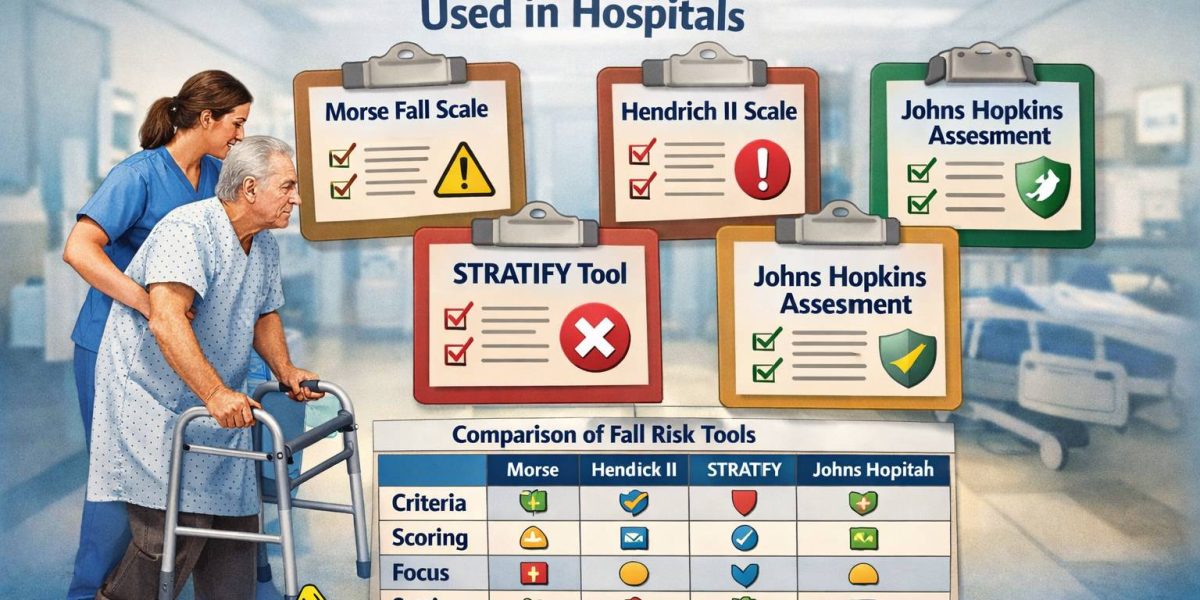
Several standardized tools are widely used in hospital settings to assess fall risk. The four most prominent are: the Morse Fall Scale, the Hendrich II Fall Risk Model, the STRATIFY Scale, and the Johns Hopkins Fall Risk Assessment Tool (JHFRAT). Each was developed with a particular context in mind, and they differ in items, scoring, and recommended use. Below is an overview of each tool’s purpose and key features (detailed comparisons follow).
- Morse Fall Scale (MFS) – Developed by Nurse Janice Morse in 1989, the MFS is a simple 6-item tool for acute care and rehab settings[7]. It covers history of falling, secondary diagnoses, use of ambulatory aids, IV therapy, gait, and mental status. Nurses find it quick to use: over 80% report it takes <3 minutes per patient[7]. Total scores range 0–125; typically 0–24 indicates no elevated risk, 25–50 moderate risk, and ≥51 high risk[7][8]. The MFS has demonstrated good predictive validity and reliability in acute care[7]. (Its strengths are simplicity and wide acceptance; limitations include moderate sensitivity in some studies.)
- Hendrich II Fall Risk Model (HIIFRM) – Created by Ann Hendrich and colleagues for hospital use, this model screens for key risk factors common in acute patients[12]. It includes items on confusion/disorientation, symptomatic depression, altered elimination, dizziness/vertigo, male gender, use of certain high-risk medications (anticonvulsants and benzodiazepines), and performance on a quick “Get-Up-and-Go” mobility test. A weighted score ≥5 signifies high fall risk. In validation, the Hendrich II was sensitive (~75%) and specific (~74%) for identifying falls[13]. Its strengths are brevity and focus on modifiable factors (e.g. sedating meds)[14]; it’s intended for adult inpatients in acute-care settings[12][13].
- STRATIFY Scale – Originating in the U.K. (St. Thomas’ Hospital) for elderly inpatients, STRATIFY is a 5-item yes/no questionnaire covering (1) history of falls, (2) agitation/confusion, (3) visual impairment, (4) frequent toileting, and (5) transfer/mobility[15]. Each “yes” scores 1 point (total 0–5); a score above 2 indicates high risk. The original geriatric validation reported 93% sensitivity and 88% specificity[15]. However, later studies in mixed adult populations show more modest performance: one large hospital study found only ~67% sensitivity and 61% specificity[16]. STRATIFY’s simplicity is an asset for elderly wards, but its accuracy varies by setting[16][15].
- Johns Hopkins Fall Risk Assessment Tool (JHFRAT) – Developed at Johns Hopkins Hospital as part of an evidence-based fall prevention initiative, JHFRAT evaluates risk factors such as age, fall history, elimination problems, high-risk medications, patient care equipment (e.g. IVs), mobility, and cognition. In a study reporting its use, Hopkins staff described JHFRAT as “valid and reliable, and highly effective when combined with protocol and fall prevention measures.”[17]. Clinicians score each factor and sum the total; conventionally, totals <6 are low risk, 6–13 moderate risk, and >13 high risk (most sites adopt these cutoffs). JHFRAT is intended mainly for adult inpatients, especially older adults. Its comprehensive scope tends to yield high specificity (fewer false positives) compared to some other tools.
All these tools have been implemented in hospital protocols. For example, many facilities use the MFS or JHFRAT on admission for every patient (especially those aged 65+)[9], then reassess whenever a patient’s condition changes. Others use a tool like STRATIFY for all older adults on geriatric units. Some hospitals even embed these checklists into electronic records to prompt nurses (e.g. fall risk banners or wristbands). Ultimately, the choice of tool can depend on unit type, patient population, and clinical workflow. No tool is universally “best” – research finds similar sensitivity among leading scales[13][11] – so many experts recommend using them alongside clinical judgment and comprehensive prevention programs[11].
Comparison of Key Fall Risk Assessment Tools
| Tool | Items / Scoring | Target Population / Use | Performance (Sens/Spec) | Strengths & Considerations |
| Morse Fall Scale | 6 factors (fall history, diagnoses, gait aids, IV line, gait quality, mental status); total score 0–125. Risk cutoffs: 0–24 = no risk, 25–50 = low risk, ≥51 = high risk[7][8]. | Acute care (hospital wards, rehab, LTC). Widely used on admission and for high-risk patients. | Varies by study; generally good reliability; moderate predictive validity[7]. (One review: sens ~78%, spec ~70% in acute care.) | Very quick and easy to administer[7]. Widely validated. However, may over-predict risk in patients who naturally score points (e.g. any IV line gives +20). Should be calibrated per setting[8]. Best as a broad initial screen. |
| Hendrich II Model | 8 factors (confusion/disorientation, symptomatic depression, altered elimination, dizziness/vertigo, male gender, use of anticonvulsants, use of benzodiazepines, “Get-Up-And-Go” mobility test). Score range: 0–16; high risk ≥ 5 points[12]. | Acute-care adult inpatients (medical/surgical). Designed by nursing experts for hospital use. | Originally sens 74.9%, spec 73.9%[13] in validation. Subsequent studies show similar sensitivity; tends to have better specificity among acute-care tools. | Brief and focused on modifiable factors (meds, fall symptoms)[12][14]. Includes a brief mobility test. Validated in diverse settings (ICU, step-down, etc). Requires training to score “Get-Up-And-Go.” May not capture sensory or vision factors. |
| STRATIFY | 5 yes/no items (prior falls, agitation/confusion, visual impairment, frequent toileting, transfer/mobility). Score: 0–5; high risk if >2 (i.e. ≥3)[15]. | Originally developed for elderly inpatients (geriatric units); now sometimes used for general adult hospitalized patients. | Original geriatric study: sens 93%, spec 88%[18]. More recent general adult study: sens ~67%, spec ~61%[16]. Wide variability across populations. | Very simple (yes/no). Useful in geriatric wards. However, performance declines in mixed-age acute care[16][18]. Best used where population and environment match validation (elderly, rehab). Likely underestimates risk in younger or highly complex patients. |
| Johns Hopkins FRAT | Multidimensional tool with subcategories: Age, Fall History, Elimination, Medications, Patient Care Equipment, Mobility, Cognition. Each factor has weighted points. Scoring: Low (<6), Moderate (6–13), High (>13) risk (common cutoffs). | Adult inpatients, especially older adults, on admission and routinely thereafter. Originated at JHH as part of fall safety program. | Described as valid and reliable by developers[17]. Reportedly has higher specificity than some others (i.e. fewer false alarms), though exact values vary. | Comprehensive: covers environment (equipment) and cognition. Tends to classify more patients as low or moderate risk. Requires chart review (e.g. meds list). Helps target specific interventions. Hospitals using it often integrate it with protocols (alerts). |
各 Use Cases: Hospitals often choose one primary scale for all admissions (e.g. MFS or JHFRAT on every ward). Some units may prefer a specialized tool (e.g. STRATIFY on geriatric floors, Hendrich in ICU). Because of variability in patient age and condition, many facilities retest patients on transfer between units or upon condition changes. In practice, standard policy (see our how it works page) is to screen at admission (usually within 24 hours) and then with any significant status change.
The table above summarizes how these tools differ. Notably, no single tool is best for all settings[11]. For example, STRATIFY may excel in a geriatric ward but underperform in a complex cardiology ICU[15][16]. Jenkins and colleagues found similar sensitivity across tools but recommended using them alongside clinical judgment[11]. Therefore, many hospitals combine tools: perhaps a rapid screen on admission (Morse or JHFRAT) and a targeted one (Hendrich or STRATIFY) if specific issues are present.
When and How to Use Each Tool
Morse Fall Scale: Typically used by nursing staff for all adult inpatients on admission (especially if age ≥65) and after any fall or treatment change. It is quick enough to include in every nurse’s admission paperwork. Its simplicity makes it popular for general-medical and surgical floors. For example, a patient arriving with pneumonia might immediately be scored on the MFS to determine baseline risk. Many hospitals then repeat the MFS at intervals (shift change or once a day) per protocol.
Hendrich II Model: Often applied in acute-care settings for patients with complex conditions. Because it includes specific factors like certain medications and a mobility test, it is well-suited for hospital patients at risk from deliriogenic drugs or limited ambulation. Clinicians may use Hendrich on units with a high incidence of falls (e.g. general medicine, neurology) or on patients with mental status changes. High-scoring patients (≥5) prompt targeted interventions.
STRATIFY: Originally meant for elderly hospital inpatients, it is commonly used on geriatric or rehabilitation units. If a hospital does fall-risk screening for patients of all ages, STRATIFY may still be chosen for older populations due to its geriatric focus. It can be administered rapidly (5 yes/no questions) by nursing or therapy staff. Some hospitals use STRATIFY on admission of all patients ≥65, and then again if mental status or mobility changes.
Johns Hopkins FRAT: This is widely used in academic medical centers and many hospitals for older inpatients. Because of its many categories, it may be used primarily on admission (often within the first day) for patients age 60 or older, or any patient deemed potentially high-risk. JHFRAT may also be tied to electronic health records so that a new admission triggers the form. It’s often repeated whenever there is a significant change (e.g. transfer to another unit, new high-risk medication, or after a fall). An advantage is that if the initial “screen” portion flags a patient as clearly low or high risk, further questions can sometimes be skipped, saving time.
Expert guidelines suggest that fall risk tools should not be the sole strategy. For instance, NICE (UK) recommends starting with a broad assessment of patient status and factors, then using a tool like STRATIFY if needed. Similarly, U.S. guidelines (CDC/AGS) advise annual screening of all older adults[9]; in hospitals, this translates to regularly using a standardized tool plus professional judgment. In practice, many hospitals incorporate fall-risk checks into their “head-to-toe” nursing assessments and care plans.
Benefits of Our Nursing Dissertation Service
Studying or writing about fall risk in hospitals requires attention to medical detail, statistics, and patient care practices. Our team provides expert support so you can focus on your objectives rather than wrestling with methodology or writing. Key benefits include:
- Experienced Nursing Experts: Our authors and editors have advanced nursing and healthcare credentials. Many hold PhDs or DNPs and have published in healthcare journals. (Learn more on our About Us)
- Comprehensive Coverage: We cover everything from statistical analysis to narrative writing. For example, if your project involves quantitative data on falls, we offer SPSS data analysis help and regression analysis help to ensure correct modeling. If you have interviews or qualitative data on patient experiences, we provide qualitative data analysis services. We also assist with inferential statistics help for hypothesis testing. In short, we can handle the numbers so your conclusions are sound.
- Medical and Clinical Writing: Whether you need a formal research paper, a clinical report, or a dissertation, our report writing and medical research paper writing service ensure it meets academic standards. We can even draft clinical case studies – our case study help will shape your findings into a coherent narrative. All writing is 100% original and supported by credible scholarly sources.
- Academic Support & Proofing: From nursing research papers to DNP dissertations, we offer full writing and editing assistance. If you’re in a nursing program, our coursework help for nursing students, nursing assignment help and nursing homework help services can clarify concepts or check your work. We emphasize ethical academic guidance – see our clear refund policy to understand our plagiarism guarantees.
- Convenience & Trust: We operate 24/7 for your deadlines. Our nursing dissertation pricing is competitive, and we often run discounts (e.g. via our affordable coursework writing service). Read our client case studies to see examples of successful nursing projects we’ve completed. With transparent pricing, secure payment, and a client-focused approach (detailed on our how it works page), you can proceed confidently.
In summary, partnering with us means gaining a dedicated team that understands fall risk assessment and healthcare research. We not only write about these tools – we can help design and analyze the study behind them.
Our Process Explained
Getting expert help is straightforward. Here’s how our process works:
- Place Your Order: Visit our Order page and submit your requirements (topic, length, deadline, etc.). We offer a simple order form or live chat.
- Confirm Details: We’ll clarify any questions via email or phone. You’ll be assigned a project manager who coordinates between you and the writing team.
- Match with Expert: Based on your topic (e.g. “fall risk assessment tools”), we assign a writer with relevant nursing or statistics expertise – perhaps someone familiar with patient safety research.
- Work & Reviews: The writer develops your document (literature review, data analysis, write-up, etc.). You receive drafts for feedback. We offer unlimited revisions to ensure the final product meets your needs.
- Delivery & Support: Once completed, you receive the final work. We also provide free bibliographies or formatting help as needed. Post-delivery support is ongoing (you can ask questions or request edits at no extra charge).
All communication and file transfers occur in our secure system. We stand by the quality of our service: please see our Refund Policy for full details on revisions and guarantees.
How to Choose the Best Academic Service
Not all writing services are equal. Here are factors to consider:
- Expertise and Credibility: Look for services with experienced nursing experts. At our company, our About Us page highlights our team’s credentials. We publish content consistent with nursing literature. For example, our detailed guides (like this one) cite peer-reviewed sources. We also offer specialized help – from DNP dissertation help to clinical medical writing services – to fit advanced nursing projects.
- Transparency: Check for clear policies and pricing. We post our fees on the Pricing page so you know what you’ll pay. We have zero hidden charges. If you ever need a refund or adjustment, our Refund Policy is straightforward.
- Results Proven by Case Studies: Reputable services showcase past work. You can explore our Case Studies section to see examples of nursing dissertations, research papers, and data analysis projects we completed for clients (always anonymized). These real-world samples demonstrate our ability to handle topics like fall risk, statistical analysis, and more.
- Writing and Research Depth: A good service supports all parts of research. We not only write and edit but also assist with methodology. For instance, if you have fall incidence data, our SPSS Data Analysis Help and Inferential Statistics Help ensure proper analysis. If you’re conducting a mixed-method study, our Qualitative Data Analysis team can handle interviews. We can also incorporate relevant nursing models or guidelines (like STEADI).
- Communication and Support: A responsive service should answer questions and provide guidance. We have 24/7 customer support to discuss your project. You’ll always know who is working on your project. We encourage you to read testimonials on our Case Studies page or contact us directly (via chat, Email, or Whatsapp to gauge our responsiveness.
Ultimately, the best service meets your specific needs. Whether you need an intensive DNP dissertation help or quick editing for a research report, ensure the provider is specialized in nursing/healthcare. Our team’s focus on nursing topics – from fall risk to epidemiology – means we understand the context and literature. Check out our How It Works page for details on our guarantee and quality measures.
Key Steps in Conducting Fall Risk Research
If you’re researching fall risk or writing a paper on this topic, following a structured approach is crucial. Here are the typical steps – and how our services can assist at each stage:
- 1. Define Objectives & Literature Review: Start by clearly stating your research questions (e.g., “Which fall risk tool best predicts injuries in stroke patients?”). Gather and synthesize existing studies from PubMed or CINAHL. We can help with this via our nursing research paper help or medical research paper writing service, providing annotated bibliographies and summaries of evidence.
- 2. Select an Assessment Tool: Decide which fall risk scale(s) to use. Your choice depends on patient age and setting (see table above). We can advise on tool selection based on published validity data, ensuring you choose a scale with evidence in your setting. Our experts can even compare tool algorithms or interview you on your patient population before recommending Morse vs. STRATIFY vs. Hendrich, etc.
- 3. Design the Study: Plan your methodology. Will you do a retrospective chart review of admissions and falls? Or a prospective observational study? Our DNP dissertation help team can assist in writing a strong proposal, including IRB considerations and sample size calculation.
- 4. Data Collection & Management: Collect your data (e.g., chart reviews of patient scores and outcomes). During this phase, keep data organized. Our Case Study Help can advise on best practices for data collection and patient privacy.
- 5. Statistical Analysis: Analyze the data to find fall risk predictors. Use appropriate statistics: t-tests, chi-square, or logistic regression to see which factors correlate with actual falls. This is where our SPSS Data Analysis Help and Regression Analysis Help become valuable. We can run the analyses for you or guide you through each test. For nursing research, we also help with Inferential Statistics Help to interpret p-values, confidence intervals, and predictive validity measures (sensitivity, specificity, AUC).
- 6. Interpret and Contextualize Results: Once you have numbers (e.g., “The Morse Scale predicted 80% of falls vs. 67% for STRATIFY”), explain them in the context of clinical practice. Our statistical experts and nurses can help frame these findings. For example, a significant p-value (p<0.05) can be translated into “tool A had statistically better performance.” We can ensure you draw the right conclusions for nursing guidelines.
- 7. Writing and Presentation: Craft your paper or report. We provide Clinical Medical Writing Service and [report writing] support to structure your document: introduction, methods, results, discussion, etc. We specialize in healthcare formatting (APA, AMA, Vancouver, etc.). Our editing team polishes the language, and we insert relevant citations (like those shown above) to back every claim.
- 8. Review and Revision: Finalize the draft. We offer comprehensive editing – check coherence, fix inconsistencies, and format tables/figures (for example, we can help design a fall risk comparison table or chart). After your feedback, we revise until you’re satisfied.
By following these steps, you ensure a rigorous fall risk study. Let us assist wherever you need support – from data crunching to final proofreading – so you can submit a top-quality project with confidence.
Ethical Considerations
Fall risk assessment and academic research both carry ethical responsibilities. Clinically, use these tools to improve patient safety without stereotyping or causing undue anxiety. Always couple a high-risk score with respectful communication and proper interventions, rather than blame. If conducting research, obtain necessary approvals (IRB or ethics board) before collecting patient data. Ensure patient identifiers are protected.
Academically, it’s vital to use writing services ethically. Our role is to provide guidance, model answers, and professional editing, not to encourage plagiarism or dishonest work. We strictly deliver original content. Our Refund Policy outlines that we do not tolerate plagiarism; if any copy is detected, we will revise or refund. You should cite any ideas or direct quotes according to Chicago/Turabian style. Think of us as co-authors helping you learn. For example, if we assist with your fall risk paper, the final submission should be in your voice and include your own critical insights.
In short, whether applying fall risk tools or using our service, the aim is always ethical excellence. We help you uphold academic integrity, patient confidentiality, and professional standards. You can read about our commitment to ethics on our About Us page and find details in the Refund Policy and How It Works pages.
FAQs
Q1: What exactly is a fall risk assessment?
A: A fall risk assessment is a systematic way to gauge how likely a patient is to fall, based on factors like age, medical history, medications, and mobility. It typically involves a questionnaire or checklist (one of the tools above) that yields a score or category. For example, the Morse Fall Scale asks about past falls, gait, and mental status, then totals a score[7][8]. A higher score means higher fall risk. Clinicians use the result to decide on interventions (bed alarms, physical therapy, etc.).
Q2: Why are fall risk assessment tools important in hospitals?
A: These tools help nurses and doctors identify patients who need extra precautions. Falls in hospitals can cause injuries, longer stays, or even death[2]. For instance, if an older patient scores high on a fall risk scale, staff might use non-slip mats, keep the bed low, or ensure the patient has a call button and sitter. Using standardized tools (versus gut feeling alone) has been shown to reduce fall rates. One study noted that a comprehensive program using such tools led to a 25% reduction in falls[10]. Thus, employing validated scales like Morse or Hendrich II is a proactive step toward patient safety.
Q3: How do the Morse, Hendrich II, STRATIFY, and Johns Hopkins tools differ?
A: Each tool has its own focus:
- The Morse Fall Scale (MFS) uses six items (history of falls, diagnoses, walking aid, IV use, gait, orientation) to give a score[7]. It’s quick and general-purpose, widely used in many hospitals.
- The Hendrich II Model looks at factors like confusion, depression, elimination issues, dizziness, gender, certain medications, and mobility (get-up test)[12]. It’s designed for acute-care patients and highlights medication-related risks.
- The STRATIFY scale has five yes/no questions tailored for older inpatients (falls history, agitation, vision, toileting, transfer)[15]. It’s simple but can miss risks in younger or very sick patients.
- The Johns Hopkins Fall Risk Tool is more comprehensive – scoring categories such as age, fall history, elimination, meds, equipment (e.g. IVs), mobility, and cognition – and was validated in a hospital setting[17]. It tends to have high specificity (few false positives). In summary, MFS and JHFRAT are broad, Hendrich II focuses on specific clinical factors, and STRATIFY targets geriatrics. Many studies find similar accuracy across tools[11], so choice often depends on your patient group and workflow.
Q4: When should a hospital use each tool?
A: In practice, hospitals often assign one tool per patient admission. For example, Morse or JHFRAT might be used universally on admission (especially for patients ≥65), then every shift or status change. Hendrich II might be used for higher-acuity units (ER, ICU) or on patients with altered mental status. STRATIFY is typically used on geriatric wards or rehab units for older patients, given its design. It’s important to follow facility policy: many institutions screen every patient at admission and then re-screen if a fall occurs or the patient’s condition changes. The CDC and geriatrics societies recommend at least annual screening for older adults[9], so on a hospital ward that means checking each new admission and periodically thereafter. Always use the tool’s protocol (e.g. frequency of checks) that fits your clinical context.
Q5: How can NursingDissertationHelp.com assist with my fall risk project or assignment?
A: Our team can support you at every stage of a fall risk study. If you’re writing a nursing paper or dissertation on this topic, we provide: nursing research paper help for structuring your literature review and discussion; statistical support via dissertation data analysis help, SPSS data analysis help, regression analysis help, and inferential statistics help to analyze fall data correctly; and qualitative data analysis if you have interviews or observational notes.
Once data are in hand, our clinical medical writing service and medical research paper writing service can turn your results into a polished report. We also cover general writing needs such as report writing, case study help, even nursing assignment help or do my nursing homework service if you have a homework question. For advanced students, our DNP dissertation help specializes in doctoral projects. In short, we match you with expert nurse writers and statisticians so you can submit high-quality, evidence-based work on fall risk assessment.
Q6: Is using a service like yours ethical for my assignment?
A: Absolutely. Think of us as your academic coaching team. We do not do your assignment and hand it off as if it were ours. Instead, we help you learn how to present your findings and write clearly. All content we provide is original and properly cited, and we encourage you to write in your own voice. Our refund policy guarantees 100% originality; if any plagiarism were found (which we prevent with checks), we revise or refund. We take academic integrity very seriously. Many of our clients use our services for editing, brainstorming, or learning complex methods (like regression modeling on falls data). This enhances the final product without cheating – it’s akin to hiring a tutor or consultant.
Call to Action
Ready to strengthen your fall risk assessment project? Our expert team is here to help. Whether you need guidance on the best tool for your study, statistical analysis, or a well-written report, we’ve got you covered.
- Order Now: Visit our Order page to get started. Choose the services you need – from nursing dissertation help and report writing to SPSS data analysis help. We’re available 24/7.
- Contact Us: Questions? Check our How It Works page or chat with us any time. You can also view our transparent pricing and refund policy for peace of mind.
- Learn More: Explore our case studies to see examples of past work and read more about our team on the About Us
Don’t let questions about fall risk assessment hold you back. Partner with NursingDissertationHelp.com and ensure your research or coursework stands out.
[1] [3] [5] Falls and Fall Prevention in Older Adults – StatPearls – NCBI Bookshelf
https://www.ncbi.nlm.nih.gov/books/NBK560761/
[2] [11] [15] [16] [18] Validation of the stratify scale for the prediction of falls among hospitalized adults in a tertiary hospital in Colombia: a retrospective cohort study | Scientific Reports
[4] [6] [10] The Ongoing Journey to Prevent Patient Falls | PSNet
https://psnet.ahrq.gov/perspective/ongoing-journey-prevent-patient-falls
https://riverside.networkofcare.org/library/Morse%20Fall%20Scale.pdf
[9] Fall Risk Assessment: MedlinePlus Medical Test
https://medlineplus.gov/lab-tests/fall-risk-assessment/
https://www.wsha.org/wp-content/uploads/Hendrich-II-Fall-Risk.pdf
[17] Johns Hopkins Nursing Innovations | Johns Hopkins Medicine
https://www.hopkinsmedicine.org/institute-nursing/models-tools
