

Foundations of Gibbs Reflective Cycle Nursing
Gibbs Reflective Cycle Nursing: Meaning, Purpose, and Importance in Nursing Education and Practice
Gibbs Reflective Cycle nursing is one of the most widely used reflective models in healthcare education because it gives nursing students and practitioners a structured way to think critically about clinical experiences. In nursing, reflection is not simply about remembering what happened during a shift or clinical placement. Rather, it is about examining an event in a disciplined way so that learning can be drawn from it and applied to future practice.
For nursing students, reflective writing is often required in essays, portfolios, placement reports, and professional development tasks. However, many students struggle because they either become too descriptive or fail to move from experience to analysis. That is where the Gibbs reflective cycle in nursing becomes especially useful. It provides a sequence of stages that pushes the writer beyond narration and into deeper reflection, evaluation, and improvement.
At its core, the Gibbs reflection model in nursing helps students answer three important questions. What happened? Why did it matter? What will I do differently next time? These questions may seem simple, yet they are central to safe nursing practice, professional growth, and patient-centered care. Nursing is a profession where clinical judgment, communication, ethics, teamwork, and emotional awareness all matter. Therefore, a model that helps nurses examine these dimensions carefully is highly valuable.
In both academic and clinical settings, reflection matters because nursing decisions affect real patients. A medication delay, a communication failure, a missed assessment cue, or even a successful intervention can all become powerful learning opportunities if examined properly. Consequently, Gibbs’ model is not just a writing framework. It is also a professional thinking tool.
What Is Gibbs Reflective Cycle in Nursing?
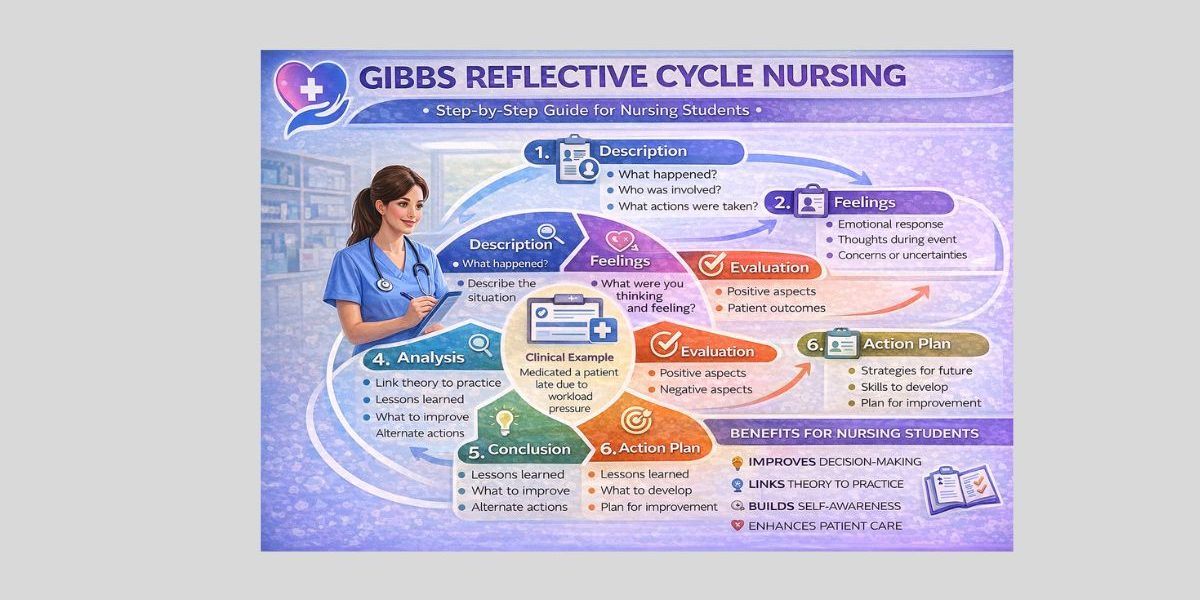
The Gibbs reflective cycle nursing model was developed by Graham Gibbs in 1988 as a six-stage framework for structured reflection. Although it is used in different disciplines, it has become particularly popular in nursing because it aligns well with how nurses learn from practice.
The six stages are:
- Description
- Feelings
- Evaluation
- Analysis
- Conclusion
- Action Plan
What makes this model so useful is that it guides the learner through an experience in layers. First, the nurse identifies and describes the event. After that, the nurse explores emotional responses. Then, the situation is evaluated, analyzed in depth, and used to generate future improvement. As a result, the reflective process becomes more comprehensive and meaningful.
Unlike informal reflection, which may stay at the level of “I think I did well” or “that shift was difficult,” Gibbs’ model demands a more disciplined and thoughtful approach. It helps the writer organize reflection into a clear progression. Therefore, it is often preferred in nursing assignments where academic structure is important.
Another reason the Gibbs cycle in nursing reflection is so widely used is that it allows integration of both personal experience and professional knowledge. Nursing students are not only expected to state how they felt; they are also expected to link their reflections to nursing standards, communication principles, evidence-based practice, ethical responsibilities, and patient outcomes. Gibbs’ model makes that easier because it provides distinct spaces for description, interpretation, and future planning.
Why Reflection Matters in Nursing
To understand the importance of the Gibbs reflective cycle in nursing practice, it is first necessary to understand why reflection itself matters in nursing. Nursing is a practice-based profession. This means that learning does not occur only in lectures, textbooks, and skills labs. It also occurs at the bedside, in clinics, in handovers, during procedures, in interactions with families, and even in difficult moments of uncertainty.
Reflection matters in nursing for several reasons.
1. Reflection strengthens clinical judgment
Nurses often work in fast-paced environments where decisions must be made quickly. Reflective practice allows students and practitioners to revisit those decisions afterwards and ask whether they were appropriate, timely, and effective. In this way, reflection sharpens future judgment.
For example, if a student nurse realizes after a shift that they focused too much on a technical task and missed signs of patient anxiety, reflection can help them recognize the importance of holistic care. Over time, repeated reflection improves awareness and decision-making.
2. Reflection links theory to practice
Many nursing students understand theory in class but struggle to apply it in real patient situations. Reflection bridges that gap. By using the Gibbs reflective cycle nursing framework, students can connect what happened in practice to concepts such as therapeutic communication, infection prevention, confidentiality, dignity, patient education, or the nursing process.
This is especially important because nursing education is not only about memorizing information. It is about applying knowledge safely and thoughtfully in real situations.
3. Reflection promotes self-awareness
Nursing involves not only clinical competence but also emotional intelligence. A nurse who is unaware of their own stress, fear, frustration, assumptions, or communication style may unintentionally affect patient care. Reflection helps students become more aware of how their emotions and reactions shape their practice.
For instance, a student may discover through reflective writing that nervousness caused them to speak too quickly during a patient interaction. Recognizing this pattern allows for improvement. Thus, the Gibbs model of reflection in nursing also supports personal growth.
4. Reflection supports professional accountability
Modern nursing requires accountability. Nurses must be able to justify their decisions, recognize errors, and commit to improvement. Reflection is part of that professional responsibility. Rather than ignoring mistakes or difficult experiences, reflective practice encourages honest examination and learning.
This does not mean reflection is only about failure. Successful experiences should also be reflected upon. If something went well, the nurse should still ask why it worked and how it can be repeated. In that sense, reflection supports both correction and reinforcement.
5. Reflection improves patient care
Ultimately, the value of the Gibbs reflective cycle nursing approach is that it can lead to better patient care. When nurses learn from experience, they are more likely to communicate effectively, notice clinical changes, avoid repeated mistakes, and provide more compassionate care in the future.
Reflection is therefore not only an academic exercise. It has practical consequences for safety, quality, and patient experience.
Why Gibbs Reflective Cycle Is Popular in Nursing Education
There are several reflective models available, yet Gibbs remains one of the most commonly assigned in nursing courses. This popularity is not accidental. It is largely due to the model’s clarity, structure, and relevance to healthcare learning.
It gives students a clear sequence
One reason students are often asked to use the Gibbs reflective cycle nursing model is that it reduces confusion. Reflection can feel vague when students are simply told to “reflect on an experience.” Gibbs solves this by breaking reflection into steps. Each stage focuses on a different aspect of the event, so the student knows exactly how to proceed.
It encourages deeper reflection than simple description
A common weakness in student reflective essays is over-description. Students sometimes spend most of the essay explaining what happened and very little time interpreting the meaning of the experience. Gibbs helps prevent this because description is only the first stage. The model then pushes the student toward feelings, evaluation, analysis, conclusion, and action planning.
It fits nursing placement experiences well
Nursing students encounter many situations that are suitable for Gibbs-based reflection, such as:
- communicating with a distressed patient
- participating in medication administration
- responding to feedback from a mentor
- handling a conflict in teamwork
- maintaining patient dignity during care
- observing a deterioration in patient condition
- dealing with an ethical concern
Because these experiences involve action, feeling, judgment, and learning, the model fits them naturally.
It supports academic marking criteria
Many nursing lecturers assess reflective essays based on structure, depth, insight, and application to future practice. Gibbs supports all of these. It helps students organize the essay clearly, demonstrate reflective depth, and show how learning will influence future action. As a result, it often performs well against marking rubrics.
The Six Stages of Gibbs Reflective Cycle Nursing: An Overview
Before moving into deeper application in later parts, it is important to understand what each stage is designed to do.
1. Description
This stage answers the question: what happened? The purpose is to set the context clearly and objectively. The writer should explain the event without immediately judging it.
2. Feelings
Here, the writer explores emotional responses before, during, and after the event. This stage is important because feelings influence behavior and decision-making.
3. Evaluation
At this point, the nurse identifies what was good and bad about the experience. This stage begins the move from description into judgment.
4. Analysis
This is usually the deepest part of the reflection. The writer examines why things happened the way they did, often connecting the event to theory, communication, ethics, teamwork, or evidence-based practice.
5. Conclusion
In this stage, the writer identifies what could have been done differently and what was learned from the experience.
6. Action Plan
Finally, the writer explains what they will do in the future if a similar situation occurs. This makes the reflection practical and forward-looking.
Together, these stages make the Gibbs reflective cycle in nursing especially effective for both learning and writing.
Key Benefits of Using Gibbs Reflective Cycle in Nursing Assignments
Using the Gibbs reflective cycle nursing framework offers several direct benefits for students writing reflective essays.
Better organization
A reflective essay can easily become repetitive or disorganized if it lacks a framework. Gibbs gives the essay a natural structure.
Improved critical thinking
Because the model requires the writer to move beyond surface narration, it helps develop critical thinking and analytical ability.
Stronger academic writing
The clear stages make it easier to develop coherent paragraphs, maintain flow, and meet academic expectations.
Greater relevance to practice
Since the model focuses on actual events and future action, it keeps the essay closely tied to real nursing practice rather than vague generalities.
More meaningful personal learning
The model does not just help students complete assignments. It also helps them identify specific areas for professional improvement.
Common Misunderstandings About Gibbs Reflective Cycle Nursing
Even though the model is clear, students often misuse it.
Misunderstanding 1: Reflection means retelling the story
This is one of the biggest problems. A reflective essay is not simply a timeline of events. Good reflection includes interpretation and learning.
Misunderstanding 2: Feelings are not important in academic writing
Some students skip emotions because they think academic writing should be purely objective. In reflective writing, however, feelings matter because they affect practice.
Misunderstanding 3: Analysis is the same as evaluation
These are different. Evaluation judges what was good or bad. Analysis goes deeper and explains why things happened.
Misunderstanding 4: Action plans can be vague
A weak action plan says, “I will do better next time.” A stronger one specifies what the student will improve, how they will improve it, and why that matters.
Understanding these misunderstandings early helps students use the Gibbs reflection model in nursing more effectively.
Where Nursing Students Commonly Use Gibbs Reflective Cycle
Students may be asked to apply the model in several contexts, including:
- clinical placement reflections
- communication reflections
- ethical incident reflections
- medication administration reflections
- teamwork and leadership reflections
- patient safety incident reflections
- reflective portfolios
- revalidation-style learning entries
This is one reason the keyword Gibbs reflective cycle nursing has strong search value. It applies to many parts of nursing education and professional development.
Final Thoughts on the Foundation of Gibbs Reflective Cycle Nursing
The Gibbs reflective cycle nursing model is much more than a template for writing reflective essays. It is a structured way of learning from experience, improving professional judgment, and strengthening patient care. In nursing, where practical situations are often complex and emotionally demanding, reflection is essential. Gibbs remains especially valuable because it helps students move through experience systematically rather than superficially.
For nursing students, mastering this model brings several benefits. It improves reflective writing, deepens understanding of clinical events, encourages accountability, and supports future improvement. More importantly, it helps transform everyday experiences into meaningful professional learning.
This foundation matters because deep reflective writing does not begin with the six stages alone. It begins with understanding why reflection matters, what Gibbs is designed to do, and how it fits the realities of nursing education and practice.
Request Quotes Now
Need a well-structured, in-depth Gibbs reflective cycle nursing essay with strong analysis and academic quality? Request quotes now for expert nursing writing support.
