

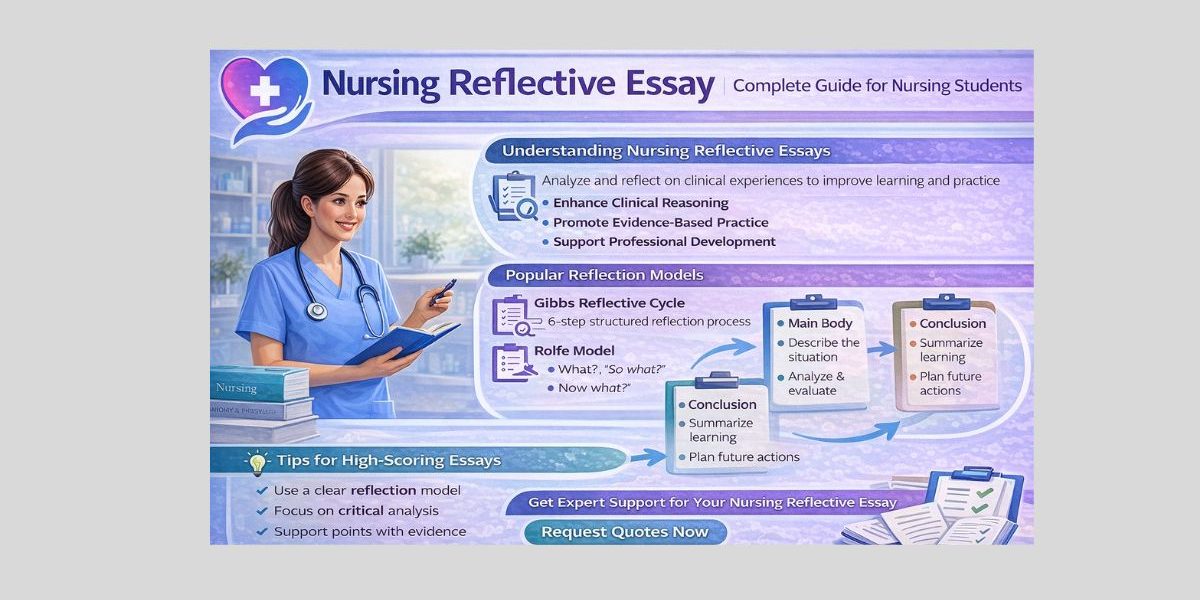
Nursing students often face the Nursing Reflective Essay Guide challenge of transforming raw experiences into meaningful learning. Whether you’re a pre‑registration student writing your first reflective assignment or a working nurse preparing for revalidation, reflective essays can feel daunting. They require you to not only recall clinical experiences but also analyze emotions, mistakes and successes, and connect them to theories and standards. Many students worry about structure, referencing or how to balance honesty with professionalism. This article provides a comprehensive guide to reflective essays so you can write confidently, deepen your learning and showcase your growth.
Why reflection matters in nursing
Reflection isn’t just a box to tick; it is essential for professional growth and safe practice. The UK’s Nursing and Midwifery Council emphasises that reflection is critical to continuous learning and improvement. Their 2024 Supporting information for reflection document states that reflection enables students and registered nurses to make sense of situations, develop self‑awareness and identify learning needs[1]. Reflective practice also helps nurses understand how experiences have affected them and contributes to personal and professional development[2]. Similar research shows that nurses who take time to reflect provide enhanced care and develop better clinical judgement[3].
Benefits for students and practitioners
- Improved clinical skills – Studies reveal that reflective practice helps nursing students apply theory to practice and view clinical situations from different angles. Students report greater responsibility, accountability and improved decision‑making[4].
- Self‑awareness and confidence – Reflective writing encourages self‑awareness. Students become more aware of their achievements and report feeling more confident in their role[5].
- Continuous learning – Reflection leads to action plans and lifelong learning. The NMC document notes that reflection supports identification of learning needs and informs wellbeing[6].
- Professional requirements – Revalidation and practice standards require nurses to gather and reflect on feedback to improve performance[7].
Challenges students face when writing reflective essays
While reflection is powerful, writing about it isn’t easy. Common challenges include:
- Structuring the essay – Many students feel unsure about organizing a narrative and analysis. Should you describe the incident first? How do you transition from feelings to theory?
- Balancing honesty with professionalism – Reflective essays ask for personal feelings, yet students worry about exposing weaknesses or breaching confidentiality.
- Linking theory to practice – Integrating academic literature, nursing codes and models of reflection often intimidates writers.
- Time pressures – Reflection requires planning and dedicated time. The NMC notes that reflection “requires planning, structure and a time commitment”[8].
- Fear of judgement – Students may worry about how their reflections are assessed or how mentors will view their experiences.
Evidence of these challenges
The International Journal of Caring Sciences review highlighted that students saw reflective practice as useful but challenging. Students appreciated its role in developing practice but needed structured support[9]. Without guidance, they struggled to integrate theory and identify learning needs. Similarly, the NMC guidelines suggest that reflection can be informal or formal, but it must remain structured and planned[10].
Why our Nursing Reflective Essay Guide is essential
Our comprehensive guide demystifies reflective writing. We provide step‑by‑step instructions, examples, scholarly insights and a clear structure so you can produce a well‑reasoned reflective essay. This guide also introduces trusted models of reflection like Gibbs’ Reflective Cycle, ensuring your reflection meets academic standards. Furthermore, we direct you to expert services like Nursing Dissertation Help for additional support and ethical guidance. By following this guide, you’ll improve your reflection skills, enhance your grades and develop professionalism.
How reflective practice models help structure your essay
Models of reflection provide a framework to organize your thoughts and ensure you address all essential aspects. Several models exist; here are two widely used in nursing:
Gibbs’ Reflective Cycle (1988)
Gibbs’ model is a cyclical process with six stages: description, feelings, evaluation, analysis, conclusion and action plan. According to the University of Edinburgh’s Reflection Toolkit, the model leads you through each stage, helping you learn from experiences[11]. It allows repeated use, enabling you to plan improvements in future similar situations[12].
| Stage | Purpose |
|---|---|
| Description | Summarize what happened, who was involved and why. |
| Feelings | Describe your emotions before, during and after the event. |
| Evaluation | Analyze what went well or poorly, considering positive and negative aspects. |
| Analysis | Explore why events unfolded as they did, drawing on theory or literature. |
| Conclusion | Identify what you learned and what you could have done differently. |
| Action plan | Plan how to handle similar situations or apply lessons to future practice. |
Reflection in action vs. reflection on action
The NMC distinguishes between reflection “in action” (thinking on your feet during care) and reflection “on action” (after practice). Reflection in action involves actively thinking about what you are doing as you interact with patients[13]. Reflection on action is more structured and requires time and planning[8]. For essays, reflection on action is more common since it allows deeper analysis and integration of literature.
Other models
While Gibbs’ cycle is popular, other models may suit your learning style. These include:
- Kolb’s Experiential Learning Cycle – Emphasises concrete experience, reflective observation, abstract conceptualization and active experimentation.
- Johns’ Model of Structured Reflection – Guides you through structured questions focusing on ethics, self-awareness and patient context.
- Brookfield’s Four Lenses – Encourages reflection from the perspectives of self, students, colleagues and theory.
Selecting a model provides clarity and ensures you address description, feelings, analysis and future improvements. It also shows assessors that you are engaging critically with your practice.
Key components of a nursing reflective essay
A persuasive reflective essay includes several essential elements:
1. Introduction
Start with context: briefly describe the clinical situation, why it was significant and what you will reflect on. State the model you will use (e.g., Gibbs) and any confidentiality measures. Include your thesis: what you learned from the event.
2. Description of the experience
Present a detailed, factual account of what happened. Include relevant details such as patient demographics (without breaching confidentiality), your role, team dynamics, and the sequence of events. Keep this section descriptive, saving analysis for later.
3. Feelings and initial reactions
Describe your emotions before, during and after the event. Be honest; acknowledging anxiety or uncertainty demonstrates self-awareness. Consider how your feelings might have influenced your actions.
4. Evaluation and analysis
Evaluate what went well and what didn’t. Analyze the causes of the outcomes using nursing theories, best practices and evidence. For example, if you struggled with communication, consult research on nurse-patient communication or leadership. Use scholarly sources to support your analysis (e.g., by referencing the NMC or research like Caldwell et al.).
5. Conclusion and lessons learned
Summarize the main lessons you learned. Reflect on how the experience changed your understanding of patient care, teamwork or ethics. Relate these lessons to the nursing code of conduct and your professional development.
6. Action plan
Outline specific actions you will take to improve. For example, you might plan to attend a communication workshop, practice clinical skills in simulation labs or seek mentorship. Reference relevant guidelines or training programmes.
How the reflective essay process works with our service
Writing a reflective essay involves several steps. Our service at Nursing Dissertation Help supports you throughout:
- Consultation – You discuss your assignment requirements and share your experience. Our academic mentors ensure confidentiality and ethical support.
- Outline and structure – We help you select a reflective model (e.g., Gibbs, Kolb) and design an outline that meets your school’s criteria.
- Drafting – You write the reflective essay, while our mentors provide feedback on structure, analysis and integration of scholarly sources.
- Review and refinement – Our team reviews your work for clarity, coherence and adherence to guidelines. They help refine the narrative and ensure you meet word counts.
- Editing and referencing – We assist with referencing styles (APA, Harvard, etc.) and ensure citations align with academic standards.
Unlike generic writing services, our support is ethical; we offer guidance rather than writing your essay for you. This ensures you develop genuine reflective skills and remain compliant with academic policies.
How to choose the best reflective essay help service
When seeking support, consider the following factors:
| Criterion | What to look for |
|---|---|
| Expertise in nursing | Tutors should have nursing qualifications and experience. They should understand reflective models, NMC requirements and clinical contexts. |
| Scholarly resources | A good service draws on peer‑reviewed journals, government guidelines and reputable sources. Our mentors regularly use sources like the International Journal of Caring Sciences and NMC publications. |
| Confidentiality | Ensure the service protects your personal information and the confidentiality of patient stories. |
| Ethical support | Avoid services that offer to write your entire essay. Ethical support involves guidance, feedback and education. |
| Transparent pricing | Look for clear pricing and refund policies. You can view our transparent pricing on our nursing dissertation pricing page. |
Our case studies show how students have benefitted from our ethical support. We believe in empowering you to develop your reflective skills while maintaining academic integrity.
Ethical considerations in reflective writing
Reflective essays involve personal feelings, patient information and sometimes sensitive events. Ethics are paramount:
- Confidentiality – Avoid using real names, ward locations or details that could identify patients. Use pseudonyms (e.g., “Mr A”) and focus on your actions and learning.
- Professionalism – Maintain respect for colleagues and patients. Even when reflecting on negative experiences, avoid blame and focus on learning.
- Consent – Do not share any personal data or experiences of others without consent.
- Academic integrity – Reflective essays should be your own work. Using others’ experiences or plagiarizing reflective writing is unethical. Seek guidance but retain ownership of your reflections.
- Balancing honesty and self-compassion – Be honest about mistakes but avoid self-criticism that undermines your confidence. Reflection should encourage growth and resilience.
Benefits of using Nursing Dissertation Help
Our platform offers several advantages for nursing students:
- Expert guidance – Our tutors and researchers have nursing backgrounds and understand reflective models and practice requirements. They help you integrate theory, evidence and personal experience.
- Customized support – We tailor our guidance to your assignment, whether it is a short reflection or a long essay. You can also explore our DNP dissertation help for advanced studies.
- Data analysis assistance – If your reflection includes research elements, we offer dissertation data analysis help, regression analysis help and inferential statistics help for nursing research.
- Qualitative support – For reflective essays grounded in qualitative research, we provide qualitative data analysis assistance.
- Coursework and assignment support – Beyond reflective essays, we help with nursing coursework and nursing assignment help. Our comprehensive services allow you to develop skills across the curriculum.
- Ethical approach – We do not ghost-write; we mentor you. This ensures you meet learning objectives and abide by academic integrity policies.
- Flexible support – You can order support directly through our order page and consult our refund policy for peace of mind.
Practical steps to write a high-quality nursing reflective essay
- Choose your experience wisely – Pick a significant clinical event that challenged you. It could involve communication breakdown, ethical dilemmas, patient deterioration or a positive learning experience.
- Select a reflective model – Decide whether to use Gibbs’ cycle, Kolb’s model or another framework. Adhere to the stages to ensure completeness.
- Create an outline – Plan sections: introduction, description, feelings, analysis, conclusion and action plan. Include subheadings if allowed.
- Write descriptively first – Draft the narrative of what happened without judgment. Stick to facts and include essential details.
- Explore your feelings – Reflect on your emotional response. Ask: What was I thinking? How did I feel at different stages? Why?
- Analyse using evidence – Incorporate literature and guidelines. For instance, the NMC emphasises that reflection fosters self-awareness and continuous improvement[2]. Caldwell’s review shows reflective practice improves decision-making and accountability[4].
- Draw lessons – What have you learned about your practice, values or professional standards? Link lessons to nursing codes and evidence.
- Develop an action plan – Outline specific, measurable steps to improve. For example, plan to attend training, seek mentorship or practice new skills.
- Edit and reference – Check word counts, grammar and clarity. Cite sources properly. Use our nursing research paper help for referencing support.
- Seek feedback – Ask tutors or mentors to review your essay. Use their feedback to improve before submission.
Common questions about nursing reflective essays
Q1: How long should a reflective essay be?
Essay length varies by institution and assignment; typical word counts range from 500 to 2,000 words. Always check your assignment brief. Ensure you provide enough detail and analysis without exceeding the limit.
Q2: Can I use any reflective model?
Yes. Common models include Gibbs, Kolb, Johns and Brookfield. Choose one that suits your learning style and assignment criteria. Ensure you apply all stages of the chosen model.
Q3: Do I need to include scholarly references?
Many institutions require you to support your analysis with literature. Use peer‑reviewed journals, guidelines and credible sources. For instance, Caldwell et al. (2013) emphasize that reflective practice develops nursing practice and decision-making[4], while the NMC highlights its role in continuous improvement[1].
Q4: How do I maintain confidentiality?
Use pseudonyms and avoid details that could identify patients or colleagues. Focus on your actions, feelings and learning. Do not include hospital names or identifiable personal information.
Q5: Is it ethical to seek help with reflective essays?
Yes, as long as the support is ethical. Guidance on structure, analysis and referencing is permitted. Services like ours offer mentorship, not ghost-writing, ensuring you develop skills and maintain academic integrity.
Q6: What if my reflection exposes mistakes?
Mistakes are learning opportunities. Reflection encourages honesty and self-compassion. Use mistakes to identify areas for development and plan improvements. Assessors appreciate critical self-awareness and willingness to improve.
Final call to action
Reflective writing is a powerful tool for transforming experiences into professional growth. It fosters critical thinking, self-awareness and continuous improvement. However, crafting a high-quality reflective essay can be challenging. Our Nursing Reflective Essay Guide provides a structured framework, scholarly resources and practical tips to help you succeed. If you need additional guidance, our team at Nursing Dissertation Help is here to support you ethically. Explore our how it works page to get started, check our pricing, or place your order. Let us guide you towards reflective mastery and academic success.
References
[1] [2] [6] [7] [8] [10] [13] nmc.org.uk
[3] [4] [5] [9] 4. La.Caldwell
https://www.internationaljournalofcaringsciences.org/docs/4.%20us%20La.Caldwell.pdf
[11] [12] Gibbs’ Reflective Cycle | Reflection Toolkit | Reflection Toolkit
https://reflection.ed.ac.uk/reflectors-toolkit/reflecting-on-experience/gibbs-reflective-cycle
