

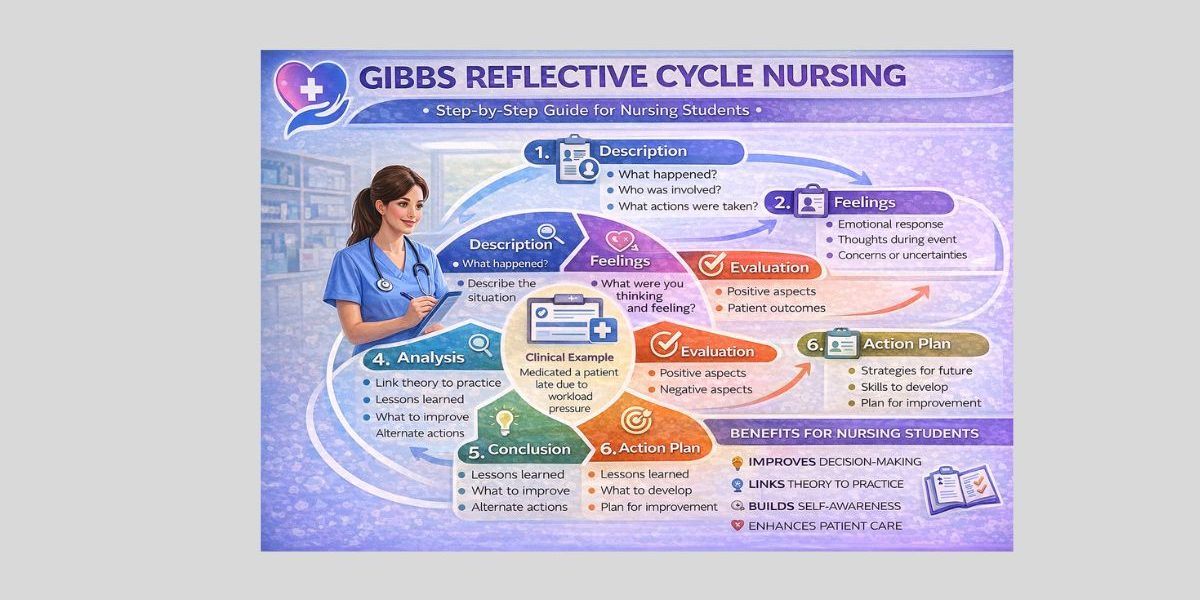
Gibbs Reflective Cycle Nursing
Structured Reflection for Clinical Learning
Gibbs Reflective Cycle Nursing provides a structured framework to analyze clinical experiences, but many nursing students struggle to apply it effectively. In practice, students and new nurses often know they should reflect on what happened during patient care, yet they may feel unsure how to do so systematically. Reflective practice is essential to nursing; it helps convert daily experiences into learning and professional growth[1][2]. However, novices often find it challenging to articulate their feelings, evaluate outcomes, and form an action plan. This article addresses those challenges: it explains why Gibbs’ model is important in nursing, outlines its key steps, and discusses how to overcome common obstacles. We’ll also explain how our expert [nursing research paper help] can support you in writing high-quality reflective assignments (e.g. essays or dissertation chapters on Gibbs’ cycle) without compromising academic integrity.
In nursing education and clinical practice, asking the right questions about an experience can lead to better understanding and sense-making[1]. For example, a systematic approach to reflection – like Gibbs’ cycle – ensures you cover all angles of a situation. This is backed by evidence: one nursing education review found that structured reflection “supports clinical competency through professional development”, enhancing self-awareness and reasoning among students[3]. Furthermore, research shows that guided reflective writing using Gibbs’ model can significantly improve empathy and communication skills in nursing students[4]. In short, incorporating Gibbs’ cycle into your learning can make reflection more effective and meaningful.
Immediately below, we’ll outline common challenges with using Gibbs’ cycle, explain why this model is beneficial, and then shift to how you can get help with reflective writing (including links to our services). By the end, you’ll have a clear roadmap: you’ll understand the six stages of Gibbs’ cycle, know how to apply them, and know where to turn for professional support if needed.
Challenges Students Face in Reflective Practice
Applying any reflective model – including Gibbs’ cycle – can be difficult in real-world nursing practice. One common issue is uncertainty about what to write. As one study of nursing students noted, some learners have trouble identifying which events to reflect on and feel uncomfortable revisiting negative experiences[5]. Other barriers include time constraints and unsupportive environments. For example, Malawian nursing students reported that limited time on busy wards and a lack of guidance in clinical placements made reflection hard to do regularly[5]. In short, the pressures of clinical work (shifts, patient load) can leave little room for structured reflection.
Emotional factors also play a role. Reflecting honestly requires acknowledging mistakes or complex feelings. Students often hesitate to critique themselves or their teams, fearing judgment[5][2]. Additionally, many students aren’t trained in reflective writing techniques; they may fill journals with vague summaries rather than deep analysis. Without practice, the reflective process can feel vague or formulaic.
These challenges can lead to superficial reflection or even avoidance of the process. It’s important to recognize that struggling with reflection is normal for beginners. The good news is that models like the Gibbs Reflective Cycle exist exactly to help overcome these hurdles. By guiding students through specific stages, Gibbs’ model reduces uncertainty – it prompts you with questions at each step – and thus addresses many of the barriers noted by learners[2][5].
Why Gibbs Reflective Cycle is Important in Nursing
Gibbs’ model is widely used because it makes reflective practice practical and meaningful. At its core, Gibbs’ cycle leads you through six stages (description, feelings, evaluation, analysis, conclusion, and action plan)[2]. This structured approach ensures you don’t skip key steps. For example, the model explicitly asks you to evaluate both the good and bad aspects of an experience and then draw conclusions about what you learned[6]. Research confirms that this comprehensiveness leads to deeper learning. A nursing education review reported that when students engaged in reflective practice (using models like Gibbs), they showed greater self-awareness and better clinical reasoning[3].
Another reason Gibbs’ model matters is that it encourages continuous improvement. The final “action plan” stage forces you to decide what changes to make in the future. In practice, this translates to ongoing professional development. For instance, a recent qualitative study found that nursing specialists who used Gibbs’ cycle to reflect on internship experiences reported professional and personal growth. They wrote reflection diaries and then applied what they learned to improve their skills[7]. In other words, Gibbs’ cycle helped these nurses transform routine clinical events into learning opportunities.
Moreover, Gibbs’ cycle is adaptable. You can use it for single events or recurring issues[2]. Whether reflecting on a one-time care error or on repeated stressful shifts, the model guides you through what happened, how you felt, and how you can do better. Because of this versatility, many nursing schools recommend Gibbs’ cycle for student journals, portfolios, and case study assignments. In fact, guidance from the University of Edinburgh notes that Gibbs’ model was specifically designed “to give structure to learning from experiences”[2].
In summary, the Gibbs Reflective Cycle is important because it:
- Structures learning: It breaks reflection into clear steps, preventing gaps in analysis[2].
- Bridges theory and practice: Using a model helps apply classroom knowledge to real-life care (a known challenge for nursing students[3]).
- Improves skills and empathy: Studies show students who reflect via Gibbs’ model tend to communicate and empathize better with patients[4].
Given these benefits, understanding Gibbs’ cycle is a key step toward more effective reflective practice.
Key Steps of the Gibbs Reflective Cycle
When applying Gibbs’ Reflective Cycle in nursing, it helps to remember the six main stages. Each stage has guiding questions that prompt deeper thinking[6]. Here’s a summary:
- Description: What happened? Write a factual account of the experience. Include who was involved, what actions occurred, and where/when it took place[6]. For example, if you’re reflecting on administering medication, describe the scene and steps you took.
- Feelings: What were you thinking and feeling? Reflect on your emotional response. How did the situation make you feel at the time? Did you feel confident, anxious, frustrated? Note feelings without judgment. This awareness helps you understand your reactions.
- Evaluation: What was good and bad about the experience? Critically assess the positives and negatives. For instance, maybe administering medication went smoothly (positive), but communicating with the patient felt rushed (negative). Be honest about what worked well and what didn’t.
- Analysis: Why did things happen the way they did? Here you dig deeper. Analyze the factors that contributed to the good or bad outcomes. Use theory or evidence where possible – for example, relate a communication issue to the nursing communication models you learned in class. This is where knowledge meets practice.
- Conclusion: What have you learned? Summarize what the experience taught you. Could you have done anything differently? Perhaps you realize you need to practice a technical skill, or that you should check patient ID more carefully.
- Action Plan: What will you do in the future? Finally, propose steps to improve. For example, if rushed communication was a problem, you might plan to always leave extra time when explaining treatments. The action plan ensures your reflection leads to concrete changes.
By systematically answering these questions, you complete the Gibbs cycle[6]. When writing your reflection, you can use bullet points or short paragraphs for each stage. If any stage feels tricky, remember that this process is iterative – you might cycle through it multiple times as you refine your understanding.
Ethical Considerations
While using reflective models and writing services, it’s important to uphold academic integrity. When using our support, you should:
- Use the Service as a Guide: Think of the delivered content as an example or study guide. Do not copy it verbatim into your assignments. Instead, read it carefully, learn from it, and then write your own reflection in your words. This way, you really internalize the lesson and avoid plagiarism.
- Cite and Reference Properly: If our work includes definitions or ideas (like the Gibbs model stages), make sure to cite standard sources (e.g. Gibbs’ original work or nursing journals). We provide references like these in our examples, but adapt them as needed. Always follow your institution’s citation style.
- Maintain Confidentiality: Any personal patient details or specific incidents you reflect on should be de-identified in writing. Respect privacy even in your notes. Our services don’t require any patient identifiers; we focus on the nurse’s perspective and learning points.
- Follow Guidelines: If your school has its own reflective model or specific assignment rubric, let us know. We can tailor our support to fit those requirements. Likewise, check your institution’s policies on academic help services. We comply with all professional standards.
- Review for Academic Rigor: Use reflective writing as a tool to improve, not just a task to complete. Incorporate evidence or theory in your analysis stage to meet academic criteria. Our writers are familiar with scholarly standards, so we can help you strike that balance between personal reflection and evidence-based reasoning.
By adhering to these ethical guidelines, you’ll get the most benefit from our service and improve as a learner. We emphasize learning over shortcuts. In fact, our refund policy and terms explicitly require that clients do not submit purchased work as their own. We encourage transparency – you can even use our materials in your study groups or drafting process. The goal is to enhance your understanding of Gibbs’ cycle and reflective practice.
Frequently Asked Questions (FAQ)
Q1: What is Gibbs’ Reflective Cycle?
A1: The Gibbs Reflective Cycle is a six-step model (Description, Feelings, Evaluation, Analysis, Conclusion, Action Plan) developed by Graham Gibbs in 1988[2]. It guides nurses through a structured reflection of a clinical experience, helping them learn from it systematically. Think of it as a framework of questions that ensure you consider not just what happened, but how you felt, why things went well or not, what you learned, and what you will do next time.
Q2: Why is reflective practice important in nursing?
A2: Reflective practice turns everyday experiences into learning. In nursing, it helps close the gap between theory and real care. Studies show that regular reflection improves clinical competency, critical thinking, and emotional well-being of nursing students[3]. For example, reflective writing has been found to enhance empathy and communication skills[4], which directly benefits patient care. In short, reflecting on your practice makes you a more self-aware, effective nurse.
Q3: How do I write a reflection using the Gibbs model?
A3: Start by describing a specific situation (What happened?). Next, detail your feelings at the time. Then evaluate the positives and negatives. Analyze why those things occurred (use theory if possible). Draw a conclusion about what you learned. Finally, make an action plan for future practice. Always use first person (“I did this”) and be honest. If you need help framing your writing, our nursing assignment help can provide examples and feedback.
Q4: Can you give an example of how to apply Gibbs’ cycle in a nursing reflection?
A4: Suppose you felt rushed during a medication round. Describe the scenario (who, what, where). In feelings, note you were stressed. In evaluation, you might say administering meds quickly avoided delay (good) but you noticed you didn’t communicate well (bad). In analysis, you might realize staffing shortage made you hurry. Conclusion: You learned that communication suffers under time pressure. Action plan: Next time, you decide to double-check patient understanding even if busy, or delegate tasks to avoid rushing. This structure covers all Gibbs stages; our examples in Coursework Help show how details fit into each stage.
Q5: How can NursingDissertationHelp.com assist with my reflective writing assignment?
A5: We have a specialized Nursing Assignment Help team that can assist with any part of your reflective assignment. For example, we can draft an outline of Gibbs’ six stages tailored to your scenario, or write full reflective paragraphs for you to learn from. We also offer Coursework Help for Nursing Students if you need step-by-step guidance on essays. All content is custom-made: tell us your specific experience or topic, and we’ll incorporate it. Plus, if your project involves research (like surveys about reflection), our Nursing Research Paper Help and Qualitative Data Analysis experts can help analyze results.
Q6: How do I know the work will be plagiarism-free and high quality?
A6: We guarantee original content. Every paper is checked with advanced plagiarism software before delivery. Our writers use credible sources (peer-reviewed journals and books), such as the studies we cited above, to support any claims. You can check our commitment to quality on the How It Works and Refund Policy pages. In short, we stand by our work: if you find any issue, our unlimited revision policy means we will fix it at no extra cost.
Ready to Enhance Your Reflective Practice?
Mastering the Gibbs Reflective Cycle can greatly improve your nursing practice, but you don’t have to do it alone. Whether you’re writing a reflective journal, essay, or dissertation chapter, our team at NursingDissertationHelp is here to support you. We combine academic expertise (see our About Us) with real-world nursing experience to ensure your work is accurate and insightful.
Take the next step: Use our Order form to get a custom quote, or explore our Nursing Dissertation Pricing page for details on rates. You can also read our case studies to see how we’ve helped other nursing students succeed.
Reflective writing should build your skills, not stress you out. Let us be your guide. Contact us 24/7 for a confidential consultation, and join the many nursing professionals who have already benefited from our expert support.
Invest in your learning and career today – place an order now and transform your Gibbs reflective cycle assignment into a powerful learning experience!
References
[1] Reflective practice and knowledge development: Transforming research for a practice-based discipline – PMC
https://pmc.ncbi.nlm.nih.gov/articles/PMC11740302/
[2] [6] Gibbs’ Reflective Cycle | Reflection Toolkit | Reflection Toolkit
https://reflection.ed.ac.uk/reflectors-toolkit/reflecting-on-experience/gibbs-reflective-cycle
[3] The impact of reflective practice on nursing students: a scoping review – ScienceDirect
https://www.sciencedirect.com/science/article/pii/S1471595325002240
[4] (PDF) Effect of narrative writing based on Gibbs’ reflective model on the empathy and communication skills of nursing students
[5] (PDF) Knowledge, Practices and Barriers of Reflective Practice Among Undergraduate Nursing and Midwifery Students in Malawi
[7] Attribute (N = 962). | Download Table
https://www.researchgate.net/figure/Attribute-N-962_tbl1_317001385
