

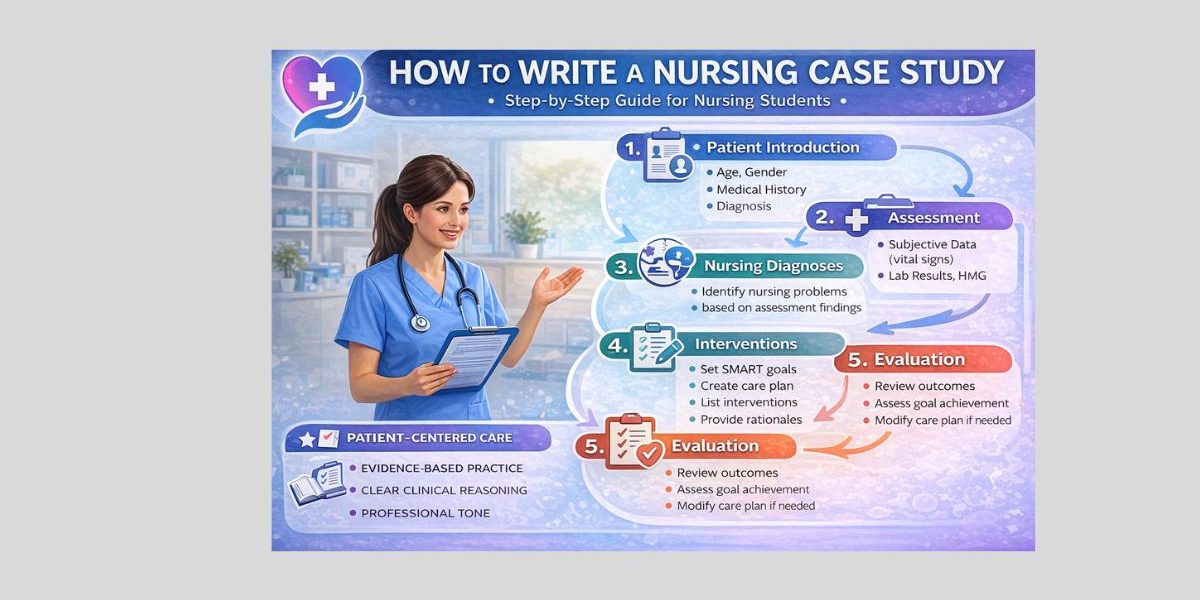
Introduction & Foundations of How to Write a Nursing Case Study.
How to Write a Nursing Case Study: Definition, Purpose, and Academic Importance
Understanding how to write a nursing case study is a foundational skill for nursing students at every level, from undergraduate to postgraduate studies. A nursing case study is not just a written assignment; rather, it is a structured clinical analysis that demonstrates your ability to apply theoretical knowledge to real patient situations.
From the outset, it is important to recognize that a nursing case study writing task requires more than simple description. Instead, it involves critical thinking, clinical reasoning, and the integration of evidence-based practice. In other words, when you learn how to write a case study in nursing, you are developing the same analytical skills required in real-world healthcare settings.
In academic contexts, lecturers expect students to show a clear understanding of patient care processes. Therefore, your case study must logically connect:
- Patient assessment
- Nursing diagnoses
- Care planning
- Interventions
- Evaluation of outcomes
Without this structured approach, even well-written assignments may lack depth and fail to achieve high grades.
What Is a Nursing Case Study in Clinical and Academic Contexts?
A nursing case study is a detailed examination of a patient scenario that allows you to analyze and present clinical findings in a structured format. Unlike general essays, a case study in nursing writing focuses on a specific patient or clinical situation.
Typically, it includes:
- Patient background and history
- Presenting condition
- Clinical assessment findings
- Nursing diagnoses
- Interventions and rationales
- Evaluation of care outcomes
However, beyond these components, a strong nursing case study analysis demonstrates how each section connects logically. For example, the interventions you propose must directly address the diagnoses identified from your assessment.
Why Learning How to Write a Nursing Case Study Matters
1. Development of Clinical Reasoning Skills
First and foremost, writing a nursing case study enhances your ability to think critically. Rather than memorizing information, you learn to interpret patient data and make informed decisions.
For instance, when analyzing a patient with diabetes, you must determine not only the diagnosis but also the underlying causes and appropriate interventions. Consequently, this strengthens your clinical judgment.
2. Application of Theory to Practice
In addition, case study writing bridges the gap between classroom learning and real clinical practice. Many students struggle to apply theoretical knowledge in practical settings. However, by practicing nursing case study writing, you learn how to translate theory into actionable care.
3. Preparation for Professional Nursing Roles
Moreover, the skills gained from writing case studies are directly applicable in clinical environments. Nurses are required to assess patients, develop care plans, and evaluate outcomes daily.
Therefore, mastering how to write a nursing case study prepares you for real-world responsibilities.
4. Academic Performance and Assessment
From an academic perspective, case studies often carry significant weight in grading. A well-structured case study demonstrates:
- Depth of knowledge
- Analytical ability
- Understanding of patient-centered care
As a result, students who develop strong case study skills consistently achieve higher grades.
Key Characteristics of a High-Quality Nursing Case Study
To write effectively, you must understand what distinguishes an excellent case study from an average one.
1. Patient-Centered Focus
A strong nursing case study always prioritizes the patient. Rather than presenting generic information, it focuses on individual needs, conditions, and responses to care.
2. Logical Structure and Flow
Equally important is organization. Each section should flow naturally into the next. For example:
- Assessment leads to diagnosis
- Diagnosis leads to planning
- Planning leads to interventions
Without this logical progression, the case study becomes disjointed.
3. Evidence-Based Practice
In modern nursing, decisions must be supported by evidence. Therefore, your case study in nursing writing should reference:
- Clinical guidelines
- Peer-reviewed research
- Best practice recommendations
4. Clear Clinical Reasoning
Another defining feature is the ability to explain why certain decisions are made. For example, instead of simply stating an intervention, you should justify it with a rationale.
5. Professional and Academic Tone
Finally, your writing must be formal, clear, and precise. Avoid unnecessary repetition or informal language.
Common Misconceptions About Nursing Case Study Writing
Many students misunderstand what is required when learning how to write a nursing case study. Addressing these misconceptions can significantly improve your work.
Misconception 1: It Is Just a Patient Description
In reality, a case study is analytical, not descriptive. Simply outlining symptoms is not enough. You must interpret and evaluate the data.
Misconception 2: More Words Equal Better Quality
While depth is important, unnecessary content reduces clarity. Instead, focus on relevant and meaningful analysis.
Misconception 3: Interventions Do Not Need Rationales
This is a major mistake. Every intervention must be supported by a clear rationale to demonstrate understanding.
Misconception 4: Structure Is Not Important
On the contrary, structure is critical. A poorly organized case study can lose marks even if the content is accurate.
Understanding the Structure Before Writing
Before moving into the actual writing process, it is essential to understand the standard structure of a nursing case study.
A complete case study typically includes:
- Introduction and patient background
- Assessment (subjective and objective data)
- Nursing diagnoses
- Planning (goals and outcomes)
- Interventions and rationales
- Evaluation
Each of these sections serves a specific purpose and must be clearly developed.
Transition to Practical Application
At this point, you now understand the theoretical foundation of how to write a nursing case study. However, understanding concepts alone is not enough. The next step involves applying this knowledge through a structured, step-by-step process.
In the next part, we will explore:
- A detailed step-by-step guide to writing a nursing case study
- How to structure each section effectively
- How to connect assessment, diagnosis, and interventions logically
Request Quotes Now
Need a high-quality, well-structured nursing case study with proper clinical reasoning and academic depth? Request quotes now and get expert support tailored to your assignment.
Advanced Step-by-Step Guide on How to Write a Nursing Case Study
Applying Clinical Reasoning in Nursing Case Study Writing
After understanding the theoretical foundation, mastering how to write a nursing case study requires moving beyond structure into clinical reasoning and analytical depth. At this level, your work must demonstrate not only what you are doing, but also why each step is clinically justified.
In high-scoring assignments, a nursing case study analysis is evaluated based on how effectively you connect patient data to nursing decisions. Therefore, each section must reflect a logical chain of reasoning, where assessment findings directly inform diagnoses, and diagnoses guide targeted interventions.
1. Writing the Patient Introduction: Establishing Clinical Context
The introduction of a case study in nursing writing is not merely descriptive; instead, it establishes the clinical context that shapes the entire analysis.
Key Elements to Include
- Patient demographics (age, gender, relevant background)
- Primary diagnosis and comorbidities
- Presenting symptoms and duration
- Clinical setting and reason for admission
Advanced Clinical Framing
Rather than simply stating facts, a strong introduction subtly signals clinical priorities.
Example (Enhanced Academic Version)
“A 65-year-old male patient with a history of poorly controlled Type 2 diabetes mellitus and hypertension presented with progressive fatigue, polyuria, and delayed wound healing, indicating potential complications related to chronic hyperglycemia.”
Notice the depth:
- Not just symptoms
- But clinical implications introduced early
Why This Matters
This approach immediately demonstrates:
- Clinical awareness
- Ability to interpret patient presentation
- Direction for the case study
2. Advanced Patient Assessment: From Data Collection to Clinical Interpretation
A key distinction between average and high-quality work in how to write a nursing case study lies in how assessment data is handled.
Most students list findings. However, high-level work interprets and connects them.
A. Subjective Data: Beyond Symptoms
Subjective data should not only describe what the patient says but also reflect underlying clinical meaning.
Example
Instead of:
- “Patient reports fatigue”
Write:
- “Patient reports persistent fatigue, which may indicate poor glycemic control and reduced cellular glucose utilization.”
This shows interpretation, not repetition
B. Objective Data: Clinical Significance Matters
Objective findings must be analyzed in context.
Example
- Blood glucose: 15 mmol/L → Indicates hyperglycemia
- HbA1c: 9% → Suggests chronic poor control
C. Pattern Recognition in Nursing Assessment
At an advanced level, you should identify patterns:
- Hyperglycemia + fatigue + polyuria → Poor glucose regulation
- Neuropathy symptoms + delayed healing → Risk of complications
This transforms your work into a true nursing case study analysis
D. Linking Assessment to Risk Identification
Assessment should naturally lead to identifying risks.
For example:
- Elevated glucose → Risk for infection
- Poor diet → Imbalanced nutrition
This prepares the foundation for accurate diagnoses.
3. Nursing Diagnoses: Clinical Accuracy and Prioritization
In learning how to write a case study in nursing, diagnosis is where your analytical skills are most visible.
Writing Strong Nursing Diagnoses
A high-quality diagnosis must include:
- Problem
- Related factors
- Evidence
Example (Basic vs Advanced)
Weak:
“Unstable blood glucose”
Strong:
“Risk for unstable blood glucose level related to inconsistent dietary intake and medication non-adherence as evidenced by elevated blood glucose readings.”
Prioritization of Diagnoses (Critical Thinking Layer)
Not all diagnoses carry equal importance.
Use frameworks such as:
- ABC (Airway, Breathing, Circulation)
- Maslow’s hierarchy
Example Priority Order
- Risk for unstable blood glucose
- Risk for infection
- Imbalanced nutrition
- Deficient knowledge
This shows clinical judgment, not just listing problems
4. Planning: Developing SMART Goals with Clinical Relevance
Planning is where you translate problems into measurable outcomes.
However, depth is achieved when goals are not only SMART but also clinically meaningful.
Short-Term Goals (Immediate Clinical Needs)
- Patient will maintain blood glucose between 4–7 mmol/L within 48 hours
Long-Term Goals (Holistic Patient Outcomes)
- Patient will demonstrate effective self-management within one month
- Patient will achieve HbA1c below 7% within three months
Linking Goals to Diagnoses
Each goal must correspond directly to a diagnosis.
Weak plans fail here because they lack alignment.
5. Nursing Interventions: Evidence-Based and Patient-Specific
Interventions are not generic actions — they must be tailored to the patient’s condition.
Example: Generic vs Advanced Intervention
Generic:
“Monitor blood glucose”
Advanced:
“Monitor capillary blood glucose before meals and at bedtime to detect fluctuations and guide timely intervention.”
Adding Evidence-Based Rationales
Rationales must explain the scientific reasoning.
Example
“Regular monitoring of blood glucose allows early detection of hyperglycemia, reducing the risk of complications such as diabetic ketoacidosis (ADA guidelines).”
Categories of Interventions
To deepen your work, group interventions:
1. Monitoring Interventions
- Vital signs
- Glucose levels
2. Therapeutic Interventions
- Medication administration
- Insulin therapy
3. Educational Interventions
- Lifestyle modification
- Diet management
4. Preventive Interventions
- Foot care
- Infection prevention
6. Integration of Evidence-Based Practice in Case Study Writing
A high-level nursing case study must reflect current clinical guidelines.
This includes:
- Referencing best practices
- Using up-to-date research
- Aligning interventions with standards
This significantly improves academic credibility.
7. Maintaining Logical Flow and Coherence
One of the biggest indicators of mastery in how to write a nursing case study is coherence.
Each section must connect:
- Assessment → Diagnosis
- Diagnosis → Planning
- Planning → Intervention
Example Flow
- Elevated glucose → Diagnosis: unstable glucose
- Diagnosis → Goal: stabilize glucose
- Goal → Intervention: monitor + medication
8. Avoiding Superficial Writing (Critical for Depth)
To ensure depth:
- Avoid listing without explanation
- Avoid generic statements
- Always explain “why”
Example
“Educate patient on diet”
“Educate patient on carbohydrate control to reduce postprandial glucose spikes and improve glycemic stability”
Request Quotes Now
Need a distinction-level nursing case study with deep clinical reasoning and evidence-based structure? Request quotes now and get expert academic support.
Advanced Interventions, Patient Education, Evaluation, and Final Structure in a Nursing Case Study
From Planning to Practice: Executing a Nursing Case Study Effectively
After completing assessment, diagnosis, and planning, the next stage in mastering how to write a nursing case study involves translating clinical decisions into targeted, evidence-based nursing interventions. At this level, your work must demonstrate precision, clinical awareness, and the ability to justify every action taken.
Importantly, a high-quality nursing case study analysis does not simply list interventions. Instead, it integrates:
- Patient-specific care strategies
- Evidence-based rationales
- Continuous evaluation of outcomes
As a result, the case study becomes a reflection of real clinical decision-making rather than a theoretical exercise.
1. Advanced Nursing Interventions in a Case Study in Nursing Writing
A. Monitoring and Assessment Interventions
To begin with, continuous monitoring remains central to effective care. Nurses must assess not only current patient status but also trends over time.
Interventions:
- Monitor capillary blood glucose levels at prescribed intervals
- Assess vital signs regularly, including blood pressure and heart rate
- Observe for early signs of complications such as neuropathy or infection
Rationale:
Ongoing monitoring allows early identification of physiological changes. Consequently, timely interventions can prevent deterioration and reduce the risk of acute complications.
Advanced Insight:
In high-scoring work, you should highlight that trend analysis is more clinically valuable than isolated readings, as it provides a broader picture of patient stability.
B. Therapeutic and Pharmacological Interventions
In addition to monitoring, therapeutic interventions form a critical component of a nursing case study.
Interventions:
- Administer insulin or prescribed medications accurately
- Ensure proper timing of medication in relation to meals
- Monitor for adverse effects such as hypoglycemia
Rationale:
Medication management directly influences patient outcomes by stabilizing blood glucose levels. Furthermore, correct administration techniques reduce the risk of complications associated with improper dosing.
Clinical Depth:
Failure to align insulin administration with meal timing is a common clinical error that may lead to hypoglycemic episodes. Highlighting such risks demonstrates advanced understanding.
C. Nutritional and Lifestyle Interventions
Equally important is addressing lifestyle factors that influence disease progression.
Interventions:
- Educate patient on carbohydrate-controlled diet
- Encourage balanced nutrition and portion control
- Promote regular physical activity tailored to patient ability
Rationale:
Diet and lifestyle modifications play a significant role in maintaining glycemic control. Therefore, addressing these factors supports both short-term stabilization and long-term health outcomes.
Higher-Level Insight:
Rather than simply advising “healthy eating,” a strong case study explains how specific dietary adjustments impact metabolic processes.
D. Preventive Interventions and Risk Reduction
Beyond immediate care, preventive strategies must be integrated into the nursing case study writing process.
Interventions:
- Conduct regular foot inspections
- Educate on proper hygiene and wound care
- Monitor for early signs of infection
Rationale:
Patients with diabetes are at increased risk of complications due to impaired circulation and immune function. Early detection and prevention significantly reduce morbidity.
2. Patient Education: The Core of Long-Term Management
A critical aspect of how to write a nursing case study involves demonstrating how nurses empower patients through education. Since many chronic conditions require self-management, patient education becomes a cornerstone of effective care.
A. Medication and Treatment Education
Patients must understand:
- How and when to take medications
- Correct insulin administration techniques
- Potential side effects
Why this matters:
Improved understanding leads to better adherence and reduces the likelihood of complications.
B. Dietary and Lifestyle Education
Education should include:
- Importance of balanced meals
- Role of carbohydrate control
- Benefits of physical activity
Clinical Insight:
Patients often misinterpret dietary advice. Therefore, education must be specific, practical, and culturally appropriate.
C. Self-Monitoring and Symptom Recognition
Patients should be taught how to:
- Monitor blood glucose levels
- Record and interpret readings
- Recognize early signs of complications
Examples:
- Hypoglycemia → dizziness, sweating, confusion
- Hyperglycemia → excessive thirst, fatigue
Rationale:
Early recognition allows prompt action, reducing the risk of severe outcomes.
Request Quotes Now
Need a fully developed nursing case study with detailed interventions, rationales, and patient education? Request quotes now for expert academic support.
3. Evaluation: Measuring Outcomes in a Nursing Case Study
Evaluation is the final step in the nursing case study writing process, yet it is often one of the most overlooked. However, it is essential because it determines whether the interventions were effective.
A. Key Evaluation Criteria
A strong evaluation section should assess:
- Whether patient goals were achieved
- Improvement in clinical indicators
- Patient understanding and adherence
- Reduction in symptoms or complications
B. Example of Effective Evaluation
Instead of writing:
“Patient improved”
Write:
“Patient demonstrated improved glycemic control, with blood glucose levels stabilizing within the target range, and successfully verbalized understanding of medication and dietary management.”
C. Reassessment and Plan Modification
If goals are not achieved, the care plan must be revised.
This may involve:
- Adjusting interventions
- Addressing barriers such as non-adherence
- Re-educating the patient
Advanced Insight:
Evaluation is not a conclusion — it is part of an ongoing cycle of care.
4. Bringing It All Together: Final Structure of a Nursing Case Study
At this stage, a complete nursing case study should include:
- Patient introduction
- Comprehensive assessment
- Nursing diagnoses
- Planning and goals
- Interventions with rationales
- Patient education
- Evaluation
Each section must connect logically, forming a cohesive and well-structured document.
5. Common Pitfalls in Advanced Case Study Writing
Even at advanced levels, students often make mistakes such as:
- Writing generic interventions
- Failing to justify decisions
- Weak evaluation sections
- Poor linkage between sections
Avoiding these errors significantly improves both academic performance and clarity.
6. Final Thoughts on How to Write a Nursing Case Study
Mastering how to write a nursing case study requires more than understanding structure. It involves developing the ability to analyze patient data, apply evidence-based interventions, and evaluate outcomes critically.
Ultimately, a strong case study reflects:
- Clinical reasoning
- Patient-centered care
- Evidence-based practice
- Logical organization
By integrating these elements, nursing students can produce work that is both academically strong and clinically relevant.
Request Quotes Now
Need a high-quality, plagiarism-free nursing case study written by experts? Request quotes now and boost your academic performance.
FAQ Section
What is a nursing case study?
A nursing case study is a structured analysis of a patient’s condition, including assessment, diagnosis, interventions, and evaluation.
How do you write a nursing case study step by step?
Follow assessment, diagnosis, planning, intervention, and evaluation while linking each section logically.
Why is patient education important in nursing case studies?
Because effective care depends on patient understanding and self-management.
What makes a high-scoring nursing case study?
Strong clinical reasoning, evidence-based interventions, clear structure, and detailed evaluation.
Can I get professional help writing a nursing case study?
Yes, expert services can help you develop structured, high-quality assignments tailored to academic standards.
