

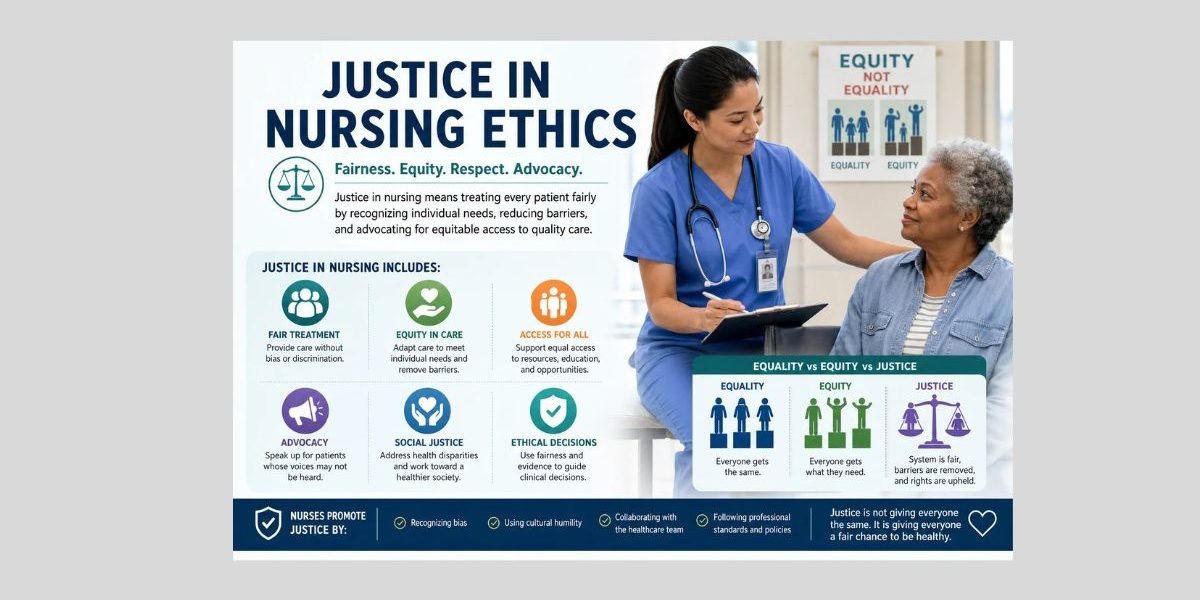
Justice in nursing ethics means treating patients fairly while recognizing that fair care does not always mean identical care. Nursing students often define justice as “fairness,” but then struggle to explain how it applies to patient care, resource allocation, health disparities, advocacy, bias, and ethical dilemmas.
This article focuses specifically on justice as one ethical principle in nursing. Justice is one part of the wider field of nursing ethics, which also includes autonomy, beneficence, nonmaleficence, confidentiality, advocacy, and professional accountability.
Quick Answer: What Is Justice in Nursing Ethics?
Justice in nursing ethics means:
- Treating patients fairly and respecting their right to appropriate care.
- Considering fairness, equity, dignity, non-discrimination, and unequal patient needs.
- Applying ethical judgment to resource allocation, access to care, advocacy, and health disparities.
- Understanding that fairness does not always mean giving every patient the exact same support.
- Advocating for fair care, avoiding bias, following ethical standards, and supporting vulnerable patients.
- Recognizing that justice can conflict with autonomy, beneficence, confidentiality, or resource stewardship.
- Using justice to analyze nursing essays, case studies, discussion posts, reflections, leadership papers, and research projects.
What Does Justice Mean in Nursing Ethics?
Justice is the ethical principle that focuses on fairness, rights, access, and equitable treatment. In nursing, justice means patients should receive care based on need, clinical condition, dignity, and ethical standards rather than bias, income, social status, race, age, disability, diagnosis, language, or personal judgment.
Justice is not simply “being nice.” It is also not the same as treating every patient in exactly the same way. A nurse may need to give one patient more teaching, more advocacy, more discharge support, or more communication assistance because that patient faces greater barriers to safe care.
For example, two patients may receive the same medication instructions. One understands immediately. The other has low health literacy, limited English proficiency, and no family support at home. Justice may require interpreter services, teach-back, simplified written instructions, and extra discharge planning so the second patient has a fair chance to follow the care plan.
The American Nurses Association Code of Ethics emphasizes dignity, respect, human rights, health equity, and social justice as part of ethical nursing practice (American Nurses Association [ANA], 2025). The International Council of Nurses also identifies human rights, dignity, equity, and social justice as central responsibilities of nurses and nursing students (International Council of Nurses [ICN], 2021).
Why Justice Matters in Nursing Practice
Justice matters because unfair care can harm patients even when nurses do not intend harm. A patient who receives less pain assessment because of stigma may suffer unnecessarily. Also, a patient who does not receive interpreter support may misunderstand medication instructions. A patient discharged without considering housing, transportation, or follow-up barriers may return with preventable complications.
Justice supports nursing practice in several ways.
It protects patient dignity. Patients should not feel less worthy of care because of their diagnosis, income, disability, age, language, culture, or social background.
It supports trust in healthcare. When patients believe nurses listen, explain, and treat them fairly, they may be more willing to share information and participate in care.
It improves access to care. Nurses often notice when a patient cannot afford medication, lacks transportation, needs home support, or does not understand discharge instructions.
It strengthens advocacy. Justice encourages nurses to speak up when a patient’s needs are overlooked or when barriers prevent safe care.
It reduces bias. Nurses are expected to base care on assessment data, patient needs, professional standards, and ethical duties rather than assumptions.
It improves professional accountability. Justice reminds nurses that ethical care includes fairness in communication, prioritization, documentation, teaching, and referrals.
Justice vs Equality vs Equity in Nursing
Students often confuse equality, equity, and justice. These concepts are related, but they are not identical.
| Concept | Meaning | Nursing Example | Student Writing Tip |
|---|---|---|---|
| Equality | Giving everyone the same support or resources | Every patient receives the same discharge packet | Use equality when discussing sameness, equal access, or equal treatment |
| Equity | Adjusting support based on patient needs and barriers | A patient with low health literacy receives teach-back and visual instructions | Use equity when explaining why different patients may need different support |
| Justice | Making fair ethical decisions based on rights, needs, dignity, resources, and professional obligations | A nurse prioritizes care based on acuity while ensuring no patient is ignored because of bias | Use justice when analyzing fairness, rights, resource allocation, and ethical conflict |
| Social justice | Addressing social and structural barriers that affect health | A community health nurse connects uninsured patients with screening, education, and referral services | Use social justice when discussing health disparities, access, and vulnerable populations |
A simple example helps clarify the difference. Suppose two patients receive the same discharge education packet. That may be equality. However, one patient has limited English proficiency and low health literacy. Equity may require interpreter support, teach-back, and visual instructions. Justice asks whether the education process is fair, respectful, safe, and responsive to the patient’s real needs.
Types of Justice Relevant to Nursing
Justice can be discussed in different ways. Nursing students do not need to turn every paper into a philosophy essay, but knowing these types can make assignments stronger.
| Type of Justice | Meaning | Nursing Example |
|---|---|---|
| Distributive justice | Fair allocation of limited resources | Prioritizing care when several patients need attention at the same time |
| Social justice | Addressing unfair social barriers that affect health | Helping patients access preventive care, follow-up, medication support, or community resources |
| Procedural justice | Fairness in the decision-making process | Using policy, triage criteria, assessment data, and team communication rather than favoritism |
| Interactional justice | Respectful, dignified communication and treatment | Speaking to each patient respectfully, using interpreters, and avoiding dismissive language |
Distributive justice is especially important in hospitals, emergency care, public health, long-term care, and disaster situations because nurses often work with limited time, staffing, beds, equipment, and supplies.
Justice in Nursing Ethics Examples
| Clinical Situation | Justice Issue | Nursing Considerations | Possible Ethical Response |
|---|---|---|---|
| Limited staffing and competing patient needs | Patients may not receive equal nursing time | Acuity, safety risks, urgent needs, policy, delegation | Prioritize based on clinical need, communicate delays, document objectively, and escalate concerns |
| Language barrier affecting patient education | Patient may not understand care instructions | Interpreter access, informed consent, discharge safety | Request interpreter support and use teach-back |
| Patient with low health literacy | Standard teaching may not be enough | Reading level, comprehension, medication safety | Use plain language, visual tools, and teach-back |
| Unequal access to follow-up care | Patient may be discharged without realistic support | Transportation, insurance, cost, clinic access | Involve case management or social work where appropriate |
| Pain management concerns | Bias may affect pain assessment or treatment | Assessment data, patient report, medication orders, safety | Assess pain consistently and report concerns through proper channels |
| Cultural or religious preference affecting care | Patient preferences may be misunderstood | Consent, safety, privacy, cultural humility | Ask respectful questions and involve appropriate team members |
| Older adult or disabled patient needing extra support | Equal care may not meet functional needs | Mobility, cognition, communication, assistive devices | Provide reasonable support and advocate for safe care |
| Patient experiencing stigma or discrimination | Patient may receive dismissive or unequal treatment | Substance use, mental health, poverty, homelessness, diagnosis | Use respectful language and base care on assessment, not stereotypes |
| Limited equipment or bed availability | Resources may not meet all needs immediately | Triage, policy, safety, urgency | Follow prioritization processes and escalate shortages |
| Discharge planning for a patient without stable housing | Standard discharge plan may be unsafe | Shelter, medication storage, wound care, follow-up | Involve discharge planning resources and document barriers |
These examples are educational. In real clinical settings, nurses and students should follow facility policy, scope of practice, instructor guidance, professional standards, and applicable law.
Justice and Resource Allocation in Nursing
Resource allocation means deciding how limited resources are distributed. In nursing, resources may include time, staffing, beds, equipment, medications, education support, interpreters, wound care supplies, isolation rooms, transportation support, or specialist referrals.
Justice becomes important when resources are limited and several patients need attention. A nurse may have one patient with chest pain, another requesting pain medication, another needing discharge education, and another at high risk for falls. Fair care does not mean responding in the exact order requests were made. It means using acuity, safety, clinical judgment, policy, and teamwork to decide what needs immediate action.
For example, a nurse caring for four patients may first assess the patient with new shortness of breath before completing routine discharge teaching for a stable patient. That decision reflects justice because prioritization is based on clinical urgency and safety, not favoritism or convenience.
However, nurses should not make resource decisions based on social worth, income, race, disability, age, insurance status, diagnosis stigma, or personal opinion. When situations are complex, nurses should communicate with the charge nurse, provider, supervisor, instructor, or ethics committee according to the setting.
Social Justice in Nursing
Social justice in nursing focuses on unfair social and structural barriers that affect health. These barriers may include poverty, housing instability, transportation problems, food insecurity, language barriers, disability, limited education, lack of insurance, unsafe neighborhoods, racism, and poor access to healthcare.
The World Health Organization defines social determinants of health as the conditions in which people are born, grow, work, live, and age, along with wider systems that shape daily life (World Health Organization [WHO], 2025). The CDC also describes social determinants as non-medical factors that influence health outcomes, including economic stability, education, healthcare access, neighborhood conditions, and social context (Centers for Disease Control and Prevention [CDC], 2024).
For nurses, social justice does not mean turning every patient interaction into a political debate. It means understanding that patient outcomes are shaped by more than individual choices. A patient may miss appointments because transportation is unreliable. Another may not take medication because the cost is too high. A family may struggle with wound care because they lack clean housing or supplies.
Nurses support social justice by assessing barriers, educating patients respectfully, using available referral pathways, advocating for safe discharge plans, and participating in quality improvement or community health efforts. In student assignments, social justice works well in topics about community health nursing, public health, health disparities, access to care, maternal health, chronic disease management, and vulnerable populations.
Justice, Bias, and Non-Discrimination in Nursing Care
Justice requires nurses to recognize and reduce bias. Bias can be conscious or unconscious. It may affect how nurses assess pain, interpret behavior, communicate with patients, prioritize concerns, or respond to patient needs.
Bias in nursing care may involve:
- Assuming a patient exaggerates pain because of substance use history.
- Speaking loudly to an older adult instead of assessing hearing needs.
- Using family members as interpreters when professional interpreter services are needed.
- Making assumptions about a patient’s beliefs because of religion, culture, race, or ethnicity.
- Treating a patient with mental illness as unreliable without assessing the actual concern.
- Ignoring disability-related needs because they require extra time.
Justice does not require nurses to agree with every patient choice. It requires respectful, professional, fair care regardless of background, diagnosis, behavior, income, identity, or social status.
Nurses can reduce bias by using assessment data, asking respectful questions, listening carefully, using standardized tools where appropriate, requesting interpreters, documenting objectively, and speaking up when a patient’s concern is dismissed without proper assessment.
Justice and Patient Advocacy
Patient advocacy is one practical way nurses apply justice. Advocacy means supporting the patient’s rights, needs, preferences, safety, understanding, and access to appropriate care.
A nurse may advocate by:
- Helping a patient understand the care plan.
- Speaking up about a safety concern.
- Requesting interpreter services.
- Communicating discharge barriers.
- Asking for reassessment when symptoms change.
- Involving case management, social work, spiritual care, or other support services.
- Supporting patients who may not know how to ask questions.
- Respecting patient preferences while following policy and safety standards.
For example, a patient is ready for discharge after a new diabetes diagnosis, but the nurse learns that the patient cannot read the written instructions and has no refrigerator for insulin storage. A justice-focused advocacy response may include notifying the provider or discharge team, requesting diabetes education, involving social work, and documenting the barriers professionally.
Students writing about this type of scenario can connect justice with advocacy, patient education, health literacy, discharge safety, and equity.
Ethical Dilemmas Involving Justice in Nursing
An ethical dilemma occurs when two or more ethical duties conflict. Justice often conflicts with other principles because nurses must balance individual patient needs with fairness to others, limited resources, safety, policy, and professional standards.
Autonomy vs Justice
A patient may request a resource-intensive option, but several other patients also need limited resources. The patient’s autonomy matters because patients have the right to participate in care decisions. Justice also matters because resources must be used fairly.
A responsible nursing response includes listening to the patient, communicating concerns to the healthcare team, following policy, and avoiding promises outside the nurse’s role.
Beneficence vs Justice
A nurse may want to spend extra time comforting one distressed patient, but another patient has urgent clinical needs. Beneficence supports helping the distressed patient. Justice requires fair prioritization of all assigned patients.
A responsible response may include addressing immediate safety needs first, asking another team member for help, returning to the distressed patient when possible, and documenting relevant concerns.
Confidentiality vs Justice or Safety
A patient may share information that raises safety, abuse, or mandatory reporting concerns. Confidentiality matters, but justice and safety may require action according to law and facility policy.
A responsible nursing response is not to guess or act alone. The nurse should follow policy, consult appropriate supervisors or instructors, and document objectively.
Justice in End-of-Life and Long-Term Care
In end-of-life care and long-term care, justice is important because vulnerable patients may have complex needs, communication barriers, family conflict, cognitive impairment, disability, or limited decision-making capacity.
Justice in these settings may involve:
- Fair access to comfort care.
- Respect for patient wishes and advance care planning where applicable.
- Avoiding ageism or disability bias.
- Protecting dignity during hygiene, feeding, mobility, and symptom management.
- Communicating respectfully with patients who have dementia or communication challenges.
- Ensuring pain and distress are assessed, not dismissed.
- Supporting family communication while protecting patient privacy and rights.
Students should be careful not to present end-of-life justice issues as simple legal questions. These situations may involve policy, advance directives, surrogate decision-making, provider orders, ethics consultation, and applicable law.
Justice in Nursing Ethics and Cultural Humility
Cultural humility means approaching patients with respect, openness, and awareness that the nurse does not automatically understand the patient’s beliefs or needs. It differs from memorizing stereotypes about cultural groups.
Justice and cultural humility connect because unfair care can occur when nurses make assumptions. A nurse may assume a patient refuses treatment because of culture when the real issue is fear, cost, language, mistrust, or lack of understanding.
Justice-focused culturally humble care may include:
- Asking respectful questions.
- Using qualified interpreters.
- Avoiding assumptions about family roles.
- Respecting religious or cultural preferences when safe and possible.
- Checking patient understanding.
- Considering health literacy.
- Protecting privacy and consent.
- Balancing preferences with safety, policy, and professional standards.
Cultural preferences matter, but they do not remove the need for patient consent, confidentiality, safety, and professional accountability.
Justice and the Nursing Code of Ethics
Nursing codes of ethics support justice by emphasizing dignity, fairness, human rights, advocacy, equity, and professional responsibility. The ANA Code of Ethics identifies ethical nursing practice as a guide for patient care decisions and includes the profession’s responsibility to advance social justice and health equity (ANA, 2025). The ICN Code of Ethics applies to nurses and nursing students and describes ethical values, responsibilities, and professional accountabilities across nursing roles (ICN, 2021).
Nurses should know the code relevant to their country, school, employer, and clinical setting. However, a code of ethics does not replace facility policy, scope of practice, clinical judgment, or applicable law. It helps nurses reason ethically, but complex situations may still require consultation with supervisors, charge nurses, instructors, providers, ethics committees, or institutional channels.
How Nurses Apply Justice in Ethical Decision-Making
Justice does not always give nurses an easy answer. It gives them a responsible process for thinking through fairness, rights, access, barriers, and competing needs.
A practical framework includes:
- Identify the justice issue.
- Gather clinical facts and patient preferences.
- Identify who may be affected.
- Review the ethical principles involved.
- Check policy, law, scope of practice, and professional standards.
- Consider bias, access barriers, and resource limits.
- Communicate with the healthcare team.
- Seek guidance from supervisors, instructors, ethics committees, or appropriate channels.
- Document objectively and professionally.
- Reflect on what could improve fairness and patient-centered care.
For assignments, this framework helps students move beyond opinion. Instead of writing, “The nurse should be fair,” explain what fairness requires, what barriers exist, what principles conflict, and what professional process should guide the response.
Common Mistakes Students Make When Writing About Justice in Nursing Ethics
Students often weaken justice papers by staying too general. Avoid these mistakes:
- Defining justice only as “fairness.”
- Confusing equality with equity.
- Ignoring patient context.
- Ignoring resource limits.
- Making unsupported claims about discrimination or patient harm.
- Treating justice as the only ethical principle.
- Failing to discuss competing principles.
- Using personal opinion without evidence.
- Ignoring policy, law, and scope of practice.
- Failing to protect patient privacy in examples.
- Using dramatic language instead of professional analysis.
- Repeating broad nursing ethics content instead of focusing on justice.
A stronger paper explains the patient situation, identifies the fairness issue, discusses barriers, applies ethical principles, supports claims with credible sources, and explains nursing implications.
How to Write About Justice in Nursing Ethics Assignments
Justice can fit many nursing assignments, but the approach should match the task.
| Assignment Type | How to Approach Justice | Example Topic |
|---|---|---|
| Discussion post | Define justice briefly and apply it to one clinical issue | Justice and language barriers in discharge teaching |
| Reflective journal | Reflect on fairness, bias, advocacy, or patient barriers | Recognizing health literacy needs during patient education |
| Case study | Identify the ethical conflict, patient needs, and nursing response | Resource allocation when two patients need urgent attention |
| Nursing essay | Compare justice, equity, equality, and advocacy | Justice and fairness in nursing care |
| Research paper | Use evidence to discuss disparities, access, or ethical practice | Health disparities and nursing advocacy |
| Leadership paper | Discuss staffing, policy, quality improvement, or team communication | Fair prioritization during staffing shortages |
| DNP/capstone project | Connect justice to outcomes, systems, and practice improvement | Improving equitable discharge education for high-risk patients |
Students who need help organizing an ethics assignment can use nursing assignment help for guidance on structure, rubric alignment, and academic tone. For clinical scenarios, nursing case study help may be useful when applying justice to patient data, ethical conflicts, and nursing interventions. Students working on evidence-based topics can also review nursing research paper help when developing research questions, sources, and APA formatting. DNP students can connect justice to practice change, access, quality improvement, and health equity through DNP dissertation help.
Justice in Nursing Ethics Essay and Research Topics
Useful topic ideas include:
- Justice and resource allocation in nursing.
- Equity in discharge education.
- Justice in pain management.
- Language barriers and fair patient education.
- Social justice in community health nursing.
- Health disparities and nursing advocacy.
- Justice in end-of-life nursing care.
- Justice and disability in healthcare.
- Cultural humility and ethical nursing care.
- Justice in long-term care.
- Ethical issues in triage and prioritization.
- Justice and professional accountability in nursing.
Students should narrow broad topics by population, setting, ethical issue, principle, or outcome. For example, “justice in nursing” is broad. “Justice and discharge education for older adults with low health literacy” is more focused and easier to support with evidence.
Sample Thesis Statement and Paragraph Structure
Sample thesis statement:
“Justice in nursing ethics is essential because it helps nurses promote fair treatment, respect patient dignity, reduce bias, advocate for equitable care, and make responsible decisions when resources, rights, and patient needs conflict.”
A strong paragraph can follow this structure:
- Topic sentence.
- Definition of justice or the justice-related issue.
- Clinical example.
- Support from credible evidence or professional standards.
- Nursing implication.
Example structure:
Justice requires nurses to consider whether patients have a fair opportunity to understand and follow their care plan. In discharge education, fairness may require more than giving every patient the same printed instructions. A patient with low health literacy may need plain-language teaching, teach-back, visual aids, or caregiver involvement with consent. This approach supports ethical nursing practice because it respects dignity, reduces preventable misunderstanding, and promotes equitable patient-centered care.
Quick Checklist for Writing About Justice in Nursing Ethics
Before submitting your paper, ask:
- Did I define justice clearly?
- Did I distinguish justice from equality and equity?
- Did I identify the patient or group affected?
- Did I discuss patient rights, dignity, and access?
- Did I consider resource limits or barriers to care?
- Did I identify competing ethical principles?
- Did I avoid unsupported personal opinion?
- Did I include policy, professional standards, or code of ethics where relevant?
- Did I protect patient privacy?
- Did I use credible sources?
- Did I write in a professional tone?
- Did I avoid repeating the whole nursing ethics article?
FAQs About Justice in Nursing Ethics
What is justice in nursing ethics?
Justice in nursing ethics means providing fair, respectful, and equitable care. It includes attention to patient rights, dignity, access, non-discrimination, resource allocation, and barriers that may prevent safe care.
What is an example of justice in nursing?
An example is using interpreter services for a patient who does not understand discharge instructions in English. Giving the patient the same written packet as everyone else may be equal, but interpreter support promotes equity and justice.
Why is justice important in nursing?
Justice is important because unfair care can affect safety, trust, dignity, access, and outcomes. It helps nurses recognize bias, advocate for vulnerable patients, and make fair decisions when resources or patient needs conflict.
What is the difference between justice, equality, and equity in nursing?
Equality means giving everyone the same thing. Equity means adjusting support based on different needs. Justice considers fairness, rights, needs, resources, dignity, and ethical obligations.
What is distributive justice in nursing?
Distributive justice is the fair allocation of limited resources. In nursing, it may involve staffing, time, beds, equipment, medications, or patient education resources.
How does justice relate to patient advocacy?
Justice and advocacy connect because nurses often speak up when patients face barriers to fair care. Advocacy may include requesting interpreters, communicating safety concerns, supporting discharge planning, or helping patients understand care options.
What ethical dilemmas involve justice in nursing?
Justice-related dilemmas may involve triage, staffing shortages, pain management, language barriers, discharge planning, confidentiality concerns, end-of-life care, and conflicts between one patient’s needs and the needs of others.
How do I write about justice in a nursing ethics assignment?
Define justice, explain the clinical issue, identify who is affected, discuss equality and equity if relevant, include competing ethical principles, use credible sources, and connect your analysis to nursing practice.
Final Thoughts on Justice in Nursing Ethics
Justice in nursing ethics helps nurses think critically about fairness, dignity, access, equity, advocacy, and responsible care when patient needs, resources, and ethical duties conflict. It reminds students that ethical nursing is not only about good intentions. It also requires professional judgment, awareness of barriers, respect for patient dignity, and a commitment to fair treatment.
If students need help writing a justice in nursing ethics essay, case study, discussion post, clinical reflection, research paper, leadership assignment, or DNP project, they can upload their instructions and request academic guidance.
References
American Nurses Association. (2025). Code of ethics for nurses. American Nurses Association. https://codeofethics.ana.org/home
Centers for Disease Control and Prevention. (2024). Social determinants of health. https://www.cdc.gov/health-disparities-hiv-std-tb-hepatitis/about/social-determinants-of-health.html
International Council of Nurses. (2021). The ICN code of ethics for nurses. https://www.icn.ch/sites/default/files/2023-06/ICN_Code-of-Ethics_EN_Web.pdf
Marmot, M. (2014). Social determinants of health inequalities. The Lancet, 365(9464), 1099–1104. https://doi.org/10.1016/S0140-6736(05)71146-6
National Academies of Sciences, Engineering, and Medicine. (2021). The future of nursing 2020–2030: Charting a path to achieve health equity. National Academies Press. https://doi.org/10.17226/25982
Office of Disease Prevention and Health Promotion. (n.d.). Social determinants of health. Healthy People 2030. https://odphp.health.gov/healthypeople/priority-areas/social-determinants-health
World Health Organization. (2025). Social determinants of health. https://www.who.int/news-room/fact-sheets/detail/social-determinants-of-health
