

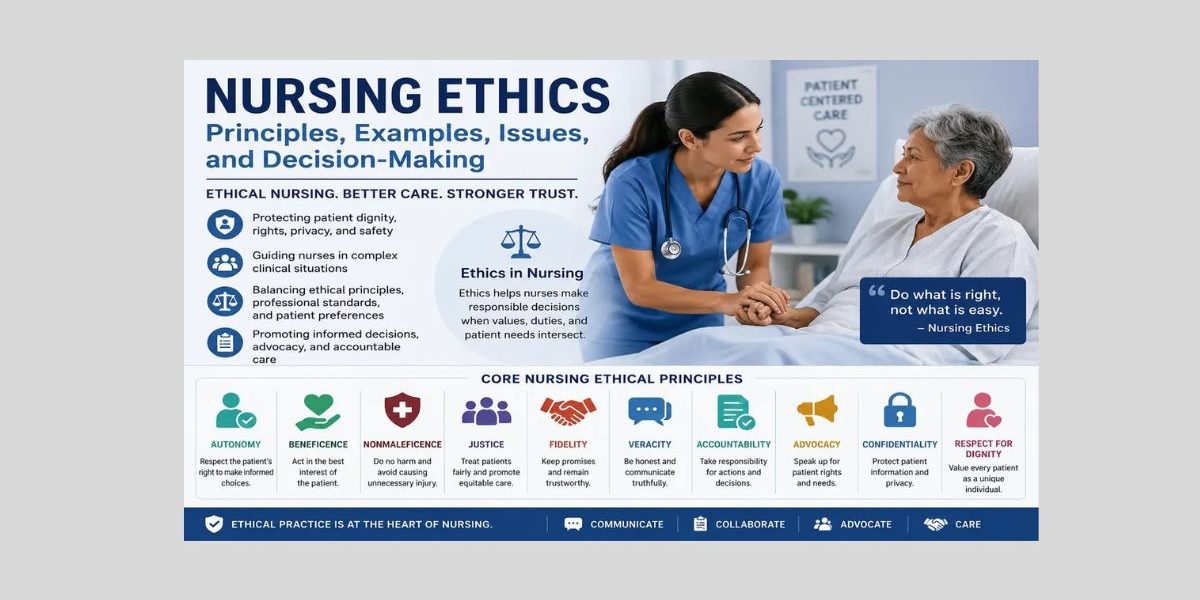
Nursing ethics helps nurses protect patient dignity, rights, safety, privacy, and wellbeing when clinical situations are not simple. Many nursing students can memorize autonomy, beneficence, nonmaleficence, and justice, but struggle to apply those principles in case studies, care plans, discussion posts, clinical reflections, and real patient-care situations.
This guide explains what ethics means in nursing, why it matters, how ethical principles work, what common ethical issues look like, and how students can write about ethical dilemmas in academic assignments. It also covers confidentiality, informed consent, patient advocacy, professional boundaries, end-of-life care, moral distress, documentation, and ethical decision-making.
Quick Answer: What Is Nursing Ethics?
- Nursing ethics is the application of ethical principles and professional values to nursing practice.
- It guides how nurses protect patient dignity, rights, safety, privacy, and wellbeing.
- Major nursing ethical principles include autonomy, beneficence, nonmaleficence, justice, fidelity, veracity, accountability, advocacy, and confidentiality.
- Ethical practice requires more than knowing rules; nurses must apply judgment in real clinical situations.
- Ethical dilemmas often involve competing duties, patient preferences, safety risks, resource limits, family concerns, or legal requirements.
- Nurses and students should follow their nursing code of ethics, facility policy, scope of practice, professional standards, instructor guidance, and applicable laws.
- Students can use ethics to analyze case studies, reflections, discussion posts, research papers, leadership papers, and DNP or capstone projects.
What Is Nursing Ethics?
Nursing ethics is the use of ethical principles, professional values, and clinical judgment to guide nursing care. It helps nurses decide how to act when patient rights, safety, preferences, policies, laws, and professional responsibilities must be balanced.
Ethics in nursing is not only about “being kind” or “doing the right thing.” Kindness matters, but ethical nursing practice goes deeper. A nurse may need to protect a patient’s privacy, respect a refusal of treatment, report a safety concern, advocate for pain control, maintain professional boundaries, or communicate honestly with a patient who is frightened or confused.
The American Nurses Association describes the Code of Ethics for Nurses as a standard that guides ethical nursing practice and supports nurses in patient-care and professional decisions (American Nurses Association [ANA], 2025). The International Council of Nurses also presents nursing ethics as a guide to ethical values, responsibilities, and professional accountability for nurses and nursing students (International Council of Nurses [ICN], 2021).
For students, nursing ethics matters because many assignments require more than a definition. In a case study, you may need to explain why a patient’s refusal of medication creates an ethical issue. For a reflection, you may need to describe how confidentiality shaped your communication. In a research paper, you may need to analyze moral distress, end-of-life care, informed consent, or patient advocacy using credible evidence.
Why Nursing Ethics Matters in Patient Care
Ethics supports patient trust. Patients share sensitive information with nurses because they expect respect, honesty, privacy, and professional care. If a nurse dismisses concerns, shares information carelessly, or ignores patient preferences, trust can weaken.
Ethics also supports informed consent. Informed consent is not just a signature on a form. It involves communication, understanding, voluntariness, and the patient’s right to make decisions about care. Patients may refuse or withdraw consent, and informed consent is closely connected to respect for autonomy (Shah et al., 2024).
Patient autonomy matters because competent patients have the right to participate in decisions about their bodies and treatment. A nurse may disagree with a patient’s choice, but ethical practice requires respect for the patient’s values while also ensuring that the patient receives accurate information, support, and appropriate escalation when needed.
Ethics protects confidentiality and privacy. Health information should be shared only for appropriate care purposes and according to policy and law. The HIPAA Privacy Rule, for example, sets national standards in the United States for protecting medical records and individually identifiable health information (U.S. Department of Health & Human Services [HHS], 2025).
Ethics also supports safe care. A nurse who notices a possible medication error, unsafe staffing concern, or change in patient condition has a professional responsibility to communicate through proper channels. Ethical practice connects closely to accountability, patient advocacy, and nonmaleficence.
Finally, ethics supports equitable care. Justice requires nurses to consider fairness, bias, access, and respectful treatment. This matters when patients have different cultures, languages, health literacy levels, financial barriers, disabilities, or family situations.
Core Nursing Ethical Principles
| Ethical principle | What it means | Nursing example | Student writing tip |
|---|---|---|---|
| Autonomy | Respecting the patient’s right to make informed choices | A competent patient refuses a medication after education | Explain the patient’s choice, capacity, information provided, and safety concerns |
| Beneficence | Acting to benefit the patient | A nurse provides pain relief, comfort, education, and emotional support | Show how the nursing action promotes wellbeing |
| Nonmaleficence | Avoiding preventable harm | A nurse checks allergies before giving medication | Connect the principle to safety, prevention, and risk reduction |
| Justice | Treating patients fairly and supporting equitable care | A nurse advocates for interpreter services for a patient with limited English proficiency | Discuss fairness, access, bias, and equal respect |
| Fidelity | Keeping commitments and being trustworthy | A nurse follows through after promising to return with discharge instructions | Link fidelity to trust and professional reliability |
| Veracity | Telling the truth and communicating honestly | A nurse gives accurate information within scope and clarifies questions with the provider | Avoid saying nurses should disclose beyond their role |
| Accountability | Taking responsibility for professional actions | A nurse reports and documents a medication concern according to policy | Discuss policy, scope, documentation, and escalation |
| Advocacy | Speaking up for patient rights, needs, and safety | A nurse informs the provider that a patient does not understand the procedure | Show how advocacy protects the patient without ignoring team communication |
| Confidentiality | Protecting patient information | A nurse avoids discussing patient details in public spaces | Include privacy, records, assignments, and social media |
| Respect for dignity | Valuing every patient as a person | A nurse provides hygiene care while protecting privacy and modesty | Connect dignity to communication, culture, comfort, and respect |
These principles often work together, but they can also conflict. A patient’s autonomy may conflict with safety. Family wishes may conflict with patient confidentiality. A nurse’s desire to tell the truth may require careful coordination with the provider and facility policy. That is why ethical reasoning matters. Ethical principles are not simple formulas; they guide a responsible decision-making process.
Nursing Code of Ethics and Professional Standards
A nursing code of ethics is a professional guide that explains the values, duties, and responsibilities expected in nursing practice. It helps nurses understand how to protect patient dignity, privacy, rights, safety, and wellbeing while maintaining professional accountability.
The ANA Code of Ethics includes provisions on compassion, dignity, patient commitment, advocacy, safety, accountability, collaboration, professional responsibility, and social justice (ANA, 2025). The ICN Code of Ethics for Nurses also guides nurses and nursing students across settings by describing ethical values, responsibilities, and professional accountabilities (ICN, 2021).
Students should know the nursing code relevant to their country, school, and clinical placement. A student in the United States may be expected to reference the ANA Code. A student in another country may need the ICN Code or a national nursing council code.
Codes of ethics support ethical practice, but they do not replace clinical judgment, facility policy, law, scope of practice, or instructor guidance. In real dilemmas, nurses often need to communicate with charge nurses, supervisors, providers, ethics committees, risk management, or other approved institutional channels.
Common Ethical Issues in Nursing
Ethical issues in nursing appear in everyday care, not only in dramatic situations. Common issues include:
Informed consent. Patients need understandable information before agreeing to treatments or procedures. Nurses often support consent by assessing understanding, encouraging questions, and notifying the provider when the patient seems confused.
Patient refusal of care. A competent patient may refuse medication, treatment, hygiene care, surgery, or discharge instructions. Ethical care requires respect for autonomy, patient education, safety assessment, communication, and documentation.
Confidentiality and privacy. Nurses protect health information during conversations, documentation, handoff reports, bedside care, and student assignments. Privacy also includes physical privacy during assessment, bathing, procedures, and sensitive discussions.
End-of-life decisions. Nurses may encounter advance directives, comfort-focused care, family disagreement, pain management concerns, or questions about withholding or withdrawing treatment. These issues require interprofessional communication and policy guidance.
Patient advocacy. Nurses may need to speak up when patients are confused, unheard, unsafe, undertreated, or unable to communicate their needs clearly.
Medication safety. Errors, near misses, unclear orders, allergy concerns, and unsafe practices raise ethical duties related to nonmaleficence, accountability, and patient safety.
Resource allocation. Limited staff, equipment, beds, or time can create ethical tension. Justice requires fair and safe prioritization.
Cultural or religious preferences. Patients may have beliefs that affect diet, modesty, blood products, gender preferences for care, prayer, family involvement, or end-of-life decisions.
Family conflict. Families may disagree with the patient, each other, or the care plan. Nurses must keep the patient’s rights and preferences central when the patient has decision-making capacity.
Truth-telling. Patients deserve honest communication, but nurses must stay within scope and coordinate with providers when complex diagnoses, prognosis, or treatment decisions are involved.
Professional boundaries. Nurses should avoid relationships, gifts, social media contact, or personal disclosures that blur the nurse-patient relationship.
Social media use. Nurses and students should not post identifiable patient information or clinical details online. ANA social media guidance emphasizes professionalism, privacy, policy awareness, and protection of patient confidentiality (ANA, 2024).
Unsafe staffing concerns. Staffing problems can create moral distress and safety risks. Nurses should use appropriate reporting and escalation channels.
Workplace incivility or bullying. Ethical nursing also includes respectful professional relationships, teamwork, and safe communication.
Reporting errors or safety concerns. Ethical practice requires honesty, accountability, and patient safety. AHRQ’s CANDOR approach emphasizes timely, transparent, patient-centered responses to unexpected harm events (Agency for Healthcare Research and Quality [AHRQ], n.d.).
Ethical Dilemmas in Nursing
An ethical dilemma is a situation where two or more ethical values, duties, or responsibilities conflict. It is different from a simple problem because there may not be one easy answer.
For example, a patient may refuse a treatment that the healthcare team believes is necessary. The nurse must respect autonomy while also supporting safety and beneficence. Or a family may ask the nurse not to tell the patient the truth. The nurse must consider veracity, confidentiality, patient rights, cultural context, provider communication, and facility policy.
Scenario 1: Patient Refuses a Recommended Treatment
A patient refuses a prescribed medication because they fear side effects.
The ethical conflict involves autonomy, beneficence, and nonmaleficence. The patient has the right to make informed decisions, but the nurse also has a duty to support safe care and prevent harm.
A responsible nursing response may include assessing the patient’s understanding, providing education within scope, asking about concerns, notifying the provider when appropriate, documenting objectively, and following facility policy.
Scenario 2: Family Asks the Nurse to Hide Information
A family tells the nurse, “Do not tell him the diagnosis. He cannot handle it.”
The ethical conflict involves veracity, autonomy, confidentiality, family involvement, and cultural sensitivity. Family concerns may be sincere, but the patient’s rights and preferences remain central when the patient has capacity.
A responsible nursing response may include listening respectfully, avoiding unauthorized disclosure or deception, clarifying what the patient wants to know, involving the provider, and following policy.
Scenario 3: Nurse Notices a Possible Medication Error
A nurse sees that a patient may have received the wrong dose.
The ethical conflict involves patient safety, accountability, nonmaleficence, veracity, and professional responsibility.
A responsible nursing response may include assessing the patient, notifying the appropriate clinician, following medication error policy, documenting according to policy, and participating in safety review processes. The nurse should not hide, alter, or minimize the concern.
Nursing Ethics Examples in Clinical Practice
| Clinical situation | Ethical issue | Nursing considerations | Possible ethical response |
|---|---|---|---|
| Patient refuses medication | Autonomy vs safety | Does the patient understand the purpose, risks, and alternatives? | Educate within scope, notify provider if needed, document refusal objectively |
| Patient asks for privacy from family | Confidentiality and autonomy | What information may be shared, and with whom? | Respect the patient’s wishes unless policy or law requires otherwise |
| Confused patient is at risk for falls | Safety vs autonomy | Is the patient oriented? What fall precautions are least restrictive? | Use approved safety measures, reassess, communicate with the team |
| End-of-life pain management concern | Beneficence, nonmaleficence, dignity | Is pain controlled? Are goals of care clear? | Advocate for comfort, communicate concerns, follow orders and policy |
| Cultural preference affects care | Respect, justice, patient-centered care | What does the patient prefer? Is an interpreter needed? | Ask respectfully, avoid assumptions, coordinate safe care |
| Social media privacy concern | Confidentiality and boundaries | Could the post identify the patient or setting? | Do not post patient information or identifiable clinical details |
| Unequal access to care | Justice and advocacy | Are barriers affecting treatment, education, or follow-up? | Advocate for resources, referrals, interpreter services, or discharge support |
| Student observes unsafe practice | Accountability and safety | What is the student’s role and reporting process? | Notify instructor or assigned nurse through proper channels |
These examples show why ethical practice depends on context. Nurses and students should not treat examples as legal instructions. Patient condition, capacity, institutional policy, scope of practice, and applicable law matter.
Patient Autonomy and Informed Consent in Nursing
Essentially, Patient autonomy means the patient has the right to make informed decisions about their care. In nursing ethics, autonomy requires respect for the patient’s values, preferences, beliefs, and choices.
Informed consent generally involves information, understanding, capacity, and voluntary agreement. A patient should understand what is being proposed, why it is recommended, possible risks and benefits, and available alternatives. Consent is not just a form; it is a communication process.
The nurse’s role often includes supporting understanding, encouraging questions, identifying confusion, checking whether the patient needs an interpreter, and notifying the provider when the patient does not appear to understand. Nurses should avoid explaining procedures beyond their role or pressuring patients to agree.
Patient refusal of care is also connected to autonomy. A competent patient may refuse treatment even when the healthcare team believes the treatment is beneficial. Refusal still requires careful assessment, education, communication, and documentation.
Autonomy has limits. Capacity concerns, emergency situations, public safety requirements, mental health laws, court orders, mandatory reporting, and facility policy may affect what happens next. Students should follow instructor guidance, provider direction, facility policy, scope of practice, and legal requirements.
Confidentiality, Privacy, and Professional Boundaries
Confidentiality in nursing means protecting patient information from unnecessary or unauthorized disclosure. Privacy includes how nurses manage physical space, conversations, records, electronic communication, clinical assignments, and social media.
Patient information should be shared only for appropriate care purposes and with authorized people. Nurses should avoid discussing patients in elevators, cafeterias, public hallways, social media posts, or casual conversations.
Professional boundaries also matter. The nurse-patient relationship exists for the patient’s benefit, not the nurse’s personal needs. Boundary problems can include inappropriate gifts, personal relationships, social media contact, excessive self-disclosure, favoritism, or communication outside professional channels.
Student nurses must also protect privacy in assignments and reflections. Do not include names, room numbers, exact dates, rare identifying details, photos, or combinations of details that could identify the patient.
Wrong: “I posted about an interesting patient case.”
Better: “Do not share patient information or identifiable clinical details on social media.”
Wrong: “Mrs. K in room 214 has HIV.”
Better: “Share protected information only with authorized team members involved in care.”
Wrong: “My patient at St. Mary’s on Tuesday had a rare condition.”
Better: “A de-identified patient scenario involved a complex chronic condition.”
Patient Advocacy in Nursing Ethics
Patient advocacy means speaking up for patient needs, rights, preferences, safety, and dignity. Advocacy does not mean making decisions for the patient. It means helping patients understand options, ask questions, communicate concerns, and receive respectful care.
Advocacy is especially important when patients have low health literacy, language barriers, disabilities, fear, pain, limited family support, or difficulty communicating with the healthcare team.
For example, a patient signs a consent form but later tells the student nurse, “I do not understand what the surgery is for.” The ethical issue involves informed consent, autonomy, and patient safety. The nurse or student should not ignore the statement. A responsible response would be to notify the assigned nurse, instructor, or provider according to policy so the patient’s questions can be addressed before the procedure.
Advocacy must still respect autonomy. A nurse may believe one option is safer, but the patient’s informed preferences matter. Ethical advocacy supports safe, informed, patient-centered care.
Cultural, Religious, and Family Considerations in Nursing Ethics
Culture, religion, family roles, and personal beliefs can shape how patients understand illness, pain, modesty, diet, blood products, death, gender interactions, and decision-making. Ethical nursing care requires cultural humility, not assumptions.
Cultural humility means asking respectfully, listening carefully, and recognizing that patients are individuals. Two patients from the same religion, country, or community may have different preferences.
Interpreter use is important when language barriers affect understanding. Family members may help emotionally, but they should not automatically replace professional interpreters when accurate clinical communication is needed.
Family involvement also depends on patient consent and privacy rules. Some patients want family members included in decisions. Others do not. When the patient has capacity, the patient’s wishes should guide information sharing.
Culture does not override patient rights, informed consent, safety obligations, professional standards, or legal requirements. Nurses should balance respect for beliefs with patient safety, policy, and ethical care.
End-of-Life Care and Nursing Ethics
End-of-life care often involves dignity, comfort, autonomy, beneficence, nonmaleficence, truth-telling, family communication, and moral distress. Patients may have advance directives, goals-of-care preferences, religious beliefs, or wishes about life-sustaining treatment.
Ethical end-of-life care focuses on respecting patient wishes, relieving suffering, supporting dignity, and communicating through the interprofessional team. Healthcare providers should respect patient autonomy while also aiming to benefit patients and avoid harm (Akdeniz et al., 2021).
Nurses may face difficult situations. A family may request continued aggressive treatment when the patient’s documented wishes favor comfort care. A patient may need pain relief while family members worry that medication will hasten death. A nurse may feel distress when care seems inconsistent with the patient’s values.
Withholding or withdrawing treatment can be ethically complex and legally sensitive. Nurses and students should not manage these concerns alone. They should use facility policy, provider communication, ethics consultation, palliative care teams, supervisors, instructors, and appropriate institutional channels.
Moral Distress in Nursing Ethics
Moral distress in nursing occurs when nurses believe they know the ethically appropriate action but feel blocked from acting because of institutional, team, legal, resource, or power-related barriers. The concept is commonly associated with situations where nurses know the right thing to do but constraints make it difficult or impossible to act (Morley et al., 2018).
Examples include unsafe staffing, repeated care that seems burdensome at end of life, lack of resources, family conflict, poor team communication, bullying, or pressure to stay silent about safety concerns.
Moral distress is not the same as ordinary stress. Stress may come from workload, time pressure, or emotional fatigue. Moral distress includes an ethical conflict: the nurse feels unable to act according to professional values or patient needs.
It also differs from nursing burnout, although the two can overlap. Burnout is usually broader and may involve exhaustion, cynicism, and reduced professional efficacy. Moral distress is specifically tied to ethical constraint.
Support matters. Nurses may need debriefing, supervisor support, ethics consultation, peer discussion, employee support services, reporting systems, or leadership involvement. Students should talk with instructors or clinical supervisors when they experience ethical discomfort in placement.
Ethical Decision-Making in Nursing
Ethical decision-making in nursing is not always about finding a perfect answer. It is about using a responsible process when values, duties, risks, and patient preferences conflict.
A practical framework includes:
- Identify the ethical issue. What makes the situation ethical, not just clinical or practical?
- Gather relevant clinical facts. What is the patient’s condition, diagnosis, prognosis, risk, and care plan?
- Identify the patient’s wishes, values, and rights. What does the patient want? Does the patient have capacity? Are there advance directives?
- Review the ethical principles involved. Which principles apply: autonomy, beneficence, nonmaleficence, justice, fidelity, veracity, accountability, advocacy, confidentiality, or dignity?
- Check facility policy, law, and scope of practice. What policies, professional standards, and legal requirements guide the situation?
- Communicate with the healthcare team. Ethical issues often require collaboration, not isolated decision-making.
- Seek guidance through appropriate channels. This may include the charge nurse, instructor, supervisor, provider, ethics committee, or institutional process.
- Consider possible actions and consequences. What are the risks, benefits, and likely outcomes of each option?
- Document objectively and professionally. Record relevant facts, patient statements, education, notifications, and actions according to policy.
- Reflect and learn from the situation. Reflection helps students and nurses improve ethical reasoning.
This framework helps students avoid shallow answers. Instead of writing, “The nurse should respect autonomy,” explain how the nurse assessed understanding, communicated concerns, followed policy, advocated safely, and documented professionally.
Documentation and Nursing Ethics
Documentation is an ethical issue because patient records affect communication, safety, legal accountability, continuity of care, and professional trust.
Ethical documentation should be accurate, timely, objective, and professional. Nurses should avoid judgmental language, assumptions, blame, exaggeration, or vague statements. They should document patient statements accurately, education provided, refusals of care, safety concerns, notifications, and patient responses according to policy.
Judgmental: “Patient was difficult and refused care.”
Professional: “Patient declined wound dressing change at 1000 and stated, ‘I want to speak with the provider first.’ Education provided. Provider notified according to policy.”
Incomplete: “Patient educated.”
Better: “Reviewed medication purpose, dose schedule, and common side effects. Patient verbalized concern about dizziness. Provider notified.”
Unsafe: “Late entry added to make chart complete.”
Better: Follow facility policy for late entries, corrections, and amendments. Do not falsify, backdate, delete, or alter records improperly.
Students should also document ethically in academic work. De-identify patient information, avoid unnecessary details, and follow school and clinical-site rules for reflections, case studies, and care plans.
Common Mistakes Students Make When Writing About Nursing Ethics
Many students lose marks because they define ethics too generally. “Ethics means doing what is right” is not enough for college-level nursing writing. Explain the specific ethical issue, principle, conflict, and nursing implication.
Another mistake is listing principles without applying them. Do not only write, “This case involves autonomy and beneficence.” Show how autonomy appears in the patient’s choice and how beneficence appears in the nurse’s duty to promote wellbeing.
Students also forget the patient’s perspective. Ethical analysis should ask what the patient wants, understands, fears, values, and has the right to decide.
Some students treat autonomy as unlimited. Autonomy is important, but capacity, emergency care, safety, public health, mandatory reporting, and legal requirements can affect decision-making.
Confidentiality is another common weak area. Students may include identifying details in reflections or case studies without realizing that combinations of facts can identify a patient.
Avoid unsupported personal opinion. Ethical writing should use professional standards, credible sources, clinical facts, and reasoned analysis.
Do not use dramatic language. Instead of writing, “The nurse abandoned the patient,” explain the specific action, ethical concern, standard, and safer response.
How to Write About Nursing Ethics in Assignments
| Assignment type | How to approach nursing ethics | Example topic |
|---|---|---|
| Discussion post | Define the issue, apply one or two principles, and respond professionally | Should a competent patient be allowed to refuse treatment? |
| Reflective journal | Describe the situation without identifiers, explain your feelings, and connect to ethical principles | Confidentiality during bedside handoff |
| Case study | Identify the conflict, patient preference, relevant principles, nursing actions, and documentation | Patient refuses wound care |
| Nursing essay | Build a thesis, explain principles, use evidence, and analyze examples | Patient autonomy and informed consent |
| Research paper | Use scholarly sources to examine a focused ethics issue | Moral distress among ICU nurses |
| Leadership paper | Discuss ethical leadership, reporting, safety culture, and communication | Unsafe staffing and nurse advocacy |
| DNP/capstone project | Connect ethics to quality improvement, stakeholder impact, patient safety, and equity | Reducing moral distress through ethics debriefing |
For general ethics essays, students can use nursing assignment help when they need help interpreting instructions or organizing an academic argument.
In clinical scenarios, nursing case study help can support structure, ethical issue identification, and patient-centered analysis.
On longer evidence-based papers, nursing research paper help may help students narrow topics, find credible sources, and organize APA-style arguments.
For advanced projects, DNP dissertation help can support ethics-related quality improvement, leadership, policy, or patient-safety topics.
Nursing Ethics Essay and Research Paper Topics
Useful topics include:
- Patient autonomy and refusal of care
- Confidentiality in nursing practice
- Social media and nursing ethics
- Moral distress among nurses
- Ethical issues in end-of-life care
- Informed consent and patient education
- Nursing advocacy and patient rights
- Ethical issues in mental health nursing
- Cultural humility and ethical nursing care
- Ethical leadership in nursing
- Unsafe staffing and moral distress
- Nursing ethics in clinical education
- Professional boundaries between nurses and patients
- Truth-telling and family conflict in clinical care
- Ethical issues in medication safety
Students should narrow broad topics by patient population, setting, ethical principle, clinical issue, or outcome. “Moral distress in nursing” is broad. “Moral distress among ICU nurses during end-of-life care” is more focused. “Confidentiality in nursing” is broad. “Confidentiality challenges in student clinical reflections” is more specific.
Sample Thesis Statement and Paragraph Structure
Sample thesis statement:
“Nursing ethics is essential because it guides nurses in protecting patient dignity, respecting autonomy, maintaining confidentiality, advocating for safe care, and making responsible decisions when clinical values conflict.”
A strong paragraph can follow this structure:
- Topic sentence
- Definition of the ethical principle or issue
- Clinical example
- Support from credible evidence or professional standards
- Nursing implication
Example paragraph structure:
Patient autonomy is central to ethical nursing care because it protects the patient’s right to make informed decisions. In a medication refusal case, the nurse should assess understanding, provide education within scope, and communicate concerns to the provider rather than forcing compliance. This approach respects the patient’s decision-making rights while supporting safety and professional accountability. The nursing implication is that ethical care requires both respect for patient choice and careful communication when refusal may increase risk.
Quick Nursing Ethics Checklist for Students
Before submitting an ethics assignment, ask:
- Did I identify the ethical issue clearly?
- Did I include the patient’s wishes, rights, and safety?
- Did I identify the relevant ethical principles?
- Did I consider confidentiality and privacy?
- Did I consider facility policy, scope of practice, and legal context?
- Did I avoid unsupported personal opinion?
- Did I explain competing duties or values?
- Did I protect patient identity?
- Did I use credible sources?
- Did I write in a professional tone?
FAQs About Nursing Ethics
What is nursing ethics?
Nursing ethics is the application of ethical principles, professional values, and clinical judgment to nursing practice. It guides how nurses protect patient dignity, rights, safety, privacy, and wellbeing.
What are the main ethical principles in nursing?
The main nursing ethical principles include autonomy, beneficence, nonmaleficence, justice, fidelity, veracity, accountability, advocacy, confidentiality, and respect for dignity.
Why is nursing ethics important?
Nursing ethics is important because nurses often make decisions that affect patient safety, consent, privacy, comfort, communication, and rights. Ethics helps nurses act professionally when clinical situations involve uncertainty or conflict.
What are examples of ethical issues in nursing?
Examples include refusal of care, informed consent, confidentiality, end-of-life decisions, family conflict, medication safety, cultural preferences, social media use, unsafe staffing, and reporting errors.
What is an ethical dilemma in nursing?
An ethical dilemma occurs when two or more ethical values or responsibilities conflict. For example, a patient’s right to refuse treatment may conflict with the healthcare team’s concern for safety.
How do nurses handle ethical dilemmas?
Nurses handle ethical dilemmas by gathering facts, identifying patient wishes, reviewing ethical principles, following policy and scope of practice, communicating with the team, seeking guidance, documenting objectively, and reflecting on the outcome.
What is moral distress in nursing?
Moral distress occurs when nurses believe they know the ethically appropriate action but feel unable to act because of barriers such as policy limits, unsafe staffing, resource shortages, family conflict, or team dynamics.
How do I write about nursing ethics in an assignment?
Start by identifying the ethical issue, then apply relevant principles, include the patient’s perspective, discuss competing duties, use credible sources, protect patient identity, and explain the nursing implications.
Final Thoughts on Nursing Ethics
Nursing ethics helps nurses protect patient dignity, rights, safety, privacy, and wellbeing while making responsible decisions in complex clinical situations. It is not only a theory topic for exams. It affects informed consent, confidentiality, advocacy, medication safety, professional boundaries, cultural respect, end-of-life care, documentation, and patient trust.
For students, the strongest ethics writing does more than define principles. It applies them to realistic clinical situations, explains competing values, uses credible sources, respects patient identity, and connects ethical reasoning to nursing action.
Students who need help writing a nursing ethics essay, case study, discussion post, clinical reflection, research paper, leadership assignment, or DNP project can upload their instructions and request academic guidance.
References
Agency for Healthcare Research and Quality. (n.d.). Communication and Optimal Resolution (CANDOR) toolkit. https://www.ahrq.gov/patient-safety/settings/hospital/candor/modules.html
Akdeniz, M., Yardımcı, B., & Kavukcu, E. (2021). Ethical considerations at the end-of-life care. SAGE Open Medicine, 9, 1–9. https://doi.org/10.1177/20503121211000918
American Nurses Association. (2024). Social media do’s and don’ts for nurses. https://www.nursingworld.org/content-hub/resources/workplace/social-media-dos-and-donts-for-nurses/
American Nurses Association. (2025). Code of ethics for nurses. https://codeofethics.ana.org/
Haddad, L. M., & Geiger, R. A. (2023). Nursing ethical considerations. In StatPearls. StatPearls Publishing. https://www.ncbi.nlm.nih.gov/books/NBK526054/
International Council of Nurses. (2021). The ICN code of ethics for nurses. https://www.icn.ch/sites/default/files/2023-06/ICN_Code-of-Ethics_EN_Web.pdf
Morley, G., Ives, J., Bradbury-Jones, C., & Irvine, F. (2018). What is “moral distress” in nursing? A feminist empirical bioethics study. Nursing Ethics, 26(5), 1297–1314. https://doi.org/10.1177/0969733017724354
Shah, P., Thornton, I., Turrin, D., & Hipskind, J. E. (2024). Informed consent. In StatPearls. StatPearls Publishing. https://www.ncbi.nlm.nih.gov/books/NBK430827/
U.S. Department of Health & Human Services. (2025). Summary of the HIPAA Privacy Rule. https://www.hhs.gov/hipaa/for-professionals/privacy/laws-regulations/index.html
Varkey, B. (2021). Principles of clinical ethics and their application to practice. Medical Principles and Practice, 30(1), 17–28. https://doi.org/10.1159/000509119
