

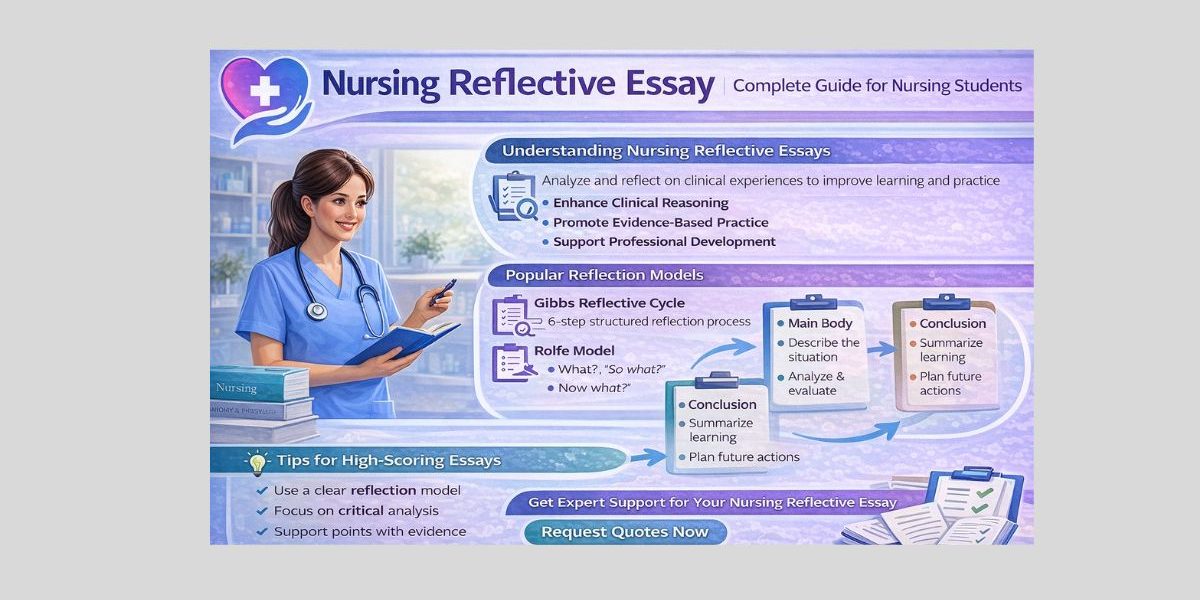
What Is a Nursing Reflective Essay and Why It Matters
A nursing reflective essay is a critical academic assignment that allows nursing students to analyze their clinical experiences and improve their professional practice. From the very beginning, understanding how to write a reflective essay in nursing helps students connect theory to practice, evaluate their actions, and develop deeper clinical insight.
Unlike traditional essays, a nursing reflection paper focuses on personal experience, structured analysis, and evidence-based learning. Therefore, it is not simply about describing events; instead, it requires critical thinking, self-awareness, and the ability to evaluate outcomes.
In nursing education, reflective writing is essential because it supports continuous professional development. As a result, students who master nursing reflective essay writing demonstrate stronger clinical reasoning, improved patient care, and higher academic performance.
What Is a Reflective Essay in Nursing?
A reflective essay in nursing is a structured piece of writing that examines a clinical experience and evaluates what was learned. It requires students to:
- Describe a situation or experience
- Analyze actions and decisions
- Reflect on outcomes
- Identify lessons learned
- Plan for future improvement
Importantly, a strong nursing reflective essay goes beyond storytelling. Instead, it demonstrates critical analysis and links experiences to professional standards and evidence-based practice.
Importance of Reflective Writing in Nursing Practice
Enhancing Clinical Reasoning
First, reflective writing improves clinical reasoning by encouraging students to analyze decisions and outcomes. Rather than simply performing tasks, nurses learn to evaluate why certain actions were effective or ineffective.
Promoting Evidence-Based Practice
In addition, a nursing reflection essay encourages the integration of research and clinical guidelines. This ensures that care decisions are based on best practices rather than assumptions.
Supporting Professional Development
Moreover, reflection helps nurses identify strengths and weaknesses. As a result, they can continuously improve their skills and adapt to complex healthcare environments.
Improving Patient Care
Ultimately, reflective practice leads to better patient outcomes. By learning from past experiences, nurses can deliver safer, more effective care.
Reflection Models Used in Nursing Reflective Essays
Understanding reflection models is essential when learning how to write a nursing reflective essay. These frameworks provide structure and guide critical thinking.
1. Gibbs Reflective Cycle in Nursing
The Gibbs Reflective Cycle is one of the most widely used models in nursing reflective writing.
Stages of Gibbs Model
- Description – What happened?
- Feelings – What were your thoughts?
- Evaluation – What was good or bad?
- Analysis – Why did it happen?
- Conclusion – What did you learn?
- Action Plan – What would you do differently?
This model is popular because it provides a clear, step-by-step structure.
2. Rolfe Reflective Model in Nursing
The Rolfe model simplifies reflection into three key questions:
- What?
- So what?
- Now what?
This approach is effective for concise nursing reflection essays and encourages focused analysis.
3. Driscoll Reflective Model
Similarly, the Driscoll model follows a structured approach:
- What happened?
- Why does it matter?
- What will you do next?
This model is particularly useful for linking experience to future practice.
Structure of a Nursing Reflective Essay
A well-written nursing reflective essay follows a clear academic structure.
1. Introduction
The introduction should:
- Briefly describe the experience
- State the purpose of reflection
- Identify the reflection model used
2. Main Body (Analysis Section)
The body of the essay should include:
- Description of the experience
- Analysis using a reflection model
- Evaluation of actions and outcomes
This section should demonstrate critical thinking and depth.
3. Conclusion
The conclusion should:
- Summarize key learning points
- Highlight professional growth
- Suggest future improvements
Step-by-Step Guide to Writing a Nursing Reflective Essay
Step 1: Choose a Relevant Clinical Experience
Select an experience that provides meaningful learning. For example:
- Patient interaction
- Clinical error
- Communication challenge
Step 2: Apply a Reflection Model
Use a structured framework such as Gibbs or Rolfe to organize your thoughts.
Step 3: Analyze the Experience Critically
Go beyond description. Ask:
- Why did this happen?
- What were the outcomes?
- What could have been done differently?
Step 4: Link to Theory and Practice
Support your reflection with:
- Nursing theories
- Clinical guidelines
- Research evidence
Step 5: Maintain Professional Tone
Even though reflection is personal, your writing must remain formal and academic.
Request Quotes Now
Need help writing a high-quality nursing reflective essay with proper structure and academic depth? Request quotes now for expert assistance.
Example of a Nursing Reflective Essay.
During a clinical placement, I encountered a patient who was anxious about a surgical procedure. Initially, I focused on completing routine tasks and did not address the patient’s emotional needs.
Using Gibbs Reflective Cycle, I realized that my approach lacked patient-centered care. Although clinical tasks were completed, the patient’s anxiety remained unaddressed. This highlighted the importance of communication and emotional support in nursing practice.
As a result, I learned to prioritize holistic care. In future situations, I will ensure that both physical and emotional needs are addressed effectively.
Common Mistakes in Nursing Reflective Essay Writing
1. Being Too Descriptive
Many students focus only on describing events rather than analyzing them.
2. Lack of Structure
Without a clear framework, reflections become disorganized.
3. Ignoring Evidence-Based Practice
Failing to link experiences to theory weakens the essay.
4. Overuse of Informal Language
Maintain a professional tone at all times.
Tips for Writing a High-Scoring Nursing Reflective Essay
- Use a clear reflection model
- Focus on critical analysis
- Support ideas with evidence
- Maintain logical flow
- Keep the writing concise and clear
Our Nursing Reflective Essay Writing Support
At NursingDissertationHelp.com, we specialize in helping nursing students produce high-quality academic work.
What We Offer
- Customized nursing reflective essays
- Expert use of reflection models
- Evidence-based academic writing
- Plagiarism-free content
Why Choose Us
- RN and PhD-level writers
- Nursing-specific expertise
- Confidential service
- Timely delivery
Request Quotes Now
Struggling with your nursing reflective essay assignment? Request quotes now and get professional academic support tailored to your needs.
Final Thoughts on Nursing Reflective Essay Writing
A well-written nursing reflective essay is a powerful tool for both academic success and professional growth. By applying structured reflection models, analyzing experiences critically, and linking practice to theory, students can develop strong clinical reasoning skills.
Ultimately, reflective writing is not just an academic requirement—it is a lifelong skill that enhances patient care and professional competence.
Request Quotes Now
Need a professionally written nursing reflective essay that meets academic standards? Request quotes now and boost your grades today.
FAQ Section
What is a nursing reflective essay?
A nursing reflective essay is an academic paper that analyzes clinical experiences to improve learning and practice.
Which model is best for nursing reflection?
Gibbs Reflective Cycle is the most commonly used model due to its structured approach.
How long should a nursing reflective essay be?
Typically between 1500–3000 words depending on academic requirements.
Can I use first person in a nursing reflective essay?
Yes, reflective essays often use first person while maintaining academic tone.
Why is reflective writing important in nursing?
It helps improve clinical reasoning, supports learning, and enhances patient care.
