

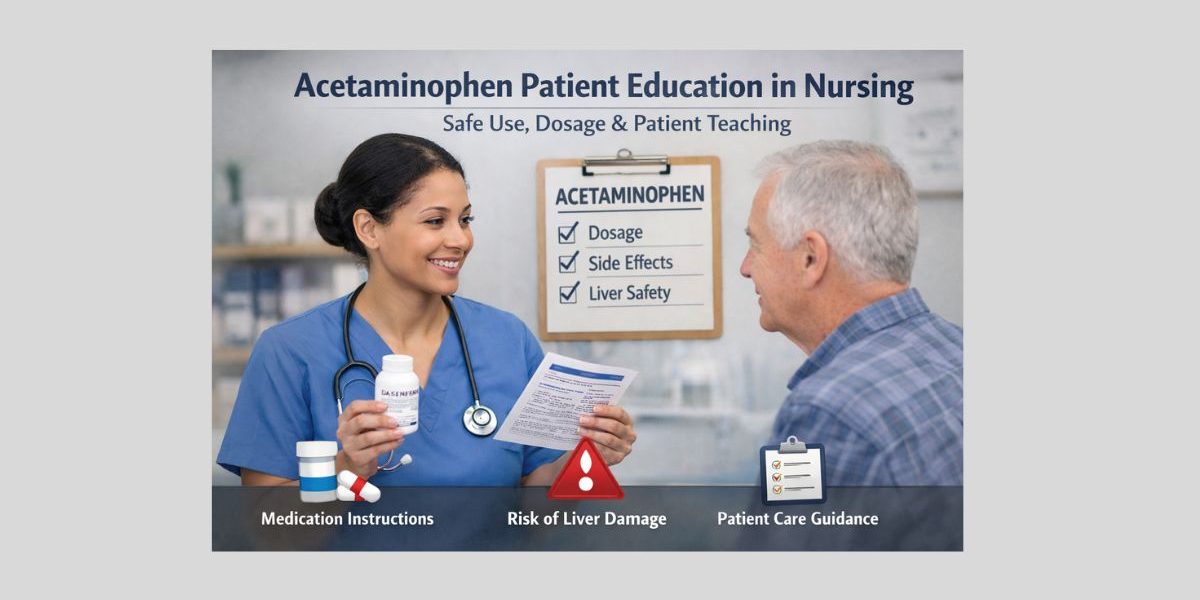
Acetaminophen Patient Education in Nursing Guide
Acetaminophen Patient Education in Nursing often gets rushed, yet dosing confusion and “hidden” ingredients can turn a trusted pain reliever into preventable harm.
Acetaminophen Patient Education in Nursing and the everyday risk
Acetaminophen (paracetamol) is one of the most commonly used medicines for pain and fever. A large outpatient clinic survey found that a significant minority of respondents were unaware of acetaminophen’s potential liver toxicity, and substantial confusion existed about regular-strength versus extra-strength products.[1] When patients cannot clearly answer “What is in this product?” they are at higher risk of stacking doses across brands and formulations.
From a nursing perspective, Acetaminophen Patient Education in Nursing is not “extra counselling”. It is a direct safety intervention. Clinical summaries of acetaminophen toxicity emphasize that unintentional overdoses are common, and they explicitly call out the need to educate patients about correct dosing and about acetaminophen’s presence in both prescribed and over-the-counter preparations.[2] In other words: many injuries happen not because patients are reckless, but because the system makes it easy to take “more than you meant to”.
Clinical summaries also underscore the scale of the problem. They report that acetaminophen poisoning contributes to tens of thousands of emergency department visits and thousands of hospitalizations annually in the United States, and they highlight that approximately half of cases are unintentional overdoses.[2] These figures are context-specific, but they explain why Acetaminophen Patient Education in Nursing is treated as a core safety skill rather than optional counselling. When we teach patients to calculate totals and avoid duplicate products, Acetaminophen Patient Education in Nursing directly targets the most common pathway into harm: accidental dosing mistakes.
A human, real-life pattern of error
Most errors are not dramatic. They look like this:
A person has a headache and takes two tablets. Later they develop a sore throat and take a “cold and flu” sachet. At bedtime they take a “night-time” product for sleep. Each product label is followed, but the total daily acetaminophen is never calculated. The PLOS ONE survey discussion explains how this can happen easily when patients assume extra-strength preparations are a different product rather than the same drug in a higher dose per tablet.[1]
That is exactly why Acetaminophen Patient Education in Nursing should always include the total-daily-dose concept and label-reading practice, not just a spoken number.
Why this matters clinically
Clinical summaries describe acetaminophen toxicity as a major contributor to severe liver injury and highlight that early recognition and prompt treatment reduce morbidity and mortality.[2] Therefore, the nurse who prevents a “small” dosing mistake is often preventing the start of an avoidable clinical escalation.
Challenges nurses face when teaching acetaminophen safely
The biggest barrier to effective medication teaching is not knowledge, it is communication in the real world. Nurses frequently teach at discharge, in noisy environments, with patients who are tired, uncomfortable, worried, or multi-tasking.
A teach-back systematic review summarizes a central problem: patients often have limited ability to recall what they have been told, and evidence shows that less than half of medication and diet information is accurately recalled.[3] This is why repeating information and checking understanding are part of safe care, not a “soft skill”.
Why patients forget what we say
The teach-back literature describes a “communication gap” where clinicians may overestimate how clear their explanations are, while patients leave consultations with incomplete or incorrect recall.[3] It also notes that patients frequently misunderstand medical terminology and that recall of information is an important mediator for adherence.[3]
In practical terms, Acetaminophen Patient Education in Nursing should assume misunderstanding is normal. Therefore, build in redundancy: say it, show it on the label, write it down, and check it back.
Time pressure and competing priorities
Medication education often competes with transport, meals, pain control, and family updates. Research into nurses’ medication education behaviors suggests that even when nurses value medication education, limited time can constrain what is delivered at transitions of care.[4]
This is where Acetaminophen Patient Education in Nursing benefits from a repeatable structure: a 2–3 minute micro-script, a written plan, and one teach-back question that fits into routine work.
Health literacy and label overload
Even motivated patients may struggle with:
- multiple names for the same ingredient (acetaminophen vs paracetamol),
- different strengths (325 mg, 500 mg, 650 mg),
- multiple formulations (liquid, tablet, sustained release),
- abbreviations such as “APAP”.
In a study of patient knowledge about OTC acetaminophen, unfamiliarity with the abbreviation “APAP” was highlighted as a problem that can contribute to inadvertent excessive dosing.[5] In practice, this means Acetaminophen Patient Education in Nursing should teach patients to scan for the full ingredient name, not abbreviations or brand names.
Pain and fever change decision-making
Pain makes people impatient. Fever makes people anxious. Both can push patients to “top up” earlier than planned. Therefore, Acetaminophen Patient Education in Nursing must include “what to do when symptoms return early” and “when to stop self-treatment and seek assessment”.
Acetaminophen Patient Education in Nursing basics nurses can teach with confidence
Strong Acetaminophen Patient Education in Nursing starts with plain explanations, then moves quickly to a practical plan.
Clarify purpose, expectations, and names
Clinical summaries describe acetaminophen as an analgesic and antipyretic: it helps with pain and fever.[6] It does not act as a primary anti-inflammatory medicine, so it may not be the best option if inflammation is the main driver of pain.
When you start Acetaminophen Patient Education in Nursing, address naming clearly:
- “Acetaminophen and paracetamol are the same ingredient.”
- “Different brands can contain the same ingredient.”
- “Extra strength usually means more milligrams per dose, not a different drug.”
This is short, but it prevents double-dosing across medicines.
Dosing basics
Your facility protocol and the product label are the final authority. Still, nurses need an evidence-based structure to explain safe timing and safe totals.
An NCBI Bookshelf summary of acetaminophen dosing describes adult/adolescent dosing patterns (for ≥50 kg) such as 1000 mg every 6 hours or 650 mg every 4 hours, with minimum intervals, maximum single doses, and an emphasis that maximum daily dosage should not exceed 4000 mg.[7] The same source stresses that the “maximum daily allowable dosage” must include all routes and all formulations containing acetaminophen.[7]
Teaching daily maximums without confusing patients
You will see both “3,000 mg” and “4,000 mg” discussed in clinical resources and product labels. One NCBI Bookshelf acetaminophen summary states an overall maximum daily dosage should not exceed 4,000 mg for adults and adolescents ≥50 kg, while a toxicity-focused summary describes typical therapeutic dosing in adults with a maximum daily dose of 3 g/day.[8]
In Acetaminophen Patient Education in Nursing, your safest phrasing is:
- “Follow the maximum on your specific product label, and do not combine products that both contain acetaminophen.”
- “If you need acetaminophen more than a few days in a row, or you have liver risk factors, check what limit is safest for you.”[8]
That keeps the message accurate without turning counselling into a debate.
Education-focused dosing table
Use this only as a teaching framework; always confirm with local policy and product labelling.
| Patient group | How to explain spacing and counting doses | Maximum-dose concept to teach | Why it matters for patient education |
|---|---|---|---|
| Adults/adolescents ≥50 kg | “Wait at least 4 hours between doses unless your clinician says otherwise.”[7] | “From all products combined, do not exceed 4,000 mg in 24 hours.”[7] | Prevents stacking across cold remedies and pain relievers. |
| Adults/adolescents <50 kg | “Your dose depends on your weight; follow your clinician’s plan.”[7] | “Max is weight-based (e.g., 75 mg/kg/day) up to a cap.”[7] | Protects smaller adults from exceeding dose limits. |
| Children 2–12 | “Dose by weight and measure liquids carefully.”[8] | “Max daily total is typically weight-based (e.g., 75 mg/kg/day).”[8] | Reduces common pediatric dosing errors. |
| Neonates | “Neonate dosing must follow neonatal protocols.”[7] | “Max daily totals are lower in neonates in clinical summaries.”[7] | Neonates are more vulnerable; avoid estimation. |
The single sentence that prevents many mistakes
In Acetaminophen Patient Education in Nursing, the safest habit to teach is this:
“Add up all acetaminophen from all medicines you take in one day.”
Clinical summaries repeat this theme: liver injury is associated with high doses and can occur when patients take multiple acetaminophen-containing products.[8]
Acetaminophen Patient Education in Nursing safety checklist for home use
When patients go home, they do not have a medication chart on a wall. They have pain, work, and a cupboard of mixed products. Acetaminophen Patient Education in Nursing should therefore focus on what the patient can do in 30 seconds at home.
Teach label-reading as a skill
The PLOS ONE acetaminophen awareness survey showed confusion about product strength and about what “extra strength” means.[1] That is why nurses should practice label-reading with the patient.
A short step-by-step teaching routine:
- Point to the active ingredient line and read it together.
- Circle the strength per tablet or per 5 mL.
- Circle the maximum per 24 hours.
- Ask the patient to show you where it is written.
Then use teach-back.
Case scenario with a “dose math” moment
Use this scenario for teaching (and it also works well in nursing assignments):
A patient takes 2 tablets of 325 mg acetaminophen four times daily. That total is 2,600 mg/day. If the same patient switches to 2 tablets of 650 mg four times daily, the total becomes 5,200 mg/day beyond common recommended limits.
The PLOS survey discussion explains how simply switching to higher-strength preparations without adjusting the number of pills can unintentionally push patients far beyond a 4 g/day total.[1] In Acetaminophen Patient Education in Nursing, teaching “milligrams per day” is more reliable than teaching “number of pills”.
The “hidden acetaminophen” rule
Teach patients that acetaminophen can hide inside:
- cold and flu multi-symptom products,
- prescription pain combinations (including some opioids),
- migraine combinations,
- night-time pain products.
Clinical reviews emphasize that unintentional overdoses highlight the need to educate patients about acetaminophen’s presence in multiple OTC and prescription preparations.[2]
Because dosing errors can occur, especially in children, many clinical references highlight the importance of preventing pediatric dosing mistakes and ensuring the total daily dose does not exceed the recommended maximum when accounting for all medicines containing acetaminophen.[7] In Acetaminophen Patient Education in Nursing, that translates into two simple actions: teach caregivers to use a measuring device (not a kitchen spoon) and to keep a written log of dose times and amounts.
A patient-facing safety checklist
Here is a checklist you can use verbally or provide as a handout. It keeps Acetaminophen Patient Education in Nursing practical.
| Patient question | What you want the patient to do | Nurse phrasing that works |
|---|---|---|
| “Is this acetaminophen?” | Check the active ingredient line. | “Look for ‘acetaminophen’ or ‘paracetamol’—not just the brand.” |
| “How strong is it?” | Check mg per tablet or per 5 mL. | “Extra strength means more milligrams, so you may need fewer doses.”[1] |
| “Can I take this with my cold medicine?” | Avoid double-ingredient use; check both labels. | “Do not take two products that both contain acetaminophen.”[2] |
| “What if the pain returns early?” | Use non-drug measures and seek advice rather than extra doses. | “Don’t top up early—call if it’s not controlled.” |
| “When should I get help?” | Seek urgent advice if over the limit or unsure. | “If you think you took too much, get help immediately.”[2] |
Scholarly sources you can link in patient materials or academic work
If you need credible links for Acetaminophen Patient Education in Nursing, these sources are widely used:
- NCBI Bookshelf: Acetaminophen[9]
- NCBI Bookshelf: Acetaminophen Toxicity[10]
- Acetaminophen public awareness survey in PLOS ONE[1]
High-risk situations and when to escalate care
A complete education plan includes a safety layer. In Acetaminophen Patient Education in Nursing, treat risk screening as part of the teaching, not a separate task.
Liver disease, alcohol use, and depleted reserves
Clinical summaries list severe hepatic impairment or active liver disease as contraindications and recommend caution and dose reduction in mild hepatic impairment.[7] They also describe chronic alcohol misuse as a risk factor for acetaminophen toxicity through metabolic changes, including increased production of toxic metabolites and reduced detoxification capacity.[8]
A patient-friendly way to say it:
- “If you have liver trouble, don’t guess your dose—ask.”
- “If you drink alcohol most days, you may need a lower limit.”
- “If you’re not eating well, your body may be less able to handle high doses.”
Warfarin and anticoagulation
Clinical summaries warn that prolonged high-dose acetaminophen has been associated with increased INR in patients taking warfarin and suggest more frequent INR monitoring.[7] A systematic review and meta-analysis reported a significant INR increase in anticoagulated patients and suggested a dose-dependent effect.[11]
Therefore, in Acetaminophen Patient Education in Nursing, teach warfarin patients to:
- inform their anticoagulation clinic if they use acetaminophen regularly,
- avoid sustained high-dose use without monitoring.
Renal impairment and older adults
Clinical summaries advise that in severe renal impairment (e.g., low creatinine clearance), clinicians may extend dosing intervals and reduce daily totals.[7] The same source references geriatric dosing approaches and notes that in older adults with hepatic impairment or alcohol misuse history, maximum doses may need to be reduced substantially.[7]
This fits a simple nurse rule: “If you’re older or have kidney or liver issues, use the lowest effective dose and check in before using it for many days.”
Pregnancy and breastfeeding
Clinical summaries state that obstetric guidance considers acetaminophen safe in pregnancy, while noting that observational research has explored possible developmental associations that remain inconclusive.[7] The same source states acetaminophen is suitable in breastfeeding, with low levels in breast milk relative to typical infant dosing and infrequent reports of adverse effects.[7]
Your clinical message in Acetaminophen Patient Education in Nursing can be:
- “Use the lowest effective dose for the shortest time.”
- “Avoid multi-symptom cold products unless advised.”
- “If you need daily use, ask your clinician.”
Overdose: what to teach and when to act
Clinical summaries describe therapeutic dosing ranges and toxicity thresholds, and they emphasize that early antidote treatment is most effective when delivered early after overdose.[2]
Patient education should focus on action, not pathology:
- If you exceed the recommended dose (or you are not sure), seek urgent advice immediately.
- Bring the packaging or take a photo to help calculate the total.
- Do not wait for symptoms, because early symptoms can be mild or non-specific.[2]
How to deliver Acetaminophen Patient Education in Nursing using teach-back
Even the most accurate medication teaching fails if the patient cannot repeat it. That is why teach-back is central to Acetaminophen Patient Education in Nursing.
Teach-back: the method in one paragraph
Teach-back is a structured education approach where you explain, then check the patient’s understanding by asking them to explain back in their own words. If they misunderstand, you clarify and check again until they can correctly recall the information.[3]
Evidence also supports teach-back as a practical strategy that improves outcomes like disease knowledge, adherence, and self-efficacy in health education contexts.[12]
A teach-back script you can copy into practice
Use this short script to standardize Acetaminophen Patient Education in Nursing:
- “I want to be sure I explained this clearly. How will you take this at home?”
- “What is the maximum total acetaminophen you should take in 24 hours?”
- “Which medicines will you check so you don’t double-dose?”
- “What will you do if you feel you took too much?”
This script is short enough for a busy ward and effective enough to catch misunderstandings.
Plain language and good design
Plain language reduces risk without reducing respect. A university guide on plain language and good design for medication information emphasizes clear questions, short answers, and practical formatting for older adults.[13]
In Acetaminophen Patient Education in Nursing, that means:
- use short sentences,
- avoid jargon (“hepatotoxicity” becomes “can harm your liver”),
- write the plan down,
- use a simple dosing schedule.
Documenting patient education
Documentation supports continuity of care and risk management. Consider documenting:
- the product name and strength discussed,
- the total daily maximum you taught and that it includes all sources,
- that teach-back was used and the patient repeated the plan,
- risk factors flagged (liver disease, alcohol, anticoagulation).
That documentation turns Acetaminophen Patient Education in Nursing into a measurable practice rather than an informal chat.
Benefits of ethical academic support for acetaminophen education projects
Nursing students and clinicians often need to translate Acetaminophen Patient Education in Nursing into assignments, patient leaflets, posters, policy updates, or evidence-based practice projects. Doing that well requires two things at once: clinical accuracy and academic clarity. That is why many students seek coaching specifically for Acetaminophen Patient Education in Nursing assignments: they need speed, accuracy, and ethical boundaries.
What ethical support should do
Ethical support should help you build skills and strengthen your own work. For acetaminophen education projects, that may include:
- finding and summarizing credible sources,
- creating a clear outline aligned to a rubric,
- editing for clarity and correct referencing,
- coaching you on how to justify your education plan.
You can review the team approach and service boundaries on the About Us page.
How the process works and what to look for
A transparent process reduces stress and protects academic integrity. A clear walkthrough of steps is available on the How it Works page.
Before committing, it is reasonable to check cost clarity and protections. You can review nursing dissertation pricing and the refund policy.
For credibility, look for real examples of successful support, such as published case studies samples.
Matching support to your nursing workload
Different projects need different types of help. If you are working under tight deadlines, you may look for coursework help for nursing students or more targeted nursing assignment help.
If you are writing academically about medication safety, evidence appraisal, or patient education outcomes, you may benefit from nursing research paper help.
If you are working on a practice-based doctorate or quality improvement work, specialist DNP dissertation help may be relevant.
Finally, if your project includes data work, such as auditing education outcomes or analyzing survey results, support options include dissertation data analysis help, regression analysis help, inferential statistics coaching, and qualitative data analysis support.
Ethical considerations and academic integrity
Ethical support strengthens learning. Contract cheating undermines it. A university academic integrity page defines contract cheating as having academic work completed on a student’s behalf and then submitting it as the student’s own work.[18]
So, use support to learn how to do Acetaminophen Patient Education in Nursing better through coaching and editing and not to outsource authorship.
FAQs and next steps for Acetaminophen Patient Education in Nursing
What is the most important safety message for patients?
In Acetaminophen Patient Education in Nursing, the highest-yield message is: do not exceed the maximum daily total from all sources, and always check combination products. Clinical summaries stress maximum daily totals and highlight the risk from multiple acetaminophen-containing products.[8]
How do I teach “extra strength” in a way patients remember?
Use a package comparison and point to milligrams per dose. The PLOS ONE survey describes substantial misunderstanding about extra-strength preparations being the same drug in a higher dose, which can lead to unintended high daily totals.[1] In Acetaminophen Patient Education in Nursing, teach “milligrams per day”, not “number of tablets”.
What is the fastest way to check understanding?
Use teach-back. Teach-back is defined as checking understanding by having the patient explain back what they understood, clarifying errors, and checking again until correct.[3] Even a single teach-back question can catch the common “I can take this with my cold medicine” mistake.
What should I emphasize for patients who drink alcohol?
Emphasize that alcohol use increases toxicity risk and that they should not self-escalate doses or use high doses for extended periods without advice. Clinical summaries describe chronic alcohol misuse as a risk factor through metabolic effects.[8]
What is the key counselling point for patients on warfarin?
Warn them about INR changes if they use acetaminophen regularly, especially at higher doses, and advise contacting the anticoagulation team for monitoring.[19]
I’m writing an assignment on this topic—what support is ethical?
Ethical support includes evidence searching, outlining, editing, and coaching while you remain the author. Avoid outsourcing the work. University definitions of contract cheating focus on work completed on a student’s behalf and submitted as their own.[18]
Final call to action
Treat Acetaminophen Patient Education in Nursing as a clinical intervention: show the label, teach the total daily limit across all products, and use teach-back until the patient can repeat the plan confidently.[20]
Finally, if you want help turning this topic into an excellent, ethical nursing assignment or patient handout, you can place an order here.
[1] https://journals.plos.org/plosone/article?id=10.1371%2Fjournal.pone.0229070
https://journals.plos.org/plosone/article?id=10.1371%2Fjournal.pone.0229070
[2] [10] https://www.ncbi.nlm.nih.gov/books/NBK441917/
https://www.ncbi.nlm.nih.gov/books/NBK441917/
[3] [20] https://journals.plos.org/plosone/article/file?id=10.1371%2Fjournal.pone.0231350&type=printable
https://journals.plos.org/plosone/article/file?id=10.1371%2Fjournal.pone.0231350&type=printable
[4] https://pubmed.ncbi.nlm.nih.gov/28690696/
https://pubmed.ncbi.nlm.nih.gov/28690696/
[5] https://www.sciencedirect.com/science/article/abs/pii/S1544319115301321
https://www.sciencedirect.com/science/article/abs/pii/S1544319115301321
[6] [7] [8] [9] [19] https://www.ncbi.nlm.nih.gov/books/NBK482369/
https://www.ncbi.nlm.nih.gov/books/NBK482369/
[11] https://www.sciencedirect.com/science/article/abs/pii/S0049384814005672
https://www.sciencedirect.com/science/article/abs/pii/S0049384814005672
[12] https://cre-ckd.centre.uq.edu.au/files/702/a2016_JBI_The%20effectiveness%20of%20the%20teach-back.pdf
https://cre-ckd.centre.uq.edu.au/files/702/a2016_JBI_The%20effectiveness%20of%20the%20teach-back.pdf
[13] https://ogg.osu.edu/media/documents/health_lit/goodmed_e.pdf
https://ogg.osu.edu/media/documents/health_lit/goodmed_e.pdf
[18] https://www.auckland.ac.nz/en/staff/education-office/academic-integrity/academic-integrity-policies-and-guidelines/contract-cheating.html
