

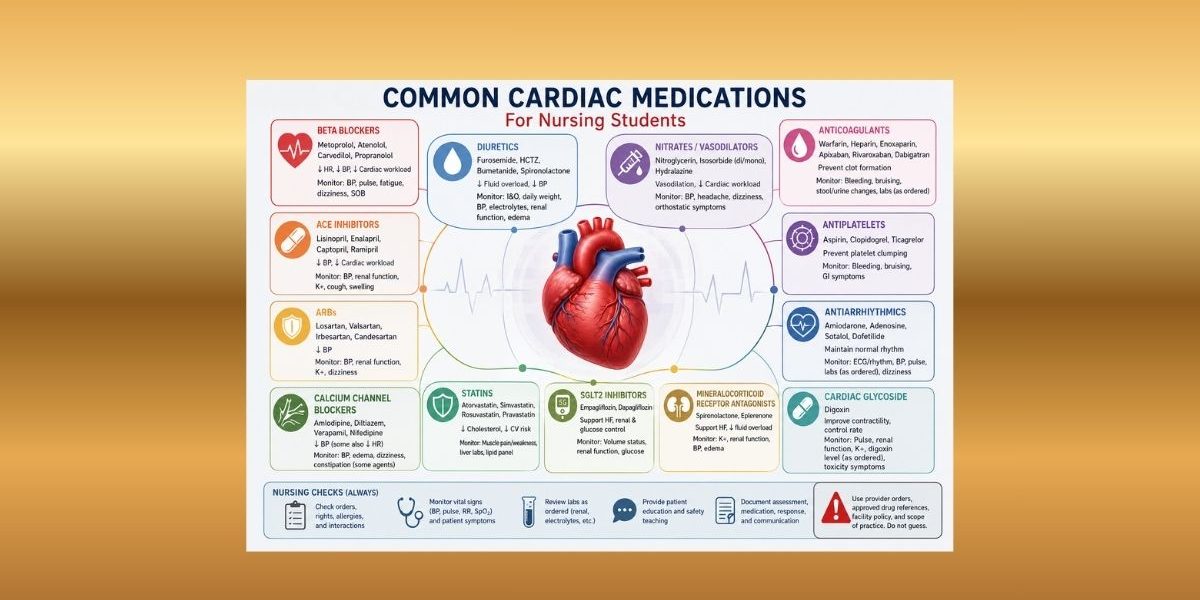
Common cardiac medications are easier to understand when nursing students recognize the medication name, class, monitoring priorities, adverse-effect concerns, patient education points, and documentation needs. Many students see cardiac medication names in lectures, medication cards, case studies, simulation labs, and clinical rotations but struggle to connect those names with safe nursing responsibilities.
This article explains common cardiac medications grouped by class. It focuses on medication recognition, nursing monitoring, safety checks, adverse-effect awareness, patient education, documentation, cue clustering, and common student mistakes.
This guide is for nursing education and pharmacology learning only. Cardiac medication use must follow provider orders, medication labels, approved drug references, facility policy, pharmacist guidance, instructor guidance, and scope of practice.
This article is not an exhaustive cardiac medication database. Students should use approved drug guides, course materials, facility policy, medication labels, pharmacist guidance, provider orders, and instructor direction for medication-specific details. Students who need the wider overview can review the full cardiac medications for nursing students guide, while those who need deeper class-by-class explanation can also review the classes of cardiac medications guide.
Quick Answer: What Are Common Cardiac Medications?
- Common cardiac medications include frequently encountered drugs used for blood pressure, heart rate, rhythm, fluid balance, clotting, cholesterol, or cardiac workload when ordered.
- Nursing students should recognize medication names by class rather than memorizing isolated drug names.
- Common classes include beta blockers, ACE inhibitors, ARBs, ARNIs, calcium channel blockers, diuretics, nitrates, anticoagulants, antiplatelets, antiarrhythmics, cardiac glycosides, statins, SGLT2 inhibitors, and mineralocorticoid receptor antagonists.
- Nurses monitor vital signs, rhythm context, renal function, electrolytes, bleeding risk, fall risk, fluid balance, patient symptoms, and adverse effects depending on the medication and order.
- Nurses do not independently choose, dose, hold, titrate, restart, or adjust cardiac medications unless following provider orders and facility policy.
- Medication-specific details must come from approved drug references, provider orders, pharmacist guidance, facility policy, and instructor guidance.
What Makes a Cardiac Medication “Common” in Nursing?
A cardiac medication is “common” when nursing students are likely to encounter it in pharmacology lectures, medication cards, adult health, medical-surgical nursing, older adult care, cardiac units, chronic disease care, and case studies. Common cardiac medications often appear in assignments because they connect directly to assessment, vital signs, labs, patient education, and documentation.
Common does not mean simple nor safe for every patient. It does not mean the nurse chooses it. Common does not mean every institution uses the same medication in the same way. It only means the medication name or class is frequently encountered in nursing education and clinical care.
The American Heart Association lists several cardiovascular medication groups students commonly study, including ACE inhibitors, ARBs, beta blockers, calcium channel blockers, diuretics, nitrates, anticoagulants, antiplatelets, and cholesterol-lowering medications (American Heart Association, 2025a).
For nursing students, the goal is not to memorize every cardiac medication in existence. The goal is to recognize common medication names, identify the class, understand what assessment areas matter, and know when to report concerns.
Common Cardiac Medications by Class
This table gives a practical overview. It is not a complete cardiac medications list, drug database, or prescribing reference.
| Class | Common examples | Main nursing recognition point | Key monitoring focus |
|---|---|---|---|
| Beta blockers | Metoprolol, atenolol, carvedilol, propranolol, labetalol | Often connected to heart rate, BP, and workload | BP, pulse, fatigue, dizziness, symptoms |
| ACE inhibitors | Lisinopril, enalapril, captopril, ramipril | Many end in “-pril” | BP, renal function, potassium, cough, swelling symptoms |
| ARBs | Losartan, valsartan, irbesartan, candesartan | Many end in “-sartan” | BP, renal function, potassium, dizziness |
| ARNIs | Sacubitril/valsartan | Modern heart failure pharmacology concept | BP, renal function, potassium, fluid symptoms |
| Calcium channel blockers | Amlodipine, diltiazem, verapamil, nifedipine | Some are more vascular-focused; some affect rate more | BP, pulse where relevant, edema, dizziness |
| Diuretics | Furosemide, hydrochlorothiazide, bumetanide, spironolactone | Fluid balance and electrolyte awareness | I&O, daily weight, edema, BP, renal function, electrolytes |
| Nitrates/vasodilators | Nitroglycerin, isosorbide dinitrate, isosorbide mononitrate, hydralazine | Vessel relaxation and workload reduction concepts | BP, headache, dizziness, orthostatic symptoms |
| Anticoagulants | Warfarin, heparin, enoxaparin, apixaban, rivaroxaban, dabigatran | Bleeding-risk monitoring | Bruising, bleeding, stool/urine changes, ordered labs |
| Antiplatelets | Aspirin, clopidogrel, ticagrelor | Platelet-related clot prevention | Bleeding, bruising, GI symptoms, education |
| Antiarrhythmics | Amiodarone, adenosine, sotalol, dofetilide | Rhythm-related medications differ widely | ECG/rhythm context, pulse, BP, ordered labs |
| Cardiac glycosides | Digoxin | High-yield nursing-school medication | Pulse, renal function, potassium, toxicity symptoms |
| Statins | Atorvastatin, simvastatin, rosuvastatin, pravastatin | Cholesterol-lowering therapy | Muscle symptoms, liver-related labs where ordered, adherence |
| SGLT2 inhibitors | Empagliflozin, dapagliflozin | Cardiac, renal, and endocrine overlap | Volume status, renal function, glucose context |
| Mineralocorticoid receptor antagonists | Spironolactone, eplerenone | Potassium and fluid-status awareness | Potassium, renal function, BP, fluid status |
Medication-name recognition helps students identify a likely class, but it never replaces order verification, allergy review, patient assessment, approved drug references, facility policy, pharmacist guidance, provider orders, or instructor direction.
Medication Name Clues Nursing Students Should Recognize
Medication suffixes can help students organize common cardiovascular medications, but suffix recognition is not enough for safe practice. Some medications do not follow simple patterns, and some names may confuse students. Always verify the medication using approved references.
| Name clue | Common examples | Likely class connection | Nursing caution |
|---|---|---|---|
| -olol | Metoprolol, atenolol, propranolol, labetalol | Often beta blockers | Verify class and medication-specific checks. Do not rely on suffix alone. |
| -pril | Lisinopril, enalapril, captopril, ramipril | Often ACE inhibitors | Think BP, renal function, potassium, cough, and swelling symptoms where relevant. |
| -sartan | Losartan, valsartan, candesartan, irbesartan | Often ARBs | Related to ACE inhibitors but not interchangeable without an order. |
| -statin | Atorvastatin, rosuvastatin, simvastatin, pravastatin | Often statins | Think adherence, muscle symptoms, and ordered lipid/liver-related labs. |
| No simple suffix | Warfarin, heparin, nitroglycerin, digoxin, amiodarone | Varies by medication | Memorize by class and verify with approved references. |
This recognition table supports learning, but it is not a medication administration tool. Before administration, students must still check the MAR, medication label, order, patient identity, allergies, route, time, dose as ordered, patient condition, and facility policy.
Common Beta Blockers
Common beta blockers students may encounter include metoprolol, atenolol, carvedilol, propranolol, and labetalol. Many beta blockers end in “-olol,” which can help with recognition. However, suffix recognition is only a starting point. Students must still verify the medication with the MAR, medication label, provider order, and approved drug reference.
Beta blockers may reduce heart rate, lower blood pressure, and decrease cardiac workload. The American Heart Association describes beta blockers as medications that can prevent the heart from beating too quickly and forcefully (American Heart Association, 2025b).
Nursing monitoring often includes blood pressure, pulse, dizziness, fatigue, weakness, activity tolerance, and symptoms. Students should avoid treating a pulse or BP number as an isolated fact. A lower-than-usual pulse becomes more meaningful when the patient also reports dizziness, fatigue, faintness, shortness of breath, or a new decrease in activity tolerance.
Patient education may include taking the medication as prescribed, not stopping it suddenly unless instructed by the provider, and reporting dizziness, fainting, severe weakness, worsening shortness of breath, or symptoms that affect normal activity.
Documentation should include BP, pulse, patient symptoms, medication administration, patient education, response, and any communication with the RN, instructor, preceptor, pharmacist, or provider. Do not use universal hold parameters.
Common ACE Inhibitors
Common ACE inhibitors include lisinopril, enalapril, captopril, and ramipril. Many ACE inhibitors end in “-pril,” which helps students identify the class.
ACE inhibitors are commonly discussed in blood pressure, cardiovascular, renal, and heart failure-related contexts. They may relax blood vessels and reduce cardiac workload when ordered. Nursing students should connect ACE inhibitors with BP, renal function, potassium, dizziness, cough where relevant, and angioedema awareness.
ACE inhibitors are important in nursing pharmacology because they show how one medication can connect cardiovascular assessment with renal and electrolyte monitoring. A student should not only ask, “What does this medication lower?” A stronger question is, “What vital signs, labs, symptoms, and safety cues matter for this patient?”
Monitoring may include:
- Blood pressure.
- Dizziness or orthostatic symptoms.
- Renal function where ordered.
- Potassium where ordered.
- Cough where relevant.
- Swelling of the face, lips, tongue, or airway-related symptoms as safety concerns.
- Patient response and education needs.
Patient education may include taking the medication as prescribed, reporting dizziness or swelling symptoms, keeping ordered lab appointments, and asking a pharmacist or provider before adding new OTC medications or supplements.
Documentation should include BP, symptoms, education, lab-related communication where assigned, and any clarification or reporting. Do not give dose adjustment or substitution advice.
Common ARBs
Common ARBs include losartan, valsartan, irbesartan, and candesartan. Many ARBs end in “-sartan,” which can help students recognize the class.
ARBs are often compared with ACE inhibitors because both relate to the renin-angiotensin system and may appear in blood pressure, cardiac, and renal contexts. However, students should not treat ACE inhibitors and ARBs as interchangeable. Substitution or medication selection belongs to provider-guided care.
Nursing monitoring for ARBs may include:
- Blood pressure.
- Dizziness or faintness.
- Renal function where ordered.
- Potassium where ordered.
- Patient symptoms.
- Therapeutic response.
- Adverse effects according to approved references.
Patient education may include taking the medication as prescribed, reporting dizziness or concerning symptoms, attending ordered lab follow-up, and avoiding medication changes unless directed by the provider.
Documentation should include vital signs, patient symptoms, education, and reporting of renal or electrolyte concerns according to facility policy.
Common ARNIs
The common ARNI example students usually encounter is sacubitril/valsartan. ARNIs may appear in modern cardiac and heart failure pharmacology education.
Current as of May 2026, the 2022 AHA/ACC/HFSA heart failure guideline discusses ARNIs and SGLT2 inhibitors among key medication categories used in selected heart failure contexts (Heidenreich et al., 2022).
For nursing students, ARNI learning should stay focused on monitoring rather than treatment algorithms. Students should monitor blood pressure, renal function where ordered, potassium where ordered, dizziness, fluid-related symptoms, patient response, and medication adherence.
Patient education should reinforce provider and pharmacist instructions, ordered follow-up, symptom reporting, and avoiding independent medication changes. Documentation should include BP, symptoms, fluid-related assessment where relevant, patient response, education, and communication with the RN, preceptor, pharmacist, or provider when concerns arise.
Do not use ARNI content to create a heart failure medication protocol or prescribing sequence.
Common Calcium Channel Blockers
Common calcium channel blockers include amlodipine, diltiazem, verapamil, and nifedipine. Nursing students should recognize that medications in this class may differ. Some calcium channel blockers are more associated with vascular effects, while others may have more heart-rate or conduction relevance.
At a nursing-student level, the key is not advanced cardiology. The key is safe recognition. If a medication lowers blood pressure or relaxes vessels, students should think about BP, dizziness, edema, and fall risk. If it can affect heart rate, pulse and rhythm context may also matter.
Nursing monitoring may include:
- Blood pressure.
- Pulse where relevant.
- Dizziness or faintness.
- Edema.
- Constipation where relevant.
- Patient response.
- Fall risk if dizziness or hypotension occurs.
Patient education may include taking the medication as prescribed, reporting dizziness, swelling, constipation concerns, or worsening symptoms, and following provider or pharmacist instructions.
Documentation should include BP, pulse where relevant, edema or symptom assessment, education, and communication about adverse effects or unclear orders.
Common Diuretics
Common diuretics include furosemide, hydrochlorothiazide, bumetanide, and spironolactone. Students often learn common subtypes such as loop diuretics, thiazide diuretics, and potassium-sparing diuretics. Spironolactone also overlaps with mineralocorticoid receptor antagonist learning.
Diuretics are common cardiac medications because they connect directly to fluid balance, blood pressure, edema, lung sounds, daily weight, renal function, electrolytes, and fall risk. They are not assessed only by urine output.
A patient receiving a diuretic may show improvement in swelling or breathing, but may also develop dizziness, weakness, dehydration signs, low BP, or electrolyte concerns. Nursing students should cluster cues rather than focus on one finding.
Nursing monitoring may include:
- Intake and output.
- Daily weight where ordered.
- Edema.
- Lung sounds where relevant.
- Blood pressure.
- Urine output.
- Potassium, sodium, magnesium, and renal function where ordered.
- Signs of dehydration.
- Dizziness and fall risk.
Patient education may include following ordered fluid, diet, weight, and lab instructions; reporting dizziness or severe weakness; and taking the medication as prescribed. Students should not independently teach potassium replacement decisions or medication adjustments.
Documentation should include I&O, daily weight where ordered, edema, lung sounds where relevant, BP, symptoms, education, lab concerns where assigned, and notifications.
Common Nitrates and Vasodilators
Common nitrates include nitroglycerin, isosorbide dinitrate, and isosorbide mononitrate. Hydralazine is a common vasodilator students may encounter. Nitrates cause vasodilation and can be associated with adverse effects such as headache, dizziness, and hypotension (Lee & Gerriets, 2023).
Nursing students should connect nitrates and vasodilators with blood pressure, headache, dizziness, orthostatic symptoms, symptom response, and fall risk. This section is not a chest pain protocol and should not be used to teach emergency algorithms, dosing, or treatment decisions.
Monitoring may include:
- Blood pressure before and after administration where required.
- Headache.
- Dizziness or faintness.
- Orthostatic symptoms.
- Weakness.
- Fall risk.
- Patient-reported symptom response.
Patient education should follow provider orders, medication labels, pharmacist instructions, and facility-approved teaching. Documentation should include vital signs, symptoms, patient response, education, and notifications.
Because common cardiac medications may be administered by oral, sublingual, transdermal, injectable, IV, or other ordered routes depending on the medication and setting, students should review medication administration routes when preparing for clinical medication administration.
Common Anticoagulants
Common anticoagulants include warfarin, heparin, enoxaparin, apixaban, rivaroxaban, and dabigatran. These medications reduce clot formation risk when ordered. They are frequently encountered in nursing because they require bleeding-risk awareness.
MedlinePlus explains that blood thinners help prevent blood clots, and bleeding is an important adverse-effect concern. The American Heart Association also distinguishes anticoagulants and antiplatelet drugs as two major types of medications commonly called blood thinners (MedlinePlus, 2024; American Heart Association, 2025a).
Nursing monitoring for anticoagulants may include:
- Bruising.
- Bleeding gums.
- Nosebleeds.
- Blood in urine.
- Black, tarry, or bloody stool.
- Prolonged bleeding from small cuts.
- Fall risk.
- Head injury concerns.
- Ordered labs where applicable.
- Medication interactions according to approved references.
- Patient understanding of bleeding precautions.
Patient education may include reporting bleeding concerns, keeping an updated medication list, avoiding unsafe self-adjustment, asking a pharmacist or provider before taking new OTC medications or supplements, and following ordered lab or follow-up appointments.
Documentation should include bleeding assessment, bruising, patient education, ordered lab communication where assigned, fall-risk concerns, patient response, and notifications.
Do not provide reversal-agent instructions, INR adjustment rules, bridging protocols, perioperative hold instructions, individual anticoagulant pathways, or dose protocols.
Common Antiplatelets
Common antiplatelets include aspirin, clopidogrel, and ticagrelor. Antiplatelets reduce platelet clumping when ordered. At a nursing-student level, the basic distinction is that anticoagulants affect clotting pathways, while antiplatelets affect platelet activity. Both can increase bleeding-risk concerns, but they are not the same class.
Nursing monitoring may include:
- Bruising.
- Bleeding gums.
- Nosebleeds.
- Blood in stool or urine.
- GI discomfort where relevant.
- Medication adherence.
- Patient understanding.
- Interaction awareness according to approved references.
- Fall and injury risk.
Patient education may include taking the medication as prescribed, reporting bleeding symptoms, avoiding medication changes unless instructed, maintaining an updated medication list, and asking a pharmacist or provider before using new OTC medications or supplements.
Documentation should include medication administration, bleeding assessment, bruising or GI symptom findings, patient teaching, and communication with the RN, provider, pharmacist, instructor, or preceptor where required. Do not provide therapy-selection guidance.
Common Antiarrhythmics
Common antiarrhythmics students may encounter include amiodarone, adenosine, sotalol, and dofetilide. These examples should be handled carefully because antiarrhythmics differ widely. Students should never assume that all rhythm-related medications have the same monitoring needs, adverse effects, or administration requirements.
Antiarrhythmics may be used in rhythm management when ordered. Nursing students should focus on rhythm context, pulse, blood pressure, symptoms, ordered labs, medication-specific adverse effects, and safe reporting.
Nursing monitoring may include:
- ECG or rhythm context where assigned.
- Pulse.
- Blood pressure.
- Dizziness.
- Palpitations.
- Shortness of breath.
- Weakness.
- Ordered labs.
- Medication-specific adverse effects from approved references.
Antiarrhythmics are a strong example of nursing scope boundaries. A student may recognize symptoms and report rhythm-related concerns, but should not independently manage arrhythmias, select medications, titrate therapy, or apply treatment algorithms.
Documentation should include rhythm-related assessment if assigned, pulse, BP, symptoms, medication response, education, and communication. Do not provide arrhythmia treatment algorithms or dosing advice.
Common Cardiac Glycosides
Digoxin is the main cardiac glycoside nursing students commonly encounter. It is a high-yield nursing-school medication because it connects pulse checks, renal function, potassium context, ordered serum levels, toxicity awareness, and patient education.
Digoxin helps control ventricular response rates and improves cardiac output, but it requires careful safety awareness because toxicity can occur, especially when renal function, electrolytes, or drug interactions become concerns (David & Shetty, 2024; Regina et al., 2025).
Nursing monitoring may include:
- Pulse or apical pulse as required by order or policy.
- Patient symptoms.
- Renal function where ordered.
- Potassium context.
- Ordered digoxin level awareness.
- Nausea, unusual weakness, confusion, visual changes, dizziness, or rhythm-related concerns.
- Patient education needs.
Patient education should reinforce provider and pharmacist instructions, symptom reporting, ordered lab follow-up, and safe medication use. Students should avoid teaching independent rules.
Do not provide universal pulse hold parameters, digoxin dosing, toxicity treatment steps, or serum-level interpretation rules.
Common Statins and Cholesterol-Lowering Medications
Common statins include atorvastatin, simvastatin, rosuvastatin, and pravastatin. Statins are cholesterol-lowering medications used in cardiovascular risk reduction contexts when ordered.
Unlike many common heart medications, statins may not produce immediate bedside changes in BP or pulse. Nursing care often focuses on adherence, patient education, long-term therapy understanding, symptom reporting, and ordered lab follow-up.
Nursing monitoring may include:
- Muscle pain or weakness reports.
- Liver-related labs where ordered.
- Lipid panels where ordered.
- Medication adherence.
- Interaction awareness according to approved references.
- Patient understanding of therapy purpose.
Patient education may include taking the medication as prescribed, reporting new or severe muscle symptoms according to instructions, keeping follow-up appointments, and asking a pharmacist or provider before adding new OTC medications or supplements.
Documentation should include patient education, reported symptoms, adherence concerns, ordered lab communication where assigned, and notifications. Do not provide individualized cholesterol treatment recommendations.
Common SGLT2 Inhibitors in Cardiac Care
Common SGLT2 inhibitors students may encounter include empagliflozin and dapagliflozin. These medications may appear in selected cardiac or heart failure education, but they also have endocrine and renal relevance. Current as of May 2026, SGLT2 inhibitors appear in modern heart failure guideline discussions for selected patients, but nursing students should study them at a monitoring and safety-awareness level rather than as a prescribing pathway (Heidenreich et al., 2022).
Nursing monitoring may include:
- Volume status.
- Blood pressure.
- Renal function where ordered.
- Glucose context where relevant.
- Hydration concerns.
- Patient education according to approved references.
- Medication-specific adverse-effect awareness.
Patient education should follow provider, pharmacist, label, and approved reference guidance. Students should not provide prescribing criteria, dosing guidance, or treatment algorithms.
Common Mineralocorticoid Receptor Antagonists
Common mineralocorticoid receptor antagonists include spironolactone and eplerenone. Spironolactone may also appear in diuretic discussions, which can confuse students. The safest approach is to recognize the class connection and then focus on monitoring.
This group matters in nursing because it connects cardiac medication learning with potassium, renal function, blood pressure, and fluid status.
Nursing monitoring may include:
- Potassium.
- Renal function.
- Blood pressure.
- Fluid status.
- Edema.
- Daily weight where ordered.
- Patient symptoms.
- Medication adherence.
Patient education may include following lab appointments, reporting dizziness or concerning symptoms, and avoiding medication changes unless instructed. Documentation should include vital signs, fluid-status assessment, lab-related communication where assigned, education, and patient response.
Do not provide dosing, patient-selection guidance, or heart failure treatment algorithms.
Common Cardiac Medications and Vital Signs
Many common cardiac medications affect blood pressure, pulse, rhythm, respirations, oxygen saturation, or symptoms. Nursing students should avoid treating vital signs as isolated numbers. Baseline and trends matter.
For example, a patient’s blood pressure may be low compared with their usual trend. That finding becomes more important if the patient also reports dizziness, weakness, faintness, or unsteadiness. A pulse may be lower than expected. That cue matters more when paired with a rate-affecting medication, fatigue, dizziness, or rhythm concerns.
Students should connect common cardiac medications with vital signs because BP, pulse, respirations, oxygen saturation, symptoms, and clinical trends are central to safe medication administration.
Do not provide or use universal hold parameters. Follow provider orders, facility policy, medication labels, approved references, instructor guidance, and scope of practice.
Common Cardiac Medications and Lab Monitoring
Lab monitoring depends on the medication, provider order, patient condition, facility policy, and nursing scope. Nurses may review, document, or report labs according to policy, but medication interpretation and dose adjustment belong to provider-guided care or authorized protocols.
| Lab category | Why it may matter | Common medication connections |
|---|---|---|
| Renal function | Some medications affect or depend on kidney function | ACE inhibitors, ARBs, ARNIs, diuretics, digoxin, MRAs, SGLT2 inhibitors |
| Potassium | High or low potassium can affect cardiac safety | Diuretics, ACE inhibitors, ARBs, ARNIs, MRAs, digoxin context |
| Sodium | Fluid and electrolyte status may affect symptoms | Diuretics and selected cardiac contexts |
| Magnesium/calcium | May matter in rhythm-related contexts | Antiarrhythmics and selected rhythm concerns |
| Coagulation tests | May be ordered for some anticoagulants | Warfarin and selected anticoagulation contexts |
| Drug levels | May be ordered for narrow-therapeutic-index medications | Digoxin where ordered |
| Liver-related labs | May be ordered for some medications | Statins and selected medication-specific contexts |
| Lipid panels | Help monitor lipid-lowering therapy response | Statins and cholesterol-lowering therapies |
| Glucose-related values | Relevant when medications overlap endocrine care | SGLT2 inhibitors where relevant |
Students can review pharmacokinetics for nursing students when learning why renal clearance, metabolism, half-life, serum levels, and drug accumulation may matter. They can also review pharmacodynamics for nursing students to understand how medications affect BP, heart rate, rhythm, clotting, fluid balance, and cholesterol.
Common Side Effects and Safety Concerns
Common cardiac medication side effects should be organized by class or monitoring category. Students should not say, “All cardiac medications cause the same side effects.” Medication-specific details must come from approved drug references.
| Medication group | Common nursing concern | What students should monitor |
|---|---|---|
| Rate-lowering medications | Bradycardia, fatigue, dizziness, low BP | Pulse, BP, rhythm context, symptoms, activity tolerance |
| Blood-pressure-lowering medications | Hypotension, dizziness, orthostatic symptoms, falls | BP trends, posture symptoms, weakness, fall risk |
| Diuretics | Fluid changes, electrolyte shifts, dehydration, renal concerns | I&O, daily weight, edema, lung sounds, BP, electrolytes, renal function |
| Anticoagulants/antiplatelets | Bleeding, bruising, injury-related bleeding risk | Bruising, bleeding gums, stool/urine changes, falls, ordered labs |
| Statins | Muscle symptoms and adherence concerns | Muscle pain/weakness reports, lipid/liver-related labs where ordered |
| Cardiac glycosides | Toxicity awareness and rhythm-related concerns | Pulse, renal function, potassium, symptoms, ordered levels |
| SGLT2 inhibitors | Volume, renal, glucose, hydration concerns | BP, volume status, renal function, glucose context where relevant |
| Antiarrhythmics | Rhythm-related and medication-specific adverse effects | ECG/rhythm context, pulse, BP, dizziness, ordered labs |
Patient Education for Common Cardiac Medications
Patient education should be clear, safe, and within nursing scope. Students should reinforce provider instructions, pharmacist counseling, medication labels, and facility-approved education materials.
| Medication group | Patient education focus | Safety reminder |
|---|---|---|
| Beta blockers | Take as prescribed; report dizziness, fainting, unusual fatigue, or breathing concerns | Do not stop suddenly unless instructed by provider. |
| ACE inhibitors/ARBs | Report dizziness, swelling symptoms, cough concerns where relevant, and follow lab instructions | Do not substitute medications without provider order. |
| ARNIs | Follow provider/pharmacist instructions and ordered monitoring | Confirm current guidance with approved references. |
| Calcium channel blockers | Report dizziness, swelling, constipation concerns, or worsening symptoms | Drugs in the class differ. |
| Diuretics | Follow weight, fluid, diet, and lab instructions where ordered | Report severe weakness, dizziness, or fluid-status changes. |
| Nitrates/vasodilators | Follow medication label and provider instructions | Do not teach independent chest-pain protocols here. |
| Anticoagulants | Report bleeding, bruising, stool/urine changes, falls, or prolonged bleeding | Do not self-adjust or stop unless instructed. |
| Antiplatelets | Report bleeding symptoms and follow medication instructions | Ask provider/pharmacist before new OTC products. |
| Antiarrhythmics | Report palpitations, dizziness, fainting, worsening symptoms, or unusual weakness | Use medication-specific guidance. |
| Digoxin/cardiac glycosides | Report concerning symptoms and follow ordered monitoring | Avoid independent digoxin rules. |
| Statins | Report new or severe muscle symptoms as instructed | Keep follow-up labs where ordered. |
| SGLT2 inhibitors | Follow hydration, renal, glucose, and symptom guidance where relevant | Recognize endocrine/renal/cardiac overlap. |
| MRAs | Follow potassium and renal monitoring instructions where ordered | Avoid medication changes without provider direction. |
Documentation for Common Cardiac Medications
Documentation should show what was administered, what was assessed, how the patient responded, what education was provided, and who was notified when concerns arose.
Document according to facility policy:
- Medication administration on the MAR.
- Relevant vital signs.
- Pulse or apical pulse if required.
- ECG/rhythm context where assigned.
- Relevant labs reviewed within scope.
- Patient symptoms.
- Therapeutic response.
- Adverse reactions.
- Patient education.
- Provider, RN, instructor, preceptor, or pharmacist notification where required.
- Held, delayed, clarified, refused, or omitted medications according to order and policy context.
Documentation Focus by Common Medication Group
| Medication group | Documentation focus |
|---|---|
| Beta blockers | BP, pulse, dizziness, fatigue, activity tolerance, response |
| ACE inhibitors/ARBs | BP, dizziness, renal/potassium communication where assigned, cough or swelling concerns |
| ARNIs | BP, renal/potassium communication where assigned, dizziness, fluid symptoms, response |
| Calcium channel blockers | BP, pulse where relevant, edema, dizziness, constipation concerns |
| Diuretics | I&O, daily weight where ordered, edema, lung sounds, BP, electrolyte/renal concerns |
| Nitrates/vasodilators | BP, headache, dizziness, orthostatic symptoms, symptom response |
| Anticoagulants/antiplatelets | Bleeding signs, bruising, stool/urine changes, fall risk, education |
| Antiarrhythmics | Pulse, BP, rhythm context where assigned, symptoms, ordered labs |
| Digoxin/cardiac glycosides | Pulse, renal/electrolyte context, symptoms, ordered levels where assigned |
| Statins | Muscle symptoms, adherence education, lipid/liver-related labs where ordered |
| SGLT2 inhibitors | Volume status, renal function communication where assigned, glucose context where relevant |
| MRAs | Potassium, renal function communication where assigned, BP, fluid status |
Examples:
- “BP and pulse reviewed per policy before ordered medication administration.”
- “Patient education provided on reporting dizziness and bleeding symptoms.”
- “Medication clarification requested due to patient report of adverse reaction history.”
- “Provider/RN notified of patient-reported symptoms after medication administration.”
- “Patient reported dizziness after ordered medication; safety measures initiated and RN notified per facility process.”
- “Bleeding-risk education reinforced while patient receives ordered anticoagulant.”
- “Ordered lab concern reported to RN/instructor according to facility policy.”
Avoid vague documentation such as “med given” or “patient okay.” Good documentation supports patient safety, continuity of care, communication, and legal accountability.
Common Mistakes Students Make With Common Cardiac Medications
| Mistake | Why it matters | Safer habit |
|---|---|---|
| Memorizing names without class recognition | Names alone do not guide monitoring | Learn the class first, then common examples. |
| Assuming all drugs ending in the same suffix are identical | Suffixes help recognition but do not replace references | Verify with approved drug references. |
| Using universal hold parameters | Orders and policies differ | Follow provider orders, facility policy, and instructor guidance. |
| Forgetting BP or pulse checks | Many medications affect BP or rate | Review assessment requirements before administration. |
| Missing electrolyte monitoring | Electrolytes affect rhythm and medication safety | Review potassium, sodium, magnesium, and calcium where ordered. |
| Forgetting renal function relevance | Renal changes can affect medication safety | Connect renal labs to medication context. |
| Missing bleeding risk | Anticoagulants and antiplatelets require bleeding awareness | Assess bruising, bleeding, stool/urine changes, and falls. |
| Ignoring orthostatic/fall risk | Hypotension can cause injury | Ask about dizziness and use safety precautions. |
| Mixing up anticoagulants and antiplatelets | They work differently but both may raise bleeding concern | Learn the basic difference and monitoring needs. |
| Treating digoxin like a simple medication | Digoxin requires special nursing awareness | Connect it to pulse, potassium, renal function, symptoms, and ordered levels. |
| Thinking nurses choose or adjust medications independently | This violates scope and safety | Stay within orders, policy, and scope. |
| Documenting without assessment context | Poor documentation weakens continuity of care | Include vitals, symptoms, education, and notifications. |
Nursing Clinical Judgment: Common Cardiac Medication Examples
Example 1: Beta Blocker and Rate-Related Concern
Scenario: A patient has an ordered beta blocker such as metoprolol.
Medication class context: Beta blockers may affect pulse, blood pressure, and cardiac workload.
Objective cues: Pulse is lower than the patient’s usual trend. Blood pressure is also lower than earlier readings.
Subjective cues: The patient reports unusual fatigue and mild dizziness.
Possible nursing concern: The concern is the cluster of a rate-affecting medication, lower pulse trend, lower blood pressure, fatigue, and dizziness.
Appropriate student action: Reassess as instructed, seek RN/instructor/preceptor guidance, follow facility policy, document findings, and avoid independent medication decisions.
Example 2: Diuretic and Fluid/Electrolyte Concern
Scenario: A patient is receiving an ordered diuretic such as furosemide.
Medication class context: Diuretics may affect fluid balance, BP, renal function, and electrolytes.
Objective cues: Intake/output has changed, blood pressure is lower than baseline, and an ordered electrolyte value is outside the expected range.
Subjective cues: The patient reports weakness and lightheadedness.
Possible nursing concern: Possible fluid-volume or electrolyte-related safety issue.
Appropriate student action: Report findings to the RN/instructor/preceptor, follow lab-reporting policy, maintain safety, and document objective and subjective cues.
Example 3: Anticoagulant and Bleeding Concern
Scenario: A patient receives an ordered anticoagulant such as warfarin, heparin, enoxaparin, apixaban, or rivaroxaban.
Medication class context: Anticoagulants reduce clot formation risk but increase bleeding-risk concern.
Objective cues: New bruising is present. The patient’s urine appears darker than usual.
Subjective cues: The patient reports prolonged bleeding after a small cut.
Possible nursing concern: Possible bleeding complication.
Appropriate student action: Report promptly according to policy, avoid independent medication instructions, document findings, and reinforce provider/pharmacist instructions.
Example 4: Nitrate or Vasodilator and Orthostatic Concern
Scenario: A patient receives an ordered nitrate or vasodilator.
Medication class context: Nitrates and vasodilators may lower BP and contribute to dizziness or orthostatic symptoms.
Objective cues: BP drops from the earlier baseline. The patient appears unsteady when standing.
Subjective cues: The patient reports headache and dizziness.
Possible nursing concern: Hypotension and fall risk.
Appropriate student action: Maintain safety, assist within role, notify the RN/instructor/preceptor, reassess as directed, and document symptoms and communication.
Example 5: Digoxin and Potassium/Renal Context
Scenario: A patient is taking ordered digoxin.
Medication class context: Digoxin connects to pulse, renal function, potassium, ordered levels, and toxicity awareness.
Objective cues: Renal function and potassium are being monitored. Pulse assessment is required by policy.
Subjective cues: The patient reports nausea and unusual weakness.
Possible nursing concern: Potential digoxin-related adverse effect or toxicity concern.
Appropriate student action: Reassess, notify the RN/instructor/provider according to policy, document findings, and avoid dosing or toxicity-treatment advice.
When to Report Concerns About Common Cardiac Medications
Students should report concerns according to facility policy, instructor or preceptor guidance, provider orders, pharmacist guidance, and patient condition.
Report concerns such as:
- Abnormal vital signs according to policy.
- Symptomatic hypotension.
- Low pulse concerns according to order or policy.
- New rhythm changes if assigned to monitor.
- Bleeding concerns.
- Severe dizziness or fall risk.
- Electrolyte concerns where assigned to review labs.
- Renal function concerns where assigned to review labs.
- New or worsening adverse effects.
- Patient refusal.
- Missed doses.
- Unclear orders.
- Possible medication allergy or adverse reaction history.
- Patient misunderstanding of medication instructions.
Escalate uncertainty rather than guessing. Document communication according to facility policy. Do not provide emergency treatment instructions or medication adjustment advice.
How to Study Common Cardiac Medications
The best way to study common cardiac medications is to group them by class, then connect each class to nursing monitoring priorities.
Use this method:
- Learn the class first.
- Add common examples under each class.
- Identify what vital signs matter.
- Identify what labs may matter.
- List major adverse-effect categories.
- Write patient education points in nursing-safe language.
- Practice documentation examples.
- Use case studies to apply cue clustering.
- Ask instructors which common medications and safety checks your course emphasizes.
- Use approved drug references instead of unreliable shortcuts.
A medication card should include the medication name, class, general purpose, nursing assessments, relevant labs where ordered, adverse-effect concerns, patient education, documentation needs, and when to ask for help.
When to Ask for Help With Common Cardiac Medication Assignments
Common cardiac medication assignments can be challenging because they combine nursing pharmacology, assessment, pathophysiology, medication administration, patient education, documentation, and clinical judgment. Students may need help with medication cards, common medication tables, care plans, case studies, clinical reflections, or patient education plans.
Academic support can help students organize answers, explain nursing responsibilities, apply medication-safety concepts, and connect common cardiac medications to patient cues without giving unsafe prescribing advice.
Students who need structured academic guidance can review nursing assignment help or nursing case study help for support with medication cards, care plans, nursing pharmacology assignments, and clinical reasoning work.
FAQs About Common Cardiac Medications
1. What are common cardiac medications?
Common cardiac medications are frequently encountered drugs used in cardiovascular care when ordered. They may support blood pressure, heart rate, rhythm, fluid balance, clotting, cholesterol, or cardiac workload. “Common” means nursing students are likely to see these names in coursework or clinical practice, not that the medication is appropriate for every patient.
2. What are common cardiac medications in nursing?
Common cardiac medications in nursing include beta blockers, ACE inhibitors, ARBs, ARNIs, calcium channel blockers, diuretics, nitrates, anticoagulants, antiplatelets, antiarrhythmics, digoxin, statins, SGLT2 inhibitors, and mineralocorticoid receptor antagonists. Examples include metoprolol, lisinopril, losartan, amlodipine, furosemide, nitroglycerin, warfarin, clopidogrel, amiodarone, digoxin, atorvastatin, empagliflozin, and spironolactone.
3. What are common beta blockers?
Common beta blockers include metoprolol, atenolol, carvedilol, propranolol, and labetalol. Nursing students often connect beta blockers with pulse, BP, dizziness, fatigue, activity tolerance, and symptoms. Students should follow orders and policy instead of using universal hold parameters.
4. What are common ACE inhibitors and ARBs?
Common ACE inhibitors include lisinopril, enalapril, captopril, and ramipril. Common ARBs include losartan, valsartan, irbesartan, and candesartan. Both classes may connect to BP, renal function, potassium, dizziness, and patient education, but they are not interchangeable without provider orders.
5. What are common diuretics?
Common diuretics include furosemide, hydrochlorothiazide, bumetanide, and spironolactone. Nursing monitoring may include I&O, daily weight where ordered, edema, lung sounds where relevant, BP, renal function, electrolytes, dehydration signs, dizziness, and fall risk.
6. What common cardiac medications increase bleeding risk?
Anticoagulants and antiplatelets are the main common cardiac medication groups linked with bleeding-risk monitoring. Examples include warfarin, heparin, enoxaparin, apixaban, rivaroxaban, aspirin, clopidogrel, and ticagrelor. Nursing students should monitor for bruising, bleeding, stool or urine changes, falls, and ordered labs where applicable.
7. What common cardiac medications affect heart rate?
Common cardiac medications that may affect heart rate include beta blockers, some calcium channel blockers, antiarrhythmics, and digoxin. Students should monitor pulse, BP, rhythm context where assigned, symptoms, and facility-specific requirements. Heart-rate findings should be interpreted with the full patient picture.
8. What labs matter for common cardiac medications?
Relevant labs may include renal function, potassium, sodium, magnesium, calcium, coagulation tests, drug levels, liver-related labs, lipid panels, and glucose-related values. Examples include renal function and potassium for ACE inhibitors, ARBs, diuretics, MRAs, and digoxin context; coagulation-related tests for selected anticoagulants where ordered; lipid panels and liver-related labs for statins where ordered; and drug levels for digoxin where ordered.
9. Can nurses hold or adjust common cardiac medications independently?
Nurses do not independently hold, stop, restart, switch, titrate, or adjust cardiac medications unless acting under provider orders, authorized protocols, facility policy, and scope of practice. Nursing students should ask the RN, instructor, preceptor, pharmacist, or provider when unsure.
10. How should nursing students study common cardiac medications?
Nursing students should study common cardiac medications by class first. Then they should add common examples, vital sign checks, lab monitoring, adverse-effect concerns, patient education, documentation needs, and clinical cue examples. This approach is safer than memorizing isolated medication names.
Final Thoughts on Common Cardiac Medications
Common cardiac medications are easier to understand when grouped by class. Nursing students should focus on medication recognition, monitoring priorities, adverse-effect awareness, patient education, documentation, and scope of practice.
A common medication list should never become a dosing guide, prescribing guide, or treatment protocol. Nurses must still use provider orders, medication labels, approved references, facility policy, pharmacist guidance, instructor guidance, and scope of practice.
If students need help with common cardiac medication assignments, nursing pharmacology case studies, medication cards, clinical reflection, or care plan interpretation, they can upload their instructions and rubric for academic guidance.
References
American Heart Association. (2025a, February 27). Types of heart medications. https://www.heart.org/en/health-topics/heart-attack/treatment-of-a-heart-attack/cardiac-medications
American Heart Association. (2025b, June 17). Medications used to treat heart failure. https://www.heart.org/en/health-topics/heart-failure/treatment-options-for-heart-failure/medications-used-to-treat-heart-failure
David, M. N. V., & Shetty, M. (2024). Digoxin. In StatPearls. StatPearls Publishing. https://www.ncbi.nlm.nih.gov/books/NBK556025/
Hanson, A., & Haddad, L. M. (2023). Nursing rights of medication administration. In StatPearls. StatPearls Publishing. https://www.ncbi.nlm.nih.gov/books/NBK560654/
Heidenreich, P. A., Bozkurt, B., Aguilar, D., Allen, L. A., Byun, J. J., Colvin, M. M., Deswal, A., Drazner, M. H., Dunlay, S. M., Evers, L. R., Fang, J. C., Fedson, S. E., Fonarow, G. C., Hayek, S. S., Hernandez, A. F., Khazanie, P., Kittleson, M. M., Lee, C. S., Link, M. S., … Yancy, C. W. (2022). 2022 AHA/ACC/HFSA guideline for the management of heart failure. Circulation, 145(18), e895–e1032. https://doi.org/10.1161/CIR.0000000000001063
Lee, P. M., & Gerriets, V. (2023). Nitrates. In StatPearls. StatPearls Publishing. https://www.ncbi.nlm.nih.gov/books/NBK545149/
MedlinePlus. (2024, June 27). Blood thinners. U.S. National Library of Medicine. https://medlineplus.gov/bloodthinners.html
Regina, A. C., Schwinghammer, A. J., & DeCamp, M. M. (2025). Cardiac glycoside and digoxin toxicity. In StatPearls. StatPearls Publishing. https://www.ncbi.nlm.nih.gov/books/NBK459165/
Sizar, O., Khare, S., Jamil, R. T., & Talati, R. (2024). Statin medications. In StatPearls. StatPearls Publishing. https://www.ncbi.nlm.nih.gov/books/NBK430940/
