

Introduction
Nursing research datasets are rarely ready for analysis immediately after data collection. A student may open an Excel file, SPSS file, REDCap export, Qualtrics download, clinical audit sheet, interview transcript folder, or electronic health record export and find missing values, duplicate participant IDs, unclear variable labels, impossible clinical values, outliers, inconsistent coding, date errors, and identifiers that should not appear in an analysis dataset.
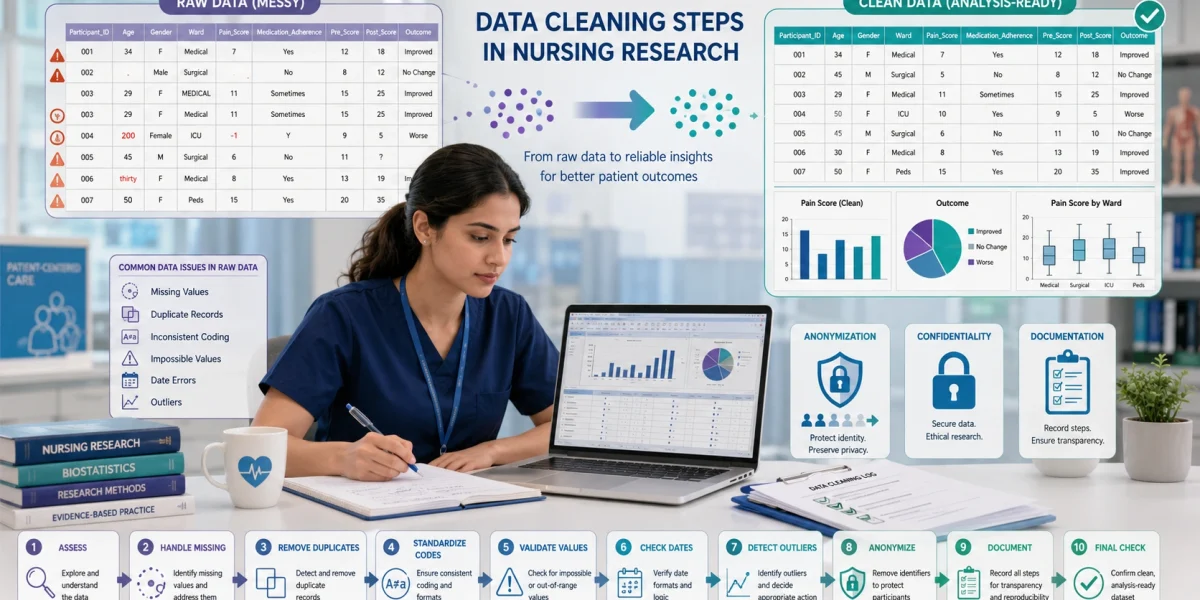
The main data cleaning steps in nursing research are to save the raw file, compare the dataset with the research questions and data collection tool, create a cleaning plan, check variable names and labels, inspect missing data, identify duplicates, standardize codes, validate clinical ranges, clean dates, assess outliers, anonymize participant information, document every decision, and save a final clean dataset for analysis.
This stage matters because scientific data should be good enough to validate and replicate research findings, and NIH links responsible data management with research rigor, transparency, and participant privacy (National Institutes of Health [NIH], 2026). In nursing dissertations, capstones, quality improvement projects, and clinical studies, data cleaning protects validity, reliability, data integrity, ethical handling of patient data, confidentiality, transparent reporting, and safer evidence-based recommendations.
What Is Data Cleaning in Nursing Research?
Data cleaning in nursing research is the process of checking, correcting, validating, organizing, anonymizing, and documenting raw research data before analysis. It prepares the dataset; it does not manipulate the findings.
For example, if a pain score scale runs from 0 to 10, a value of 77 is not a valid pain score. It may be a typing error, a missing-value code placed in the wrong column, or a copied value from another variable. The student’s task is not to “fix” the result to support a preferred conclusion. The task is to investigate the value, verify it where possible, document the decision, and prepare an accurate dataset.
Data cleaning in nursing research may involve quantitative files, qualitative transcripts, mixed methods datasets, clinical audit data, REDCap forms, Qualtrics exports, SPSS files, Excel workbooks, EHR downloads, or NVivo-ready interview folders. REDCap is commonly used in clinical and translational research because it supports structured electronic data capture and research database workflows (Harris et al., 2009).
Why Data Cleaning Matters Before Nursing Data Analysis
Data cleaning matters because nursing research often informs clinical education, patient safety, staffing, quality improvement, medication adherence, discharge planning, infection prevention, fall prevention, and evidence-based practice. A small data error can change a dissertation table, or produce an inaccurate practice recommendation.
For example, a duplicate participant ID in a patient satisfaction study may inflate the sample size. A missing post-test pain score may affect the interpretation of an intervention. A miscoded intervention group may place control participants in the treatment group. An impossible blood pressure value may distort descriptive statistics. A transcript that still contains a patient’s name may create an ethical problem.
High-quality health data are commonly judged by characteristics such as completeness, accuracy, validity, consistency, and timeliness. CDC public health surveillance guidance identifies completeness, accuracy, and timeliness as core features of data quality, while WHO’s data quality framework emphasizes systematic methods and metrics for assessing health facility data quality (Centers for Disease Control and Prevention [CDC], 2020; World Health Organization [WHO], 2023).
Common Data Problems in Nursing Research Datasets
Nursing datasets commonly contain errors because data may come from busy clinical settings, self-administered surveys, manual entry, EHR exports, audit tools, interviews, or multiple data collectors.
Common problems include missing pain scores, incomplete patient satisfaction responses, duplicate participant IDs, gender coded as “F,” “Female,” “2,” and “woman,” impossible age values, blood pressure values outside logical clinical ranges, reversed pre-test and post-test scores, inconsistent ward names, medication adherence coded in different formats, wrong admission or discharge dates, outliers in nurse burnout scores, and EHR export formatting problems.
Data Cleaning Steps in Nursing Research
This is the main section for students who need a practical workflow. Each step explains what to do, why it matters, a nursing example, and a mistake to avoid.
How the Data Cleaning Steps Protect Research Integrity
The data cleaning steps protect the link between what was collected and what is analyzed. They reduce preventable errors, preserve confidentiality, and create an audit trail for supervisors, dissertation committees, ethics reviewers, and journal readers.
A cleaned nursing dataset should still reflect the original study data. It should not erase inconvenient findings, remove true clinical variation, or recode values to make results appear more significant. Transparent reporting is also important. STROBE reporting guidance asks researchers to report key methodological details, including participant data and missing data, so readers can evaluate the study clearly (STROBE, 2026).
Step 1: Review the Research Questions and Data Collection Tool
Start by comparing the dataset with the research questions, objectives, hypotheses, questionnaire, audit tool, interview guide, EHR extraction form, or clinical data collection sheet.
For example, if the research question asks whether education improves medication adherence among adult patients with diabetes, the dataset should include participant ID, group, age, gender, baseline adherence, post-intervention adherence, relevant clinical variables, and follow-up status.
In Excel, check whether every column matches the tool. In SPSS, compare Variable View with the questionnaire or audit form. Each important item should have a clear variable name, label, type, and measurement level.
Mistake to avoid: Cleaning a dataset without confirming which variables are needed for the research questions.
Step 2: Save the Raw Dataset Before Cleaning
Always save the original file unchanged. Use a clear naming system such as:
- xlsx
- xlsx
- sav
This protects data integrity. If a supervisor asks why a value changed, you can compare the cleaned file with the raw file.
Mistake to avoid: Editing the only copy of the dataset.
Step 3: Create a Data Cleaning Plan
A data cleaning plan explains how you will handle missing values, duplicate records, inconsistent codes, outliers, date errors, anonymization, and documentation.
In a dissertation, this plan belongs naturally in Chapter 3 under data management, data screening, or data preparation. It does not need to be long, but it should show that cleaning decisions were planned and transparent.
For example, the plan may state that duplicate participant IDs will be reviewed against the original collection log, missing outcome scores will be reported, impossible clinical values will be checked against source documents, and patient identifiers will be removed before analysis.
Mistake to avoid: Making cleaning decisions only after seeing the statistical results.
Step 4: Check Variable Names, Labels, and Measurement Levels
Variable names should be clear, consistent, and analysis-friendly. Examples include Participant_ID, Age, Gender, Ward, Pain_Score, Medication_Adherence, Fall_Risk, Pre_Score, Post_Score, and Outcome.
In SPSS, Variable View helps students define variable labels, value labels, data type, measurement level, and user-defined missing values (IBM, 2026a). Value labels are especially useful when numeric codes represent categories, such as 1 = Male and 2 = Female, or 0 = Control and 1 = Intervention (IBM, 2026b).
Nursing example: A column named Q7 should be labelled as “Pain score after wound dressing education” if that is what the item measures.
Mistake to avoid: Leaving variables as Q1, Q2, Q3, or Var0001 with no labels.
Step 5: Inspect Missing Data
Missing data in nursing research may appear as blank cells, “NA,” “not recorded,” “999,” “-99,” skipped survey items, missing follow-up scores, incomplete EHR records, or unanswered interview questions.
Do not delete missing data automatically. First, check which variables are missing, how much data is missing, whether missingness affects key outcomes, and whether missing values follow a pattern. The TARMOS framework emphasizes systematic planning, exploration, analysis, and transparent reporting when dealing with missing data in observational studies (Lee et al., 2021).
Excel guidance: Use filters, conditional formatting, and blank-cell checks to locate missing values.
SPSS guidance: Run Frequencies for categorical variables and Descriptives for numeric variables. SPSS Missing Value Analysis can also describe missing-data patterns and identify where missing values are located (IBM, 2021).
Mistake to avoid: Deleting every row with a missing value without explaining why.
Step 6: Identify Duplicate Records
Duplicate records may come from repeated survey submissions, copied patient records, repeated EHR exports, or data entry mistakes.
In Excel, students can highlight duplicates or use the Remove Duplicates tool, but duplicates should be reviewed before deletion because duplicate-looking rows may represent different encounters or follow-up visits. Microsoft’s Excel guidance also warns that duplicate data may sometimes be useful and should be reviewed before removal (Microsoft, 2026).
Nursing example: Participant 014 appears twice. One record has a complete post-test score and the other does not. The student should verify whether this is a duplicate survey, a corrected submission, or two different visits.
Mistake to avoid: Removing duplicate IDs without confirming which record should remain.
Step 7: Check Coding Consistency
Coding consistency means that the same meaning is represented the same way throughout the dataset. Gender should not be coded as F, Female, 2, and woman in the same variable. Intervention group should not be coded as intervention, Intervention, INT, 1, and Yes without a clear codebook.
Nursing example: Medication adherence may appear as “Adherent,” “Yes,” “1,” “High,” or “>=80%.” The student should standardize the coding according to the study protocol.
Excel guidance: Sort the column or use filters to see all unique categories.
SPSS guidance: Run Frequencies and check whether unexpected categories appear.
Mistake to avoid: Recoding categories without keeping a codebook.
Step 8: Validate Clinical Values and Logical Ranges
Clinical variables must be checked against logical and clinically plausible ranges. Examples include age, systolic blood pressure, diastolic blood pressure, temperature, BMI, pain score, fall risk score, pressure injury stage, length of stay, medication adherence percentage, and blood glucose.
Nursing example: A pain score of 14 on a 0-10 scale is invalid. A pressure injury stage of 7 is invalid if the tool uses stages 1-4 plus unstageable. Medication adherence of 180% may reflect a formula error or data entry issue.
Excel guidance: Use filters to sort numeric values from smallest to largest.
SPSS guidance: Run Descriptives to check minimum and maximum values.
Mistake to avoid: Assuming a value is correct simply because Excel or SPSS accepts it.
Step 9: Clean Date, Time, and Follow-Up Variables
Date errors can seriously affect nursing research, especially in studies involving admission, discharge, intervention, follow-up, pre-test, and post-test timing.
Nursing example: A discharge date should not occur before an admission date. A post-test date should not occur before a pre-test date. A 30-day follow-up should not be coded as 300 days unless verified.
Excel guidance: Format date columns consistently and check for text-formatted dates.
SPSS guidance: Define dates properly rather than treating them as ordinary strings.
Mistake to avoid: Mixing day-month-year and month-day-year formats without verification.
Step 10: Detect and Assess Outliers
Outliers are values that are unusually high or low compared with the rest of the dataset. In nursing research, outliers may occur in length of stay, blood glucose, blood pressure, nurse burnout scores, satisfaction scores, pain scores, waiting time, or number of missed medication doses.
Outliers should be investigated, not automatically removed. Some extreme values are real clinical observations. Others are data entry errors.
Nursing example: A blood glucose value of 32 mmol/L may be clinically possible in severe hyperglycemia. A blood glucose value of 999 may be a missing-value code or entry error.
Mistake to avoid: Removing outliers because they make the data look messy.
Step 11: Standardize Categories and Text Responses
Nursing datasets often include text categories such as ward names, diagnosis categories, nursing units, education levels, job titles, and short-answer responses. These need standardization before analysis.
Nursing example: “ICU,” “I.C.U.,” “Intensive Care,” and “critical care unit” may refer to the same unit, but this must be confirmed before merging.
For qualitative data, standardization should not change participant meaning. Correct obvious transcription errors, but do not rewrite a participant’s words to sound more academic.
Mistake to avoid: Over-cleaning text responses until meaning is lost.
Step 12: Correct Data Entry Errors Carefully
Corrections should be based on evidence. Use source documents, original questionnaires, audit sheets, EHR records, or supervisor-approved rules.
Nursing example: If age is recorded as 244, do not assume it means 24. Check the original data source. If no verification is possible, mark it as invalid or missing according to the cleaning plan.
Mistake to avoid: Guessing corrected values.
Step 13: Anonymize Patient and Participant Information
Remove direct identifiers such as names, phone numbers, email addresses, hospital numbers, addresses, staff IDs, and patient record numbers from the analysis dataset. Use study IDs instead.
HHS explains that HIPAA de-identification is intended to reduce the risk that health information can identify an individual, and NIH emphasizes that responsible data sharing should protect human research participant privacy (HHS, 2025; NIH, 2025).
For qualitative research, anonymization may involve removing names, locations, rare job titles, hospital names, or details that could identify a participant indirectly. UK Data Service guidance recommends balancing confidentiality with data quality so that anonymization does not make qualitative data unreliable or misleading (UK Data Service, 2022).
Mistake to avoid: Keeping patient identifiers in the Excel or SPSS analysis file.
Step 14: Document Every Cleaning Decision
A data cleaning log records what changed, why it changed, who changed it, and when it changed. This supports transparency and protects the student during dissertation review.
A simple cleaning log may include:
| Date | Variable | Problem found | Cleaning decision | Reason | Person responsible |
| 04/06/2026 | Gender | F, Female, 2 used | Recode to 1 = Female | Codebook standardization | Student |
| 05/06/2026 | Age | Age = 145 | Marked invalid after source check | Source record unclear | Student/supervisor |
| 05/06/2026 | Participant_ID | ID 014 duplicated | Retained complete verified record | Duplicate survey submission | Student |
Mistake to avoid: Cleaning the dataset but having no record of what changed.
Step 15: Create the Final Clean Dataset for Analysis
The final dataset should be saved separately from the raw file. It should have clear variable names, correct labels, standardized coding, validated ranges, checked dates, documented missing data, assessed outliers, anonymized identifiers, and a completed cleaning log.
Create the correct file type for your analysis tool:
- Excel: .xlsx
- SPSS: .sav
- R: .csv or .rds
- Stata: .dta
- Jamovi: .omv
- NVivo: cleaned transcript files and organized folders
Mistake to avoid: Using one messy file for raw data, cleaned data, notes, and analysis outputs.
Common Nursing Research Data Problems and Cleaning Actions
| Data problem | Nursing research example | Cleaning action | Why it matters |
| Missing data | Missing post-test pain score after discharge education | Flag missing values, check patterns, document handling decision | Prevents biased or unclear findings |
| Duplicate records | Same participant ID appears twice in a satisfaction survey | Verify source, retain correct record, document removal | Prevents inflated sample size |
| Inconsistent coding | Gender coded as F, Female, 2, and woman | Recode consistently using a codebook | Allows accurate grouping and analysis |
| Impossible clinical values | Pain score of 77 on a 0-10 scale | Check source record and correct or mark invalid | Protects clinical accuracy |
| Outliers | Extremely high blood glucose value | Investigate whether true value or entry error | Prevents inappropriate deletion |
| Wrong date format | Discharge date appears before admission date | Standardize format and verify chronology | Protects follow-up calculations |
| Unclear variable labels | Q5 or Var0001 has no description | Add meaningful labels and measurement levels | Improves interpretation |
| Identifiable patient information | Patient names or hospital numbers in dataset | Remove identifiers and replace with study IDs | Protects confidentiality and ethics |
Example of Data Cleaning in a Nursing Dissertation
Consider a nursing dissertation titled: “Medication Adherence Among Adult Patients With Type 2 Diabetes After Nurse-Led Education.”
The student exports data from a survey platform and combines it with a clinical audit sheet. The raw dataset includes participant ID, age, gender, ward, group, baseline adherence, post-intervention adherence, blood glucose, pre-test date, post-test date, and follow-up status.
Before cleaning, the dataset contains several problems:
| Participant_ID | Age | Gender | Group | Adherence_Pre | Adherence_Post | Blood_Glucose | Pre_Date | Post_Date | Problem |
| 014 | 56 | Female | Intervention | 62 | 82 | 9.8 | 03/04/2026 | 30/04/2026 | Valid |
| 014 | 56 | F | INT | 62 | 9.8 | 03/04/2026 | 30/04/2026 | Duplicate ID | |
| 022 | Male | Control | 70 | 74 | 8.1 | 04/04/2026 | 01/05/2026 | Missing age | |
| 031 | 145 | 2 | Control | 65 | 68 | 7.9 | 05/04/2026 | 02/05/2026 | Impossible age, inconsistent gender |
| 044 | 49 | woman | Intervention | 55 | 88 | 999 | 04/06/2026 | 06/04/2026 | Outlier/missing code, date confusion |
| 050 | 61 | Female | Intervention | 80 | 76 | 10.5 | 07/04/2026 | 05/04/2026 | Post-test before pre-test |
After cleaning, the student should not simply delete rows. The correct process is to verify the duplicate ID, standardize gender coding, check missing age against the data collection form, investigate whether 999 is a missing-value code, confirm date format, and document all decisions.
A cleaned version may look like this:
| Participant_ID | Age | Gender_Code | Group_Code | Adherence_Pre | Adherence_Post | Blood_Glucose | Pre_Date | Post_Date | Cleaning note |
| 014 | 56 | 2 | 1 | 62 | 82 | 9.8 | 03/04/2026 | 30/04/2026 | Duplicate removed after verification |
| 022 | Missing | 1 | 0 | 70 | 74 | 8.1 | 04/04/2026 | 01/05/2026 | Age unavailable; retained with missing flag |
| 031 | Invalid | Missing | 0 | 65 | 68 | 7.9 | 05/04/2026 | 02/05/2026 | Age and gender unresolved |
| 044 | 49 | 2 | 1 | 55 | 88 | Missing | 04/06/2026 | 06/04/2026 | Blood glucose 999 treated as missing after codebook check; date verified |
| 050 | 61 | 2 | 1 | 80 | 76 | 10.5 | 07/04/2026 | Date error | Post-date unresolved; flagged |
This example shows why dissertation data cleaning is not the same as data analysis. The student has not run a statistical test. The student has prepared a clean, confidential, analysis-ready file. Once this is complete, the student can move to methods such as quantitative data analysis in nursing research or descriptive data analysis in nursing research.
Data Cleaning for Quantitative Nursing Research
Quantitative nursing research often uses surveys, Likert scales, clinical measures, pre-test/post-test tools, audit forms, medication adherence records, patient satisfaction scores, and EHR extracts.
Cleaning quantitative data involves checking numeric coding, missing values, duplicates, outliers, measurement levels, reverse-coded items, total scale scores, group coding, and analysis-ready formatting.
For Likert scales, confirm that every item uses the same response direction. If 1 means “strongly disagree” for most items but means “strongly agree” for a reverse-coded item, the reverse item must be recoded before computing total scores.
For intervention studies, confirm that pre-test and post-test scores are in the correct columns. For audit studies, check whether each variable matches the audit standard. When it comes to EHR datasets, confirm that each row represents the correct unit of analysis, such as patient, visit, medication order, or clinical encounter.
This section prepares the dataset only. It should not compete with broader guides on statistical methods or mixed methods data analysis in nursing research.
Data Cleaning for Qualitative Nursing Research
Qualitative data cleaning focuses on transcript preparation, confidentiality, file organization, and meaning preservation. It does not involve coding themes yet.
Before qualitative analysis, students should check that transcripts are complete, speaker labels are consistent, audio-to-text errors are corrected without changing meaning, identifiers are removed, file names are organized, and transcripts are ready for NVivo or manual coding.
For example, “Participant 4: My nurse manager at [hospital name] called me after my shift” may need anonymization if the hospital name, ward, or manager could identify the participant. However, students should avoid over-anonymizing because removing too much context can weaken meaning and reduce data quality. UK Data Service guidance specifically warns that over-anonymizing qualitative data can make it unusable, unreliable, or misleading (UK Data Service, 2022).
After transcript cleaning, students can proceed to qualitative data analysis in nursing research.
Tools Used for Data Cleaning in Nursing Research
Excel is useful for beginner-friendly checks, duplicate highlighting, filters, sorting, conditional formatting, date formatting, and simple validation. It is often the easiest starting point for nursing students.
SPSS is useful for variable labels, value labels, missing value codes, frequencies, descriptive checks, sorting, filtering, and identifying unexpected categories. SPSS Variable View is especially helpful because it separates the data values from the variable definitions (IBM, 2026a).
R and Stata are stronger for reproducible cleaning scripts, large datasets, and complex recoding. Jamovi is useful for students who want a more guided interface. REDCap and Qualtrics can reduce cleaning problems during data collection by supporting structured surveys, metadata, validation, and export options. Qualtrics notes that exported response data can be saved for analysis in another software package, shared with a trusted colleague, or imported back into a survey workflow (Qualtrics, 2026).
NVivo is useful for organizing qualitative transcripts after anonymization and formatting. EHR exports may require expert review because they can include repeated encounters, hidden identifiers, complex dates, medication codes, and clinical values that require range checks.
Data Cleaning Checklist for Nursing Students
Use this checklist before analysis:
- Raw file saved unchanged.
- Cleaned working copy created.
- Research questions compared with dataset.
- Data collection tool reviewed.
- Variable names checked.
- Variable labels added.
- Measurement levels reviewed.
- Missing data inspected.
- Duplicate records checked.
- Category coding standardized.
- Clinical ranges validated.
- Dates and follow-up periods checked.
- Outliers investigated.
- Reverse-coded items reviewed.
- Identifiers removed or anonymized.
- Cleaning log completed.
- Final dataset saved separately.
- Analysis file prepared for Excel, SPSS, R, Stata, Jamovi, NVivo, or another tool.
Common Data Cleaning Mistakes Nursing Students Should Avoid
The first mistake is deleting missing data without justification. Missing data can affect bias, sample size, and interpretation, so it must be reviewed and reported.
The second mistake is changing values without documentation. Every correction should be traceable to a source document, codebook, supervisor decision, or cleaning rule.
The third mistake is cleaning after analysis. Data screening in nursing research should happen before Chapter 4 tables are generated.
The fourth mistake is ignoring impossible clinical values. A pain score of 77, a temperature of 80°C, or an age of 145 in an adult outpatient study should be investigated.
The fifth mistake is treating all outliers as errors. Some outliers are true clinical values.
The sixth mistake is mixing raw and cleaned files. This destroys transparency.
The seventh mistake is failing to anonymize data. Ethical handling of patient and participant data is essential in nursing research.
The eighth mistake is ignoring reverse-coded items. This can completely change scale interpretation.
The ninth mistake is using unclear codes. A dissertation committee should be able to understand what 0, 1, 2, and 9 mean.
The tenth mistake is failing to report cleaning steps. Transparent reporting improves the credibility of the dissertation or paper.
How to Report Data Cleaning in a Nursing Dissertation or Research Paper
In Chapter 3, report how data were prepared before analysis. In Chapter 4, report any cleaning decisions that affect the sample, missing data, exclusions, or interpretation.
A strong report should mention data screening, missing data checks, duplicate checks, coding consistency, range validation, outlier review, anonymization, software used, and documentation.
Sample dissertation paragraph:
“Before analysis, the raw dataset was saved separately and a cleaned working copy was created. Variables were reviewed against the data collection tool, and variable labels, value labels, coding rules, and measurement levels were checked. Missing values were examined for demographic, clinical, and outcome variables. Duplicate participant IDs were screened and resolved using the original data collection log. Clinical values were checked against logical ranges, and outliers were investigated before any decision was made. Identifiable information was removed and replaced with study IDs. All data cleaning decisions were recorded in a cleaning log. The final anonymized dataset was imported into SPSS for analysis.”
This type of paragraph helps show dissertation methodology standards, data integrity, confidentiality, and transparent reporting.
When Nursing Students Need Help With Data Cleaning
Nursing students may need support when datasets are large, SPSS coding is confusing, missing data decisions are unclear, Excel files contain many inconsistent categories, survey exports are messy, EHR data has clinical range issues, qualitative transcripts need anonymization, or Chapter 4 depends on a clean dataset.
Support may also be useful when students are unsure whether to delete, retain, recode, flag, or verify problematic values. The goal is not to manipulate findings. The goal is to create a clean dataset for analysis while protecting validity, reliability, ethics, and confidentiality.
For support with cleaning raw data, preparing SPSS or Excel files, documenting cleaning decisions, and organizing a nursing dissertation dataset before analysis, Request Quote Now. You can also review broader dissertation data analysis help when your clean dataset is ready for statistical interpretation.
Conclusion
The data cleaning steps in nursing research are essential for accurate findings, stronger dissertation chapters, transparent reporting, ethical handling of patient data, and safer evidence-based nursing recommendations.
A student should never move directly from raw data to analysis without checking missing values, duplicates, coding errors, variable labels, clinical ranges, dates, outliers, identifiers, and documentation. A clean dataset does not guarantee perfect research, but it gives nursing students a stronger foundation for valid analysis, trustworthy interpretation, and defensible dissertation reporting.
References
Centers for Disease Control and Prevention. (2020). 7.5 Key characteristics of data quality in public health surveillance. CDC Archive.
Harris, P. A., Taylor, R., Thielke, R., Payne, J., Gonzalez, N., & Conde, J. G. (2009). Research electronic data capture (REDCap): A metadata-driven methodology and workflow process for providing translational research informatics support. Journal of Biomedical Informatics, 42(2), 377-381.
IBM. (2021). IBM SPSS Missing Values 28.
IBM. (2026a). Data Editor. IBM SPSS Statistics 30.0.0 documentation.
IBM. (2026b). Defining value labels and other variable properties. IBM SPSS Statistics 30.0.0 documentation.
Lee, K. J., Tilling, K., Cornish, R. P., Little, R. J. A., Bell, M. L., Goetghebeur, E., Hogan, J. W., & Carpenter, J. R. (2021). Framework for the treatment and reporting of missing data in observational studies: The TARMOS framework. Journal of Clinical Epidemiology, 134, 79-88.
Microsoft. (2026). Find and remove duplicates. Microsoft Support.
National Institutes of Health. (2025). Data Management and Sharing Policy. NIH Grants & Funding.
National Institutes of Health. (2026). Data Management & Sharing Policy overview. NIH Grants & Funding.
Office for Civil Rights, U.S. Department of Health and Human Services. (2025). Guidance regarding methods for de-identification of protected health information in accordance with the HIPAA Privacy Rule.
Qualtrics. (2026). Exporting response data. Qualtrics Support.
STROBE. (2026). Statement: Guidelines for reporting observational studies. EQUATOR Network.
UK Data Service. (2022). How to anonymise qualitative and quantitative data.
World Health Organization. (2023). Data quality assurance: Module 1: Framework and metrics.
