

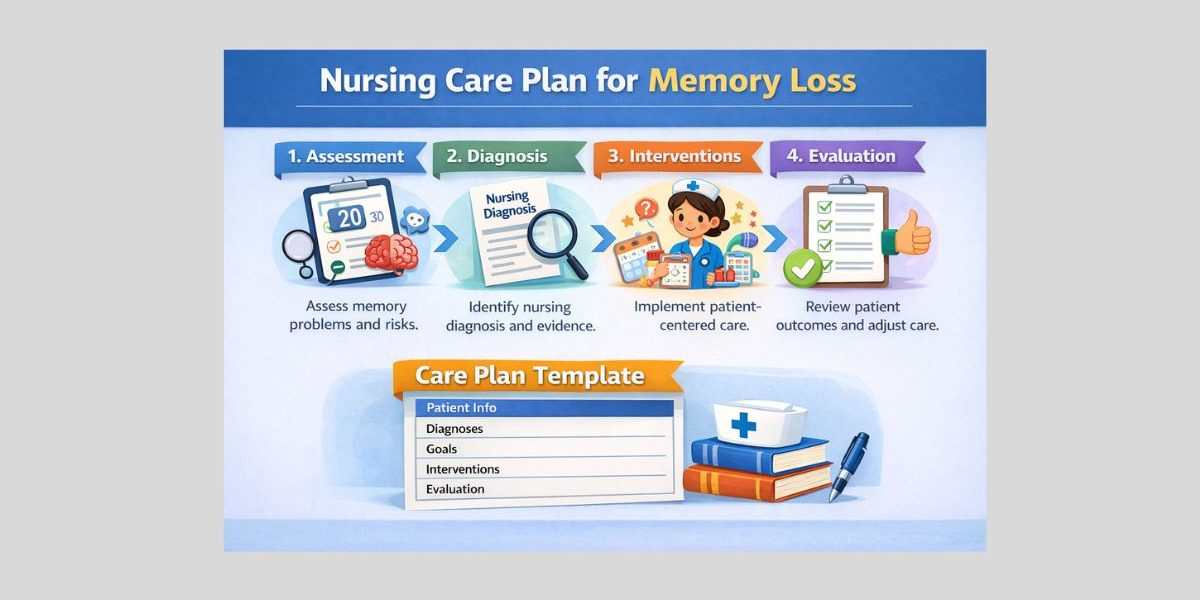
Nursing Care Plan for Memory Loss – Foundations, Clinical Understanding, and Patient Assessment
Nursing Care Plan for Memory Loss: Introduction and Clinical Importance
A nursing care plan for memory loss is a structured, patient-centered approach used to assess, manage, and support individuals experiencing cognitive decline. From the very beginning, it is important to understand that memory loss is not a single condition. Instead, it is a symptom that can arise from various causes such as dementia, aging, neurological disorders, or psychological factors.
In clinical practice, a well-developed memory loss nursing care plan focuses on maintaining cognitive function, ensuring patient safety, and improving quality of life. At the same time, it supports caregivers and promotes independence wherever possible.
For nursing students, mastering a care plan for memory impairment is essential. Not only does it demonstrate clinical reasoning, but it also reflects the ability to provide compassionate, holistic care. Therefore, this topic is both academically important and highly relevant in real-world healthcare settings.
Understanding Memory Loss in Nursing Practice
What Is Memory Loss?
Memory loss refers to the inability to recall information, events, or learned skills. It may be temporary or progressive, depending on the underlying cause.
In a nursing care plan for memory loss, understanding the type and severity of memory impairment is critical because it directly influences interventions and outcomes.
Types of Memory Loss Relevant to Nursing Care
To create an effective nursing care plan for cognitive impairment, it is important to recognize different forms of memory loss.
Short-Term Memory Loss
- Difficulty recalling recent events
- Common in early dementia
Long-Term Memory Loss
- Loss of past memories
- Seen in advanced neurological conditions
Mild Cognitive Impairment (MCI)
- Noticeable memory problems
- Does not significantly interfere with daily life
Dementia-Related Memory Loss
- Progressive and severe
- Affects daily functioning
Each type requires a tailored care plan.
Common Causes of Memory Loss
A strong nursing care plan for memory loss must consider underlying causes:
- Alzheimer’s disease
- Stroke
- Brain injury
- Depression
- Medication side effects
- Aging
Identifying the cause helps guide accurate interventions.
Pathophysiology of Memory Loss
Understanding the biological basis of memory loss strengthens your care planning.
Memory loss often occurs due to:
- Neuronal damage in the brain
- Reduced neurotransmitter activity
- Impaired blood flow to brain tissue
As a result:
- Cognitive function declines
- Learning becomes difficult
- Recall ability weakens
Therefore, nursing interventions must aim to support remaining cognitive function and prevent further decline.
Clinical Importance of a Memory Loss Nursing Care Plan
Promoting Patient Safety
Patients with memory impairment are at higher risk of:
- Falls
- Medication errors
- Wandering
Therefore, safety is a primary focus of any nursing care plan for memory loss.
Maintaining Independence
Even with memory challenges, patients can retain some level of independence. A strong care plan helps preserve this ability through structured support.
Enhancing Quality of Life
Memory loss affects emotional well-being. Patients may feel confused, frustrated, or anxious. Therefore, care must address both physical and psychological needs.
Supporting Caregivers
Caregivers often experience stress and burnout. As a result, education and support are essential components of the care plan.
Comprehensive Nursing Assessment for Memory Loss
Assessment is the foundation of any nursing care plan for memory loss. Without accurate data, diagnosis and interventions may be ineffective.
Subjective Assessment in Memory Loss Care
Subjective data includes patient and caregiver reports.
Examples:
- Forgetfulness
- Difficulty following instructions
- Repeating questions
- Confusion
However, patients may not always recognize their deficits. Therefore, caregiver input is crucial.
Objective Assessment in a Memory Loss Nursing Care Plan
Objective data includes measurable findings.
Examples:
- Cognitive tests (e.g., Mini-Mental State Examination)
- Behavioral observations
- Neurological assessments
- Medication review
Advanced Clinical Interpretation of Assessment Data
Strong care plans go beyond listing data.
Example
- Patient repeats questions frequently → short-term memory impairment
- Difficulty recognizing familiar people → advanced cognitive decline
Interpretation transforms data into clinical insight.
Assessing Risk Factors in Memory Loss Patients
An effective nursing care plan for memory impairment must identify risks:
- Age-related decline
- Neurological disorders
- Poor nutrition
- Social isolation
- Chronic illness
These factors guide intervention strategies.
Functional and Cognitive Assessment
Activities of Daily Living (ADLs)
Assess the patient’s ability to:
- Dress
- Eat
- Bathe
- Manage medication
Cognitive Function Assessment
Evaluate:
- Orientation (time, place, person)
- Attention
- Problem-solving ability
Behavioral Assessment
Observe:
- Agitation
- Wandering
- Mood changes
These findings are critical in care planning.
Linking Assessment to Clinical Problems
After collecting data, the next step is identifying patterns.
Example
- Forgetfulness + confusion → impaired memory
- Wandering + disorientation → risk for injury
This prepares for accurate nursing diagnoses.
Common Challenges in Memory Loss Assessment
Frequent Issues
- Ignoring caregiver input
- Failing to assess safety risks
- Lack of detailed observation
- Poor interpretation of data
Addressing these improves care plan quality.
The Role of Holistic Care in Memory Loss
A strong nursing care plan for memory loss must address:
- Physical health
- Cognitive function
- Emotional well-being
- Social support
Holistic care leads to better outcomes.
Transition to Diagnosis and Care Planning
At this point, you now have:
- A clear understanding of memory loss
- Comprehensive patient assessment
- Identified risk factors
- Clinical interpretation of findings
The next step is developing:
- Accurate nursing diagnoses
- Prioritized patient problems
- Clear goals and expected outcomes
Request Quotes Now
Need a detailed nursing care plan for memory loss with accurate assessment and clinical reasoning? Request quotes now for expert academic support.
Nursing Diagnoses, Prioritization, Goal Setting, and Clinical Reasoning in a Nursing Care Plan for Memory Loss
From Assessment to Clinical Judgment in a Nursing Care Plan for Memory Loss
After completing a thorough assessment, the next step in developing a nursing care plan for memory loss is transforming data into meaningful clinical decisions. This stage is where a nursing student moves beyond observation and begins to think like a nurse. Assessment findings alone are not enough. Instead, the nurse must interpret what those findings mean, identify patient problems, prioritize risks, and set realistic goals.
This is also the stage where many students struggle. They may collect accurate patient information but fail to connect it to the correct nursing diagnoses. Alternatively, they may identify a diagnosis but then choose goals that are too broad, too vague, or unrelated to the patient’s actual needs. Therefore, a high-quality memory loss nursing care plan must show a clear line of reasoning from assessment to diagnosis and from diagnosis to planning.
Memory loss is especially challenging because it affects many areas of life at once. It may interfere with safety, self-care, communication, orientation, treatment adherence, emotional well-being, and social functioning. Consequently, the nurse must not focus only on “forgetfulness” as an isolated symptom. Instead, the care plan must consider how memory loss changes the patient’s ability to function in daily life and how those changes increase the risk of complications.
For example, if a patient forgets to turn off the stove, misses medication doses, becomes lost in familiar places, and shows increasing agitation, the problem is not only impaired memory. There may also be a risk for injury, self-care deficit, deficient knowledge, chronic confusion, or caregiver role strain affecting the family. This is why a deep nursing care plan for memory impairment requires careful interpretation rather than a narrow focus.
Understanding the Role of Nursing Diagnosis in Memory Loss Care Planning
A nursing diagnosis describes a patient response or problem that nurses can address through care, observation, education, and support. It differs from a medical diagnosis, which identifies the disease itself.
For example:
- Medical diagnosis: Alzheimer’s disease
- Possible nursing diagnoses: chronic confusion, impaired memory, risk for injury, self-care deficit, ineffective health maintenance
This distinction is very important. A nursing care plan for memory loss must not simply restate the medical diagnosis. Instead, it should identify how the memory problem affects the patient and what nursing priorities arise from that effect.
In academic work, this is one of the clearest markers of strong clinical thinking. Students who understand the difference between medical and nursing diagnoses usually produce more focused and more convincing care plans.
How to Write Strong Nursing Diagnoses for Memory Loss
A strong nursing diagnosis is clear, specific, and supported by assessment data. In many nursing programs, diagnosis statements are written using a three-part format:
Problem + related to + as evidenced by
This format helps the student show logic rather than assumption.
Example
Impaired memory related to cognitive decline as evidenced by repeated questions, inability to recall recent events, and forgetting scheduled medications.
This statement is stronger than simply writing “memory loss” because it identifies:
- the problem
- the cause or contributing factor
- the evidence supporting it
However, not all diagnoses require the same structure. Risk diagnoses, for example, often do not include “as evidenced by” because the problem has not yet occurred.
Example of a risk diagnosis
Risk for injury related to disorientation, wandering behavior, and impaired judgment.
This type of accuracy improves both academic quality and clinical usefulness.
Core Nursing Diagnoses in a Nursing Care Plan for Memory Loss
A patient with memory loss may have many possible nursing diagnoses. The correct diagnosis depends on the patient’s condition, cause of memory impairment, and current level of functioning. Below are the most relevant and commonly used diagnoses, explained in depth.
1. Impaired Memory
This is often the central diagnosis in a nursing care plan for memory loss. It applies when the patient shows reduced ability to remember or recall information.
Possible related factors
- neurological degeneration
- age-related cognitive decline
- reduced cerebral perfusion
- medication side effects
- brain injury
Possible evidence
- inability to remember names
- repeated questioning
- forgetting recent instructions
- loss of recent events from memory
- forgetting daily routines
Why this diagnosis matters
Impaired memory affects almost every other area of care. It may interfere with medication use, self-care, communication, appointment keeping, safety, and treatment adherence. Therefore, this diagnosis often serves as the starting point for the rest of the care plan.
2. Chronic Confusion
This diagnosis is appropriate when the patient shows long-term, progressive disturbances in memory, judgment, interpretation, and decision-making.
Possible related factors
- dementia
- neurodegenerative disease
- chronic neurological damage
Possible evidence
- disorientation to time or place
- inability to make appropriate decisions
- impaired short-term and long-term recall
- confused conversation
- altered behavior patterns
Clinical importance
Chronic confusion is broader than impaired memory. It acknowledges that the patient’s cognitive state affects thinking as a whole, not just recall. Therefore, this diagnosis is particularly useful in patients with moderate or advanced dementia.
3. Risk for Injury
Memory loss can quickly become a safety issue. A patient may leave the house and become lost, misuse appliances, forget to use walking aids, or fail to recognize dangerous situations.
Possible related factors
- disorientation
- wandering
- impaired judgment
- impaired memory
- inability to recognize hazards
Why this diagnosis is often high priority
Safety problems can become life-threatening. A patient with memory loss may not understand danger, may forget instructions, or may not remember their location. Therefore, risk for injury is one of the most important diagnoses in a care plan for memory impairment, especially when wandering, confusion, or poor judgment are present.
4. Self-Care Deficit
Memory loss often reduces a person’s ability to carry out basic daily tasks independently.
Types of self-care deficits
- bathing/hygiene
- dressing/grooming
- feeding
- toileting
Possible related factors
- impaired memory
- cognitive decline
- inability to sequence tasks
- decreased attention span
Clinical importance
This diagnosis is useful when the patient begins to lose independence in daily living. It shows that the impact of memory loss goes beyond recall and affects actual function.
5. Deficient Knowledge
This diagnosis may apply when the patient does not understand the condition, treatment plan, medication schedule, or self-management needs. However, it should be used carefully in patients with severe cognitive impairment because the problem may not be “lack of information” but inability to retain it.
Possible related factors
- new diagnosis
- limited health literacy
- impaired memory affecting retention
- insufficient teaching
Possible evidence
- inability to explain treatment plan
- incorrect medication use
- repeated misunderstanding of instructions
Clinical caution
For a patient with advanced memory loss, repeated teaching alone may not solve the problem. In such cases, the care plan may need to involve family or caregiver education more heavily.
6. Ineffective Health Management
This diagnosis applies when the patient is unable to integrate treatment recommendations into daily life.
Possible related factors
- impaired memory
- decreased judgment
- poor support system
- complex medication regimen
Possible evidence
- missed medications
- failure to attend appointments
- inability to follow care instructions
- unmanaged chronic illness
Why it matters
This diagnosis is particularly useful when memory loss affects the management of other health conditions like diabetes, hypertension, or heart disease.
7. Social Isolation
Patients with memory loss may withdraw from social interaction due to embarrassment, fear, frustration, or progressive decline.
Possible related factors
- cognitive impairment
- difficulty communicating
- fear of getting confused in public
- reduced confidence
Possible evidence
- avoiding others
- reduced participation in activities
- emotional withdrawal
Clinical importance
Memory loss is not only a cognitive problem. It also affects emotional and social well-being. Therefore, a good nursing care plan for memory loss should assess whether social isolation is developing.
8. Anxiety
Many patients, especially those in earlier stages of memory decline, recognize that something is wrong. This awareness may create fear, frustration, embarrassment, or emotional distress.
Possible related factors
- awareness of declining memory
- unfamiliar environments
- confusion
- fear of dependence
Possible evidence
- restlessness
- repeated concerns
- agitation
- verbalized fear
Why this diagnosis is important
If anxiety is ignored, it may worsen confusion and reduce cooperation with care. Therefore, it can become both a psychological and functional problem.
9. Caregiver Role Strain
In cases of progressive memory loss, family members often provide ongoing support. Over time, this can cause emotional, physical, and financial strain.
Possible related factors
- continuous supervision needs
- behavioral changes in patient
- lack of respite
- emotional burden
Possible evidence
- caregiver fatigue
- verbalized stress
- frustration
- inability to cope
Clinical value
A deep memory loss nursing care plan should not ignore caregiver burden. Supporting the caregiver often improves patient outcomes as well.
Choosing the Most Appropriate Nursing Diagnosis
A common mistake in student care plans is selecting too many diagnoses without prioritization. Although several diagnoses may be correct, not all of them can be addressed at once. Therefore, the nurse must decide which problems are most urgent, most dangerous, or most influential.
For example:
Patient A
- forgets names
- mildly repeats questions
- still performs basic self-care independently
Likely priorities:
- impaired memory
- deficient knowledge
Patient B
- wanders at night
- leaves taps running
- is disoriented to place
- misses medication doses
Likely priorities:
- risk for injury
- chronic confusion
- ineffective health management
This comparison shows why care planning must be individualized. The same symptom, memory loss, can create very different nursing priorities depending on its severity and impact.
Prioritization in a Nursing Care Plan for Memory Loss
Prioritization is one of the most important features of a strong care plan. Once diagnoses are identified, the nurse must decide what should be addressed first.
In most cases, priorities are based on:
- safety
- physiological stability
- urgency
- long-term function
- emotional well-being
Why safety often comes first
Memory loss can place patients at immediate risk. If a patient is wandering, forgetting to eat, leaving appliances on, or becoming lost, safety concerns must take priority over less urgent issues.
Example priority order
For a patient with moderate dementia:
- Risk for injury
- Chronic confusion
- Self-care deficit
- Ineffective health management
- Caregiver role strain
This ordering makes sense because the patient must first be kept safe before other goals can be addressed successfully.
Using Clinical Frameworks to Prioritize Diagnoses
Although care planning is individualized, nursing students often use established frameworks to support prioritization.
ABC framework
This stands for:
- Airway
- Breathing
- Circulation
In memory loss, ABC may not always dominate unless the patient also has acute physical compromise. However, if memory loss leads to unsafe medication use or inability to report symptoms, physical risk can still become urgent.
Maslow’s hierarchy
This framework can be more useful in memory loss care planning:
- physiological needs
- safety needs
- love and belonging
- esteem
- self-actualization
In most memory-related care plans, safety needs become central.
Risk versus actual problem
Actual problems often come before risk diagnoses. However, a risk diagnosis may take priority if the danger is severe enough.
For example:
- A mild self-care deficit may be less urgent than risk for injury caused by wandering.
This is where clinical judgment matters most.
Goal Setting in a Nursing Care Plan for Memory Loss
Once diagnoses are prioritized, the next step is setting goals. Goals describe what the nurse wants to achieve through care. They give direction to interventions and later provide the basis for evaluation.
A strong goal should be:
- specific
- measurable
- achievable
- relevant
- time-bound
These are often called SMART goals.
Short-Term Goals for Memory Loss Patients
Short-term goals focus on immediate or near-term outcomes. They are especially useful in hospital or residential care settings.
Examples
- Patient will remain free from injury during the shift.
- Patient will correctly identify own name and room with prompting by the end of the day.
- Patient will participate in one structured orientation activity daily for one week.
- Patient will accept assistance with bathing and dressing without distress within 48 hours.
These goals are realistic because they match the patient’s immediate situation rather than expecting full cognitive recovery.
Long-Term Goals in a Memory Loss Nursing Care Plan
Long-term goals focus on maintaining function, reducing decline, and improving quality of life.
Examples
- Patient will maintain the highest possible level of independence in activities of daily living over one month.
- Patient will demonstrate reduced episodes of wandering with environmental support strategies over four weeks.
- Caregiver will verbalize at least three strategies for managing patient confusion before discharge.
- Patient will follow a simplified medication routine with caregiver support for the next month.
These goals are especially useful in chronic and progressive conditions where the aim is not cure but stability and support.
How to Link Goals to Diagnoses
A goal must clearly respond to the diagnosis it is meant to address.
Example
Diagnosis: Risk for injury related to disorientation and wandering
Goal: Patient will remain free from falls, wandering-related incidents, or environmental injuries during hospitalization.
This is strong because the goal directly addresses the identified risk.
Another example
Diagnosis: Impaired memory related to cognitive decline as evidenced by repeated questions and inability to recall recent events
Goal: Patient will use memory aids such as calendars, labels, or reminders to improve orientation during daily care within one week.
Again, the goal directly matches the problem.
Writing Goals That Are Realistic for Memory Loss
One common error is setting goals that are too ambitious.
Weak goal
Patient will regain full memory function.
This is unrealistic for progressive dementia and therefore weakens the care plan.
Strong goal
Patient will demonstrate improved orientation to person and place with use of environmental cues during daily interactions.
This goal is more realistic and more clinically meaningful.
In patients with memory loss, nursing goals often focus on:
- safety
- orientation support
- emotional stability
- preserved independence
- caregiver adaptation
- reduced complications
These are usually more appropriate than goals centered on full cognitive recovery.
Common Errors in Diagnosis and Goal Setting for Memory Loss
Students often make several avoidable mistakes:
1. Using only one diagnosis
Memory loss affects many areas. A care plan with only “impaired memory” may be too narrow.
2. Choosing diagnoses not supported by assessment
Every diagnosis must be traceable to patient data.
3. Writing vague goals
Goals like “patient will improve” are too unclear.
4. Ignoring caregiver needs
In chronic memory loss, caregiver support is often essential.
5. Failing to prioritize safety
This is one of the most serious errors in memory loss care planning.
Avoiding these mistakes immediately improves the quality of the care plan.
Clinical Reasoning Questions to Strengthen Your Care Plan
To deepen your analysis, ask the following:
- What is the real nursing problem behind the patient’s forgetfulness?
- How does memory loss affect safety, self-care, treatment, and relationships?
- What could happen if this problem is not addressed?
- Which diagnosis is most urgent?
- What outcome is realistic for this patient’s stage of decline?
- What support does the caregiver need?
These questions make your nursing care plan for memory loss much more thoughtful and complete.
Nursing Interventions, Rationales, Examples, Template, Evaluation, and Patient-Centered Care in a Nursing Care Plan for Memory Loss
From Planning to Implementation in a Nursing Care Plan for Memory Loss
After identifying diagnoses and setting clear goals, the next step in a nursing care plan for memory loss is implementation. At this stage, the nurse moves from planning to action. However, effective implementation is not just about performing tasks. Instead, it requires thoughtful, evidence-based interventions that directly address the patient’s cognitive limitations, safety risks, and emotional needs.
Importantly, a strong memory loss nursing care plan ensures that each intervention is:
- clearly linked to a diagnosis
- appropriate for the patient’s level of cognitive function
- practical in real-life settings
- adaptable as the condition progresses
Because memory loss often worsens over time, interventions must also focus on maintaining function, preventing harm, and supporting both the patient and caregiver.
Core Nursing Interventions for Memory Loss (In-Depth)
1. Orientation and Cognitive Support
Patients with memory loss often struggle with orientation to time, place, and person. Therefore, structured support is essential.
Interventions:
- Provide clocks, calendars, and labeled environments
- Reorient the patient regularly (e.g., “You are in the hospital, today is Monday”)
- Maintain a consistent daily routine
Rationale:
Repetition and environmental cues help reinforce memory pathways and reduce confusion. Consistency also lowers anxiety.
2. Ensuring Patient Safety
Safety is a top priority in any nursing care plan for memory impairment.
Interventions:
- Remove environmental hazards
- Install bed alarms or monitoring systems if needed
- Supervise ambulation
- Ensure safe use of equipment
Rationale:
Patients with impaired memory may forget safety precautions, increasing the risk of falls, burns, or wandering-related injuries.
3. Simplifying Communication
Communication must be adapted to the patient’s cognitive level.
Interventions:
- Use short, clear sentences
- Speak slowly and calmly
- Ask one question at a time
- Allow time for responses
Rationale:
Simplified communication reduces confusion and improves understanding, especially in patients with cognitive decline.
4. Promoting Independence in Activities of Daily Living (ADLs)
Even with memory loss, patients should be encouraged to maintain independence where possible.
Interventions:
- Break tasks into simple steps
- Provide cues rather than doing tasks for the patient
- Encourage participation in self-care
Rationale:
Maintaining independence supports dignity, confidence, and functional ability.
5. Medication Management Support
Memory loss often affects medication adherence.
Interventions:
- Use pill organizers
- Involve caregivers in medication administration
- Provide written instructions
Rationale:
Structured medication systems reduce errors and ensure treatment effectiveness.
6. Emotional and Psychological Support
Patients with memory loss may experience anxiety, frustration, or depression.
Interventions:
- Provide reassurance
- Use a calm and supportive tone
- Validate feelings rather than correcting aggressively
Rationale:
Emotional support reduces distress and improves cooperation with care.
7. Preventing Social Isolation
Memory loss can lead to withdrawal from social interaction.
Interventions:
- Encourage participation in simple activities
- Facilitate family visits
- Provide group interaction where appropriate
Rationale:
Social engagement helps maintain cognitive function and emotional well-being.
8. Caregiver Education and Support
Caregivers are central to long-term care.
Interventions:
- Educate caregivers on disease progression
- Teach safety strategies
- Provide stress management support
- Encourage use of community resources
Rationale:
Supporting caregivers improves patient outcomes and reduces burnout.
Advanced Insight: Individualizing Interventions
A high-quality nursing care plan for memory loss must be individualized.
Consider:
- stage of memory loss
- underlying cause
- patient environment
- cultural factors
- available support systems
Individualization is what separates average care plans from excellent ones.
Full Nursing Care Plan Example for Memory Loss
Patient Profile
- Age: 72 years
- Condition: Mild dementia
- Symptoms: forgetfulness, confusion, missed medications
Assessment
- Repeats questions frequently
- Disoriented to time
- Misses medication doses
Nursing Diagnosis
Impaired memory related to cognitive decline as evidenced by repeated questioning and inability to recall recent events
Goal
Patient will demonstrate improved orientation using memory aids within one week
Interventions and Rationales
- Provide calendar and clock
→ Improves orientation - Reorient patient regularly
→ Reinforces awareness - Use medication reminders
→ Prevents missed doses - Encourage routine activities
→ Enhances memory retention
Evaluation
Patient uses memory aids effectively and shows improved orientation
Second Nursing Care Plan Example (Safety Focus)
Nursing Diagnosis
Risk for injury related to wandering and impaired judgment
Goal
Patient will remain free from injury
Interventions
- Supervise mobility
- Secure environment
- Use monitoring devices
Rationale
Reduces risk of accidents and harm
Comprehensive Nursing Care Plan Template (Memory Loss)
Use this structured template for assignments:
1. Patient Information
- Age:
- Diagnosis:
2. Assessment
- Subjective Data:
- Objective Data:
3. Nursing Diagnoses
- Diagnosis 1
- Diagnosis 2
4. Goals
- Short-term
- Long-term
5. Interventions and Rationales
- Intervention:
- Rationale:
6. Evaluation
- Outcome achieved
- Adjustments required
This template ensures clarity, structure, and completeness.
Request Quotes Now
Need a complete nursing care plan for memory loss with examples and structured template? Request quotes now for expert academic support.
Evaluation in a Nursing Care Plan for Memory Loss
Evaluation determines whether interventions are effective.
Key Indicators
- Improved orientation
- Reduced confusion
- No safety incidents
- Better adherence to routines
Example of Strong Evaluation
“Patient demonstrated improved orientation to place and time using environmental cues and maintained safety during daily activities.”
Continuous Adjustment
Memory loss is often progressive. Therefore, care plans must be updated regularly.
Common Mistakes in Memory Loss Care Plans
Frequent Errors
- Ignoring safety risks
- Writing vague interventions
- Missing rationales
- Lack of caregiver involvement
- Unrealistic goals
Avoiding these improves both academic and clinical quality.
Final Thoughts on Nursing Care Plan for Memory Loss
A well-developed nursing care plan for memory loss integrates assessment, diagnosis, planning, intervention, and evaluation into a structured and patient-centered approach. More importantly, it reflects compassionate care. Patients with memory loss require not only clinical support but also dignity, patience, and understanding.
Request Quotes Now
Struggling with your nursing care plan for memory loss? Request quotes now and get high-quality, plagiarism-free academic support tailored to your needs.
FAQ Section
What is a nursing care plan for memory loss?
It is a structured approach to managing cognitive decline through assessment, interventions, and evaluation.
What are common nursing diagnoses for memory loss?
Impaired memory, chronic confusion, risk for injury, and self-care deficit.
What interventions are used for memory loss patients?
Orientation support, safety measures, communication strategies, and caregiver education.
Why is safety important in memory loss care?
Patients may forget hazards, increasing the risk of injury.
Can I get help writing a nursing care plan?
Yes, professional services can assist with structured, high-quality care plans.
