

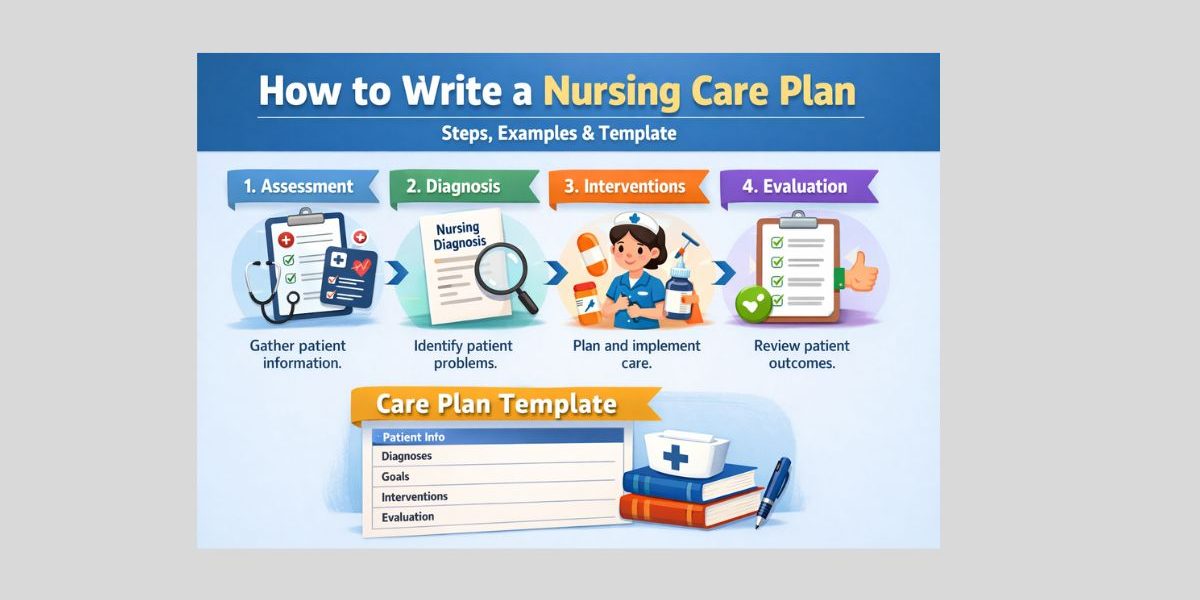
Nursing Care Plan Fundamentals, Purpose, Structure, and Clinical Importance
Nursing Care Plan: Meaning and Purpose
A nursing care plan is a structured guide that helps nurses deliver safe, organized, and patient-centered care. From the very beginning, it is important to understand that a care plan is not just an academic requirement. Instead, it reflects how nurses think, plan, and act in real clinical situations.
In simple terms, a care plan in nursing outlines what needs to be done for a patient, why it needs to be done, and how outcomes will be evaluated. Therefore, it connects assessment, diagnosis, intervention, and evaluation into one clear process.
For nursing students, learning how to develop a nursing care plan is essential. Not only does it improve academic performance, but it also builds clinical reasoning skills. As a result, students become more confident in both exams and real healthcare settings.
What Is a Nursing Care Plan in Practice?
In practice, a nursing care plan is a written framework that organizes patient care. However, it is more than just documentation. It is a tool that guides decision-making and ensures that care is consistent.
Typically, a care plan includes:
- Patient assessment
- Nursing diagnosis
- Goals and expected outcomes
- Nursing interventions
- Rationales
- Evaluation
Importantly, these components are connected. For example, assessment data leads to diagnosis, while diagnosis guides interventions. Consequently, a strong care plan always follows a logical flow.
Why Nursing Care Plans Are Important
Promotes Patient-Centered Care
First, a nursing care plan ensures that care is tailored to the individual. Instead of using a general approach, nurses focus on the patient’s specific needs. As a result, care becomes more effective and meaningful.
Improves Clinical Decision-Making
In addition, care planning strengthens critical thinking. Nurses must analyze patient data and choose the best course of action. Therefore, writing care plans helps students learn how to make informed clinical decisions.
Enhances Communication
Moreover, a well-written plan improves communication among healthcare providers. Since multiple professionals may care for the same patient, a clear plan ensures continuity.
Supports Better Patient Outcomes
Most importantly, structured care leads to better results. When interventions are planned and monitored carefully, patients are more likely to recover or stabilize.
Difference Between Medical and Nursing Diagnosis
Many students struggle because they confuse medical and nursing diagnoses. However, understanding the difference is essential for writing a strong nursing care plan.
A medical diagnosis identifies a disease, such as:
- Diabetes
- Pneumonia
- Hypertension
On the other hand, a nursing diagnosis focuses on the patient’s response to that condition.
Examples of Nursing Diagnoses
- Acute pain
- Risk for infection
- Impaired mobility
- Deficient knowledge
For example, a patient with pneumonia may have:
- Ineffective airway clearance
- Impaired gas exchange
Therefore, nursing diagnoses guide the care plan, not the medical condition alone.
The Nursing Care Planning Process
A standard nursing care plan follows five key steps. Each step builds on the previous one.
1. Assessment
To begin with, nurses collect patient data. This includes both subjective and objective information.
Subjective data:
- Pain
- Symptoms
- Patient concerns
Objective data:
- Vital signs
- Lab results
- Physical findings
Strong assessment is essential because it forms the foundation of the entire care plan.
2. Nursing Diagnosis
Next, nurses analyze the data to identify patient problems. This step requires clinical reasoning.
For example:
- High blood glucose → Risk for unstable blood glucose
- Immobility → Risk for pressure ulcers
3. Planning (Goals and Outcomes)
After identifying problems, nurses set goals. These goals should be clear and measurable.
Example:
- Patient will maintain stable blood glucose within 48 hours
As a result, interventions have a clear direction.
4. Implementation (Interventions)
At this stage, nurses carry out actions to achieve the goals.
Examples include:
- Monitoring vital signs
- Administering medication
- Providing education
Each intervention should be specific and relevant.
5. Evaluation
Finally, nurses evaluate whether the goals were achieved.
If the patient improves, the plan continues. However, if goals are not met, the plan must be adjusted. Therefore, care planning is a continuous process.
Core Components of a Nursing Care Plan
Assessment Data
Every strong nursing care plan begins with relevant data. Without proper assessment, the rest of the plan becomes weak.
Nursing Diagnosis
This identifies the patient’s main problems. It must be based on evidence from assessment.
Goals and Outcomes
Goals define what you want to achieve. They should be realistic and measurable.
Interventions
These are the actions taken to address the problem. They must be specific and purposeful.
Rationales
Rationales explain why each intervention is necessary. Therefore, they show understanding, not just action.
Evaluation
Evaluation measures success. It answers whether the care plan worked.
Types of Nursing Care Plans
Although the structure is similar, there are different types of nursing care plans.
Formal Care Plans
These are detailed and written, often used in academic settings.
Informal Care Plans
These may exist mentally or in brief notes during clinical practice.
Standardized Care Plans
These are prewritten for common conditions. However, they must be adjusted for individual patients.
Individualized Care Plans
These are tailored to a specific patient. As a result, they are the most effective and academically valuable.
Qualities of a High-Quality Nursing Care Plan
A strong nursing care plan should be:
- Patient-centered – focused on individual needs
- Specific – clear and detailed
- Logical – well-structured
- Evidence-based – supported by best practices
- Measurable – outcomes can be evaluated
When these qualities are present, the care plan becomes both clinically useful and academically strong.
Common Challenges in Nursing Care Plan Writing
Despite understanding the concept, many students struggle.
For example, they may:
- Choose incorrect diagnoses
- Write vague goals
- Miss rationales
- Fail to connect sections
Therefore, practice and structured guidance are essential for improvement.
Request Quotes Now
Need a detailed nursing care plan with proper structure, examples, and expert guidance? Request quotes now and get professional academic support.
Patient Assessment, Nursing Diagnosis, Prioritization, and Goal Setting in a Nursing Care Plan
Applying Clinical Thinking in a Nursing Care Plan
After understanding the fundamentals, the next step in mastering a nursing care plan is applying clinical thinking. At this stage, you move beyond definitions and begin to analyze patient data in a structured and meaningful way.
Importantly, a strong care plan in nursing is not built on guesswork. Instead, it is based on careful assessment, logical interpretation, and prioritization of patient needs. Therefore, every section must connect clearly to the next.
Comprehensive Patient Assessment in a Nursing Care Plan
To begin with, assessment is the foundation of every nursing care plan. Without accurate and relevant data, it is impossible to identify correct nursing problems or plan effective interventions.
Types of Assessment Data in Nursing Care Planning
Subjective Data (Patient-Reported Information)
Subjective data includes what the patient feels or reports. For example:
- Pain level and location
- Fatigue or weakness
- Nausea or dizziness
- Emotional concerns such as anxiety
However, strong nursing students go beyond listing symptoms. Instead, they interpret what those symptoms may indicate.
Example:
- Patient reports extreme thirst → may indicate hyperglycemia or dehydration
Objective Data (Observable and Measurable Findings)
Objective data includes measurable information collected during assessment.
Examples include:
- Vital signs (temperature, pulse, blood pressure)
- Laboratory results (blood glucose, HbA1c, electrolytes)
- Physical examination findings
- Intake and output
Why Assessment Must Be Analytical, Not Descriptive
Many students make the mistake of listing data without analysis. However, in a high-quality nursing care plan, data must be interpreted.
For instance:
- Blood glucose: 15 mmol/L → indicates poor glycemic control
- Elevated temperature → suggests possible infection
Therefore, interpretation transforms raw data into meaningful clinical insight.
Linking Assessment Data to Patient Problems
Once data is collected, the next step is identifying patterns. This is where clinical reasoning becomes essential.
Example of Pattern Recognition
- High glucose + fatigue + frequent urination → unstable blood glucose
- Immobility + skin redness → risk for pressure ulcers
As a result, the nurse can move confidently into the diagnosis stage.
Nursing Diagnosis in a Care Plan in Nursing
After assessment, the next step is writing nursing diagnoses. This is one of the most important parts of a nursing care plan, as it defines the patient’s problems.
Structure of a Nursing Diagnosis
A proper nursing diagnosis often follows this format:
Problem + related to + evidence
Example
“Risk for infection related to elevated blood glucose levels and impaired immunity as evidenced by delayed wound healing.”
Types of Nursing Diagnoses
Actual Diagnoses
These are current problems affecting the patient.
Examples:
- Acute pain
- Impaired mobility
Risk Diagnoses
These indicate potential problems.
Examples:
- Risk for infection
- Risk for falls
Health Promotion Diagnoses
These focus on improving well-being.
Examples:
- Readiness for enhanced nutrition
Common Nursing Diagnoses Used in Care Plans
Some diagnoses appear frequently in nursing care plan examples:
- Risk for unstable blood glucose
- Imbalanced nutrition
- Impaired skin integrity
- Deficient knowledge
- Ineffective breathing pattern
However, it is important to choose diagnoses based on patient data, not memorization.
Prioritization in a Nursing Care Plan
Not all patient problems are equally urgent. Therefore, prioritization is a critical skill in nursing care planning.
Using the ABC Framework
One common method is the ABC approach:
- Airway
- Breathing
- Circulation
Problems affecting these areas are prioritized first.
Using Maslow’s Hierarchy of Needs
Another method involves Maslow’s hierarchy:
- Physiological needs
- Safety needs
- Psychological needs
For example:
- Oxygenation issues take priority over anxiety
Example of Prioritization
A patient may have:
- Unstable blood glucose
- Risk for infection
- Anxiety
Priority order:
- Unstable blood glucose
- Risk for infection
- Anxiety
This shows logical clinical reasoning.
Planning and Goal Setting in a Nursing Care Plan
After identifying and prioritizing problems, the next step is planning. This involves setting goals that guide interventions.
Characteristics of Effective Goals
Goals in a nursing care plan should be:
- Specific
- Measurable
- Achievable
- Relevant
- Time-bound
Short-Term vs Long-Term Goals
Short-Term Goals
Focus on immediate outcomes.
Example:
- Patient will maintain stable blood glucose within 48 hours
Long-Term Goals
Focus on overall improvement.
Example:
- Patient will demonstrate effective self-management within one month
Linking Goals to Nursing Diagnoses
Every goal must directly relate to a diagnosis.
Example
- Diagnosis: Risk for infection
- Goal: Patient will remain free from infection during hospitalization
If this link is missing, the care plan becomes weak and unclear.
Common Mistakes in Assessment and Diagnosis
Even when students understand the process, errors still occur.
Frequent Issues Include
- Listing data without interpretation
- Choosing incorrect diagnoses
- Failing to prioritize
- Writing vague goals
- Weak connection between sections
Therefore, careful analysis and structure are essential.
Developing Strong Clinical Reasoning
To improve your nursing care plan, focus on reasoning rather than memorization.
Ask yourself:
- What does this data mean?
- What problem does it suggest?
- What should I address first?
- What outcome do I expect?
By doing this, your care plan becomes more logical and effective.
Transition to Interventions and Evaluation
At this stage, you now have:
- A detailed patient assessment
- Accurate nursing diagnoses
- Clear priorities
- Well-defined goals
Request Quotes Now
Need help developing a complete nursing care plan with accurate diagnoses and SMART goals? Request quotes now for expert academic support.
Nursing Interventions, Rationales, Examples, Templates, and Evaluation in a Nursing Care Plan
From Planning to Action in a Nursing Care Plan
After completing assessment, diagnosis, and goal setting, the next stage in a nursing care plan involves implementation. At this point, the nurse translates clinical decisions into specific actions that directly improve patient outcomes.
However, a strong care plan in nursing does not simply list tasks. Instead, it explains what should be done, why it should be done, and how it contributes to patient recovery. Therefore, interventions must always be clear, purposeful, and evidence-based.
Nursing Interventions in a Nursing Care Plan
What Are Nursing Interventions?
Nursing interventions are the actions taken to address patient problems identified in the care plan. These actions aim to achieve the goals set during the planning phase.
Importantly, interventions must be:
- Specific
- Patient-centered
- Measurable
- Linked to diagnosis
Types of Nursing Interventions
Independent Interventions
These are actions nurses can perform without a physician’s order.
Examples:
- Repositioning a patient
- Providing education
- Monitoring vital signs
Dependent Interventions
These require a physician’s order.
Examples:
- Administering medication
- Starting IV fluids
Collaborative Interventions
These involve working with other healthcare professionals.
Examples:
- Consulting a dietitian
- Referring to physiotherapy
Writing Nursing Interventions with Strong Rationales
A high-quality nursing care plan always includes rationales. These explain the scientific or clinical reason behind each intervention.
Example
Intervention:
Monitor blood glucose levels before meals and at bedtime
Rationale:
Regular monitoring helps detect fluctuations early and prevents complications such as hypoglycemia or hyperglycemia
Advanced Tip
Instead of writing generic rationales, connect them directly to the patient’s condition. As a result, your care plan becomes more specific and academically strong.
Detailed Nursing Care Plan Example (Diabetes)
To illustrate how everything connects, consider the following nursing care plan example.
Patient Information
- Age: 55 years
- Condition: Type 2 diabetes
- Symptoms: fatigue, increased thirst, poor wound healing
Assessment
- Blood glucose: 16 mmol/L
- HbA1c: 9%
- Skin: slow healing wound
Nursing Diagnosis
Risk for unstable blood glucose related to poor glycemic control
Goal
Patient will maintain blood glucose within target range within 72 hours
Interventions and Rationales
- Monitor blood glucose regularly
→ Detects early changes and prevents complications - Administer insulin as prescribed
→ Helps regulate blood glucose levels - Educate patient on diet
→ Supports long-term glycemic control - Encourage physical activity
→ Improves insulin sensitivity
Evaluation
Blood glucose reduced to target range; patient demonstrates understanding of management
This example shows how each section connects logically.
Nursing Care Plan Example (Pressure Ulcer Risk)
Nursing Diagnosis
Risk for impaired skin integrity related to immobility
Goal
Patient will remain free from pressure ulcers
Interventions
- Reposition patient every 2 hours
- Keep skin clean and dry
- Use pressure-relieving devices
Rationale
Reducing pressure prevents tissue damage and improves circulation
Nursing Care Plan Template (Comprehensive)
Use this nursing care plan template to structure your assignments effectively.
1. Patient Information
- Age:
- Gender:
- Diagnosis:
2. Assessment
- Subjective Data:
- Objective Data:
3. Nursing Diagnoses
- Diagnosis 1:
- Diagnosis 2:
4. Goals and Outcomes
- Short-term goal:
- Long-term goal:
5. Nursing Interventions and Rationales
- Intervention:
- Rationale:
6. Evaluation
- Outcome achieved:
- Changes required:
Using a template improves organization and ensures completeness.
Request Quotes Now
Need a fully structured nursing care plan with examples and a ready-to-use template? Request quotes now for expert academic support.
Patient Education in a Nursing Care Plan
Patient education is a key part of any nursing care plan. Without proper education, patients may fail to follow treatment plans.
Areas of Patient Education
- Medication adherence
- Diet and nutrition
- Lifestyle changes
- Symptom monitoring
Why Education Matters
Educated patients are more likely to:
- Follow treatment plans
- Recognize warning signs
- Prevent complications
Therefore, education improves both short-term and long-term outcomes.
Evaluation in a Nursing Care Plan
Evaluation determines whether the care plan is effective. It answers a simple question: did the patient improve?
Key Evaluation Criteria
- Goals achieved
- Symptoms reduced
- Patient understanding improved
- No new complications
Example of Strong Evaluation
Instead of writing:
“Patient improved”
Write:
“Patient maintained stable blood glucose levels within target range and demonstrated correct insulin administration.”
Continuous Improvement
If goals are not met, the care plan must be adjusted. Therefore, evaluation is not the end but part of an ongoing process.
Common Mistakes in Nursing Interventions and Evaluation
Even strong students make mistakes at this stage.
Common Errors
- Writing vague interventions
- Missing rationales
- Weak evaluation statements
- Not linking interventions to goals
However, these can be avoided by focusing on clarity and logic.
Final Thoughts on Nursing Care Plan Writing
A well-developed nursing care plan combines assessment, diagnosis, planning, intervention, and evaluation into a clear and logical process.
More importantly, it reflects how nurses think in real clinical settings. Therefore, mastering this process is essential for both academic success and professional practice.
Request Quotes Now
Need a high-quality, plagiarism-free nursing care plan with examples and template included? Request quotes now and boost your academic performance.
FAQ Section
What is a nursing care plan?
A nursing care plan is a structured approach used to assess patients, identify problems, and plan care.
What are the steps in a nursing care plan?
Assessment, diagnosis, planning, intervention, and evaluation.
Why are nursing care plans important?
They improve patient care, support decision-making, and enhance communication.
What is an example of a nursing care plan?
A diabetes care plan includes monitoring glucose, medication, and patient education.
Can I get help with a nursing care plan?
Yes, professional services can assist with writing and structuring your assignment.
