

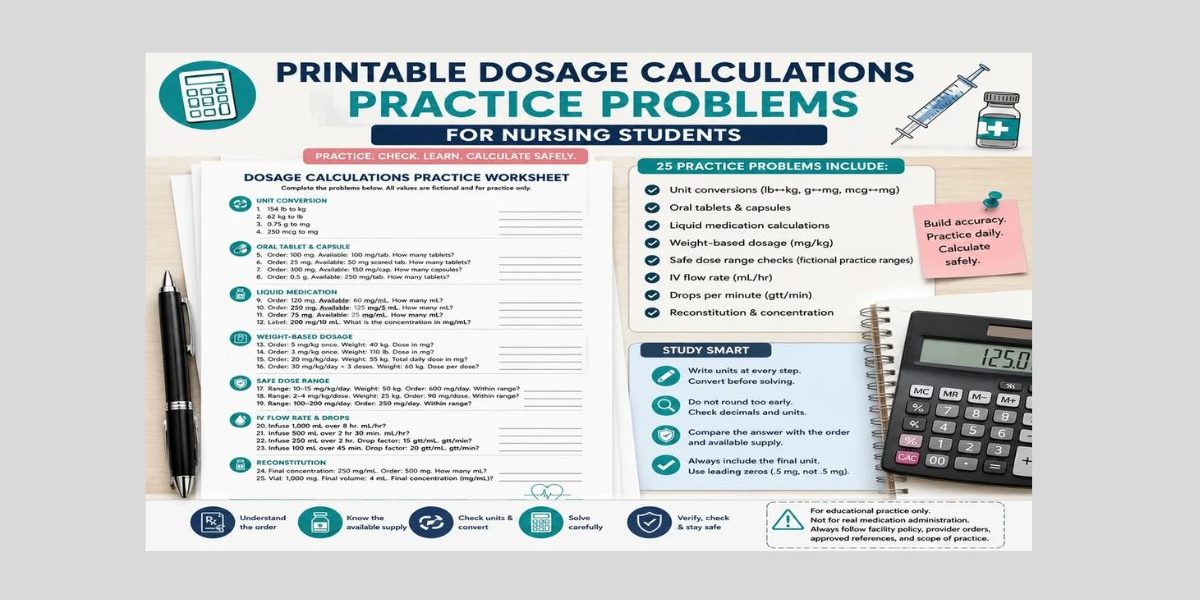
Printable dosage calculations practice problems help nursing students move from “I understand the formula” to “I can set up, solve, round, and check the answer safely.” Many students know dosage calculation formulas during class but struggle when they must choose the correct setup, convert units, avoid decimal errors, round correctly, and explain the final answer under exam conditions.
This article gives you a printable-style dosage calculation practice set with unit conversions, oral tablets, liquid medications, weight-based calculations, safe dose range checks, IV mL/hr, drops per minute, reconstitution, a dosage calculation answer key, worked solutions, and safety checks.
Educational safety disclaimer: This practice set is for nursing education and dosage calculation practice only. Medication administration must follow provider orders, medication labels, approved drug references, facility policy, instructor guidance, and scope of practice.
If you need a broader formula review before using this worksheet, read the full guide on dosage calculations for nursing students. That article covers the main dosage calculation methods, unit conversions, oral and liquid calculations, IV rates, safe dose ranges, reconstitution, rounding, and general nursing math examples. This supporting article stays focused on printable practice problems and worked answers, as requested in the provided article brief.
Medication calculation accuracy is only one part of medication safety. Nurses also verify the order, patient identity, medication label, dose, unit, route, time, allergies, patient weight when required, facility policy, and approved drug reference information when needed. Nursing math chapters and medication safety resources emphasize that dosage calculations support safe medication preparation, but they do not replace complete medication administration checks (Ernstmeyer & Christman, 2023; Hanson & Haddad, 2023).
Quick Answer: How to Use These Printable Dosage Calculations Practice Problems
Work through the blank practice problems before checking the answer key.
- Write units at every step.
- Convert units before solving when needed.
- Do not round too early.
- Check decimal placement and final units.
- Compare the final answer with the order and available supply.
- Use the worked solutions to identify the exact step where you made an error.
Before You Print: Dosage Calculation Safety Reminders
This worksheet is for education-only nursing math practice. It does not provide patient-specific dosing advice, treatment recommendations, medication protocols, or drug-specific safe dose ranges.
Use the conversion chart, rounding rules, and medication calculation method approved by your nursing program. Some instructors prefer dimensional analysis. Others accept ratio-proportion or the desired-over-have formula. The method matters less than the accuracy, unit logic, and safety of the final answer.
Medication error prevention resources warn that decimal placement and dose notation can create serious safety risks. Use a leading zero for doses less than 1, such as 0.5 mg, and avoid trailing zeros, such as 1.0 mg, because they may be misread (Institute for Safe Medication Practices [ISMP], 2023).
Safety Checklist Before Solving
Before you solve any dosage calculation problem, ask:
- What is ordered?
- What is available?
- Do the units match?
- Do I need to convert pounds to kilograms?
- Is the answer asking for tablets, mL, mL/hr, gtt/min, mg per dose, or mg per day?
- Does the answer look reasonable?
- Did I avoid rounding too early?
- Did I include the final unit?
- Did I use a leading zero where needed?
- Did I avoid unsafe trailing zeros?
Printable Dosage Calculations Practice Problems: Blank Worksheet
Complete this blank worksheet before reviewing the answer key. All medication names, orders, concentrations, and safe dose ranges are fictional and for nursing education only.
Unit Conversion Practice
- A student weighs 154 lb. Convert the weight to kilograms. Round to the nearest tenth if needed.
- A patient weighs 62 kg. Convert the weight to pounds. Round to the nearest tenth if needed.
- Convert 0.75 g to milligrams.
- Convert 250 mcg to milligrams.
Oral Tablet and Capsule Practice
- Fictional order: Medication A 100 mg PO once. Available: Medication A 100 mg/tablet. How many tablets are needed?
- Fictional order: Medication B 25 mg PO once. Available: Medication B 50 mg scored tablet. How many tablets are needed? Add a policy safety note.
- Fictional order: Medication C 300 mg PO once. Available: Medication C 150 mg/capsule. How many capsules are needed?
- Fictional order: Medication D 0.5 g PO once. Available: Medication D 250 mg/tablet. How many tablets are needed?
Liquid Medication Practice
- Fictional order: Medication E 120 mg PO once. Available: Medication E 60 mg/mL. How many mL are needed?
- Fictional order: Medication F 250 mg PO once. Available: Medication F 125 mg/5 mL. How many mL are needed?
- Fictional order: Medication G 75 mg PO once. Available: Medication G 25 mg/mL. How many mL are needed?
- Medication H label reads 200 mg/10 mL. What is the concentration in mg/mL?
Weight-Based Dosage Practice
- Fictional order: Medication I 5 mg/kg once. Patient weight: 40 kg. What is the ordered dose in mg?
- Fictional order: Medication J 3 mg/kg once. Patient weight: 110 lb. What is the ordered dose in mg? Round the weight to the nearest tenth before calculating.
- Fictional order: Medication K 20 mg/kg/day. Patient weight: 55 kg. What is the total daily dose in mg/day?
- Fictional order: Medication L 30 mg/kg/day divided into 3 equal doses. Patient weight: 60 kg. What is the dose in mg per dose?
Safe Dose Range Practice
All ranges in this section are fictional and practice-only.
- Fictional practice-only safe range: Medication M 10–15 mg/kg/day. Patient weight: 50 kg. Ordered total daily dose: 600 mg/day. Calculate the safe range and state whether the ordered dose appears within the example range.
- Fictional practice-only safe range: Medication N 2–4 mg/kg/dose. Patient weight: 25 kg. Ordered dose: 90 mg per dose. Calculate the safe range and state whether the ordered dose appears within the example range.
- Fictional practice-only safe range: Medication O 100–200 mg/day. Ordered dose: 250 mg/day. Is the ordered dose within the example range?
IV Flow Rate and Drops per Minute Practice
- Fictional IV order: Infuse 1,000 mL over 8 hours. Calculate the flow rate in mL/hr.
- Fictional IV order: Infuse 500 mL over 2 hours 30 minutes. Calculate the flow rate in mL/hr.
- Fictional gravity infusion order: Infuse 250 mL over 2 hours. Drop factor: 15 gtt/mL. Calculate gtt/min. Round to the nearest whole drop.
- Fictional gravity infusion order: Infuse 100 mL over 45 minutes. Drop factor: 20 gtt/mL. Calculate gtt/min. Round to the nearest whole drop.
Reconstitution Practice
- Fictional reconstitution label: After reconstitution, Medication P concentration is 250 mg/mL. Ordered dose: 500 mg. How many mL are needed?
- Fictional reconstitution label: Medication Q vial contains 1,000 mg. After reconstitution, the final volume is 4 mL. What is the final concentration in mg/mL?
Dosage Calculation Answer Key
| Problem | Final Answer |
| 1 | 70 kg |
| 2 | 136.4 lb |
| 3 | 750 mg |
| 4 | 0.25 mg |
| 5 | 1 tablet |
| 6 | 0.5 tablet, if scored and permitted by policy/instructor guidance |
| 7 | 2 capsules |
| 8 | 2 tablets |
| 9 | 2 mL |
| 10 | 10 mL |
| 11 | 3 mL |
| 12 | 20 mg/mL |
| 13 | 200 mg |
| 14 | 150 mg |
| 15 | 1,100 mg/day |
| 16 | 600 mg per dose |
| 17 | 500–750 mg/day; 600 mg/day appears within the fictional range |
| 18 | 50–100 mg per dose; 90 mg per dose appears within the fictional range |
| 19 | No; 250 mg/day is above the fictional range |
| 20 | 125 mL/hr |
| 21 | 200 mL/hr |
| 22 | 31 gtt/min |
| 23 | 44 gtt/min |
| 24 | 2 mL |
| 25 | 250 mg/mL |
Worked Solutions for Unit Conversion Practice
Problem 1: Convert 154 lb to kg
Problem: A student weighs 154 lb. Convert the weight to kilograms.
Setup:
154 lb ÷ 2.2 = kg
Solve:
154 ÷ 2.2 = 70
Final answer: 70 kg
Reasonableness check: Kilograms are smaller in number than pounds. A 154 lb weight becoming 70 kg is reasonable.
Problem 2: Convert 62 kg to lb
Problem: A patient weighs 62 kg. Convert the weight to pounds.
Setup:
62 kg × 2.2 = lb
Solve:
62 × 2.2 = 136.4
Final answer: 136.4 lb
Reasonableness check: Pounds are larger in number than kilograms. A 62 kg weight becoming 136.4 lb is reasonable.
Problem 3: Convert 0.75 g to mg
Problem: Convert 0.75 g to milligrams.
Setup:
1 g = 1,000 mg
0.75 g × 1,000 = mg
Solve:
0.75 × 1,000 = 750
Final answer: 750 mg
Reasonableness check: Since 1 g equals 1,000 mg, a value less than 1 g should become less than 1,000 mg.
Problem 4: Convert 250 mcg to mg
Problem: Convert 250 mcg to milligrams.
Setup:
1 mg = 1,000 mcg
250 mcg ÷ 1,000 = mg
Solve:
250 ÷ 1,000 = 0.25
Final answer: 0.25 mg
Reasonableness check: Micrograms are smaller than milligrams, so the mg value should be smaller than the mcg value.
Worked Solutions for Oral Tablet and Capsule Practice
Problem 5: Whole Tablet Calculation
Problem: Medication A 100 mg is ordered. Available strength is 100 mg/tablet.
Formula:
Ordered dose ÷ available dose per tablet = tablets
Solve:
100 mg ÷ 100 mg/tablet = 1 tablet
Final answer: 1 tablet
Safety check: The ordered dose and available strength match exactly.
Problem 6: Half-Tablet Style Calculation
Problem: Medication B 25 mg is ordered. Available strength is 50 mg scored tablet.
Formula:
Ordered dose ÷ available dose per tablet = tablets
Solve:
25 mg ÷ 50 mg/tablet = 0.5 tablet
Final answer: 0.5 tablet
Safety note: Tablet splitting depends on whether the tablet is scored, whether splitting is allowed by medication guidance, and whether facility or instructor policy permits it. Do not assume every tablet can be split.
Problem 7: Multiple-Capsule Calculation
Problem: Medication C 300 mg is ordered. Available strength is 150 mg/capsule.
Formula:
Ordered dose ÷ available dose per capsule = capsules
Solve:
300 mg ÷ 150 mg/capsule = 2 capsules
Final answer: 2 capsules
Reasonableness check: Two 150 mg capsules provide 300 mg.
Problem 8: Strength Conversion Problem
Problem: Medication D 0.5 g is ordered. Available strength is 250 mg/tablet.
Step 1: Convert grams to milligrams.
0.5 g × 1,000 = 500 mg
Step 2: Calculate tablets.
500 mg ÷ 250 mg/tablet = 2 tablets
Final answer: 2 tablets
Safety check: Convert the ordered dose before dividing. Do not divide grams by milligrams without converting units.
Worked Solutions for Liquid Medication Practice
Problem 9: mg/mL Liquid Calculation
Problem: Medication E 120 mg is ordered. Available concentration is 60 mg/mL.
Setup:
120 mg ÷ 60 mg/mL = mL
Solve:
120 ÷ 60 = 2
Final answer: 2 mL
Reasonableness check: If 1 mL contains 60 mg, then 2 mL contains 120 mg.
Problem 10: mg/5 mL Liquid Calculation
Problem: Medication F 250 mg is ordered. Available concentration is 125 mg/5 mL.
Setup:
250 mg × 5 mL ÷ 125 mg = mL
Solve:
250 ÷ 125 = 2
2 × 5 mL = 10 mL
Final answer: 10 mL
Reasonableness check: 5 mL contains 125 mg. The ordered dose is double 125 mg, so the volume is double 5 mL.
Problem 11: Ordered Dose to mL
Problem: Medication G 75 mg is ordered. Available concentration is 25 mg/mL.
Setup:
75 mg ÷ 25 mg/mL = mL
Solve:
75 ÷ 25 = 3
Final answer: 3 mL
Reasonableness check: 1 mL gives 25 mg. 3 mL gives 75 mg.
Problem 12: Concentration Interpretation
Problem: Medication H label reads 200 mg/10 mL. Find mg/mL.
Setup:
200 mg ÷ 10 mL = mg/mL
Solve:
200 ÷ 10 = 20
Final answer: 20 mg/mL
Reasonableness check: If 10 mL contains 200 mg, each 1 mL contains one-tenth of 200 mg.
Worked Solutions for Weight-Based Dosage Practice
Problem 13: mg/kg Single-Dose Problem
Problem: Medication I is ordered at 5 mg/kg once. Patient weight is 40 kg.
Setup:
5 mg/kg × 40 kg = mg
Solve:
5 × 40 = 200
Final answer: 200 mg
Dose type: This is a single dose answer.
Problem 14: lb to kg Then mg/kg
Problem: Medication J is ordered at 3 mg/kg once. Patient weight is 110 lb.
Step 1: Convert lb to kg.
110 lb ÷ 2.2 = 50 kg
Step 2: Calculate dose.
3 mg/kg × 50 kg = 150 mg
Final answer: 150 mg
Dose type: This is a single dose answer.
Safety check: Weight-based calculations usually require kilograms. Do not use pounds in a mg/kg formula.
Problem 15: mg/kg/day Total Daily Dose
Problem: Medication K is ordered at 20 mg/kg/day. Patient weight is 55 kg.
Setup:
20 mg/kg/day × 55 kg = mg/day
Solve:
20 × 55 = 1,100
Final answer: 1,100 mg/day
Dose type: This is the total daily dose, not the amount per dose.
Problem 16: Divided Dose Problem
Problem: Medication L is ordered at 30 mg/kg/day divided into 3 equal doses. Patient weight is 60 kg.
Step 1: Calculate total daily dose.
30 mg/kg/day × 60 kg = 1,800 mg/day
Step 2: Divide into 3 doses.
1,800 mg/day ÷ 3 = 600 mg per dose
Final answer: 600 mg per dose
Dose type: This is the amount per dose.
Safety check: Do not confuse total daily dose with each divided dose.
Worked Solutions for Safe Dose Range Practice
Safe dose range calculations in this section use fictional practice-only ranges. Real safe ranges must come from approved drug references, instructor examples, facility policy, or pharmacist guidance. Nursing students should never apply a fictional worksheet range to real medication administration.
Problem 17: Fictional Per-Day Safe Range
Problem: Medication M has a fictional practice-only safe range of 10–15 mg/kg/day. Patient weight is 50 kg. Ordered dose is 600 mg/day.
Step 1: Calculate minimum daily dose.
10 mg/kg/day × 50 kg = 500 mg/day
Step 2: Calculate maximum daily dose.
15 mg/kg/day × 50 kg = 750 mg/day
Step 3: Compare order with range.
Fictional range: 500–750 mg/day
Ordered dose: 600 mg/day
Final answer: 600 mg/day appears within the fictional practice-only range.
Safety note: A real medication decision would require an approved reference, current order, patient-specific context, and facility policy.
Problem 18: Fictional Per-Dose Safe Range
Problem: Medication N has a fictional practice-only safe range of 2–4 mg/kg/dose. Patient weight is 25 kg. Ordered dose is 90 mg per dose.
Step 1: Calculate minimum dose.
2 mg/kg/dose × 25 kg = 50 mg per dose
Step 2: Calculate maximum dose.
4 mg/kg/dose × 25 kg = 100 mg per dose
Step 3: Compare order with range.
Fictional range: 50–100 mg per dose
Ordered dose: 90 mg per dose
Final answer: 90 mg per dose appears within the fictional practice-only range.
Safety note: Real safe dose ranges must be checked against approved references, instructor guidance, or facility policy.
Problem 19: Compare Ordered Dose With Example Range
Problem: Medication O has a fictional practice-only safe range of 100–200 mg/day. Ordered dose is 250 mg/day.
Compare:
Fictional range: 100–200 mg/day
Ordered dose: 250 mg/day
Final answer: No. The ordered dose is above the fictional practice-only range.
Safety note: In clinical practice, a nurse should not guess, ignore, or independently adjust the order. Follow facility policy, clarify concerns through the appropriate clinical process, and use approved references.
Worked Solutions for IV Flow Rate and Drops per Minute Practice
This section is math-only. It does not teach IV insertion, pump programming, titration, compatibility, high-alert infusion management, or IV therapy procedures.
Problem 20: Basic mL/hr Problem
Problem: Infuse 1,000 mL over 8 hours.
Formula:
mL/hr = total volume ÷ time in hours
Solve:
1,000 mL ÷ 8 hr = 125 mL/hr
Final answer: 125 mL/hr
Reasonableness check: 125 mL each hour for 8 hours equals 1,000 mL.
Problem 21: mL/hr With Time Conversion
Problem: Infuse 500 mL over 2 hours 30 minutes.
Step 1: Convert time to hours.
30 minutes = 0.5 hour
2 hours 30 minutes = 2.5 hours
Step 2: Calculate mL/hr.
500 mL ÷ 2.5 hr = 200 mL/hr
Final answer: 200 mL/hr
Safety check: Convert minutes correctly before calculating mL/hr.
Problem 22: Basic gtt/min Problem
Problem: Infuse 250 mL over 2 hours. Drop factor is 15 gtt/mL.
Formula:
gtt/min = volume × drop factor ÷ time in minutes
Step 1: Convert time to minutes.
2 hours × 60 = 120 minutes
Step 2: Calculate drops per minute.
250 mL × 15 gtt/mL ÷ 120 min = 31.25 gtt/min
Step 3: Round to whole drop.
31.25 rounds to 31.
Final answer: 31 gtt/min
Rounding note: Drops are counted as whole drops, so gtt/min is usually rounded to the nearest whole number in nursing math practice.
Problem 23: gtt/min With Minutes Conversion
Problem: Infuse 100 mL over 45 minutes. Drop factor is 20 gtt/mL.
Formula:
gtt/min = volume × drop factor ÷ time in minutes
Solve:
100 mL × 20 gtt/mL ÷ 45 min = 44.44 gtt/min
Round:
44.44 rounds to 44.
Final answer: 44 gtt/min
Reasonableness check: The infusion time is less than 1 hour, so the drop rate should be faster than if the same volume were infused over several hours.
Worked Solutions for Reconstitution Practice
These problems use fictional final concentrations for education-only math practice. They do not teach real medication preparation or patient-specific administration.
Problem 24: Ordered Dose From Final Concentration
Problem: After reconstitution, Medication P concentration is 250 mg/mL. Ordered dose is 500 mg.
Setup:
500 mg ÷ 250 mg/mL = mL
Solve:
500 ÷ 250 = 2
Final answer: 2 mL
Reasonableness check: If 1 mL contains 250 mg, 2 mL contains 500 mg.
Problem 25: Final Concentration After Reconstitution
Problem: Medication Q vial contains 1,000 mg. After reconstitution, final volume is 4 mL. Find final concentration.
Setup:
1,000 mg ÷ 4 mL = mg/mL
Solve:
1,000 ÷ 4 = 250
Final answer: 250 mg/mL
Safety check: The question asks for concentration, not volume to administer.
How to Check Your Dosage Calculation Answers
A correct dosage calculation should answer the exact question asked. Before you accept your answer, check the final unit.
Ask yourself:
- Did the question ask for mg, mL, tablets, capsules, mL/hr, gtt/min, mg/day, or mg per dose?
- Did I convert the unit before solving?
- Did I use kilograms for a mg/kg calculation?
- Did I compare the ordered dose with the correct safe range?
- Did I round only at the end?
- Did I include a leading zero for answers less than 1?
- Did I avoid a trailing zero?
- Does the number seem realistic?
- Can I repeat the problem using another method?
Open nursing math resources emphasize unit setup, conversion accuracy, dosage formulas, and checking the calculated dose or rate as part of safe preparation (Ernstmeyer & Christman, 2023; Gage & Murphy, 2023).
Common Mistakes These Practice Problems Help You Catch
| Mistake | Example From Practice Type | How to Avoid It |
| Forgetting unit conversion | Using 0.5 g as 0.5 mg | Convert before solving. |
| Confusing mg and mcg | Treating 250 mcg as 250 mg | Memorize that 1 mg = 1,000 mcg. |
| Using pounds instead of kilograms | Calculating mg/kg with 110 lb | Convert lb to kg first. |
| Mixing per-dose and per-day answers | Reporting 1,800 mg/day as each dose | Identify whether the answer is per day or per dose. |
| Rounding too early | Rounding weight before the instructed step | Keep extra decimals until the final answer unless your program says otherwise. |
| Decimal placement errors | Writing .25 mg instead of 0.25 mg | Use leading zeros for values less than 1. |
| Missing units | Writing “2” instead of “2 mL” | Add units to every final answer. |
| Misreading mg/mL and mg/5 mL | Treating 125 mg/5 mL as 125 mg/mL | Read the full label expression. |
| Forgetting time conversion | Using 2 hr as 2 minutes | Convert hours to minutes for gtt/min. |
| Using the wrong drop factor | Using 10 gtt/mL when the problem says 15 gtt/mL | Circle the drop factor before calculating. |
| Comparing the ordered dose to the wrong safe range | Comparing a daily dose with a per-dose range | Match per-day with per-day and per-dose with per-dose. |
| Assuming a calculation is safe without medication checks | Treating math accuracy as the only safety step | Verify order, patient, label, route, time, allergies, references, and policy. |
How to Turn This Into a Printable Dosage Calculation Worksheet
To use this article as a printable dosage calculation worksheet:
- Copy the blank worksheet section into a document.
- Print the blank worksheet before the answer key.
- Keep the answer key and worked solutions separate.
- Practice by category first.
- Move to mixed practice problems after you improve accuracy.
- Mark missed questions by error type, such as conversion, decimal, setup, rounding, or unit error.
- Redo missed questions after 24–48 hours.
- Create a one-page conversion and rounding reminder sheet based on your program’s requirements.
Do not only memorize answers. The goal is to learn how to read the order, identify the available supply, choose the setup, solve carefully, and check the result.
When to Ask for Help With Dosage Calculation Practice
Ask for help if you repeatedly miss:
- Unit conversions
- Decimal placement
- mg to mcg conversions
- lb to kg conversions
- Safe dose range comparisons
- IV mL/hr problems
- Drops per minute problems
- Weight-based calculations
- Divided daily dose problems
- Reconstitution-style concentration problems
Academic support can help you understand practice questions, assignment instructions, step-by-step explanations, and error correction. If you need help with medication math assignments or nursing coursework, you may find nursing assignment help or nursing homework help useful. If your assignment also involves route selection or medication administration concepts, review medication administration routes separately from the math.
FAQs About Printable Dosage Calculations Practice Problems
1. Are these printable dosage calculations practice problems for nursing students?
Yes. These printable dosage calculations practice problems are designed for nursing students, pre-nursing students, healthcare students, and students preparing for medication calculation exams.
2. Can I print these dosage calculation problems?
Yes. Copy the blank worksheet section into a document and print it before the answer key. Keep the worked solutions separate so you can test yourself first.
3. Do these problems include an answer key?
Yes. The answer key lists final answers for all 25 dosage calculation practice problems.
4. Do the practice problems include worked solutions?
Yes. The article includes dosage calculation worked solutions by category, including unit conversions, oral medications, liquids, weight-based calculations, safe dose range checks, IV rates, drops per minute, and reconstitution.
5. What dosage calculation types should nursing students practice first?
Start with unit conversions, oral tablets, and liquid medication calculations. Then move into weight-based dosage practice, safe dose range practice, IV mL/hr, gtt/min, and reconstitution.
6. How many dosage calculation problems should I practice daily?
A short daily set of 10–15 focused problems is often more useful than rushing through a long worksheet once. Track your missed problem types and repeat them.
7. How do I know which formula to use?
Read what the question asks for. If it asks for tablets, divide the ordered dose by the available dose per tablet. And if it asks for mL, use the available concentration. If it asks for mL/hr, divide volume by time in hours. If it asks for gtt/min, use volume, drop factor, and time in minutes.
8. Why do I keep making decimal mistakes?
Decimal mistakes often happen when students skip units, rush conversions, round too early, or fail to use leading zeros. ISMP warns that missing leading zeros and trailing zeros can contribute to dose misinterpretation (ISMP, 2023).
9. Are these practice problems safe for real medication administration?
No. These are fictional, education-only practice problems. Real medication administration must follow provider orders, medication labels, approved drug references, facility policy, instructor guidance, and scope of practice.
- Where can I review dosage calculation formulas before practicing?
You can review broader formulas and methods in the full nursing dosage calculations guide before completing this worksheet.
Final Thoughts on Printable Dosage Calculations Practice Problems
Printable dosage calculation practice builds accuracy, speed, confidence, and safer math habits. Practice by category first, then use mixed problems once you can identify the setup without help.
Every final answer should include the correct unit and a reasonableness check. A calculation may be mathematically correct but still incomplete if you fail to verify the order, label, route, time, patient identity, allergies, weight, approved references, facility policy, and instructor or preceptor guidance.
Use this worksheet to strengthen your medication math skills, then return to the broader dosage calculation guide when you need more formula review. If you need help understanding dosage calculation practice problems, medication math assignments, or nursing pharmacology coursework, you can upload your instructions, rubric, and practice questions for academic guidance.
References
Ernstmeyer, K., & Christman, E. (Eds.). (2023). Nursing skills: Chapter 5 math calculations. NCBI Bookshelf. https://www.ncbi.nlm.nih.gov/books/NBK596732/
Gage, C. B., & Murphy, D. (2023). Dose calculation. StatPearls Publishing. https://www.ncbi.nlm.nih.gov/books/NBK430836/
Hanson, A., & Haddad, L. M. (2023). Nursing rights of medication administration. StatPearls Publishing. https://www.ncbi.nlm.nih.gov/books/NBK560654/
Institute for Safe Medication Practices. (2023). ISMP list of error-prone abbreviations, symbols, and dose designations. https://www.ismp.org/
Tariq, R. A., Vashisht, R., Sinha, A., & Scherbak, Y. (2024). Medication dispensing errors and prevention. StatPearls Publishing. https://www.ncbi.nlm.nih.gov/books/NBK519065/
