

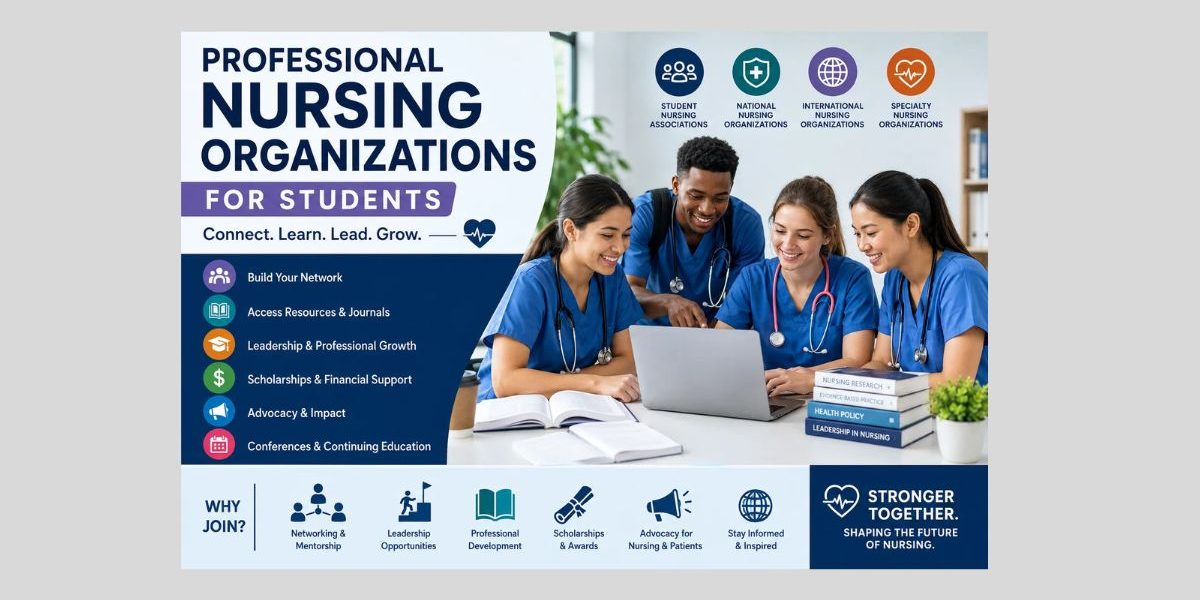
Professional nursing organizations help nursing students understand the profession beyond lectures, exams, skills labs, and clinical placement. Many students hear that they should join a nursing association, but they may not know which organization matters, what membership includes, or whether it is worth the cost.
This guide explains what nursing organizations are, why they matter, the types students may encounter, examples of major organizations, how to choose the right one, and how to use professional organizations in nursing assignments, discussion posts, reflections, leadership papers, research papers, and career-development essays.
Quick Answer: What Are Professional Nursing Organizations?
Professional nursing organizations are formal groups that support nurses, nursing students, nursing specialties, education, advocacy, leadership, research, and professional development.
- Nursing students may join student, national, international, local, school-based, or specialty nursing organizations depending on eligibility and goals.
- These organizations may offer networking, conferences, journals, scholarships, mentorship, leadership opportunities, continuing education, and career resources.
- Benefits vary by organization, country, state, school, membership type, and student status.
- Students should verify current fees, eligibility rules, benefits, student discounts, scholarship details, and conference information on official websites.
- Joining a nursing organization does not guarantee a job, scholarship, clinical placement, licensure success, or academic success.
- Nursing students can use professional organizations as credible examples in career papers, leadership assignments, ethics discussions, evidence-based practice assignments, and professional development reflections.
What Are Professional Nursing Organizations?
Professional nursing organizations are structured groups created to support nurses, nursing students, educators, researchers, leaders, and specialty practitioners. They may focus on the whole nursing profession, a specific specialty, student development, nursing education, research, leadership, public policy, or continuing professional development.
They are different from informal student clubs. A student club may organize peer support, school events, volunteering, or campus activities. A professional nursing organization usually has a defined mission, membership rules, leadership structure, official resources, publications, conferences, standards, position statements, or professional development opportunities.
For example, the American Nurses Association describes membership as a way for nurses to access professional resources, webinars, journals, and broader support for the nursing profession. The International Council of Nurses works through national nursing associations rather than direct individual membership, showing that some nursing organizations operate at a national or international policy level rather than as simple student clubs (ANA, n.d.)
Students should understand these organizations before entering practice because nursing is not only about completing assignments or passing clinical evaluations. Professional organizations show how nurses build identity, share knowledge, influence standards, support specialties, and participate in the future of healthcare.
Why Professional Nursing Organizations Matter for Students
Professional nursing organizations matter because they help students see nursing as a profession, not just a course of study. A student may begin nursing school focused on grades, care plans, and skills checkoffs. Those things matter, but professional growth also includes networking, leadership, ethical awareness, specialty exploration, advocacy, and lifelong learning.
A nursing organization may help students build professional identity. When students attend meetings, read organization resources, follow practice updates, or join student chapters, they begin to understand how nurses speak, lead, collaborate, and advocate.
These organizations may also support nursing networking. Students can meet other students, practicing nurses, faculty, specialty nurses, nurse leaders, and sometimes recruiters or graduate program representatives. Networking does not guarantee a job, but it can help students ask better questions, learn about practice areas, and understand professional expectations.
Mentorship is another major benefit. Some organizations offer formal mentoring, while others create informal opportunities through chapters, conferences, webinars, online communities, or committees. For a student who is unsure about emergency nursing, oncology, perioperative nursing, psychiatric nursing, public health, or advanced practice, these conversations can make career planning more realistic.
Many organizations also support leadership development. Students may serve as class representatives, chapter officers, committee members, event organizers, peer mentors, or conference volunteers. These roles can strengthen communication, teamwork, planning, and professional confidence.
Students may also benefit from scholarships, awards, journals, newsletters, continuing education, conferences, and specialty learning. However, these benefits change often. Students should check the official website before relying on any scholarship, fee, deadline, or membership benefit.
Professional Nursing Organizations vs Nursing Associations
Many students use “professional nursing organizations” and “professional nursing associations” interchangeably. That is usually acceptable in everyday writing, but there are small differences.
A nursing association is usually a membership-based professional body. A nursing organization is a broader term. It may include associations, societies, councils, honor societies, specialty groups, school-based chapters, student associations, or international federations.
| Term | Meaning | Example Use | Student Takeaway |
|---|---|---|---|
| Professional nursing organization | Broad term for formal nursing groups that support nursing practice, education, research, leadership, or advocacy | “Students can join professional nursing organizations to explore specialties.” | Use this term when discussing the broad category. |
| Nursing association | Usually a membership-based professional body | “A national nursing association may advocate for professional standards.” | Often used interchangeably with organization. |
| Student nursing association | A student-focused group for nursing students | “A school chapter may offer leadership and volunteering.” | Useful for students who want campus-based involvement. |
| Specialty nursing organization | A group focused on a practice area | “An oncology organization supports students interested in cancer care.” | Best for students with a clear specialty interest. |
The exact name matters less than the organization’s mission, credibility, membership eligibility, student relevance, and benefits.
Types of Professional Nursing Organizations
Nursing students may encounter several types of nursing membership organizations. The right choice depends on academic level, career goals, specialty interest, budget, location, and eligibility.
| Type of Organization | Main Purpose | Student Benefit | Example Category |
|---|---|---|---|
| Student nursing organizations | Support nursing students during school | Leadership, peer networking, school involvement, transition support | Student nurses’ associations |
| National nursing organizations | Support nurses within a country | Professional standards, advocacy, career resources, broad nursing identity | National nursing associations |
| International nursing organizations | Connect nursing across countries | Global nursing awareness, policy exposure, international perspective | International federations |
| Specialty nursing organizations | Focus on one clinical specialty | Specialty exploration, practice updates, conferences, journals | Critical care, emergency, oncology, perioperative, psychiatric nursing |
| Minority nursing organizations | Support representation, mentorship, equity, and professional development | Community, mentorship, leadership, scholarships where available | Culturally focused nursing associations |
| Nursing honor societies | Recognize academic excellence and leadership | Academic recognition, scholarly resources, leadership opportunities | Nursing honor societies |
| Advanced practice nursing organizations | Support APRNs and graduate-level practice | Career exploration for MSN, DNP, and advanced practice students | NP, nurse anesthetist, nurse midwife, clinical nurse specialist groups |
| Academic/research nursing organizations | Focus on nursing education, scholarship, and research | Useful for graduate students, faculty-track students, and research papers | Nursing education and research groups |
| State or regional nursing associations | Support nurses in a specific state or region | Local policy awareness, events, networking | State nurses associations |
| Certification-related organizations | Support specialty certification or competency development | Helps students learn future specialty expectations | Certification boards or specialty bodies |
Students do not need to join every type. One active membership is usually more useful than several memberships the student never uses.
Examples of Professional Nursing Organizations for Students
The following examples show how different professional organizations for nurses may support students. Membership options, fees, voting rights, eligibility, conference discounts, scholarships, and benefits may change, so students should verify details on each official website.
| Organization | Main Focus | Why Students May Consider It | What to Verify |
|---|---|---|---|
| National Student Nurses’ Association | Nursing student development | Student leadership, conventions, publications, and transition-to-practice exposure | Membership benefits, chapter options, dues, events |
| American Nurses Association | Broad professional nursing support in the United States | Student subscriber options, professional resources, transition awareness | Student access, state membership rules, benefits |
| International Council of Nurses | International federation of national nursing associations | Global nursing policy and international professional awareness | No direct individual membership; check country association route |
| Sigma Theta Tau International Honor Society of Nursing | Nursing scholarship, leadership, and academic excellence | Useful for eligible high-achieving students and graduate students | Invitation criteria, chapter availability, academic requirements |
| American Association of Colleges of Nursing | Academic nursing education | Useful for understanding nursing education standards and academic nursing | Institutional focus, student resources, school membership |
| Emergency Nurses Association | Emergency nursing | Students interested in emergency care may explore resources and student membership options | Student eligibility, resources, education benefits |
| American Association of Critical-Care Nurses | Acute and critical care nursing | Students interested in ICU, step-down, or high-acuity care can explore critical care resources | Student eligibility, membership limits, education resources |
| Association of periOperative Registered Nurses | Perioperative nursing | Students interested in operating room nursing can learn about perioperative pathways | Student membership, education access, conference details |
| Oncology Nursing Society | Oncology nursing | Students interested in cancer care may find student resources and learning tools | Student membership details, courses, scholarships |
| American Psychiatric Nurses Association | Psychiatric-mental health nursing | Students interested in mental health nursing can explore psychiatric nursing resources | Student eligibility, committee participation rules |
| National League for Nursing | Nursing education | Useful for graduate students interested in teaching, education, and faculty roles | Individual or graduate student membership options |
| School-based nursing organizations | Local student involvement | Good starting point for leadership, volunteering, and campus networking | Recognition by school, chapter activity, advisor support |
Official organization pages confirm that student options vary widely. For example, ANA offers student subscriber information, ICN states that it works through national nursing associations rather than individual membership, Sigma lists student membership criteria, and specialty groups such as ENA, AACN, AORN, ONS, and APNA publish their own student or membership rules.
Student Nursing Associations
Student nursing associations are organizations designed mainly for nursing students. They may exist nationally, locally, or within a nursing school. Their purpose is usually to help students develop leadership, professional identity, peer support, service involvement, and career readiness before graduation.
A student nursing association differs from a professional association for licensed nurses because it usually focuses on the student experience. Members may organize community events, host speakers, attend conventions, volunteer, run for student leadership positions, or connect with faculty advisors.
The National Student Nurses’ Association is one example of a student-focused nursing organization. Some schools also have their own student nursing associations or chapters connected to larger organizations. Students should ask their nursing department, academic advisor, student affairs office, or faculty mentor whether their school has a recognized chapter.
School-based groups can be especially useful for students who cannot afford multiple paid memberships. A campus group may offer leadership experience, volunteering, peer networking, and professional exposure without the same cost or travel commitment as national conferences.
Benefits of Joining Professional Nursing Organizations
The benefits of joining nursing organizations depend on the organization and membership type. Students should treat benefit lists as possibilities, not guarantees.
| Benefit | How It Helps Students | Example |
|---|---|---|
| Networking | Helps students meet peers, faculty, nurses, and specialty professionals | A student attends a local chapter event and learns about emergency nursing roles. |
| Mentorship | Gives students access to informal or formal guidance | A senior nurse explains how to prepare for transition into practice. |
| Leadership roles | Builds confidence, communication, planning, and teamwork | A student serves as chapter secretary or event coordinator. |
| Conferences | Exposes students to current nursing issues, specialties, and professional language | A student attends sessions on patient safety or specialty practice. |
| Scholarships or awards | May support education costs or recognize achievement | A student checks current scholarship eligibility on the official site. |
| Journals and newsletters | Helps students follow professional updates | A student uses an organization article to understand a specialty issue. |
| Continuing education | Introduces lifelong learning expectations | A student learns how nurses maintain knowledge after graduation. |
| Specialty exploration | Helps students compare practice areas | A student interested in oncology reviews ONS student resources. |
| Advocacy and policy awareness | Shows how nurses influence healthcare systems | A student reads a position statement about workforce or patient safety. |
| Resume/CV development | Demonstrates engagement when participation is meaningful | A student lists an officer role, committee role, or presentation. |
| Professional identity | Helps students think and act like future nurses | A student begins to understand standards, ethics, and professional language. |
| Research and evidence updates | Supports evidence-informed thinking | A student uses organization resources alongside peer-reviewed sources. |
These benefits are strongest when students participate actively. Paying dues but never attending meetings, reading resources, applying for opportunities, or networking may provide little value.
How to Choose the Right Professional Nursing Organization
Students should choose a nursing organization based on goals, not popularity alone. The “best” organization for one student may be irrelevant for another.
A pre-nursing student may need a low-cost student group that offers basic exposure to nursing. A BSN student interested in critical care may benefit from exploring AACN resources. A student interested in cancer care may review ONS student resources. A graduate student interested in teaching may explore NLN. A high-achieving student invited to Sigma may consider whether the honor society aligns with academic and leadership goals.
Use these criteria before joining:
- Academic level: pre-nursing, ADN, BSN, RN-to-BSN, MSN, DNP, or PhD.
- Career goals: bedside nursing, advanced practice, education, research, leadership, public health, or specialty practice.
- Specialty interests: emergency, critical care, perioperative, oncology, psychiatric nursing, pediatrics, informatics, public health, or another area.
- Location: school, state, national, or international relevance.
- Membership eligibility: student status, licensure status, academic requirements, chapter availability, or full-time enrollment.
- Cost and value: dues, travel, conference costs, and whether benefits will actually be used.
- Learning resources: journals, webinars, newsletters, guidelines, or continuing education.
- Leadership opportunities: officer roles, committees, student chapters, or volunteering.
- Mentorship and networking: local events, online communities, conferences, and faculty connections.
- Credibility: official website, recognized leadership, clear mission, and transparent membership information.
Student Checklist Before Joining
- Does it match my specialty interest?
- Does it offer student membership?
- Can I afford the fee?
- Does my school have a chapter?
- Are the benefits current and useful?
- Does it offer leadership, scholarships, or networking?
- Does it provide journals, education, or conferences?
- Will I actually use the benefits?
- Did I verify details on the official website?
National, International, and Specialty Nursing Organizations
National, international, and specialty organizations serve different purposes.
| Organization Type | Main Focus | Student Use |
|---|---|---|
| National nursing organizations | Professional standards, advocacy, broad nursing issues, education, and workforce concerns | Good for understanding the nursing profession at a national level |
| International nursing organizations | Global nursing priorities, international collaboration, and national association networks | Useful for international students and global health awareness |
| Specialty nursing organizations | Specific practice areas such as critical care, emergency, oncology, perioperative, psychiatric nursing, pediatrics, public health, or informatics | Best for students exploring a specialty direction |
A national organization may help students understand broad professional issues. An international organization may help students see nursing from a global perspective. A specialty organization may help students learn what practice looks like in a specific clinical field.
Students should not assume every organization accepts all students. Some groups welcome prelicensure students. Others offer student subscriptions. Some require full-time student status. A number of groups are mainly for licensed nurses, faculty, schools, or national associations.
Professional Nursing Organizations and Career Development
Professional organizations can support nursing career development by helping students explore roles, specialties, expectations, and professional pathways.
A student who only knows nursing from clinical rotation may have a limited view of the profession. Organization resources can introduce emergency nursing, psychiatric nursing, oncology nursing, perioperative nursing, critical care, nursing education, research, public health, leadership, and advanced practice.
Networking can also help students learn professional language. For example, students may hear nurses discuss scope of practice, certification, quality improvement, staffing, patient safety, policy, mentorship, continuing education, and interprofessional collaboration. This exposure can make classroom concepts feel more connected to real nursing practice.
Membership or participation may also support a resume or CV when it reflects real involvement. A line that says “member” is less powerful than specific participation, such as “served as student chapter treasurer,” “volunteered at a community screening event,” “presented a poster,” or “participated in a mentorship program.”
This is where students should be careful. Membership alone does not guarantee employment, scholarships, or graduate admission. It simply gives students more opportunities to participate, learn, and build professional maturity.
Professional Nursing Organizations and Leadership
Professional nursing organizations can support leadership without turning every student into a manager. Leadership in nursing school may begin with small responsibilities.
Students may serve as officers, committee members, peer mentors, event planners, volunteer coordinators, or conference participants. These roles help students practice communication, delegation, accountability, time management, and professional conduct.
Leadership experience may also support graduate school applications, scholarship essays, and reflective writing. For a deeper discussion of leadership concepts, students can read a related guide on nursing leadership when that topic fits the assignment.
Professional Nursing Organizations, Advocacy, and Policy
Nursing organizations often help nurses understand advocacy and policy. This may include workforce issues, patient safety, nursing education, public health, ethical practice, and professional standards.
Students do not need to become policy experts to benefit. They can begin by reading position statements, following legislative updates, attending policy sessions, or discussing how professional organizations represent nursing concerns.
This matters because nursing influence extends beyond the bedside. Nurses also shape health systems through committees, education, research, public health initiatives, and professional advocacy. Students writing about this topic can connect it to a focused discussion of advocacy in nursing if their assignment requires that angle.
Professional Nursing Organizations and Evidence-Based Practice
Professional nursing organizations may publish journals, newsletters, practice updates, guidelines, position statements, and educational resources. These materials can help students stay informed about current issues and specialty practice.
However, students should evaluate each source carefully. Not every organization webpage counts as a scholarly source. A professional organization page may be appropriate for definitions, policy positions, membership details, standards, or professional examples. A research paper may still require peer-reviewed journal articles, systematic reviews, clinical guidelines, or course-approved sources.
For example, Sigma highlights access to nursing journals and continuing professional development resources, while several specialty organizations publish education and practice resources for members or students (Sigma, n.d.; AACN, n.d.; ONS, n.d.).
Students writing evidence-based practice assignments can use organization resources carefully, but they should also check assignment instructions. A related article on why evidence-based practice is important in nursing may help students connect professional resources to evidence-informed care.
Are Professional Nursing Organizations Worth It for Students?
Professional nursing organizations can be worth it for students when the benefits match the student’s goals, budget, and time.
Membership may be useful when a student wants leadership experience, specialty exposure, networking, mentorship, scholarships, conferences, journals, or professional development resources. It may also be useful when a school has an active chapter that makes participation easy.
Membership may be less useful when the student cannot afford dues, does not have time to participate, has no interest in the organization’s focus, or only joins because classmates joined. A free school-based student nursing association may be a better starting point for some students.
Before paying, students should compare:
- Current dues and student discounts.
- Eligibility rules.
- Local chapter activity.
- Available scholarships or awards.
- Conference access and costs.
- Journals, newsletters, or learning resources.
- Leadership and volunteer opportunities.
- Whether the student will actually use the benefits.
The best value comes from active participation, not passive membership.
Common Mistakes Students Make When Choosing Nursing Organizations
Students often make avoidable mistakes when choosing nursing associations for students.
One mistake is joining because everyone else joined. A popular organization may still be a poor fit if it does not match the student’s academic level, specialty interest, or professional goals.
Another mistake is failing to check student eligibility. Some organizations have different rules for prelicensure students, graduate students, licensed nurses, full-time students, international members, or chapter-based members.
Students may also forget to check current fees and benefits. Membership dues, scholarships, conference discounts, and student resources can change. Always use the official website.
Other common mistakes include:
- Joining too many organizations and participating in none.
- Ignoring school-based student associations.
- Overlooking specialty organizations.
- Assuming membership guarantees scholarships or jobs.
- Choosing an organization unrelated to career goals.
- Failing to use journals, webinars, events, or mentorship opportunities.
- Citing organization webpages without checking assignment rules.
- Listing membership on a resume without describing meaningful involvement.
How to Use Professional Nursing Organizations in Assignments
Nursing students can use professional organizations in many academic assignments. The key is to connect the organization to the assignment question, not just describe the organization randomly.
| Assignment Type | How to Use Nursing Organizations | Example |
|---|---|---|
| Discussion posts | Use an organization as an example of professional development, advocacy, leadership, or specialty learning | “The Emergency Nurses Association shows how specialty groups support emergency nursing education.” |
| Professional development essays | Explain how joining or studying an organization supports identity, networking, and career planning | “NSNA may help prelicensure students build professional identity.” |
| Leadership papers | Discuss officer roles, committees, conferences, peer mentoring, and student leadership | “A student chapter role can help develop communication and accountability.” |
| Career planning assignments | Compare organizations related to a student’s specialty goals | “A student interested in oncology may review ONS resources.” |
| Nursing ethics papers | Use professional organizations to discuss standards, codes, position statements, or professional accountability | “A national association may publish ethical or professional guidance.” |
| Evidence-based practice assignments | Use organization journals, guidelines, or education resources when allowed | “A specialty organization may provide practice updates, but peer-reviewed sources may still be required.” |
| Research papers | Use official organization sources for background, professional context, or policy positions | “ANA or AACN may support discussion of professional nursing issues.” |
| Clinical reflections | Reflect on how professional organizations shape identity and transition to practice | “A student may connect clinical learning to future professional membership.” |
| DNP or capstone projects | Use organizations to discuss standards, guidelines, dissemination, leadership, or stakeholder engagement | “A DNP student may identify specialty organizations relevant to project implementation.” |
Students who need help organizing a discussion post, reflection, leadership paper, or professional development essay can use nursing assignment help for academic guidance. For source-heavy work, nursing research paper help may be useful. DNP students working on organization-related leadership, quality, or practice projects can review DNP dissertation help.
Professional Nursing Organizations Essay and Discussion Topics
Students can write about professional nursing organizations from many angles. Strong topics are specific, focused, and connected to course objectives.
Useful topic ideas include:
- Benefits of professional nursing organizations for nursing students.
- Role of nursing organizations in professional development.
- Nursing organizations and leadership development.
- Professional nursing associations and advocacy.
- Specialty nursing organizations and career planning.
- Student nursing associations and transition to practice.
- Professional organizations and evidence-based practice.
- Nursing organizations and continuing education.
- Nursing organizations and professional identity.
- Comparing two professional nursing organizations.
- How student membership supports networking and mentorship.
- The role of nursing organizations in supporting graduate nursing students.
- How professional associations influence nursing standards.
- Why specialty nursing organizations matter for new nurses.
Students should narrow broad topics by organization type, student level, specialty, professional goal, or assignment requirement. “Professional nursing organizations” is too broad for a short essay. “How student nursing associations support leadership development in BSN students” is more focused.
Sample Thesis Statement and Paragraph Structure
Sample thesis statement:
“Professional nursing organizations support nursing students by strengthening professional identity, expanding networking opportunities, encouraging leadership development, providing access to learning resources, and introducing students to advocacy and specialty practice.”
A strong paragraph can follow this structure:
- Start with a clear topic sentence.
- Define the organization or benefit.
- Give a specific example.
- Support the point with credible evidence or an official organization source.
- Explain why it matters for nursing students or professional development.
Example paragraph structure:
Professional nursing organizations can help students develop professional identity before graduation. Professional identity refers to how students begin to see themselves as future nurses who follow standards, communicate professionally, and participate in lifelong learning. For example, a student nursing association may expose students to leadership roles, professional events, and peer collaboration. This matters because students learn that nursing involves more than clinical tasks; it also includes accountability, advocacy, education, teamwork, and professional growth.
Quick Checklist for Choosing a Professional Nursing Organization
- Does the organization match my nursing goals?
- Is student membership available?
- Are the fees and benefits current?
- Does my school have a chapter?
- Does it offer networking, mentorship, leadership, or scholarships?
- Does it provide journals, conferences, or education?
- Is it relevant to my specialty interest?
- Will I actually use the benefits?
- Did I verify details on the official website?
- Can I use it appropriately in my assignment?
FAQs About Professional Nursing Organizations
1. What are professional nursing organizations?
Professional nursing organizations are formal groups that support nurses, nursing students, nursing education, specialties, leadership, advocacy, research, continuing education, and professional development.
2. What are examples of professional nursing organizations?
Examples include the National Student Nurses’ Association, American Nurses Association, International Council of Nurses, Sigma, Emergency Nurses Association, American Association of Critical-Care Nurses, Association of periOperative Registered Nurses, Oncology Nursing Society, American Psychiatric Nurses Association, National League for Nursing, and school-based student nursing associations.
3. Should nursing students join professional nursing organizations?
Nursing students may benefit from joining if the organization matches their goals, budget, academic level, and specialty interests. Students should compare benefits, costs, eligibility, and time commitment before joining.
4. What is the best nursing organization for students?
There is no single best organization for every student. The right choice depends on the student’s program level, career goals, specialty interest, location, school chapter options, and membership eligibility.
5. What are the benefits of joining a nursing organization?
Benefits may include networking, mentorship, leadership roles, conferences, scholarships, journals, newsletters, continuing education, specialty learning, advocacy awareness, and professional identity development. Benefits vary by organization and membership type.
6. Are professional nursing organizations the same as nursing associations?
The terms are often used interchangeably. “Organization” is broader and may include associations, societies, councils, honor societies, specialty groups, and student organizations. “Association” usually refers to a membership-based professional body.
7. Can nursing organizations help with scholarships or networking?
Some nursing organizations may offer scholarships, awards, conferences, chapters, online communities, or mentorship opportunities. The students should verify current opportunities on the official website because availability, eligibility, and deadlines can change.
8. How do I write about professional nursing organizations in an assignment?
You start by defining the organization type, then connect it to the assignment focus. For example, discuss how a student nursing association supports professional identity, how a specialty organization supports career planning, or how a national association contributes to advocacy and professional standards.
Final Thoughts on Professional Nursing Organizations
Professional nursing organizations can help nursing students build professional identity, explore specialties, network with others, develop leadership skills, access learning resources, and understand the broader nursing profession.
The best organization is not always the largest or most popular one. It is the one that fits the student’s goals, membership eligibility, budget, location, specialty interest, and willingness to participate.
Students writing a professional development essay, discussion post, nursing leadership paper, research paper, reflection, or DNP assignment about professional nursing organizations should use official sources, verify current details, and connect the organization clearly to the assignment purpose.
References
American Association of Colleges of Nursing. (n.d.). Membership. https://www.aacnnursing.org/membership
American Association of Critical-Care Nurses. (n.d.). AACN membership types and rates. https://www.aacn.org/membership/aacn-membership-types-and-rates
American Nurses Association. (n.d.). Nursing students: Membership and benefits. https://www.nursingworld.org/membership/student-nurses/
American Psychiatric Nurses Association. (n.d.). Membership rates for nurses, students, retirees, and military. https://www.apna.org/membership/join-or-renew/
Association of periOperative Registered Nurses. (n.d.). Student membership. https://www.aorn.org/membership/types-of-membership/student-membership
Emergency Nurses Association. (n.d.). Student membership. https://www.ena.org/membership/become-member/student
International Council of Nurses. (n.d.). Membership. https://www.icn.ch/membership
National League for Nursing. (n.d.). Membership. https://www.nln.org/membership
Oncology Nursing Society. (n.d.). Membership. https://www.ons.org/membership
Sigma Theta Tau International Honor Society of Nursing. (n.d.). Student membership criteria. https://www.sigmanursing.org/why-sigma/sigma-membership/apply-now/student-membership-criteria
