

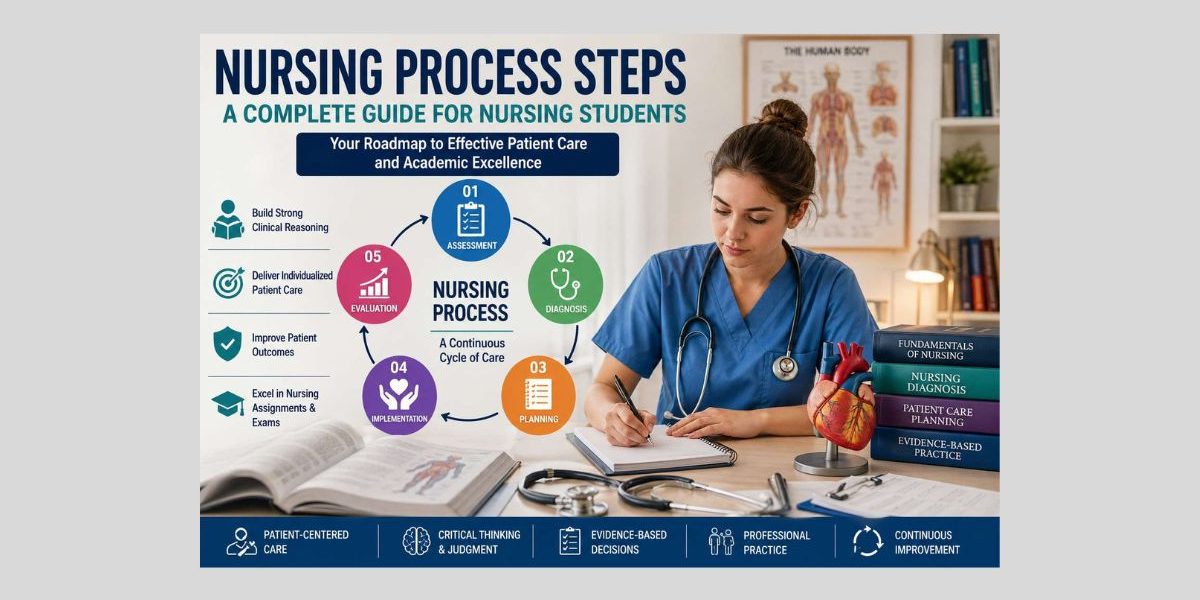
Nursing process steps can feel confusing when students move from theory to real patient scenarios, care plans, clinical notes, and graded assignments. Many learners know the words assessment, diagnosis, planning, implementation, and evaluation, yet they struggle to apply them in a way that sounds clinically accurate, evidence-based, and academically strong. This guide solves that problem by explaining the nursing process as a practical thinking framework, not just a list to memorize.
The nursing process gives structure to nursing judgment. It helps nurses collect relevant patient data, identify patient responses, set priorities, plan care, deliver interventions, and evaluate outcomes. According to StatPearls, the nursing process functions as a systematic guide to client-centered care and is commonly explained through five sequential steps: assessment, diagnosis, planning, implementation, and evaluation (Toney-Butler and Thayer 2023). The American Nurses Association also describes the process as central to holistic, patient-focused nursing practice, especially because it connects clinical thinking with safe care delivery (American Nurses Association, n.d.).
For students, however, the difficulty is rarely the definition. The real challenge is application. A nursing student may receive a case study about a patient with pneumonia, diabetes, heart failure, stroke, anxiety, or post-operative pain. The student then has to decide which information matters, which nursing diagnosis fits, which outcomes are measurable, which interventions are justified, and how evaluation should be documented. Without a clear method, the answer becomes scattered. Therefore, the nursing process works like a clinical map.
If you are writing a care plan, case study, reflective essay, clinical report, or research-based nursing assignment, understanding the process can improve both your reasoning and your writing. Students who need structured academic guidance can also review the site’s nursing research paper help for support with evidence-based nursing writing.
Why Nursing Process Steps Are More Than a Classroom Topic
The nursing process steps are important because nursing care must be organized, defensible, and responsive to patient needs. In clinical practice, nurses do not simply “do tasks.” They assess, interpret, prioritize, intervene, document, and reassess. This matters because patients change quickly. A stable patient may deteriorate. A mild symptom may signal a serious complication. A care plan that worked yesterday may fail today.
The process also supports professional accountability. Nursing Fundamentals from NCBI explains that the ANA Standards of Professional Nursing Practice include assessment, diagnosis, outcomes identification, planning, implementation, and evaluation as expected components of competent nursing practice (Ernstmeyer and Christman, 2021). This means the process is not just a school formula. It reflects how professional nurses are expected to think and act.
In academic writing, these steps help students avoid shallow answers. For example, a weak care plan may say, “Give oxygen because the patient has breathing problems.” A stronger response explains the assessment findings, identifies impaired gas exchange or ineffective breathing pattern, sets a measurable oxygenation goal, proposes evidence-based interventions, and evaluates whether oxygen saturation improved. That is the difference between listing care and demonstrating nursing judgment.
The nursing process also helps students connect theory to patient-centered care. Assessment considers physiological, psychological, sociological, and spiritual needs, not only laboratory values or vital signs (Toney-Butler and Unison-Pace 2023). Therefore, a good nursing care plan should not treat the patient as a diagnosis. It should treat the patient as a person with symptoms, fears, limitations, family concerns, health beliefs, and learning needs.
The Core Nursing Process Steps Explained
Most nursing programs teach the process through ADPIE: Assessment, Diagnosis, Planning, Implementation, and Evaluation. Some professional standards separate outcomes identification from planning, creating ADOPIE. However, the core logic remains the same. First, the nurse gathers data. Next, the nurse interprets that data. Then, the nurse creates goals and interventions. After that, the nurse implements care. Finally, the nurse evaluates whether care worked.
| Step | Main Question | Student Writing Focus |
|---|---|---|
| Assessment | What is happening with the patient? | Subjective data, objective data, risk factors, clinical cues |
| Diagnosis | What nursing problem or response is present? | Nursing diagnosis, related factors, defining characteristics |
| Planning | What outcomes should care achieve? | SMART goals, priorities, expected outcomes |
| Implementation | What nursing actions are needed? | Interventions, rationales, patient education |
| Evaluation | Did the care work? | Outcome review, revision, continued care needs |
The first step, assessment, is the foundation. If assessment is weak, the whole care plan becomes weak. For example, a patient with diabetes may present with fatigue, increased thirst, poor wound healing, and high blood glucose. A shallow assessment might only mention “high sugar.” A stronger assessment includes symptoms, blood glucose readings, medication history, dietary pattern, wound status, knowledge gaps, and risk for infection.
The second step, diagnosis, turns data into a nursing judgment. This is where many students confuse medical diagnosis with nursing diagnosis. A medical diagnosis identifies disease, such as pneumonia. A nursing diagnosis identifies the patient’s response, such as ineffective airway clearance, impaired gas exchange, activity intolerance, or deficient knowledge. The ANA explains that a nursing diagnosis reflects clinical judgment about a patient’s response to actual or potential health conditions (American Nurses Association, n.d.).
Planning comes next. Here, the nurse sets priorities and expected outcomes. Good planning uses measurable language. Instead of writing, “The patient will improve,” write, “The patient will maintain oxygen saturation above 94% within 24 hours.” This makes evaluation possible.
Implementation is the action stage. The nurse carries out interventions, provides education, monitors response, coordinates care, and documents what happened. Finally, evaluation determines whether the goal was met, partially met, or not met. If the patient does not improve, the nurse revises the care plan.
Students who struggle with structured assignments can also use nursing assignment help for ethical guidance on care plans, case study organization, and evidence-based nursing explanations.
Common Challenges Students Face With Nursing Process Steps
Many students understand the nursing process in theory but lose confidence when applying it to real assignments. One common challenge is information overload. Case studies often include vital signs, lab values, medication lists, symptoms, social history, and provider orders. Students may not know which details are most important. As a result, they include everything without prioritizing clinical cues.
Another challenge is writing vague goals. A care plan goal must be measurable. “Patient will feel better” is not strong enough. Instead, the goal should state what will improve, by how much, and by when. For example, “Patient will report pain at 3/10 or below within one hour after intervention” is clearer.
Students also struggle with rationales. A nursing intervention without a rationale looks unsupported. For example, “Encourage deep breathing” becomes stronger when the student explains that deep breathing promotes lung expansion and helps prevent atelectasis in post-operative or immobile patients. Therefore, rationales show that the student understands why an action matters.
Research also shows that implementing the nursing process can face practical barriers. A study on challenges associated with nursing process implementation found issues such as insufficient knowledge, workload pressures, documentation problems, and organizational barriers (Zamanzadeh et al. 2015). These challenges matter to students because they explain why the nursing process requires both knowledge and practice.
In academic work, these barriers appear differently. Students may face short deadlines, unclear rubrics, unfamiliar patient conditions, or difficulty using scholarly sources. That is why structured support matters. For larger nursing papers, students can review medical research paper writing service or clinical medical writing service for help with organizing complex healthcare content ethically.
Why Nursing Process Steps Improve Clinical Reasoning
The nursing process steps improve clinical reasoning because they force students to slow down and think in sequence. Instead of jumping from symptom to intervention, the student must ask: What data do I have? What does it mean? What is the priority? What outcome do I expect? What action is safest? How will I know if it worked?
Clinical reasoning is especially important because nursing decisions affect patient safety. A 2025 study on clinical reasoning and clinical judgment in nursing research emphasizes the need for nursing education and practice to strengthen clinical reasoning, particularly because of its relationship to patient safety (Doyon et al. 2025).
For example, consider a patient admitted with shortness of breath. A beginner might focus only on oxygen. However, a clinically reasoned response checks respiratory rate, oxygen saturation, lung sounds, work of breathing, skin color, anxiety level, history of COPD or asthma, medication use, and response to positioning. The nurse then decides whether the priority is impaired gas exchange, ineffective airway clearance, anxiety, or activity intolerance.
This thinking process also helps with academic grades. Instructors often look for evidence that the student can connect assessment findings to diagnosis, diagnosis to goals, goals to interventions, and interventions to evaluation. When those links are missing, the work appears fragmented. When they are present, the assignment feels professional.
Students working on advanced projects, such as capstones, DNP projects, or dissertation chapters, may also need to connect the nursing process to research design, quality improvement, patient outcomes, or evidence-based practice. For that level of work, DNP dissertation help and dissertation data analysis help can support ethical planning, structure, and analysis guidance.
Nursing Process Steps and Evidence-Based Practice
Evidence-based nursing requires students to combine patient data, clinical expertise, and research evidence. The nursing process supports that combination. Assessment gives patient-specific data. Diagnosis requires clinical interpretation. Planning requires evidence-based goals. Implementation requires appropriate interventions. Evaluation asks whether the intervention worked for that patient. This is why scholarly sources matter. A student should not rely on random online summaries when writing about nursing care. Instead, stronger work uses peer-reviewed journals, PubMed-indexed sources, NCBI Bookshelf chapters, university publications, and professional nursing standards.
For example, when writing about assessment, it is useful to cite sources explaining subjective and objective data. When discussing implementation, students can support interventions using clinical guidelines or peer-reviewed evidence. When discussing evaluation, students can refer to measurable outcomes and patient response.
However, evidence must be used carefully. Students should not overload every paragraph with citations. Instead, they should cite key claims, especially when explaining clinical risks, intervention rationales, patient outcomes, or implementation challenges. This creates a balanced, readable, and authoritative article.
For students who need help interpreting data in nursing research, support pages such as SPSS data analysis help, qualitative data analysis, regression analysis help, and inferential statistics help for nursing research can guide research-focused assignments without replacing the student’s own learning.
Ethical Academic Support for Nursing Students
Ethical support means helping students learn, structure, research, edit, and improve their work without encouraging dishonesty. Nursing education is high-stakes because students are preparing for patient care. Therefore, academic help should strengthen understanding, not bypass it.
A good nursing support service should help students clarify instructions, organize care plans, improve evidence use, refine citations, and understand clinical reasoning. It should not encourage students to submit work they do not understand. The best support works like tutoring, editing, coaching, or guided academic assistance.
This matters because nursing students often balance lectures, clinical rotations, family responsibilities, part-time work, and demanding deadlines. When pressure builds, students may produce rushed work that does not reflect their real ability. Ethical guidance helps them produce clearer, safer, and more academically acceptable work.
If a student needs structured support, they can review how the process works, compare nursing dissertation pricing, check samples, and read the refund policy before placing an order. These pages help students make informed decisions before requesting help.
Build Stronger Nursing Work From the First Step
Mastering the nursing process is one of the best ways to improve nursing assignments, care plans, case studies, clinical reflections, and research-based writing. When you understand how assessment leads to diagnosis, how diagnosis leads to planning, how planning leads to implementation, and how evaluation closes the loop, your work becomes clearer and more professional.
For guided academic support, visit About Us to learn more about the service, or start with case study help if your assignment is based on a patient scenario.
Assessment in Nursing Process Steps: Building the Clinical Foundation
Assessment is not just data collection, it is clinical filtering. Strong nurses do not document everything; instead, they identify what is clinically significant.
In real clinical environments, time is limited. Therefore, nurses must quickly distinguish between normal variation and early deterioration. For example, a respiratory rate of 22 may appear slightly elevated. However, when combined with restlessness, accessory muscle use, and dropping oxygen saturation, it becomes an early warning sign of respiratory compromise.
Clinical Pattern Recognition in Assessment
Expert nurses rely on pattern recognition, not isolated data points. This is where students often struggle. Instead of listing findings, they must connect them.
Consider this scenario:
- Patient reports shortness of breath
- Oxygen saturation: 89%
- Respiratory rate: 26
- Crackles on auscultation
A beginner lists these separately. A stronger student recognizes a pattern of impaired gas exchange.
That shift, from listing to interpreting, is what elevates academic work.
Prioritizing Assessment Data
Not all findings carry equal weight. High-level nursing thinking requires prioritization based on risk.
- Critical cues: airway obstruction, low oxygen saturation, altered consciousness
- Moderate cues: abnormal labs, persistent pain, infection signs
- Low-priority cues: stable chronic symptoms
When writing assignments, students should lead with critical cues first. This mirrors real-world nursing priorities and immediately improves grading outcomes.
To strengthen clinical reasoning in assignments, structured guidance such as nursing homework help can help students refine how they identify and prioritize meaningful data.
Diagnosis in Nursing Process Steps: Translating Data Into Clinical Judgment
Diagnosis is where nursing thinking becomes visible. At this stage, students must move beyond recognition and into clinical judgment.
However, many students rely on memorized diagnoses instead of analyzing patient-specific data. This creates generic, low-quality responses.
Diagnostic Accuracy and Clinical Risk
An incorrect nursing diagnosis does more than affect grades; it reflects flawed reasoning.
For example:
- Choosing ineffective breathing pattern instead of impaired gas exchange changes the focus of care
- Misidentifying risk for infection instead of actual infection delays intervention
Therefore, diagnosis must be grounded in evidence from assessment findings, not assumptions.
Advanced Diagnostic Framing
High-performing students go further by:
- Linking multiple symptoms to one diagnosis
- Identifying risk diagnoses (before complications occur)
- Differentiating between actual vs potential problems
For instance, a post-operative patient may not yet have an infection. However, poor wound care and elevated temperature indicate a risk for infection, which should be addressed early.
This level of thinking demonstrates anticipatory care, which is highly valued in both academic and clinical settings.
Students who want to see how expert-level diagnoses are constructed can review structured examples through case study help.
Planning in Nursing Process Steps: Setting Measurable Outcomes
Planning is where nursing care becomes strategic. Instead of reacting to problems, nurses begin to control outcomes.
Strong planning reflects three elements:
- Clear priorities
- Measurable outcomes
- Evidence-based interventions
Clinical Prioritization in Planning
In real-world settings, nurses rarely address all problems at once. Instead, they prioritize based on urgency.
For example:
- Airway obstruction → immediate intervention
- Pain management → secondary priority
- Patient education → follows stabilization
This sequencing should appear clearly in academic work. When priorities are unclear, the care plan appears unfocused.
Translating Evidence Into Practice
Planning also requires linking interventions to physiological outcomes.
For example:
- Elevating the head of the bed improves lung expansion
- Encouraging fluid intake reduces dehydration risk
- Early mobilization prevents complications like deep vein thrombosis
Rather than listing interventions, students should explain why each action works.
This approach strengthens both academic writing and clinical understanding.
Students working on structured reports can refine planning sections using report writing for better integration of evidence-based rationale.
Implementation in Nursing Process Steps: Delivering Patient-Centered Care
Implementation is often misunderstood as “doing tasks.” In reality, it requires continuous decision-making.
Even after planning, nurses must adjust actions based on patient response.
Dynamic Nature of Implementation
For example, a nurse may plan to administer oxygen therapy. However, if the patient shows signs of anxiety or intolerance, the nurse must adapt:
- Reassure the patient
- Adjust oxygen delivery method
- Monitor response closely
This demonstrates that implementation is not static. It evolves with patient condition.
Patient-Centered Care in Practice
Patient cooperation plays a critical role. A technically correct intervention can fail if the patient does not understand or accept it.
For instance:
- A diabetic patient may ignore dietary advice
- A hypertensive patient may skip medication
Therefore, effective implementation includes:
- Communication
- Education
- Behavioral support
This is where nursing goes beyond clinical tasks into human-centered care.
Students can improve how they present interventions and rationales through structured academic guidance such as do my homework service, ensuring clarity without compromising learning.
Evaluation in Nursing Process Steps: Measuring Outcomes and Adjusting Care
Evaluation is not a conclusion, it is a decision point.
At this stage, nurses determine whether care should continue, change, or stop. Many students treat evaluation as a simple statement, but in reality, it requires critical thinking.
Interpreting Outcomes Correctly
A goal may appear achieved on paper but still require deeper analysis.
For example:
- Oxygen saturation improved → goal met
- However, patient still reports fatigue → further assessment needed
This shows that evaluation must consider both objective and subjective outcomes.
Clinical Decision-Making After Evaluation
When goals are not met, nurses must decide:
- Was the diagnosis incorrect?
- Were interventions ineffective?
- Did patient factors influence outcomes?
This reflective process is essential for improving care.
Continuous Feedback Loop
Evaluation feeds directly back into assessment. This creates a cycle:
Assessment → Diagnosis → Planning → Implementation → Evaluation → Reassessment
Understanding this loop is critical for both exams and real clinical practice.
Students working on advanced academic work can strengthen evaluation discussions by integrating analytical support from qualitative data analysis or SPSS data analysis help when outcomes involve research interpretation.
Integrating Nursing Process Steps Into Academic Assignments
Applying the nursing process effectively can significantly improve assignment quality. Instructors expect logical flow, clinical reasoning, and evidence-based support.
A strong nursing paper typically follows this pattern:
- Assessment findings
- Nursing diagnosis
- Goals and planning
- Interventions
- Evaluation
When these elements are clearly linked, the work appears structured and professional.
Students working on larger academic projects such as dissertations or research papers can benefit from structured support in areas like:
- Data interpretation → dissertation data analysis help
- Statistical methods → inferential statistics help for nursing research
- Advanced analysis → regression analysis help
These resources help maintain academic integrity while improving clarity and depth.
Strengthen Your Nursing Process Skills With Expert Guidance
Mastering the nursing process takes practice, consistency, and the right support. Each step builds on the previous one, creating a structured approach to patient care and academic success.
If you want to improve your nursing assignments, care plans, or research projects, explore the platform’s academic support options. Start by reviewing coursework help for nursing students for guided assistance.
For a deeper understanding of available services and how they work, visit About Us and take the next step toward stronger academic performance.
Why Mastering Nursing Process Steps Transforms Academic and Clinical Performance
The nursing process steps do more than guide patient care. They fundamentally reshape how a nursing student thinks, writes, and makes decisions under pressure. At a basic level, they provide structure. However, at an advanced level, they develop clinical reasoning, prioritization skills, and professional judgment, which are the core competencies expected in modern nursing practice.
Many students underestimate how directly the nursing process affects academic performance. Assignments are rarely graded on memorization alone. Instead, instructors assess whether the student can interpret patient data, justify decisions, and demonstrate logical flow. When the nursing process is applied correctly, it naturally produces this flow. Assessment leads to diagnosis, diagnosis informs planning, planning guides implementation, and evaluation closes the loop. Consequently, the work becomes coherent rather than fragmented.
In clinical settings, the impact becomes even more pronounced. Nurses operate in environments where patient conditions evolve rapidly. A patient who appears stable at the start of a shift may deteriorate within hours. Therefore, nurses must continuously reassess, interpret, and adjust care. The nursing process enables this adaptability by creating a structured yet flexible framework. According to research on clinical reasoning in nursing, structured decision-making models significantly improve patient safety and reduce errors because they prevent rushed or assumption-based decisions (Doyon et al. 2025).
Moreover, mastering the process enhances confidence. Students who rely on guesswork often hesitate when making decisions or writing assignments. In contrast, those who understand the process approach tasks methodically. They know where to begin, what to prioritize, and how to justify their choices. This confidence translates into stronger academic writing and better clinical communication.
Students handling complex academic work, especially research-heavy assignments, often need additional support in connecting clinical reasoning to scholarly writing. Resources such as nursing research paper help can assist in structuring arguments while maintaining academic integrity.
Real-World Application of Nursing Process Steps in Complex Patient Care
Understanding theory is one thing. Applying it in unpredictable clinical situations is another. The nursing process steps become most valuable when dealing with complex, multi-condition patients where priorities are not immediately obvious.
Consider a patient admitted with heart failure, diabetes, and pneumonia. Each condition presents its own risks. Fluid overload may worsen respiratory distress. Poor glucose control may delay recovery. Infection increases metabolic demand. In such a case, a nurse cannot treat conditions in isolation. Instead, the nurse must integrate all findings into a unified care plan.
Assessment begins by identifying the most urgent threats. Respiratory compromise takes priority, followed by circulatory stability and metabolic control. Diagnosis must reflect the most immediate risks, such as impaired gas exchange or excess fluid volume. Planning requires setting realistic, measurable goals that address multiple conditions simultaneously. Implementation involves carefully balancing interventions. For instance, administering diuretics while monitoring electrolyte levels. Evaluation must consider whether improvements in one area negatively affect another.
This level of complexity demonstrates why the nursing process is essential. Without it, care becomes reactive and disorganized. With it, care becomes structured and intentional.
In academic assignments, students are often given similar multi-condition scenarios. Many struggle because they attempt to address every issue equally. However, high-level responses demonstrate prioritization and integration. This is where expert guidance, such as case study help, can help students understand how to structure complex clinical scenarios effectively.
The Strategic Benefits of Using Structured Academic Support
While mastering the nursing process independently is ideal, the reality is that nursing education is demanding. Students balance clinical rotations, lectures, assignments, and personal responsibilities. Under these conditions, even capable students may produce rushed or incomplete work.
Structured academic support addresses this gap by providing guidance without replacing the student’s learning process. The key benefit lies in clarity and structure. Many students understand concepts but struggle to present them coherently. Support services help organize ideas, refine language, and ensure alignment with academic standards.
Another significant benefit is time efficiency. Nursing assignments often require extensive research, referencing, and formatting. Students may spend hours searching for credible sources or structuring their arguments. With guided support, they can focus more on understanding the content rather than struggling with presentation.
Additionally, structured support improves consistency across assignments. Instead of submitting work that varies in quality, students develop a reliable approach to tackling tasks. This consistency is crucial for maintaining strong academic performance over time.
For example, a student working on a dissertation may require help with data interpretation. In such cases, resources like dissertation data analysis help or SPSS data analysis help provide targeted assistance in understanding complex datasets while preserving academic integrity.
It is important to emphasize that ethical support does not involve submitting work without understanding it. Instead, it involves using expert guidance to improve comprehension, structure, and presentation. This distinction is critical in maintaining professional and academic standards.
How to Choose the Best Nursing Academic Support Service
Selecting the right support service requires careful evaluation. Not all services provide the same level of quality, reliability, or ethical standards. Therefore, students must approach this decision strategically.
A strong service demonstrates subject expertise. Nursing is a specialized field, and generic writing services often fail to capture clinical nuances. Students should look for platforms that explicitly focus on healthcare or nursing-related content.
Equally important is transparency. Reliable services clearly explain how they operate, what they offer, and what students can expect. Pages such as how it works and nursing dissertation pricing help students understand the process before committing.
Quality assurance is another critical factor. Students should review sample work to assess writing quality, structure, and depth. Reviewing samples allows students to evaluate whether the service meets academic expectations.
Refund and revision policies also matter. A trustworthy service provides clear guidelines on revisions and refunds, as seen in the refund policy. This ensures accountability and builds trust.
Finally, students should consider whether the service aligns with ethical academic support. The goal should always be to enhance learning, not bypass it. Services that emphasize guidance, editing, and structured assistance are more aligned with academic integrity.
Ethical Considerations in Nursing Academic Support
Ethics play a central role in both nursing practice and education. Just as nurses must act in the best interest of patients, students must maintain honesty and responsibility in their academic work.
The use of academic support raises important questions. When does assistance become inappropriate? The answer lies in intent and usage. If a student uses support to understand concepts, improve structure, or refine writing, the process remains ethical. However, submitting work without comprehension undermines both learning and professional development.
Nursing is a profession built on trust. Patients rely on nurses to make informed decisions that affect their health and safety. Therefore, students must ensure that their academic work reflects genuine understanding.
Ethical support services reinforce this principle by focusing on guidance rather than substitution. For instance, a service may help a student structure a care plan or improve citation quality, but the student must still engage with the content and understand the reasoning behind it.
Students can learn more about the philosophy behind ethical academic support by visiting About Us, which outlines the service’s commitment to responsible guidance.
Advanced Application of Nursing Process Steps in Research and Professional Practice
Beyond classroom assignments, the nursing process steps play a significant role in advanced nursing practice and research. At higher levels, such as DNP or master’s programs, students are expected to apply the process to quality improvement projects, clinical audits, and evidence-based interventions.
For example, a DNP student may use the nursing process to design a project aimed at reducing hospital-acquired infections. Assessment involves identifying infection rates and contributing factors. Diagnosis highlights systemic issues such as poor hand hygiene compliance. Planning includes developing intervention strategies. Implementation introduces new protocols. Evaluation measures the effectiveness of those interventions.
This demonstrates how the nursing process extends beyond individual patient care into system-level improvements.
Research also relies on similar structured thinking. Data collection parallels assessment. Data analysis aligns with diagnosis. Hypothesis development and intervention design reflect planning and implementation. Outcome measurement corresponds to evaluation.
Students working at this level often require advanced analytical support. Services such as inferential statistics help for nursing research and regression analysis help assist in interpreting complex data while maintaining academic rigor.
Elevate Your Nursing Process Mastery With Expert Support
Developing expertise in the nursing process is not a one-time achievement—it is an ongoing process that evolves with practice, education, and experience. The more deeply you understand these steps, the more confident and effective you become in both academic and clinical environments.
If you are aiming to improve your nursing assignments, strengthen your clinical reasoning, or excel in advanced research projects, structured academic support can provide the clarity and guidance you need.
Explore available services such as coursework help for nursing students to enhance your learning experience. When you are ready to take the next step, you can confidently place an order and move toward stronger academic outcomes.
Frequently Asked Questions About Nursing Process Steps
What are the five nursing process steps in order?
The five nursing process steps are assessment, diagnosis, planning, implementation, and evaluation. This sequence reflects how nurses approach patient care logically and safely. Each step builds on the previous one. For example, a weak assessment leads to an inaccurate diagnosis, which then affects planning and outcomes.
Scholarly literature consistently reinforces this structure as the foundation of nursing practice. The American Nurses Association describes the nursing process as essential to delivering individualized, patient-centered care because it ensures that decisions are based on evidence and clinical judgment rather than assumptions.
Why do nursing students struggle with the nursing process?
Students often struggle because the nursing process requires more than memorization. It demands interpretation, prioritization, and application under pressure.
In many cases, students can define each step but fail to connect them. For instance, they may identify symptoms correctly but choose an unrelated diagnosis. Alternatively, they may write strong goals but fail to align interventions with those goals.
Research also highlights structural challenges. Clinical workload, time pressure, and limited practical exposure can affect how well learners apply theoretical frameworks like the nursing process (Zamanzadeh et al. 2015). These challenges explain why students benefit from structured guidance and repeated practice.
How can I improve my nursing process assignments?
Improvement comes from focusing on connections between steps, not just individual sections.
Start by ensuring that:
- Assessment findings directly support the diagnosis
- The diagnosis logically leads to goals
- Interventions clearly address those goals
- Evaluation measures those outcomes accurately
Additionally, strong assignments use evidence-based rationale. This means explaining why each intervention works using clinical reasoning or scholarly support.
For structured academic improvement, students can explore targeted support like nursing homework help to refine clarity, structure, and reasoning.
Are nursing process steps used in real clinical practice?
Yes. While nurses may not explicitly label each step during practice, the thinking process remains the same.
For example:
- A nurse notices abnormal vital signs (assessment)
- Interprets the issue as a clinical problem (diagnosis)
- Decides on a course of action (planning)
- Administers care (implementation)
- Observes patient response (evaluation)
This cycle happens continuously, often within minutes.
According to clinical research on nursing judgment, structured reasoning models like the nursing process significantly improve patient safety because they reduce errors caused by assumptions or incomplete data (Doyon et al. 2025).
What is the difference between nursing diagnosis and medical diagnosis?
A medical diagnosis identifies a disease or condition, such as pneumonia or diabetes. A nursing diagnosis, however, focuses on how the patient responds to that condition.
For example:
- Medical diagnosis: Pneumonia
- Nursing diagnosis: Impaired gas exchange
This distinction is critical because nursing interventions address patient responses rather than the disease itself.
The National Council of State Boards of Nursing emphasizes this difference in licensing and competency frameworks, as it reflects the independent role of nurses in patient care.
Can I use academic support services ethically?
Yes, when used correctly. Ethical academic support focuses on guidance, structure, and improvement rather than substitution.
For instance, a student may:
- Seek help organizing a care plan
- Request feedback on clarity and reasoning
- Use examples to understand structure
However, the student must still engage with the material and understand the content.
Nursing education is directly linked to patient safety. Therefore, maintaining academic integrity is not just a requirement, it is a professional responsibility.
To understand how structured guidance works, students can review how it works and explore transparent policies like the refund policy.
Final Synthesis: Bringing the Nursing Process Together
The nursing process steps are not isolated actions. Instead, they form a continuous, interconnected cycle that drives both patient care and academic success.
Assessment begins the process by identifying relevant data. Diagnosis interprets that data into meaningful clinical problems. Planning transforms those problems into measurable goals. Implementation delivers targeted interventions. Evaluation then determines whether those interventions achieved the desired outcomes.
However, the true strength of the process lies in its cyclical nature. Evaluation feeds back into assessment, creating a loop that adapts to changing patient conditions. This dynamic structure ensures that nursing care remains responsive, evidence-based, and patient-centered.
From an academic perspective, this same structure improves writing clarity. Assignments that follow the nursing process naturally demonstrate logical flow, critical thinking, and professional reasoning. Instructors recognize this immediately, which often translates into higher grades.
From a clinical perspective, the process enhances patient safety. Structured thinking reduces errors, improves communication, and ensures that care decisions are based on evidence rather than assumption.
Students who master this framework gain a significant advantage. They become more confident in exams, more effective in clinical placements, and more capable in advanced research work.
For students progressing into higher-level academic work, such as dissertations or DNP projects, applying the nursing process at a systems level becomes essential. In these cases, support resources like DNP dissertation help and medical research paper writing service can assist in structuring complex academic projects.
Take Control of Your Nursing Success
Mastering the nursing process is not optional, it is the foundation of safe, effective, and professional nursing practice. Whether you are writing assignments, preparing for clinical placements, or working on advanced research, this framework will shape your success.
If you are ready to improve your academic performance and strengthen your clinical reasoning, explore structured support options designed specifically for nursing students.
Start by reviewing samples to see real examples of high-quality work. Then explore pricing through nursing dissertation pricing to find a plan that fits your needs. When you are ready, you can confidently place an order and begin improving your results.
Strong nursing starts with strong thinking and strong thinking starts with mastering the nursing process.
References
American Nurses Association. n.d. The Nursing Process. Accessed April 2026. https://www.nursingworld.org/practice-policy/workforce/what-is-nursing/the-nursing-process/
Doyon, Olivia, et al. 2025. “Clinical Reasoning and Clinical Judgment in Nursing Research: Implications for Patient Safety.” Journal of Clinical Nursing. https://journals.sagepub.com/doi/full/10.1111/2047-3095.12484
Ernstmeyer, Karen, and Elizabeth Christman. 2021. Nursing Fundamentals. Treasure Island, FL: StatPearls Publishing. https://www.ncbi.nlm.nih.gov/books/NBK591807/
Toney-Butler, Tammy J., and Andrea Thayer. 2023. Nursing Process. Treasure Island, FL: StatPearls Publishing. https://www.ncbi.nlm.nih.gov/books/NBK499937/
Toney-Butler, Tammy J., and Heather Unison-Pace. 2023. Nursing Admission Assessment and Examination. Treasure Island, FL: StatPearls Publishing. https://www.ncbi.nlm.nih.gov/books/NBK493211/
Zamanzadeh, Vahid, et al. 2015. “Challenges Associated with the Implementation of the Nursing Process: A Systematic Review.” Iranian Journal of Nursing and Midwifery Research 20 (4): 411–419. https://www.ncbi.nlm.nih.gov/pmc/articles/PMC4525336/
