

Many nursing students learn my 5 moments for hand hygiene in class, yet struggle to apply it clearly in assignments, clinical reflections, and evidence-based writing. This article explains the concept in a practical, academic, and patient-safety-focused way so you can understand the framework, avoid vague writing, and connect hand hygiene to real nursing practice.
Why My 5 Moments for Hand Hygiene Matters in Nursing Practice
Hand hygiene is one of the simplest clinical actions, but it carries serious consequences. A missed hand hygiene moment can increase the risk of healthcare-associated infections, expose staff to pathogens, and weaken patient trust. The World Health Organization’s hand hygiene guidance explains that hand hygiene reduces transmission of harmful microorganisms in healthcare settings and supports safer care delivery (World Health Organization 2009).
For nursing students, my 5 moments for hand hygiene is more than a poster on a hospital wall. It is a clinical reasoning tool. It helps you decide when hand hygiene must happen, not just how to wash your hands. That distinction matters because many students write about handwashing in general terms, yet lose marks when they fail to connect hygiene behavior to specific patient-care moments.
If you are preparing a care plan, reflective essay, infection prevention paper, or dissertation section, you need a clear explanation of how the five moments apply to nursing judgment. Students who need structured academic support can also review ethical writing guidance through nursing research paper help or broader nursing assignment help when they are unsure how to frame evidence properly.
What Are My 5 Moments for Hand Hygiene?
The phrase my 5 moments for hand hygiene refers to the WHO framework that identifies five key times when healthcare workers should clean their hands. Sax and colleagues introduced the model as a user-centered approach to simplify hand hygiene decisions in real clinical workflows (Sax et al. 2007).
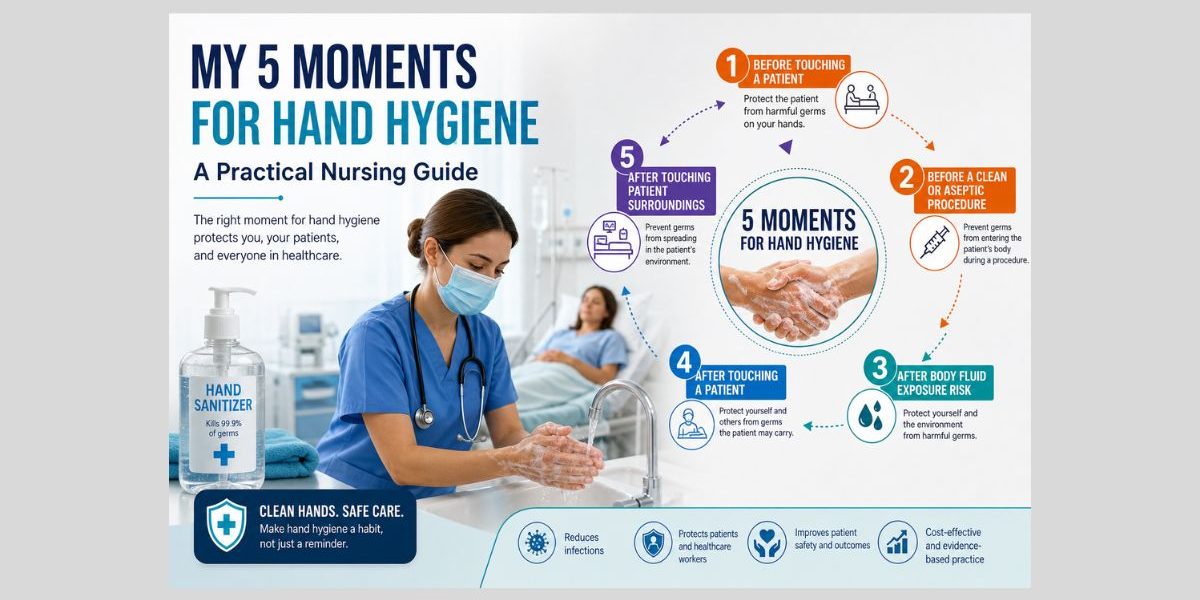
The five moments are:
| Moment | When it happens | Main purpose |
|---|---|---|
| 1 | Before touching a patient | Protect the patient |
| 2 | Before a clean or aseptic procedure | Prevent pathogen entry |
| 3 | After body fluid exposure risk | Protect staff and environment |
| 4 | After touching a patient | Protect staff and others |
| 5 | After touching patient surroundings | Prevent environmental spread |
This framework is especially useful because healthcare environments are busy. Nurses move between patients, equipment, charts, medication stations, wounds, and personal protective equipment. Therefore, hand hygiene decisions must be quick, consistent, and grounded in patient safety.
However, students often confuse the five moments with the steps of handwashing. They are not the same. The five moments explain when to clean hands. Handwashing technique explains how to clean them. In academic writing, that difference can strengthen your argument and show clinical accuracy.
The Real Problem: Knowing the Rule Is Not the Same as Following It
A major challenge in hand hygiene is the gap between knowledge and compliance. Many healthcare workers understand infection prevention principles, but real-world compliance may still fall short. A systematic review found that most hand hygiene compliance rates were between 60% and 70%, showing that missed opportunities remain common (Mouajou et al. 2022).
This gap happens for several reasons. Nurses may face heavy workloads, emergency situations, skin irritation, limited supplies, poor role modeling, or unclear workflow design. In addition, students may hesitate in clinical settings because they are still learning routines. As a result, they may miss a moment even when they know the theory.
That is why my 5 moments for hand hygiene should be taught as a decision-making habit. For example, before checking a patient’s pulse, a nurse should clean their hands. Before inserting a catheter, hand hygiene becomes even more critical because the procedure creates a direct route for microorganisms. After exposure to blood or wound drainage, hand hygiene protects both the nurse and the healthcare environment.
Students writing about these issues can benefit from structured support, especially when connecting research to practice. Services such as coursework help for nursing students and clinical medical writing support can help students organize evidence ethically without replacing their learning.
Why Healthcare-Associated Infections Make Hand Hygiene Essential
Healthcare-associated infections remain a major patient safety issue worldwide. WHO evidence summarized through NCBI notes that more than 1.4 million patients may be affected by healthcare-associated infections at any time globally (World Health Organization 2009).
This matters because infections can increase hospital stays, treatment costs, antimicrobial use, and patient harm. In nursing practice, even small lapses can contribute to transmission. For example, touching a bed rail, IV pump, wound dressing, or patient gown can create contamination risks. Therefore, hand hygiene must extend beyond direct patient contact.
This is where my 5 moments for hand hygiene becomes practical. It reminds nurses that risk is not limited to visible dirt. Hands can carry pathogens even when they look clean. Alcohol-based hand rubs, soap and water, and correct timing all play roles in prevention. According to StatPearls, hand hygiene includes soap-and-water washing, alcohol-based rubs, antiseptic handwashing, and surgical hand antisepsis, depending on the clinical situation (Toney-Butler and Carver 2023).
Academic Importance for Nursing Students
For nursing students, my 5 moments for hand hygiene is a strong topic for essays, reflective journals, evidence-based practice papers, quality improvement proposals, and dissertation discussions. It connects easily to patient safety, infection control, clinical governance, ethics, and professional accountability.
A strong academic paper should not simply say, “hand hygiene prevents infection.” Instead, it should explain:
- which moment applies;
- why that moment reduces risk;
- what evidence supports the practice;
- what barriers affect compliance;
- how nurses can improve adherence.
For larger projects, students may need help with research design, literature review, or data interpretation. In that case, ethical academic guidance such as DNP dissertation help, dissertation data analysis help, or qualitative data analysis support can help students develop stronger, evidence-based work.
This support should always be used responsibly. Ethical academic help guides structure, research clarity, formatting, and interpretation. It should not replace the student’s clinical judgment or academic responsibility.
Understanding Each of My 5 Moments for Hand Hygiene in Depth
To apply my 5 moments for hand hygiene effectively, you need more than simple recall. You must understand why each moment exists and how it fits into real clinical decisions. In practice, these moments are not isolated rules. They are part of a continuous safety mindset that guides every patient interaction.
In this section, each moment is explained with clinical context, common pitfalls, and guidance for academic writing so you can translate theory into both practice and high-quality coursework.
Moment 1: Before Touching a Patient
The first moment in my 5 moments for hand hygiene focuses on protecting the patient before any form of contact occurs. This is essential because healthcare workers often carry microorganisms from previous tasks, surfaces, or patients, even when hands appear clean.
In a busy clinical environment, nurses frequently move between different spaces and responsibilities. You may adjust equipment, write notes, or handle supplies before approaching a patient. Each of these actions can introduce unseen contamination. Therefore, performing hand hygiene before touching a patient prevents transferring harmful pathogens into a vulnerable care zone.
A common misunderstanding among students is assuming that brief or “non-invasive” contact does not require hand hygiene. However, even simple actions such as checking a pulse or adjusting a blanket can transmit microorganisms. Another frequent error is relying on gloves as a substitute. Gloves are protective, but they do not replace proper hand hygiene.
From an academic perspective, this moment should always be linked to patient protection and prevention of microorganism transfer. Strong assignments clearly explain how this moment reduces the introduction of transient flora. If you find it difficult to structure these explanations clearly, reviewing professional academic formats through report writing support can improve clarity and coherence.
Moment 2: Before a Clean or Aseptic Procedure
The second moment in my 5 moments for hand hygiene carries a higher level of risk because it involves procedures where microorganisms can directly enter the body. This includes any activity that requires sterile or near-sterile conditions, such as wound care, injections, or catheter insertion.
In these situations, the patient’s natural defenses may already be compromised. Even minimal contamination can lead to serious complications, including systemic infections. Therefore, hand hygiene at this stage is not simply routine, it is a critical barrier against infection.
In clinical practice, timing becomes especially important. Performing hand hygiene too early, then touching non-sterile surfaces, can undo the benefit. Students often overlook this detail, which can weaken both practical performance and written analysis.
When discussing this moment in academic work, it is important to emphasize aseptic technique, infection prevention, and risk reduction. Linking hand hygiene to procedural safety demonstrates deeper understanding. For students working on research-based assignments, structured guidance such as SPSS data analysis help or inferential statistics support can assist in interpreting infection control data accurately.
Moment 3: After Body Fluid Exposure Risk
The third moment in my 5 moments for hand hygiene shifts the focus from protecting the patient to protecting the healthcare worker and the surrounding environment. This moment occurs immediately after exposure or potential exposure to body fluids.
In real-world practice, exposure does not always involve visible contamination. Risk can arise during routine care activities such as handling waste, cleaning wounds, or managing catheters. Because of this, hand hygiene must be performed promptly after the task is completed.
A critical issue in clinical settings is the false sense of security created by gloves. Many students assume that removing gloves is sufficient. However, microorganisms can still transfer during glove removal or through microscopic defects. Therefore, hand hygiene remains essential even when protective equipment is used.
From an academic perspective, this moment is ideal for discussing occupational safety, infection control policies, and risk management. It demonstrates an understanding of how healthcare workers protect themselves while maintaining patient safety. When writing case-based assignments, structured support such as case study help can help you present these scenarios more effectively.
Moment 4: After Touching a Patient
The fourth moment in my 5 moments for hand hygiene ensures that any microorganisms acquired during patient contact are not transferred to others. While the first moment protects the patient, this one protects everyone else in the clinical environment.
After direct contact such as physical assessment, assistance with mobility, or personal care, hands may carry pathogens even if the patient appears healthy. This is particularly important because infections are not always visible, and asymptomatic carriers can still contribute to transmission.
Students often underestimate this moment when moving quickly between patients. In fast-paced settings, it may feel efficient to skip hand hygiene between interactions. However, this significantly increases the risk of cross-contamination.
In academic writing, this moment should be linked to infection transmission pathways and patient-to-patient risk. Strong answers explain how failure at this stage contributes to broader infection spread. Students developing research-focused work may benefit from structured guidance through medical research paper writing support or by reviewing examples available in academic samples.
Moment 5: After Touching Patient Surroundings
The fifth moment in my 5 moments for hand hygiene is often the most overlooked, yet it plays a crucial role in infection prevention. Unlike the previous moments, this one focuses on indirect contact, specifically, the patient’s environment.
Hospital surfaces can harbor microorganisms even when they appear clean. Items such as bed rails, monitors, and bedside tables are frequently touched and can act as reservoirs for pathogens. As a result, touching these surfaces carries a similar risk to touching the patient directly.
In practice, nurses interact with the environment constantly. Adjusting equipment, organizing supplies, or handling charts may seem harmless, but each action introduces potential contamination. Ignoring this moment can undermine all other infection control efforts.
From an academic standpoint, this moment allows you to discuss environmental contamination and indirect transmission. It also connects well with broader infection control systems within healthcare settings. If you are managing multiple assignments and struggling with workload, structured academic guidance such as coursework support or nursing homework help can help maintain quality without compromising learning.
Integrating My 5 Moments for Hand Hygiene into Practice
Understanding my 5 moments for hand hygiene requires seeing them as a continuous process rather than separate steps. In a typical shift, a nurse may cycle through all five moments repeatedly within a short period. Each transition between tasks represents a potential risk point.
The key to effective application is awareness. You must constantly assess whether you are moving into or out of a situation that requires hand hygiene. Over time, this becomes an automatic habit rather than a conscious decision.
For students, demonstrating this integrated understanding in assignments can significantly improve grades. Instead of listing the five moments, explain how they interact within real clinical workflows. This shows critical thinking, which is highly valued in nursing education.
Understanding my 5 moments for hand hygiene at a deeper level allows you to:
- Apply infection control principles confidently in clinical settings
- Strengthen academic arguments with clear clinical reasoning
- Avoid common mistakes that reduce both safety and marks
Real-World Challenges, Benefits, Ethics, and Academic Success with My 5 Moments for Hand Hygiene
By now, you understand how my 5 moments for hand hygiene works conceptually and clinically. However, applying it consistently in real healthcare environments and explaining it effectively in academic work requires deeper insight. This section explores the complex realities behind compliance, the measurable benefits of proper application, and how nursing students can ethically leverage academic support to produce high-quality, evidence-based work.
The Reality: Why Nurses Still Struggle with My 5 Moments for Hand Hygiene
Although my 5 moments for hand hygiene is widely taught and globally endorsed, compliance is not perfect. This is not due to ignorance alone. Instead, multiple interacting factors influence behavior in clinical environments.
Workload and Time Pressure
Healthcare settings are often fast-paced. Nurses may be responsible for multiple patients, urgent interventions, and documentation requirements simultaneously. In such situations, hand hygiene can feel like a delay rather than a priority.
However, this perception is misleading. Research shows that even brief lapses in hygiene can contribute to infection transmission, which ultimately increases workload through complications and extended care (Mouajou et al. 2022).
Environmental Constraints
Sometimes, the problem is not knowledge but accessibility. Limited availability of hand hygiene stations, poorly positioned dispensers, or supply shortages can discourage compliance. When hand rubs are not within immediate reach, even well-trained professionals may skip a moment.
Skin Irritation and Fatigue
Frequent hand hygiene can lead to skin dryness or irritation, especially when products are harsh or improperly used. Over time, discomfort can reduce adherence. This highlights the importance of institutional support, including high-quality products and skin care education.
Behavioral and Cultural Factors
Human behavior plays a major role. If senior staff do not consistently follow my 5 moments for hand hygiene, junior nurses and students may adopt similar habits. Conversely, strong role models can significantly improve compliance.
Additionally, repeated exposure to the same environment can lead to “routine blindness,” where risks are underestimated simply because they are familiar.
Evidence-Based Impact: Why My 5 Moments for Hand Hygiene Works
Despite these challenges, my 5 moments for hand hygiene remains one of the most effective infection prevention strategies in healthcare.
Reduction in Healthcare-Associated Infections
Studies show that improved hand hygiene compliance is directly linked to reduced infection rates. WHO guidelines highlight that effective hand hygiene programs can significantly lower healthcare-associated infections, improving patient outcomes (World Health Organization 2009).
Protection Across the Care Continuum
The five moments create a structured approach that protects:
- Patients from incoming pathogens
- Healthcare workers from exposure
- The clinical environment from contamination
This holistic protection is what makes the model so powerful. It addresses both direct and indirect transmission pathways.
Cost-Effectiveness
Infection prevention reduces hospital stays, antibiotic use, and additional treatments. Therefore, hand hygiene is not only clinically important but also economically beneficial. It is considered one of the most cost-effective healthcare interventions globally.
Translating Practice into Academic Excellence
Understanding my 5 moments for hand hygiene is only part of your success as a nursing student. You must also communicate this understanding effectively in academic work. Many students lose marks not because they lack knowledge, but because they struggle to structure arguments, integrate evidence, or apply theory to practice.
Common Academic Challenges
Students often face difficulties such as:
- Writing descriptive rather than analytical content
- Failing to link theory to clinical scenarios
- Weak use of scholarly sources
- Poor structure and clarity
These issues can reduce the impact of otherwise strong ideas.
How Structured Academic Support Helps
Ethical academic support services can guide you in developing high-quality work without compromising integrity. For example:
- Reviewing expectations through about our academic support helps you understand how guidance is provided
- Learning the process via how academic assistance works clarifies expectations
- Planning your workload using nursing dissertation pricing details ensures transparency
When used responsibly, these services help you improve your skills, not replace them.
For more advanced work, students often require specialized guidance. For example, those conducting research may benefit from dissertation data analysis help or more specific support such as regression analysis guidance. These services help interpret complex data accurately, which is essential when studying infection control outcomes.
How the Process Works: From Confusion to Clarity
If you are struggling with assignments related to my 5 moments for hand hygiene, a structured approach can make a significant difference.
Step 1: Identify the Academic Requirement
Start by understanding what your assignment demands. Is it a reflective essay, research paper, or case study? Each requires a different structure.
Step 2: Connect Theory to Practice
Avoid simply listing the five moments. Instead, explain how they apply in real clinical scenarios. This demonstrates critical thinking.
Step 3: Integrate Scholarly Evidence
Use peer-reviewed sources to support your claims. This strengthens credibility and aligns with academic standards.
Step 4: Refine Structure and Clarity
Ensure your work has clear arguments, logical flow, and concise explanations.
Students who need additional support can initiate guided assistance through placing an academic support request, ensuring their work meets professional standards.
Choosing the Right Academic Support for Nursing Studies
Not all academic support services are equal. Choosing the right one is essential for maintaining ethical standards and achieving meaningful learning outcomes.
Key Factors to Consider
- Transparency in services and policies
- Clear communication and guidance
- Focus on skill development rather than shortcuts
- Availability of specialized nursing expertise
For example, reviewing policies such as the refund policy for academic services can help you make informed decisions.
Ethical Considerations in Academic Support
Using academic support responsibly is crucial. The goal should always be to enhance your understanding and improve your skills.
What Ethical Support Looks Like
Ethical services:
- Help you structure your work
- Guide research and analysis
- Provide feedback and clarification
- Support learning without replacing your effort
What to Avoid
Students should avoid:
- Submitting work they do not understand
- Using services that promote plagiarism
- Ignoring institutional guidelines
When used correctly, academic support complements your learning and prepares you for professional practice.
Frequently Asked Questions (FAQs)
1. Why is my 5 moments for hand hygiene important in nursing?
It provides a clear, evidence-based framework for preventing infection at critical points during patient care.
2. Do I need to memorize all five moments?
Memorization helps, but understanding why each moment matters is more important for both practice and exams.
3. Can gloves replace hand hygiene?
No. Gloves are an additional barrier but do not eliminate the need for proper hand hygiene.
4. How can I improve my academic writing on this topic?
Focus on linking theory to clinical examples and supporting your arguments with scholarly evidence. Structured guidance can also help refine your work.
5. Is academic support ethical for nursing students?
Yes, when it is used as guidance to improve skills and understanding rather than as a shortcut.
Final Call to Action: Strengthen Your Nursing Success
Mastering my 5 moments for hand hygiene is essential for both patient safety and academic excellence. However, understanding the concept is only the first step. Applying it in practice and expressing it effectively in your assignments requires clarity, structure, and evidence-based thinking.
If you want to improve your academic performance while maintaining ethical standards, consider exploring professional guidance tailored for nursing students. Whether you need help with research, analysis, or writing clarity, the right support can make a significant difference.
Take the next step in your academic journey by exploring trusted services, reviewing available support options, and building confidence in both your clinical knowledge and academic writing.
References
World Health Organization. 2009. WHO Guidelines on Hand Hygiene in Health Care. Geneva: WHO.
https://www.ncbi.nlm.nih.gov/books/NBK144013/
Sax H., Allegranzi B., Uçkay I., Larson E., Boyce J., and Pittet D.. 2007.
“My Five Moments for Hand Hygiene: A User-Centered Design Approach to Understand, Train, Monitor and Report Hand Hygiene.” Journal of Hospital Infection 67 (1): 9–21.
https://pubmed.ncbi.nlm.nih.gov/17719685/
Mouajou V., Borges Da Silva R., Sousa-Uva M., and Ferreira J.. 2022.
“Effectiveness of Hand Hygiene Interventions in Reducing Illness Absence among Children in Educational Settings: A Systematic Review and Meta-Analysis.” Journal of Hospital Infection.
https://pubmed.ncbi.nlm.nih.gov/34582962/
Toney-Butler T. and Carver N.. 2023.
“Hand Hygiene.” In StatPearls. Treasure Island, FL: StatPearls Publishing.
https://www.ncbi.nlm.nih.gov/books/NBK470254/
World Health Organization. 2009.
WHO Guidelines on Hand Hygiene in Health Care: Burden of Health Care-Associated Infection Worldwide.
https://www.ncbi.nlm.nih.gov/books/NBK144030/
