

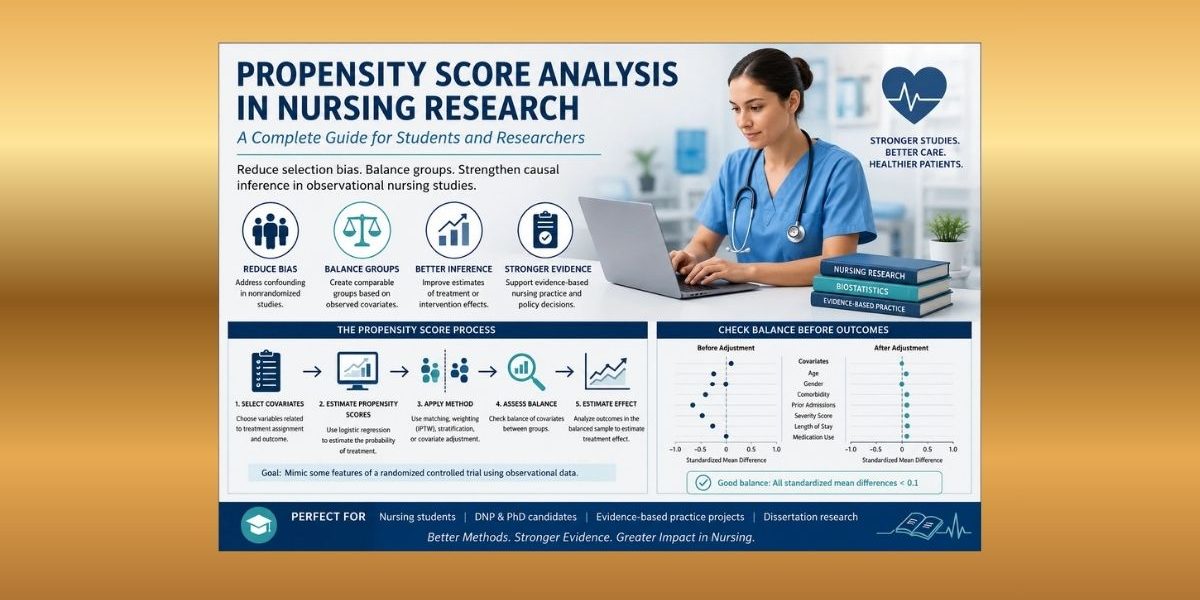
Many nursing students work with real-world healthcare data instead of randomized trial data. A DNP student may want to compare 30-day readmission rates between heart failure patients who received nurse-led discharge education and patients who received usual discharge instructions. A PhD nursing student may study whether exposure to a fall-prevention protocol is associated with fewer inpatient falls. An MSN student may use electronic health record data to compare wound-healing outcomes between patients who received two different nursing care pathways.
The challenge is that patients in these groups were not randomly assigned. Patients who received the intervention may already differ from patients who did not. They may be older, sicker, more adherent to medications, more likely to have previous admissions, or more likely to receive additional clinical attention. If these baseline differences are ignored, the final outcome comparison may be biased.
Propensity score analysis helps nursing researchers compare nonrandomized groups more fairly. It estimates each patient’s probability of receiving a treatment, exposure, or intervention based on measured baseline covariates. Researchers can then use that score to match, weight, stratify, or adjust groups before comparing outcomes.
The original concept defines the propensity score as the probability of treatment assignment conditional on observed baseline covariates (Rosenbaum & Rubin, 1983). In practical nursing language, it answers this question: Based on what we knew about the patient before the intervention, how likely was that patient to receive the intervention?
Propensity score analysis can reduce measured confounding, but it does not remove all bias. It cannot fix missing confounders, poor study design, unclear intervention definitions, or weak outcome measurement. Used carefully, however, it can strengthen observational nursing research, dissertation methods, and Chapter 4 results.
Students who are still building a foundation in research analysis may first review Types of Data Analysis in Research before applying advanced methods such as propensity score matching or inverse probability treatment weighting.
What Is Propensity Score Analysis?
Propensity score analysis is a statistical method used in observational, retrospective, cohort, case-control, quasi-experimental, and nonrandomized healthcare studies to reduce baseline differences between comparison groups.
A propensity score is the estimated probability that a participant receives a treatment, exposure, intervention, or group assignment based on measured baseline covariates.
In nursing research, the “treatment” does not have to be a medication. It may be:
- Nurse-led discharge education
- Telehealth follow-up
- Fall-prevention rounding
- Pressure-injury prevention bundle
- Pain-management protocol
- Early mobility intervention
- Wound-care pathway
- Diabetes self-management education
- Staffing exposure
- Clinical pathway implementation
For example, a DNP student may compare patients who received structured nurse-led discharge education with patients who received usual discharge instructions. The outcome may be 30-day readmission. The baseline covariates may include age, comorbidities, previous admissions, diagnosis severity, insurance status, baseline medication adherence, health literacy, and discharge destination.
Propensity score analysis helps the student create groups that are more similar on those measured baseline characteristics before comparing readmission outcomes.
Key Components of Propensity Score Analysis
Treatment or exposure group: The group that received the intervention, exposure, or condition being studied.
Comparison or control group: The group that did not receive the intervention or received usual care.
Baseline covariates: Patient, clinical, demographic, or setting characteristics measured before treatment or exposure.
Outcome: The result measured after treatment or exposure, such as readmission, falls, pain score, length of stay, medication adherence, infection, or mortality.
Confounding: A problem that occurs when a baseline factor is related to both group assignment and the outcome.
Measured confounding: Confounding from variables included in the dataset.
Unmeasured confounding: Confounding from important variables that were not measured, not collected, or not included.
Propensity score analysis can only adjust for measured baseline covariates. This is why careful study design and variable selection matter.
Why Propensity Score Analysis Matters in Nursing Research
Nursing research often happens in real clinical settings where random assignment is not possible. Hospitals may not randomly assign some patients to receive discharge education and deny it to others. A unit may introduce a fall-prevention bundle for all patients after a safety review. A DNP quality improvement project may compare outcomes before and after a protocol change. A PhD student may use EHR data that already exist.
Propensity score analysis matters because nursing students often need a stronger way to address baseline differences in these real-world designs.
It is commonly useful in:
- Retrospective chart reviews
- Electronic health record studies
- DNP quality improvement projects
- Observational cohort studies
- Quasi-experimental studies
- Comparative effectiveness research
- Patient outcome studies
- Clinical pathway evaluations
- Nurse-led intervention studies
- Healthcare policy and practice evaluations
For broader statistical group-comparison methods, students may also need Types of Quantitative Data Analysis. Propensity score analysis is a quantitative method, but it is more specific than a basic t test, chi-square test, or regression model because it focuses on balancing groups before estimating the treatment or exposure effect.
A recent nursing-relevant example is a 2025 study that evaluated an advanced clinical practice nurse-led discharge management and education program in an acute medical care unit. The study used propensity score matching to compare patients before and after implementation, matching on age, sex, Charlson Comorbidity Index, and reason for admission (Lee et al., 2025). That type of application is close to what many DNP and nursing dissertation students attempt when they evaluate real clinical interventions.
Propensity Score Analysis vs Regression Analysis
Propensity score analysis and regression analysis both help address confounding, but they work differently.
Regression analysis adjusts for covariates in the outcome model. Propensity score analysis first estimates the probability of receiving the treatment or exposure. That score is then used to match, weight, stratify, or adjust participants before or during outcome analysis.
Logistic regression is often used to estimate propensity scores when the treatment or exposure has two groups, such as intervention versus usual care. Students who need help understanding the model behind the propensity score can review Regression Analysis Help.
| Feature | Regression Analysis | Propensity Score Analysis |
|---|---|---|
| Main purpose | Adjusts the outcome model for covariates | Balances treatment and comparison groups using estimated treatment probability |
| Where covariates are used | In the outcome model | In the treatment/exposure model |
| Best use | Estimating adjusted associations | Creating more comparable groups in observational research |
| Main output | Coefficient, odds ratio, risk ratio, mean difference, p-value, confidence interval | Matched sample, weights, strata, balance diagnostics, then effect estimate |
| Nursing example | Adjusting readmission for age, severity, and comorbidities | Matching patients who did and did not receive nurse-led discharge education |
| Main limitation | Depends heavily on correct outcome model specification | Cannot adjust for unmeasured confounding and requires good overlap |
Regression is still important after matching or weighting. For example, a student may use propensity score matching first, then use logistic regression to estimate the odds of readmission in the matched sample. Propensity score analysis does not replace all regression; it changes how baseline imbalance is handled.
Austin described propensity score methods as tools that allow researchers to design and analyze nonrandomized studies in ways that mimic some characteristics of randomized studies, especially by improving baseline balance (Austin, 2011).
When Should Nursing Students Use Propensity Score Analysis?
Propensity score analysis may be appropriate when the study has a clear comparison between groups and baseline differences may bias the result.
It may fit when:
- The study is observational or nonrandomized
- There are two clear comparison groups
- The treatment or exposure happened before the outcome
- Baseline differences may affect the outcome comparison
- Important confounders were measured before treatment or exposure
- The sample size is large enough for matching, weighting, or stratification
- There is overlap between treatment and comparison groups
- The goal is to estimate an intervention, treatment, exposure, or care-pathway effect
Nursing Examples
A DNP student compares 30-day readmission among heart failure patients who received nurse-led discharge education versus usual discharge instructions.
A PhD nursing student compares fall rates among patients cared for on units with different nurse staffing levels.
An MSN student compares pain outcomes between postoperative patients who received a structured pain-assessment protocol and those who received usual pain assessment.
A healthcare researcher compares medication adherence between patients who received nurse-led diabetes education and patients who did not.
A nursing administration student evaluates whether implementation of a new handoff protocol is associated with fewer transfer-related safety incidents.
In all these examples, patients or units were not randomly assigned. Propensity score analysis helps address the question committees often ask: Were the groups comparable before the outcome was measured?
When Propensity Score Analysis Is Not Appropriate
Propensity score analysis is not suitable for every nursing dissertation.
It may not be appropriate when:
- The study is purely descriptive
- There is no treatment, exposure, intervention, or comparison group
- The main goal is prediction only
- Important confounders were not measured
- The sample is too small
- Treatment and comparison groups have poor overlap
- Covariates were measured after the intervention
- Post-treatment variables are incorrectly used as covariates
- The outcome is included in the propensity score model
- The research design cannot support even cautious causal interpretation
For example, if a student only wants to summarize age, diagnosis, length of stay, and satisfaction scores for one group of patients, propensity score analysis is unnecessary. That study would fit better with Descriptive Data Analysis in Nursing Research.
If the main goal is to predict which patients are at highest risk of readmission, the student may need Predictive Data Analysis in Healthcare Research instead of propensity score analysis.
Key Assumptions and Limitations
Propensity score analysis is powerful only when its assumptions are reasonable. Nursing students should explain these assumptions clearly in Chapter 3 and acknowledge limitations in Chapter 5.
No Unmeasured Confounding
This means all important confounders are measured and included. If health literacy affects both discharge education assignment and readmission, but health literacy was not collected, the analysis may remain biased.
Propensity score analysis cannot adjust for variables that are missing from the dataset.
Positivity, Common Support, and Overlap
There must be comparable patients in both groups. If nearly all high-risk patients received the intervention and nearly all low-risk patients received usual care, there may be poor overlap. In that case, the data may not support a fair comparison across the full sample.
Common support means the treatment and comparison groups share a similar range of propensity scores. Without this overlap, matching may discard many cases and IPTW may create extreme weights.
Correct Model Specification
The propensity score model should include clinically relevant baseline covariates. It should be guided by nursing theory, literature, clinical logic, and the study design.
Students should not select covariates only because they are statistically significant in baseline tests.
Covariates Measured Before Exposure
Covariates should be measured before the intervention or exposure. Variables measured after treatment may already be influenced by the treatment and can distort the analysis.
Stable Treatment Definition
The treatment or exposure must be clearly defined. “Discharge education” is too vague unless the student explains what was delivered, who delivered it, when it occurred, and how it differed from usual care.
Adequate Sample Size
Propensity score methods need enough cases to support matching or weighting. Matching may remove unmatched cases. IPTW may become unstable if some participants have very low probabilities of receiving their actual treatment.
Balance Checking
Students must check whether matching or weighting worked. The analysis is incomplete without balance diagnostics.
Austin and or weighting worked. The analysis is incomplete without balance diagnostics.
Austin and Stuart emphasized best practices for IPTW, including balance assessment, stabilized weights, and attention to extreme weights (Austin & Stuart, 2015).
Key Terms Students Must Understand
Treatment group: Participants who received the intervention, exposure, or treatment.
Control group: Participants who did not receive the intervention or received usual care.
Exposure: The condition, intervention, or group assignment being studied.
Outcome: The result measured after exposure.
Confounder: A variable related to both group assignment and outcome.
Baseline covariate: A pre-exposure characteristic used to estimate treatment probability.
Selection bias: Bias that occurs when groups differ systematically before the outcome occurs.
Propensity score: The estimated probability of treatment or exposure based on observed baseline covariates.
Matching: Pairing treated and untreated participants with similar propensity scores.
Weighting: Assigning statistical weights so groups become more comparable.
Stratification: Dividing participants into propensity score categories, often quintiles.
Covariate balance: Similarity of baseline covariates between groups after matching or weighting.
Standardized mean difference: A statistic used to measure baseline differences between groups.
Common support: The area where treatment and comparison groups have overlapping propensity scores.
Average treatment effect: The estimated effect if everyone in the target population received treatment compared with if no one received treatment.
Average treatment effect on the treated: The estimated effect among participants who actually received treatment.
IPTW: Inverse probability treatment weighting.
Stabilized weights: Modified IPTW weights used to reduce instability from very large weights.
Caliper: The maximum acceptable distance between propensity scores during matching.
Common Propensity Score Methods
Propensity Score Matching
Propensity score matching pairs treatment participants with comparison participants who have similar propensity scores.
A nursing example would be matching heart failure patients who received nurse-led discharge education with similar heart failure patients who received usual discharge instructions.
Common matching approaches include:
Nearest-neighbor matching: Each treated patient is matched with the comparison patient who has the closest propensity score.
Caliper matching: Matches are accepted only if the propensity score distance is small enough.
1:1 matching: One treated patient is matched with one comparison patient.
1:many matching: One treated patient is matched with two or more comparison patients.
Matching without replacement: A comparison patient can be used only once.
Matching with replacement: A comparison patient can be used more than once, which may improve match quality but can complicate interpretation.
Matching should never end with “the software matched the cases.” The student must show that balance improved after matching.
Inverse Probability Treatment Weighting
Inverse probability treatment weighting, or IPTW, uses the propensity score to create a weighted pseudo-population.
In simple terms, patients who are less likely to be in their actual treatment group receive more weight. Patients who are very likely to be in their actual treatment group receive less weight. The aim is to create a weighted sample where measured baseline covariates are more balanced between groups.
IPTW is useful when the student does not want to lose many cases through matching. However, it can create problems when some patients have very low probabilities of receiving the treatment they actually received. These cases can produce extreme weights.
Students should discuss:
- Stabilized weights
- Extreme weights
- Weight trimming
- Common support
- Balance before and after weighting
- Whether weighted results are clinically reasonable
Austin and Stuart’s IPTW guidance is useful for students because it explains why weighting must be accompanied by balance checking and careful handling of extreme weights (Austin & Stuart, 2015).
Propensity Score Stratification
Stratification divides participants into groups based on their propensity scores, often into five strata or quintiles. The outcome is then compared within these strata or adjusted across strata.
For example, a nursing student may divide patients into five levels based on their probability of receiving nurse-led discharge education, then compare readmission rates within those levels.
Propensity Score Covariate Adjustment
This method includes the propensity score as a covariate in the outcome model. It is simpler than matching or weighting, but it may not always produce the strongest balance.
For many nursing dissertations, matching or weighting is easier to explain because the student can show before-and-after balance tables. However, the best method depends on the research question, sample size, overlap, and committee expectations.
Step-by-Step Propensity Score Analysis Process
1. Define the Research Question
Example: Among adult heart failure patients, is nurse-led discharge education associated with lower 30-day readmission compared with usual discharge instructions?
2. Define the Treatment or Exposure Group
Clearly state who received the intervention. Example: patients with documented structured nurse-led discharge education before discharge.
3. Define the Comparison Group
Clearly state who did not receive the intervention. Example: patients who received usual discharge instructions.
4. Define the Outcome
The outcome must occur after the exposure. Example: 30-day all-cause hospital readmission.
5. Select Baseline Covariates
Choose covariates using clinical logic, literature, theory, and timing before exposure.
6. Estimate the Propensity Score
Use logistic regression or another appropriate model to estimate the probability of receiving the intervention.
7. Check Common Support
Review whether treatment and comparison groups have overlapping propensity score distributions.
8. Apply Matching, Weighting, Stratification, or Adjustment
Choose the method that fits the research question and data structure.
9. Assess Covariate Balance
Use standardized mean differences, balance tables, Love plots, and common support plots.
10. Estimate the Treatment or Exposure Effect
Analyze the outcome after matching, weighting, stratification, or adjustment.
11. Conduct Sensitivity Checks
Where appropriate, test alternative calipers, weighting decisions, covariate sets, or missing-data approaches.
12. Report Methods and Results Transparently
Observational studies should report design, setting, participants, variables, bias, statistical methods, missing data, results, and limitations. The STROBE Statement provides reporting guidance for observational studies (von Elm et al., 2007).
Covariate Selection in Propensity Score Analysis
Covariate selection is one of the most important decisions in propensity score analysis.
Covariates should be selected based on:
- Clinical relevance
- Nursing theory
- Prior research
- Timing before exposure
- Relationship to treatment assignment
- Relationship to the outcome
- Supervisor or statistician guidance
Students should not choose covariates only because they are statistically significant in baseline comparisons. A variable may be clinically important even when its baseline p-value is not significant.
Appropriate baseline covariates may include:
- Age
- Gender
- Diagnosis
- Baseline severity score
- Comorbidity count
- Previous admissions
- Baseline medication adherence
- Baseline pain score
- Health literacy
- Insurance status
- Unit type
- Length of stay before intervention
- Baseline lab values
- Baseline functional status
- Discharge destination
- Smoking status
- Baseline mobility level
Students should not include:
- Outcome variables
- Post-treatment variables
- Mediators caused by the intervention
- Variables measured after exposure
For example, if a nurse-led education program improves medication adherence after discharge, post-discharge medication adherence should not be used as a baseline covariate in the propensity score model. It may be part of the pathway through which the intervention affects readmission.
How to Check Covariate Balance
Covariate balance shows whether treatment and comparison groups became more similar after matching or weighting.
Students often make the mistake of reporting only p-values. This is weak because balance is not mainly about hypothesis testing. Balance is about the size of baseline differences between groups.
The standardized mean difference, or SMD, is commonly used to assess balance. A common rule of thumb is that an absolute SMD below 0.10 suggests acceptable balance, although students should follow their field, supervisor, and study context.
Zhang et al. explained that balance diagnostics after propensity score matching should include methods such as standardized mean differences and visual balance checks rather than relying only on significance testing (Zhang et al., 2019).
| Covariate | Before Matching SMD | After Matching SMD | Interpretation |
|---|---|---|---|
| Age | 0.42 | 0.06 | Improved balance |
| Comorbidity count | 0.35 | 0.08 | Improved balance |
| Previous admissions | 0.51 | 0.09 | Improved balance |
| Baseline medication adherence | 0.28 | 0.05 | Improved balance |
| Baseline severity score | 0.46 | 0.07 | Improved balance |
Students should include before-and-after balance tables where possible. Love plots are also helpful because they visually show whether each covariate moved closer to balance after matching or weighting.
For baseline tables, demographics, and pre-matching group summaries, students may use Descriptive Data Analysis in Nursing Research.
Detailed Nursing Example
Research Question
Among adult heart failure patients, is nurse-led discharge education associated with lower 30-day readmission compared with usual discharge instructions?
Treatment Group
Adult heart failure patients who received structured nurse-led discharge education before discharge.
Comparison Group
Adult heart failure patients who received usual discharge instructions.
Outcome
Thirty-day all-cause hospital readmission.
Baseline Covariates
The student includes age, gender, comorbidity count, prior admissions, baseline disease severity, baseline medication adherence, health literacy screening score, insurance status, discharge unit, discharge destination, and length of stay before education.
Why Confounding Is a Concern
Patients selected for nurse-led discharge education may differ from usual-care patients. Nurses may prioritize patients who are more clinically complex, have poor medication understanding, or have repeated admissions. If the student compares raw readmission rates without addressing these differences, the results may be biased.
Propensity Score Method Selected
The student estimates a propensity score using logistic regression and applies 1:1 nearest-neighbor matching with a caliper.
Balance Diagnostics
Before matching, the intervention group had higher comorbidity burden and more previous admissions. After matching, all selected baseline covariates had standardized mean differences below 0.10.
Outcome Analysis
The student compares 30-day readmission in the matched sample using an appropriate test or regression model for the matched design.
Interpretation
The findings suggest an association between nurse-led discharge education and lower 30-day readmission after balancing measured baseline covariates.
What the Student Can Conclude
The intervention group had lower readmission after measured baseline differences were balanced.
What the Student Cannot Conclude
The student should not claim that the intervention definitely caused lower readmission. Unmeasured confounding may remain because the study used observational data.
For hypothesis testing, confidence intervals, effect sizes, and statistical inference after matching or weighting, students may need Inferential Statistics Help for Nursing Research.
Dissertation Chapter 3 Reporting Example
The following sample is for adaptation only. Students must customize it to their actual topic, dataset, variables, university template, software, and supervisor feedback.
Sample Chapter 3 Methodology Write-Up
This retrospective observational study examined whether nurse-led discharge education was associated with 30-day hospital readmission among adult patients admitted with heart failure. The exposure variable was receipt of structured nurse-led discharge education before discharge, coded as 1 for patients who received the intervention and 0 for patients who received usual discharge instructions. The outcome variable was 30-day all-cause readmission, coded as readmitted or not readmitted.
Because patients were not randomly assigned to discharge education, propensity score analysis was used to reduce measured baseline differences between groups. The propensity score was estimated using logistic regression, with receipt of nurse-led discharge education as the dependent variable. Baseline covariates were selected based on prior research, clinical relevance, nursing judgment, and availability in the electronic health record. Covariates included age, gender, comorbidity count, previous admissions, baseline medication adherence, baseline disease severity, insurance status, health literacy screening score, unit type, discharge destination, and length of stay before the intervention.
After propensity scores were estimated, patients in the intervention group were matched to patients in the comparison group using nearest-neighbor matching with a prespecified caliper. Covariate balance was assessed before and after matching using standardized mean differences. Balance was considered acceptable when absolute standardized mean differences were below 0.10. The final outcome analysis compared 30-day readmission between matched groups. Results were reported using odds ratios, 95% confidence intervals, p-values, and cautious interpretation consistent with the observational design.
Analyses were conducted using [insert software: R, Stata, SAS, SPSS, or Python]. The reporting of study design, variables, statistical methods, missing data, and limitations followed transparent observational-reporting principles consistent with STROBE guidance (von Elm et al., 2007).
Dissertation Chapter 4 Reporting Example
Sample Chapter 4 Results Write-Up
Before matching, 214 patients received nurse-led discharge education and 386 patients received usual discharge instructions. The intervention group had a higher mean comorbidity count, more previous admissions, and lower baseline medication adherence than the comparison group. These differences suggested the possibility of baseline confounding.
After propensity score matching, 198 patients remained in each group. Covariate balance improved after matching. Before matching, standardized mean differences ranged from 0.18 to 0.51 across baseline covariates. After matching, all standardized mean differences were below 0.10, suggesting acceptable balance between the intervention and comparison groups.
In the matched sample, 30-day readmission occurred in 14.6% of patients who received nurse-led discharge education and 22.2% of patients who received usual discharge instructions. Nurse-led discharge education was associated with lower odds of 30-day readmission, OR = 0.60, 95% CI [0.39, 0.93], p = .022.
These findings suggest that nurse-led discharge education was associated with lower 30-day readmission after balancing measured baseline covariates. Because the study used observational data, the results should be interpreted cautiously. Unmeasured confounding may remain.
Students should interpret p-values alongside confidence intervals, effect sizes, clinical meaning, design limitations, and balance diagnostics. For deeper guidance, review P-Values in Nursing Research.
APA 7th Edition Reporting Examples
Reporting the propensity score model:
Propensity scores were estimated using logistic regression, with treatment assignment regressed on baseline covariates selected from prior literature and clinical relevance (Austin, 2011).
Reporting matching method:
Patients in the intervention group were matched to comparison patients using 1:1 nearest-neighbor propensity score matching with a prespecified caliper.
Reporting covariate balance:
Covariate balance was assessed using standardized mean differences before and after matching. All post-matching standardized mean differences were below 0.10, suggesting acceptable balance.
Reporting IPTW:
Inverse probability treatment weighting was used to create a weighted pseudo-population in which measured baseline covariates were more balanced between treatment groups (Austin & Stuart, 2015).
Reporting an odds ratio:
After matching, nurse-led discharge education was associated with lower odds of 30-day readmission, OR = 0.60, 95% CI [0.39, 0.93], p = .022.
Reporting a confidence interval:
The 95% confidence interval suggested that the estimated association was compatible with reduced odds of readmission, although causal interpretation was limited by the observational design.
Reporting non-significant findings:
After weighting, the difference in pain scores between groups was not statistically significant, mean difference = −0.40, 95% CI [−1.10, 0.30], p = .26. This finding does not prove that no difference exists; rather, the study did not provide sufficient evidence of a difference in this sample.
Reporting limitations:
Because propensity score analysis adjusts only for measured baseline covariates, unmeasured confounding may have influenced the findings.
Software Used for Propensity Score Analysis
SPSS
SPSS can estimate propensity scores using logistic regression. However, full propensity score matching and balance diagnostics may require extensions, syntax, custom workflows, or exporting results for additional checking.
SPSS may be suitable for students who need to estimate propensity scores and conduct simpler matching workflows, but students should be careful. The logistic regression output alone is not the final propensity score analysis. They still need matching or weighting, balance diagnostics, and outcome analysis.
R
R is one of the strongest options for propensity score analysis because it has packages for matching, weighting, balance tables, and Love plots. Commonly used packages include MatchIt, cobalt, WeightIt, twang, and survey.
R is useful for students who need strong balance diagnostics and publication-quality visuals. However, it requires coding or support from a statistician.
Stata
Stata has strong tools for treatment effects, propensity score matching, weighting, and balance checking. Commands and tools may include teffects, psmatch2, pstest, and related balance-checking procedures.
Stata is common in health services research, epidemiology, and applied quantitative dissertations.
SAS
SAS is widely used in clinical and epidemiological research. It can support propensity score estimation, matching, and weighting through procedures such as PROC LOGISTIC, PROC PSMATCH, and related modeling tools.
SAS may be required in some healthcare organizations or institutional research departments.
Python
Python can be used for propensity score estimation and matching workflows, especially with packages such as pandas, scikit-learn, statsmodels, and specialized causal inference libraries. However, Python usually requires more programming skill than point-and-click software.
Python may be useful for large EHR datasets or data science-focused healthcare projects.
Software choice matters, but method quality matters more. A good propensity score analysis depends on the research question, covariate selection, overlap, balance diagnostics, missing-data handling, and cautious interpretation.
Common Mistakes Students Make
Treating Propensity Score Analysis as Proof of Causality
Propensity score analysis does not prove causation. It reduces measured confounding when assumptions are reasonable.
Including Outcome Variables in the Propensity Score Model
The outcome should not be used to estimate the probability of treatment assignment.
Including Post-Treatment Variables
Variables measured after the intervention may already be affected by the intervention and should usually not be included as baseline covariates.
Ignoring Covariate Balance
Matching or weighting is incomplete unless the student checks whether balance improved.
Reporting Only P-Values
Balance should be assessed using standardized mean differences, balance tables, and visual diagnostics, not only p-values.
Using Too Many Covariates in a Small Sample
Small samples may not support complex propensity score models. Matching may also remove too many cases.
Ignoring Missing Data
Missing baseline covariates can affect propensity score estimation and reduce the credibility of results.
Not Checking Common Support
Poor overlap means some patients in one group do not have comparable patients in the other group.
Choosing Covariates Only Because They Are Statistically Significant
Covariates should be selected using clinical reasoning, literature, and theory.
Using the Wrong Treatment Definition
A vague or inconsistent intervention definition weakens the analysis.
Copying Software Output Without Interpretation
Chapter 4 should explain what the output means in nursing and dissertation language.
Overclaiming Results in Chapter 5
Students should use cautious wording such as “was associated with,” “suggests,” or “after balancing measured baseline covariates.”
Missing Data and Propensity Score Analysis
Missing data can seriously affect propensity score analysis because the method depends on baseline covariates.
Common missing-data issues include:
Missing baseline covariates: If baseline severity, health literacy, medication adherence, or comorbidity data are missing, the estimated propensity score may be incomplete or biased.
Missing outcomes: If readmission, pain, infection, or follow-up outcomes are missing, the final comparison may be biased.
Complete-case analysis limitations: Removing all cases with missing values can reduce sample size and may create bias if missingness is related to patient risk or outcome.
Multiple imputation: Multiple imputation is a method for handling missing data by creating plausible replacement values based on observed data patterns. Students do not need to become imputation experts, but they should consult a statistician when missingness is substantial.
Students should report how missing data were handled in Chapter 3 and describe how many cases were excluded or retained in Chapter 4.
How Propensity Score Analysis Supports Nursing Dissertation Results
When used correctly, propensity score analysis can strengthen a nursing dissertation by providing:
- Cleaner group comparisons
- Better adjustment for baseline differences
- More transparent observational methods
- Stronger Chapter 3 methodology language
- Better Chapter 4 balance and outcome tables
- Stronger response to supervisor or committee feedback
- More ethical interpretation of intervention effects
It also helps students explain why raw group comparisons may not be enough. For example, if the intervention group has more high-risk patients at baseline, a simple readmission comparison may underestimate the intervention’s value. If the intervention group has healthier patients at baseline, a raw comparison may exaggerate the intervention’s benefit.
For mixed-methods dissertations, propensity score analysis may support the quantitative strand, while interviews or open-ended responses explain how patients or nurses experienced the intervention. Students using both forms of evidence may review Mixed Methods Data Analysis in Nursing Research.
When to Seek Dissertation Data Analysis Help
Propensity score analysis can become complex quickly. Nursing students may need expert support when:
- They are unsure whether propensity score analysis is appropriate
- The treatment or exposure definition is unclear
- The research design is weak
- The dataset is messy
- Baseline covariates have missing values
- The sample size is small
- Matching removes too many cases
- Covariate balance remains poor
- IPTW creates extreme weights
- Common support is weak
- SPSS, R, Stata, SAS, or Python output is confusing
- The supervisor requests statistical revisions
- Chapter 3 needs stronger methodology language
- Chapter 4 needs APA-style results interpretation
- The student needs help explaining limitations ethically
A dissertation data analyst can help with covariate selection, propensity score estimation, matching, IPTW, balance tables, Love plots, outcome analysis, APA-style reporting, and supervisor revision responses.
For support with propensity score analysis, matching, weighting, regression, inferential statistics, and APA-style nursing results interpretation, request Dissertation Data Analysis Help.
If you need to understand service options before requesting help, review Nursing Dissertation Help Pricing.
Conclusion
Propensity score analysis is a valuable method for nursing students working with observational, retrospective, EHR, clinical, cohort, case-control, and quasi-experimental data. It helps researchers compare nonrandomized groups more fairly by balancing measured baseline covariates before outcome analysis.
However, it is not a shortcut to causality. Propensity score analysis depends on a strong research question, clear group definitions, correct covariate selection, adequate sample size, common support, balance diagnostics, transparent reporting, and cautious interpretation.
Used correctly, it can strengthen nursing dissertation methods and results. Used carelessly, it can produce misleading confidence. Students should consult their supervisor, statistician, or data analyst when the design, assumptions, software output, or interpretation is unclear.
Request help with your nursing dissertation data analysis today if you need support with propensity score analysis, matching, weighting, regression, inferential statistics, or APA-style results interpretation.
FAQs About Propensity Score Analysis
1. What is propensity score analysis in nursing research?
Propensity score analysis is a method used to balance nonrandomized treatment and comparison groups based on measured baseline covariates. In nursing research, it is often used in retrospective, EHR, cohort, quasi-experimental, and intervention studies.
2. When should I use propensity score analysis?
Use it when you have two clear nonrandomized groups, baseline differences may bias the outcome comparison, important confounders were measured before exposure, and the outcome occurred after exposure.
3. Is propensity score analysis the same as regression?
No. Regression adjusts for covariates in the outcome model. Propensity score analysis estimates the probability of treatment or exposure first, then uses that score for matching, weighting, stratification, or adjustment.
4. Does propensity score analysis prove causation?
No. Propensity score analysis can reduce measured confounding, but it cannot eliminate unmeasured confounding or prove causation by itself.
5. What is propensity score matching?
Propensity score matching pairs treated and untreated participants with similar estimated probabilities of receiving treatment. The goal is to create more comparable groups before outcome analysis.
6. What is IPTW in propensity score analysis?
IPTW means inverse probability treatment weighting. It uses propensity scores to weight participants and create a pseudo-population where measured baseline covariates are more balanced.
7. How do I know if matching worked?
You check covariate balance after matching. Standardized mean differences, balance tables, Love plots, and common support plots help show whether groups became more similar.
8. What variables should I include in a propensity score model?
Include baseline covariates selected from clinical logic, nursing theory, literature, and prior research. Do not include outcome variables, post-treatment variables, or mediators caused by the intervention.
9. Can SPSS do propensity score analysis?
Yes, SPSS can support parts of propensity score analysis, especially logistic regression for estimating propensity scores. However, matching, weighting, and balance diagnostics may require extensions, syntax, or expert support.
10. What is a standardized mean difference?
A standardized mean difference is a statistic used to compare baseline covariate differences between groups. It is commonly used to assess balance before and after matching or weighting.
11. What happens if covariate balance is poor?
Poor balance means the groups are still different on important baseline variables. The student may need to revise the propensity score model, change the matching method, use weighting, trim poor-overlap cases, or reconsider whether the design supports the analysis.
12. When should I get help with propensity score analysis?
Get help when you are unsure about design, covariate selection, missing data, sample size, matching, IPTW, balance diagnostics, software output, or APA-style interpretation.
References
Austin, P. C. (2011). An introduction to propensity score methods for reducing the effects of confounding in observational studies. Multivariate Behavioral Research, 46(3), 399–424.
Austin, P. C., & Stuart, E. A. (2015). Moving towards best practice when using inverse probability of treatment weighting using the propensity score to estimate causal treatment effects in observational studies. Statistics in Medicine, 34(28), 3661–3679.
Lee, S., Song, J. E., Won, S., Kim, N. H., Ohn, J. H., Lim, Y., Lee, J., Kim, H. W., Kim, S. W., Ryu, J., Park, H. S., Kim, J., Choi, Y., & Kim, E. S. (2025). Effects of an advanced clinical practice nurse-led discharge management and education program on patient outcomes in an acute medical care unit (ADIEU). Journal of Nursing Management, 2025(1), Article 5425868.
Rosenbaum, P. R., & Rubin, D. B. (1983). The central role of the propensity score in observational studies for causal effects. Biometrika, 70(1), 41–55.
von Elm, E., Altman, D. G., Egger, M., Pocock, S. J., Gøtzsche, P. C., & Vandenbroucke, J. P. (2007). The Strengthening the Reporting of Observational Studies in Epidemiology (STROBE) Statement: Guidelines for reporting observational studies. Annals of Internal Medicine, 147(8), 573–577.
Zhang, Z., Kim, H. J., Lonjon, G., & Zhu, Y. (2019). Balance diagnostics after propensity score matching. Annals of Translational Medicine, 7(1), Article 16.
