

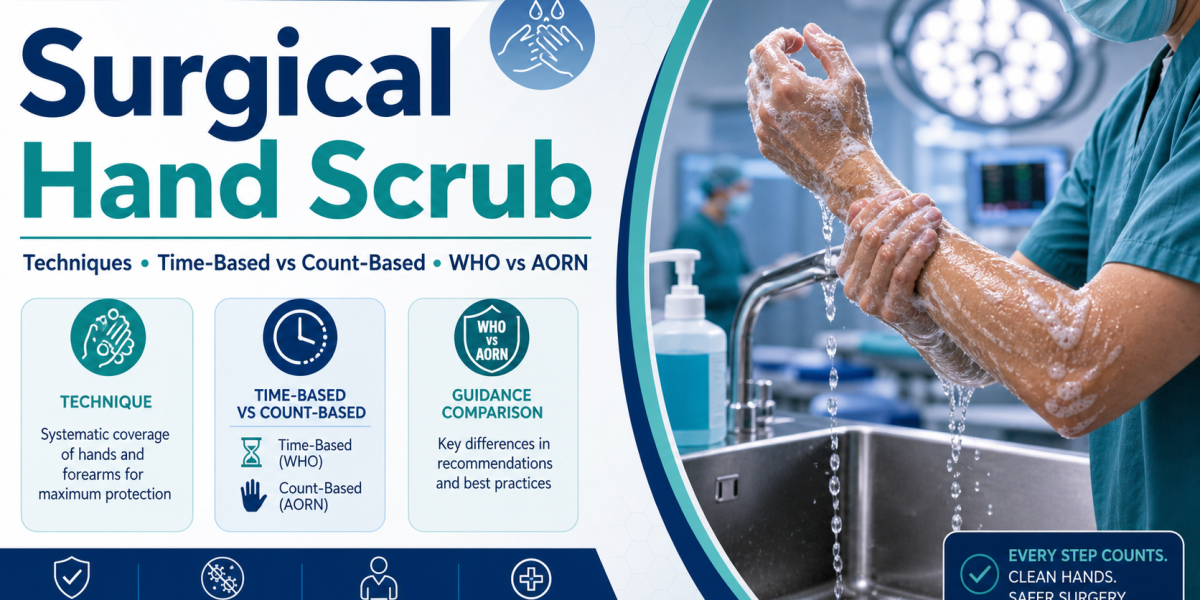
Surgical hand scrub confuses many nursing students because small errors in timing, nail cleaning, drying, or gowning can break aseptic practice. This guide explains the technique, the reasoning behind each step, and how to compare WHO and AORN guidance without memorizing rules blindly.
Quick Answer: What Is a Surgical Hand Scrub?
A surgical hand scrub is a preoperative hand antisepsis method used before sterile gowning and gloving. Its purpose is to reduce transient microorganisms, lower resident skin flora, and keep microbial counts suppressed during surgery or invasive sterile procedures.
In modern perioperative practice, surgical hand preparation may involve a traditional water-based antimicrobial scrub or an alcohol-based surgical hand rub. WHO guidance recognizes both antimicrobial soap-and-water scrubbing and alcohol-based hand rubbing for surgical hand preparation when products meet required standards (World Health Organization 2009).
| Term | Meaning | Example |
|---|---|---|
| Routine hand hygiene | Cleans hands during general care | Hand rub before patient contact |
| Surgical hand scrub | Water-based antimicrobial scrub | Chlorhexidine or povidone-iodine scrub |
| Surgical hand antisepsis | Broader term for surgical hand preparation | Scrub or alcohol-based rub |
| Alcohol-based surgical hand rub | Waterless surgical hand preparation | Alcohol rub before gowning |
A surgical hand scrub is not the same as routine hand hygiene. Routine hand hygiene reduces transmission during ordinary care. Surgical hand antisepsis prepares the hands and forearms for sterile procedures where contamination could reach deep tissue, surgical wounds, implants, or sterile equipment.
Why Surgical Hand Scrub Matters in Perioperative Nursing
Surgery breaks the body’s protective barrier. Once the skin is incised, microorganisms can enter tissue that should remain protected. Gloves reduce risk, but gloves can develop microperforations during procedures. Therefore, hand antisepsis matters even when sterile gloves are worn.
WHO describes surgical hand preparation as a process used to eliminate transient flora and reduce resident flora before surgical procedures (World Health Organization 2009). This matters because resident microorganisms live deeper in the skin and may persist even after ordinary handwashing.
Surgical site infections remain a major patient safety concern. They can increase pain, antibiotic exposure, length of stay, readmission risk, and healthcare costs. A recent review describes surgical site infections as complex postoperative complications influenced by patient, procedure, microbial, and environmental factors (Rezaei et al. 2025).
For students, the key is clinical reasoning. You should understand why hands move from fingertips toward elbows, why water should run away from clean areas, why nails matter, and why hands must remain above elbows after scrubbing.
If you need a broader foundation before studying surgical hand preparation, review our aseptic technique guide for clean technique, sterile technique, contamination control, and sterile field principles.
Surgical Hand Scrub vs Routine Hand Hygiene
Routine hand hygiene and surgical hand scrub both reduce microorganisms, but they serve different clinical purposes.
Routine hand hygiene occurs before and after patient contact, after body-fluid exposure risk, after glove removal, and after touching patient surroundings. It may involve soap and water or alcohol-based hand rub, depending on hand condition and clinical context.
A surgical hand scrub is more rigorous. This process targets the hands and forearms before sterile gowning and gloving. It requires an antimicrobial product or an approved alcohol-based surgical hand preparation, followed by controlled movement to prevent contamination after completion.
| Feature | Routine hand hygiene | Surgical hand scrub |
|---|---|---|
| Main purpose | Reduce transmission during care | Prepare for sterile procedure |
| Area cleaned | Hands, sometimes wrists | Hands, nails, wrists, forearms |
| Product | Soap/water or hand rub | Antimicrobial scrub or surgical rub |
| Timing | Throughout patient care | Before surgery or sterile procedure |
| Glove type after | Clean or sterile, depending on task | Sterile gloves |
| Technique intensity | Shorter | More structured and longer |
| Main risk if poor | Cross-transmission | Surgical or sterile-field contamination |
WHO hand hygiene guidance supports alcohol-based hand rub for routine clinical hand hygiene when hands are not visibly soiled. However, surgical preparation requires product suitability, correct duration, and full coverage of hands and forearms.
Students often lose marks because they say, “I washed my hands,” without explaining the procedure level. In an OSCE, say:
“I am performing surgical hand antisepsis because I will enter the sterile field and don sterile gown and gloves.”
That answer shows decision-making.
Surgical Hand Scrub vs Surgical Hand Antisepsis
The phrase surgical hand scrub often refers to the traditional water-based method. However, surgical hand antisepsis is the broader term. It includes both scrubbing and rubbing methods.
A traditional surgical scrub uses water, antimicrobial soap, and friction. Common agents include chlorhexidine gluconate and povidone-iodine. The person cleans under nails, fingers, hands, wrists, and forearms, then dries with a sterile towel.
An alcohol-based surgical hand rub uses an approved alcohol formulation. The user applies product to clean, dry hands and forearms according to the manufacturer’s instructions. The product must dry completely before gowning and gloving.
WHO notes that alcohol-based hand rubs can be used for surgical hand preparation, but hands should be clean and dry before use, and visible soil requires washing first (World Health Organization 2009).
This distinction matters because students sometimes think “scrub” always means brush plus water. That is outdated. Many facilities now use alcohol-based surgical hand rubs because they can be effective, faster, and less irritating when used correctly.
However, local policy controls practice. In clinical placement, follow the facility’s product instructions and perioperative policy.
Traditional Water-Based Scrub vs Alcohol-Based Surgical Hand Rub
Traditional water-based surgical scrub and alcohol-based surgical hand rub both aim to reduce microbial load before sterile procedures. They differ in method, skin effect, timing, and workflow.
Traditional surgical scrub
A traditional scrub uses antimicrobial soap and water. The nurse or scrub practitioner cleans nails, hands, and forearms using a structured sequence. Water flows from fingertips to elbows so contaminated water does not run back toward the hands.
This method provides mechanical cleaning and chemical antisepsis. It is useful when hands are visibly soiled or when local policy requires a first scrub of the day.
Alcohol-based surgical hand rub
Alcohol-based surgical hand rub does not use water during application. It depends on adequate product volume, full coverage, correct contact time, and complete drying.
Research comparing surgical hand antisepsis products has found that alcohol-based preparations can reduce bacterial counts effectively. A Cochrane review found evidence comparing aqueous scrubs and alcohol-based rubs, although the review also noted uncertainty about direct effects on surgical site infection outcomes (Tanner, Dumville, and Norman 2016).
| Area | Water-based surgical scrub | Alcohol-based surgical hand rub |
|---|---|---|
| Uses water | Yes | No during application |
| Main action | Friction plus antiseptic | Chemical antisepsis |
| Best when hands are visibly soiled | Yes | No; wash first |
| Skin irritation risk | Can be higher with harsh scrubbing | Often lower if moisturizing formula |
| Requires sterile towel | Yes | Usually no |
| Must dry before gloves | Dry with sterile towel | Air dry completely |
| Depends on manufacturer timing | Yes | Yes |
Neither method works if performed carelessly. Poor coverage, rushed timing, wet hands, contaminated towels, or touching non-sterile surfaces after preparation can undermine both methods.
Time-Based vs Count-Based Surgical Hand Scrub
Time-based and count-based methods are two ways to structure a surgical scrub.
A time-based surgical hand scrub requires scrubbing each area for a set amount of time. For example, a facility may require a scrub lasting two to five minutes, depending on product instructions and policy.
A count-based surgical hand scrub requires a set number of strokes on each surface. For example, the user may scrub each nail, each finger side, the palm, back of hand, wrist, and forearm using a defined stroke count.
AORN’s older recommended practices described an anatomical scrub method using either a prescribed number of strokes or a specified time for each surface of the fingers, hands, and arms (Association of periOperative Registered Nurses 2004).
| Method | How it works | Strength | Weakness |
|---|---|---|---|
| Time-based | Scrub for specified minutes | Easier to standardize | May miss surfaces if technique is poor |
| Count-based | Use set strokes per area | Encourages full surface coverage | Can become mechanical if rushed |
| Anatomical method | Covers each hand/arm area systematically | Strong for learning | Needs practice |
| Manufacturer-based | Follow product label | Aligns with product testing | Requires local policy awareness |
The key is not the clock alone. A three-minute scrub can fail if the student skips thumbs, fingertips, or forearms. A count-based scrub can fail if strokes are too light or rushed.
For OSCEs, explain both coverage and timing:
“I will use the facility-approved method and scrub all surfaces for the required time, moving from the cleanest area at the fingertips toward the elbows.”
That answer shows technique and rationale.
WHO vs AORN: Differences and Similarities
WHO and AORN both support surgical hand preparation, but they differ in scope. On one hand, WHO provides global infection-prevention guidance that applies across healthcare systems, while AORN focuses on perioperative practice and operating room standards.
Do not treat them as enemies. They overlap in purpose but emphasize different practice details.
WHO discusses surgical hand preparation within hand hygiene and surgical site infection prevention. It recognizes antimicrobial soap-and-water scrubbing and alcohol-based surgical hand rubbing when products meet suitable standards.
AORN focuses more directly on perioperative workflow. Its hand hygiene guidance addresses surgical hand antisepsis in the perioperative setting, including scrub roles, OR practice, and procedure-specific expectations (Association of periOperative Registered Nurses 2022).
| Topic | WHO emphasis | AORN emphasis |
|---|---|---|
| Scope | Global hand hygiene and SSI prevention | Perioperative nursing practice |
| Setting | Broad healthcare settings | Operating room and perioperative areas |
| Method | Antimicrobial soap or alcohol-based surgical rub | Facility-approved perioperative hand antisepsis |
| Timing | Follow product and guideline recommendations | Follow perioperative policy and product instructions |
| Jewelry and nails | Remove jewelry; avoid artificial nails for surgical prep | Aligns with OR hand hygiene and attire expectations |
| Workflow | Surgical preparation before procedures | Connection to scrub role, gowning, gloving, sterile field |
| Student relevance | Evidence base and infection prevention | OR role performance and policy compliance |
WHO is useful for evidence and global principles. AORN is useful for OR-specific application. A nursing student should understand both.
Step-by-Step Surgical Hand Scrub Technique
Always follow your facility’s policy and product instructions. However, most surgical scrub methods follow the same clinical logic.
Step 1: Prepare before touching water or product
Remove jewelry, watches, and bracelets. Check fingernails. Nails should be short, clean, and natural. Artificial nails and chipped nail polish create infection-control concerns because they may harbor microorganisms or interfere with cleaning.
WHO surgical hand preparation guidance identifies the removal of hand jewelry, artificial nails, and nail polish before surgical hand decontamination as part of surgical preparation recommendations (World Health Organization 2016).
Step 2: Inspect skin integrity
Check for cuts, dermatitis, cracked skin, or open lesions. Damaged skin can harbor microorganisms and may worsen with repeated scrubbing. Report significant skin problems according to local policy.
Step 3: Clean under nails
Clean the subungual area carefully, usually under running water, using the approved nail cleaner if required. Nails often trap debris and microorganisms, so this step is not optional.
Step 4: Start with fingers and hands
Begin at the fingertips and move toward the hands. Scrub all sides of each finger, the spaces between fingers, thumbs, palms, and backs of hands. Do not skip thumbs. Students often miss them.
Step 5: Move toward wrists and forearms
Continue from wrists to forearms. Keep hands higher than elbows. Water should flow from clean fingertips toward elbows, not from elbows back to hands.
Step 6: Rinse correctly
Rinse one arm at a time from fingertips to elbows. Avoid touching the sink, faucet, clothing, or non-sterile surfaces.
Step 7: Dry with a sterile towel
After scrubbing, enter the sterile area carefully. Dry one hand and arm with one end of the sterile towel, then use the other end for the opposite hand and arm. Move from fingertips toward elbows.
Step 8: Gown and glove without contamination
After drying, keep hands above waist level and away from the body. Do not touch non-sterile surfaces. Proceed to sterile gowning and gloving.
If your nursing assignment asks you to explain these steps, focus on rationale. Our nursing assignment help can support clear academic explanations for infection-control procedures.
First Scrub of the Day vs Subsequent Scrub
Many students ask whether the first scrub of the day differs from later scrubs. The answer depends on policy, product instructions, and whether hands are visibly soiled.
Some guidance recommends a more thorough antimicrobial scrub at the start of the surgical day or before the first surgical procedure. Later procedures may allow alcohol-based surgical hand rubbing if hands remain clean and product instructions are followed. A recent clinical practice review from a national infection prevention body notes that surgical scrubbing with an antimicrobial product may be used for the first surgical hand antisepsis of the day, while subsequent procedures may use alcohol-based surgical rubbing unless hands are visibly soiled (ARHAI Scotland 2023).
The clinical logic is simple. The first scrub removes accumulated debris and reduces microbial load at the start of surgical activity. Later rubs maintain antisepsis when hands are not visibly dirty.
However, do not guess during clinical placement. Check local perioperative policy.
| Situation | Likely action |
|---|---|
| First procedure of the day | Antimicrobial surgical scrub may be required |
| Hands visibly soiled | Wash/scrub according to policy |
| Moving between procedures | Alcohol-based surgical rub may be allowed |
| Product instructions differ | Follow manufacturer and facility policy |
| Skin irritation occurs | Report and seek occupational guidance |
In OSCEs, phrase it carefully:
“I will follow facility policy and manufacturer instructions. If my hands are visibly soiled, I will wash before surgical antisepsis.”
Nail Care, Jewelry, Artificial Nails, and Skin Integrity
Nail and jewelry rules are not cosmetic preferences. They relate directly to microbial control.
Jewelry can interfere with cleaning and may harbor microorganisms. Long nails create more surface area and may trap debris. Artificial nails are especially concerning in healthcare because they can increase microbial burden and make cleaning harder.
WHO guidance supports removing hand jewelry, artificial nails, and nail polish before surgical hand preparation..
Good surgical hand preparation starts before the sink.
Practical nail and jewelry rules
- Remove rings, watches, and bracelets.
- Keep nails short and clean.
- Avoid artificial nails in perioperative practice.
- Avoid chipped nail polish.
- Report skin lesions or dermatitis.
- Do not scrub damaged skin aggressively.
- Use approved skin-care products only.
Skin integrity also matters. Repeated scrubbing can cause dryness, cracking, and irritation. Damaged skin can increase microbial shedding and make hand antisepsis less effective.
This is why modern guidance often discourages harsh brush use on skin. Brush use may be limited to nails when required by policy. Excessive scrubbing does not mean better asepsis. It can damage the skin barrier.
Brush Use, Skin Damage, and Antimicrobial Agents
Traditional images of surgical scrubbing often show stiff brushes and aggressive scrubbing. Modern practice is more careful.
The goal is not to scrape the skin. The goal is to reduce microorganisms while protecting skin integrity. Excessive brushing can irritate skin, cause microabrasions, and make repeated hand antisepsis harder over time.
Common antimicrobial agents include chlorhexidine gluconate, povidone-iodine, and alcohol-based preparations. Evidence comparing agents has shown differences in bacterial colony counts. A Cochrane review found that chlorhexidine gluconate scrubs reduced colony-forming units more than povidone-iodine scrubs in several studies, although evidence linking product choice directly to SSI reduction remained limited.
Another study comparing povidone-iodine scrub with an alcohol-based chlorhexidine gluconate rub found the alcohol-based chlorhexidine product more effective at reducing baseline colony counts and sustaining antisepsis in that setting (Lai et al. 2012).
However, do not choose products based only on one study. Facilities select products based on evidence, compatibility, skin tolerance, cost, policy, and regulatory requirements.
For research papers on antiseptic agents or infection prevention, our nursing research paper help can help you structure evidence-based arguments.
Drying Technique Before Gowning and Gloving
Drying is part of surgical hand antisepsis. It is not an afterthought.
After a water-based scrub, hands and forearms must be dried using a sterile towel. Start at the fingertips and move toward the elbows. Do not move back from elbow to hand with the same towel area. The hands should remain higher than the elbows.
Why does this matter?
The fingertips and hands are the cleanest areas after scrubbing because they will enter sterile gloves and handle sterile equipment. If water runs from elbows back to hands, it may carry microorganisms toward the area that needs the highest level of cleanliness.
If using an alcohol-based surgical hand rub, allow the product to dry completely before gowning and gloving. Wet alcohol product can affect glove integrity, irritate skin, and increase fire risk in certain clinical contexts. Product drying time matters.
Common drying errors
| Error | Why it matters |
|---|---|
| Drying from elbow to hand | Moves contamination toward hands |
| Reusing the same towel surface incorrectly | Transfers organisms |
| Touching scrub attire while drying | Breaks aseptic preparation |
| Leaving hands wet before gloving | Affects glove donning and product action |
| Dropping hands below waist level | Increases contamination risk |
In OSCEs, verbalize the rationale:
“I will dry from fingertips to elbows and keep my hands above my elbows to prevent contaminated water from moving toward my hands.”
Common Student Mistakes During Surgical Hand Scrub
Students usually fail surgical hand scrub assessments because they miss small but important details.
Mistake 1: Scrubbing without removing jewelry
Rings and watches interfere with cleaning. They also signal poor preparation. Remove them before starting.
Mistake 2: Skipping nails and thumbs
Thumbs, fingertips, and nail areas are commonly missed. These areas need deliberate attention.
Mistake 3: Touching the sink
The sink is not sterile. If your hand or forearm touches it after scrubbing, you may need to restart according to policy.
Mistake 4: Letting water run from elbows to hands
Hands should stay above elbows. Water should flow from clean to less clean areas.
Mistake 5: Rushing the required time
Do not shorten the scrub. Follow product and facility instructions.
Mistake 6: Overusing the brush
Aggressive brushing can damage skin. Use brushes only as required, often for nails rather than all skin surfaces.
Mistake 7: Poor drying technique
Drying incorrectly can undo good technique.
Mistake 8: Touching non-sterile surfaces after scrubbing
After surgical hand antisepsis, your hands and arms must remain protected until sterile gowning and gloving.
If you need help preparing an infection-control assignment or OSCE explanation, our coursework help for nursing students can help you organize procedures into clear study notes.
Clinical Case Examples
Case 1: Scrub nurse preparing for first case of the day
A scrub nurse enters the perioperative area for the first procedure. The nurse removes jewelry, checks nails, performs the facility-approved first surgical scrub, dries with a sterile towel, and proceeds to gowning and gloving.
Correct reasoning: the first scrub reduces microbial load before sterile work begins. The nurse follows product and facility instructions.
Case 2: Student uses alcohol rub on visibly soiled hands
A student finishes moving equipment and notices visible soil near the fingernails. The student reaches for alcohol-based surgical hand rub.
Correct action: wash or scrub according to policy first. Alcohol-based rub should not replace cleaning when hands are visibly soiled.
Case 3: Scrubbed student touches the faucet
During rinsing, the student accidentally touches the sink fixture.
Correct action: acknowledge contamination and restart according to local policy. The sink is not sterile.
Case 4: Nurse develops skin irritation
A scrub nurse reports cracked skin after repeated scrubbing.
Correct action: report to occupational health or the clinical supervisor. Skin integrity supports safe hand antisepsis.
Clinical examples make assignments stronger because they show how rules apply in real decisions. Our case study help can help you write case-based infection-control analysis with clearer reasoning.
OSCE Preparation Checklist for Surgical Hand Scrub
Use this checklist before a practical assessment.
| OSCE step | What examiner checks |
|---|---|
| Preparation | Jewelry removed, nails checked, sleeves appropriate |
| Product knowledge | Uses correct facility-approved product |
| Nail cleaning | Cleans subungual area correctly |
| Direction | Moves from fingertips toward elbows |
| Coverage | Covers all surfaces, including thumbs |
| Timing | Follows required duration or stroke count |
| Rinsing | Keeps hands above elbows |
| Drying | Uses sterile towel correctly |
| Contamination response | Stops and corrects errors |
| Gowning transition | Avoids non-sterile contact |
Strong OSCE phrases
Use short explanations:
- “I removed jewelry because it interferes with effective hand antisepsis.”
- “I am cleaning nails first because subungual areas can retain debris.”
- “I will keep my hands above my elbows so water flows away from my hands.”
- “I will follow manufacturer and facility timing.”
- “This hand touched a non-sterile surface, so I will restart according to policy.”
- “I will let the alcohol-based product dry completely before gowning.”
These phrases show that you understand the procedure, not just the movements.
Writing About Surgical Hand Scrub in Assignments
A strong paragraph explains the clinical reason behind the action.
Weak sentence:
Surgical hand scrub is important before surgery.
Stronger sentence:
Surgical hand scrub reduces transient microorganisms and suppresses resident skin flora before sterile gowning and gloving, which lowers the risk of contaminating the sterile field during invasive procedures.
That sentence explains mechanism and purpose.
For essays, use this structure:
- Define surgical hand scrub.
- Explain the infection-control problem.
- Compare scrub and rub methods.
- Discuss timing and product instructions.
- Explain nail, jewelry, and skin rules.
- Link the procedure to sterile field protection.
- Support claims with scholarly sources.
If your draft needs stronger clinical language, our clinical medical writing support can help refine perioperative and infection-control content.
Benefits of Ethical Academic Support
Surgical hand scrub seems simple until you must explain WHO guidance, AORN expectations, scrub timing, resident flora, antiseptic agents, and OSCE errors in one assignment.
Ethical academic support helps you learn and write better. It should not replace your clinical practice or encourage dishonest submission.
Academic guidance can help you:
- Build a clear outline
- Explain procedures with rationale
- Compare WHO and AORN carefully
- Use evidence correctly
- Improve flow and readability
- Format Chicago citations
- Prepare OSCE revision notes
- Strengthen clinical examples
You can learn how our academic support works before requesting help. You can also review pricing if you want to plan around your deadline.
Ethical Considerations for Nursing Students
Nursing assignments must protect integrity. Infection-control writing connects to patient safety, so the work should be accurate.
Ethical support may include editing, outlining, feedback, source organization, citation help, and explanation of difficult concepts. It should not include fabricated clinical experiences, invented data, false references, or unsafe recommendations.
If you are unsure about the quality of academic support, check service transparency. You can review our about us page, see available samples, and read the refund policy before ordering.
For larger scholarly projects, our medical research paper writing support can help students organize evidence-based surgical and infection-control topics.
Research and Evidence-Based Project Ideas
Surgical hand scrub can support strong nursing research topics. Students may examine compliance, OSCE performance, product comparison, skin irritation, staff education, or perioperative infection prevention.
Possible topics include:
- Surgical hand antisepsis compliance among scrub staff
- Student errors during surgical scrub OSCEs
- Alcohol-based hand rub versus water-based scrub
- Skin irritation among perioperative nurses
- Knowledge of WHO surgical hand preparation guidance
- AORN hand hygiene implementation in perioperative settings
- Effect of simulation training on scrub technique
Quantitative projects may use audit scores, compliance percentages, survey data, or pre-test and post-test results. Qualitative projects may explore student confidence, barriers to compliance, or nurses’ experiences with skin irritation.
If your project includes statistical testing, our SPSS data analysis help can support results presentation. For advanced models, regression analysis help may fit quantitative infection-control projects. For evidence-based practice work, DNP dissertation help can support project structure.
CTA: Need Help With a Surgical Hand Scrub Assignment?
A surgical hand scrub article, essay, or OSCE reflection needs more than a list of steps. Your work should explain why the procedure matters, how technique prevents contamination, what WHO and AORN emphasize, and how errors affect patient safety.
Nursing Dissertation Help offers ethical academic guidance for nursing students, perioperative learners, and students writing infection-control assignments. You can request help with outlines, research support, editing, case examples, citations, and clinical reasoning.
When you are ready, you can place an order and request support for your nursing topic.
FAQs About Surgical Hand Scrub
1. What is a surgical hand scrub?
A surgical hand scrub is a preoperative hand antisepsis method used before sterile gowning and gloving. It reduces transient microorganisms and suppresses resident flora on hands and forearms.
2. How long should a surgical hand scrub take?
The time depends on facility policy and product instructions. Many protocols use two to five minutes, but the correct answer is to follow the approved product and local policy.
3. What is the difference between time-based and count-based scrub?
A time-based scrub uses a set duration. A count-based scrub uses a set number of strokes on each surface. Both require full coverage of nails, fingers, hands, wrists, and forearms.
4. Is alcohol-based surgical hand rub acceptable?
Yes, when approved by facility policy and used according to manufacturer instructions. Hands must be clean and dry before use. Visibly soiled hands require washing first.
5. Why must hands stay above elbows?
Hands should stay above elbows so water flows from the cleaner area toward the less clean area. This prevents water from running back toward the hands.
6. What is the biggest student mistake?
The biggest mistake is treating surgical hand scrub as memorized movement instead of aseptic reasoning. Students must understand timing, coverage, contamination risk, and the transition to gowning and gloving.
Get Expert Help With Perioperative Nursing Work
Surgical hand scrub is a core perioperative skill. It protects the sterile field, supports safe gowning and gloving, and reduces the risk of transferring microorganisms during surgery. However, students need more than steps. They need clinical reasoning.
A strong assignment explains the difference between routine hand hygiene and surgical hand antisepsis. It compares traditional scrubbing with alcohol-based rubbing, discusses WHO and AORN guidance carefully and also explains common mistakes and patient-safety consequences.
If your nursing assignment, research paper, OSCE reflection, or clinical report needs more depth, Nursing Dissertation Help can support you with ethical academic guidance. Review how our academic support works, check pricing, or place an order for structured support.
Reference List
ARHAI Scotland. 2023. “Literature Review: Hand Hygiene — Surgical Hand Antisepsis in the Clinical Setting.” National Infection Prevention and Control Manual.
Association of periOperative Registered Nurses. 2004. “Recommended Practices for Surgical Hand Antisepsis/Hand Scrubs.” AORN Journal.
Association of periOperative Registered Nurses. 2022. “Guideline Quick View: Hand Hygiene.” AORN Journal.
Lai, K. W., et al. 2012. “Surgical Hand Antisepsis: A Pilot Study Comparing Povidone-Iodine Hand Scrub and Alcohol-Based Chlorhexidine Gluconate Hand Rub.” Annals, Academy of Medicine, Singapore.
Rezaei, Ahmad Reza, et al. 2025. “Surgical Site Infections: A Comprehensive Review.” PubMed Central.
Tanner, Judith, Jo C. Dumville, and Gill Norman. 2016. “Surgical Hand Antisepsis to Reduce Surgical Site Infection.” Cochrane Database of Systematic Reviews.
World Health Organization. 2009. “Surgical Hand Preparation: State-of-the-Art.” In WHO Guidelines on Hand Hygiene in Health Care. NCBI Bookshelf.
World Health Organization. 2016. “WHO Surgical Site Infection Prevention Guidelines: Surgical Hand Preparation Evidence Appendix.”
