

Nursing and medical students learn early that infection control is more than just a set of rules; it is a framework that protects patients, colleagues and themselves. Yet standard precautions in healthcare has been a problem to many learners who struggle to differentiate from older practices like universal precautions, or to appreciate how these policies fit into the wider chain of infection. Without clear guidance, it is easy to overlook critical details, from when to don gloves to how to handle contaminated equipment.
This confusion can lead to unsafe habits that put patient safety at risk. This article exists to solve that problem by offering a comprehensive, research‑backed guide to standard precautions. It explains what they are, how they evolved, why they matter in clinical education, and how they intersect with transmission‑based precautions. Throughout, you’ll find practical advice, scholarly citations and links to resources that support your academic journey.
Understanding standard precautions in healthcare
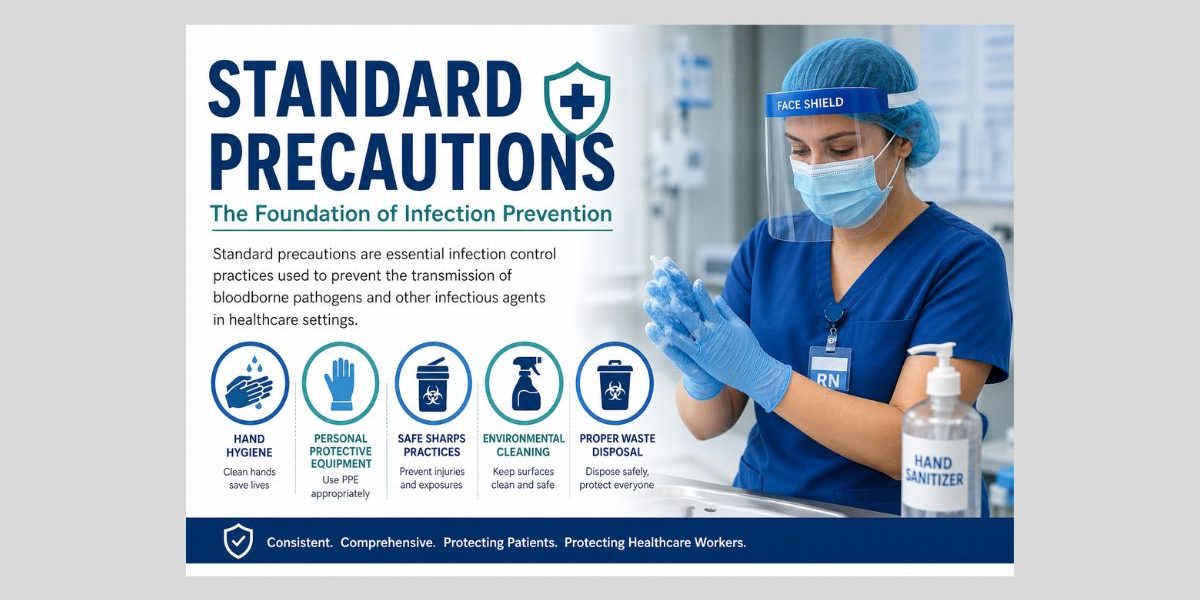
Standard precautions are the minimum infection-control practices that must be used at all times for all patients, regardless of infection status. They evolved from universal precautions and body substance isolation, which focused primarily on blood-borne pathogens.
The current approach integrates hand hygiene, use of personal protective equipment (PPE), safe injection practices, respiratory hygiene, environmental cleaning, and the proper handling of linens and sharps.
Definition and Core Principles of Standard Precautions
According to the Centers for Disease Control and Prevention (CDC), standard precautions are intended to be applied to the care of all patients and constitute the primary strategy for preventing healthcare-associated transmission of infectious agents. Unlike universal precautions, which targeted only blood and certain body fluids, standard precautions recognise that all blood, body fluids, secretions and excretions (except sweat), non-intact skin and mucous membranes may contain transmissible agents.
In practice, this means every interaction, whether drawing blood or delivering medication, should include a risk assessment and appropriate barrier protections.
Evolution from Universal to Standard Precautions
The shift from universal to standard precautions occurred in 1996. Universal precautions were introduced in the mid-1980s to protect against blood-borne pathogens and involved avoiding contact with bodily fluids using gloves, goggles and face shields. In 1996, the CDC replaced the term with standard precautions, expanding the concept to include a wider range of body fluids and infection risks. This change acknowledged that pathogens can be present even when not visible and broadened the scope of infection prevention.
Key elements of standard precautions in healthcare
The CDC’s guideline highlights several core components of standard precautions[6], each of which plays a role in preventing infection:
- Hand hygiene: Frequent handwashing or use of alcohol‑based hand rubs is recognised as the most effective method for interrupting the transmission of diseases[7]. Hands should be cleaned before and after patient contact, after removing gloves and before handling invasive devices.
- Personal protective equipment (PPE): Depending on anticipated exposure, healthcare workers use gloves, gowns, masks, eye protection or face shields[6]. PPE provides a physical barrier to prevent contamination of skin, mucous membranes, respiratory tract and clothing[8].
- Respiratory hygiene/cough etiquette: Added to standard precautions in 2007, this element includes covering the mouth and nose during coughing, using masks on coughing patients and maintaining spatial separation of at least 3 ft to reduce droplet spread[9].
- Safe injection practices: These practices prevent transmission via contaminated needles and syringes. They include using sterile, single‑use needles, employing a one‑handed scoop technique when recapping and disposing of sharps in puncture‑resistant containers[10].
- Environmental cleaning and linen handling: Appropriate cleaning and disinfection of patient‑care equipment and environmental surfaces minimise the risk of indirect transmission[11].
- Patient placement: Proper room assignment based on infection risk and ensuring that patients requiring isolation are placed appropriately help prevent cross‑contamination[12].
These elements work synergistically to interrupt multiple links in the chain of infection. In practice, nursing students should apply them consistently, whether they are performing a simple dressing change or conducting a complex procedure. Because these measures are non‑negotiable and universal, they form the first tier of infection control across healthcare settings.
How standard precautions differ from universal precautions
Universal precautions were primarily designed to protect healthcare workers from blood‑borne pathogens by treating all blood and certain body fluids as potentially infectious. They focused on barrier protections such as gloves, gowns and face shields[5]. Standard precautions, however, combine the major features of universal precautions and body substance isolation to encompass a wider range of fluids and situations[2]. For example, universal precautions did not address the use of masks during respiratory procedures or the safe disposal of contaminated equipment. Standard precautions integrate respiratory hygiene and safe injection practices to account for emerging pathogens[13]. They also emphasise patient protection by ensuring that healthcare workers do not carry infectious agents on their hands or equipment to other patients[14]. This broader scope reflects the evolution of infection control and underscores the need for continuous education and adherence.
The chain of infection and breaking its links
Infection does not occur by accident; it follows a predictable sequence known as the chain of infection. Understanding this chain helps healthcare students see where standard precautions intervene. The chain consists of six links: infectious agent, reservoir, portal of exit, mode of transmission, portal of entry and susceptible host[15]. If any link is removed or neutralised, transmission cannot occur[16]. The concept is foundational because it illustrates that infection control is not a single action but a series of strategies targeting different points in the chain.
Which link do standard precautions in healthcare break?
Standard precautions are designed to break several links in the chain. Hand hygiene and PPE disrupt the mode of transmission by preventing pathogens from moving from one person or surface to another[16]. Safe injection practices and proper disposal of sharps limit the portal of entry and exit by ensuring that contaminated needles do not introduce pathogens into new hosts[10]. Environmental cleaning reduces reservoirs by eliminating pathogens on surfaces, while respiratory etiquette curtails the portal of exit for respiratory pathogens[17]. By addressing multiple links simultaneously, standard precautions act as a broad shield against infection.
Chain of infection table
| Link in the chain | Description | How standard precautions break it |
| Infectious agent | Microorganisms capable of causing disease (bacteria, viruses, fungi)[18] | Disinfectants and cleaning protocols reduce the number of viable agents; proper antibiotic stewardship prevents resistance |
| Reservoir | Places where agents live and multiply – humans, animals, surfaces[19] | Cleaning patient‑care equipment and environmental surfaces removes reservoirs; appropriate handling of linens prevents contamination |
| Portal of exit | Route by which pathogens leave the reservoir[20] | Masks, gloves and proper wound coverings prevent exposure to blood and secretions |
| Mode of transmission | How pathogens travel (contact, droplet, airborne)[21] | Hand hygiene, PPE and spatial separation interrupt transmission between individuals |
| Portal of entry | Route by which agents enter a new host[22] | Safe injection practices and catheter insertion techniques prevent pathogens from entering the bloodstream or tissues |
| Susceptible host | Individual at risk due to weakened immunity[23] | Vaccinations, nutritional support and overall health care reduce susceptibility; standard precautions limit exposure |
Understanding this table helps students visualise how each precaution maps to a particular link. It also shows that no single measure suffices; instead, a comprehensive approach is needed to ensure the chain is effectively broken.
Transmission‑based precautions
In healthcare, standard precautions form the first tier of infection control, but some pathogens require additional measures. Transmission‑based precautions are used for patients known or suspected to be infected with agents that need more than standard precautions to prevent spread[12]. These precautions are applied empirically, based on clinical symptoms and the likely pathogen, and then modified once the pathogen is identified[24]. They do not replace standard precautions; rather, they are used in conjunction with them. There are three main categories: airborne, droplet and contact.
Airborne precautions
Airborne precautions are indicated for infections transmitted by small‑particle aerosols that can remain suspended in the air for long periods[25]. Examples include tuberculosis, measles and varicella. Patients requiring airborne precautions should be placed in a negative‑pressure isolation room with at least 6–12 air changes per hour[26]. Healthcare workers should wear respirators capable of filtering at least 95 % of airborne particles (e.g., N95 respirators)[27]. When transporting the patient, a surgical mask should be placed on the patient to minimise dissemination. These measures prevent inhalation of aerosolised pathogens.
Droplet precautions
Droplet precautions are necessary when caring for patients with infections transmitted by respiratory droplets that are generally larger than 5 µm and travel short distances (typically within 3–6 ft)[28]. Diseases such as influenza, pertussis and meningococcal meningitis fall into this category. Patients should ideally be placed in private rooms; if that is not possible, they should be separated by at least 3 ft[29]. Healthcare workers should wear surgical masks when within 6 ft of the patient and ensure the patient wears a mask during transport[30]. Doors may remain open because droplet particles do not remain suspended for long periods.
Contact precautions
Contact precautions are used for pathogens transmitted through direct or indirect contact with patients or contaminated surfaces[31]. Examples include infections caused by methicillin‑resistant Staphylococcus aureus (MRSA), Clostridioides difficile and certain gastrointestinal viruses. Patients should be placed in private rooms whenever possible; if not, cohorting with patients who have the same infection is acceptable[32]. Healthcare workers must don gloves and gowns before entering the room and remove them before exiting, followed by hand hygiene[33]. Equipment should remain in the patient’s room; if shared equipment is used, it must be cleaned and disinfected thoroughly[34]. These precautions reduce the risk of spreading pathogens via touch.
Table: Transmission‑based precautions
| Precaution type | Pathogens/examples | Room & PPE requirements | Key considerations |
| Airborne | Tuberculosis, measles, chickenpox | Negative‑pressure room; N95 or higher respirator; patient wears mask during transport[35] | Limit transport; keep doors closed; ensure adequate air changes |
| Droplet | Influenza, pertussis, meningococcal meningitis | Private room if possible; surgical mask for staff and patient; maintain 3–6 ft distance[28] | Doors may remain open; mask patient during transport |
| Contact | MRSA, C. difficile, norovirus | Private room or cohort; gloves and gown before entry; dedicated equipment[31] | Remove PPE before exit; hand hygiene; clean shared equipment thoroughly |
These categories remind students that standard precautions alone may not suffice for all pathogens. Recognising when to implement additional measures is a critical skill in clinical practice. Importantly, if the infecting agent is unknown, transmission‑based precautions are applied empirically based on the patient’s symptoms[24].
Challenges students face when learning about standard precautions in healthcare
Information overload and inconsistent sources
Nursing curricula cover a vast array of topics, from anatomy to pharmacology. Students often receive infection‑control training in multiple courses, yet the information can be fragmented. Some sources still refer to universal precautions, creating confusion about which guidelines are current. Others may emphasise certain practices (e.g., glove use) but neglect newer elements like respiratory hygiene. Scholarly sources highlight that routine hygienic practices, standard precautions and transmission‑based precautions are all used to break the chain of transmission[16]. When students cannot see how these concepts fit together, they may prioritise one element over another, leading to gaps in practice.
Translating theory into practice
Another challenge is applying classroom knowledge in real clinical settings. It is one thing to memorise that gloves should be worn when contact with blood is anticipated; it is another to decide which PPE to don during an unpredictable emergency. Studies note that proper application of standard precautions depends on the nature of the healthcare worker–patient interaction and the extent of anticipated exposure[36]. Without hands‑on experience and mentorship, students may under‑ or over‑use PPE, mismanage sharps or neglect environmental cleaning. Effective training requires simulation, feedback and reflection.
Competing priorities in clinical placements
During clinical rotations, students juggle multiple tasks: documenting care, administering medications, communicating with families and learning new procedures. Infection control can become an afterthought when time is limited. Yet the stakes are high, as healthcare‑associated infections can lead to serious patient harm. Recognising infection control as an ethical obligation and integrating it into all tasks helps avoid lapses. The adoption of standard precautions protects both patients and healthcare workers[14]; ignoring them is not an option.
Keeping up with evolving guidelines
The field of infection control is dynamic. New pathogens emerge (e.g., SARS‑CoV‑2), and existing pathogens develop resistance. The CDC periodically updates its guidelines, adding elements like respiratory hygiene and safe injection practices[13]. Students must therefore cultivate a habit of continuous learning. Leveraging credible resources such as PubMed articles, CDC updates and university guidelines ensures that practices remain current. The references used throughout this article point to primary sources that can form part of a personal learning library.
Why standard precautions are important in healthcare education
Protecting patients and reducing healthcare‑associated infections
Healthcare‑associated infections (HAIs) remain a significant burden worldwide. By adhering to standard precautions, future nurses help reduce the incidence of infections acquired in hospitals and clinics. The CDC emphasises that implementing standard precautions constitutes the primary strategy for preventing healthcare‑associated transmission[37]. Effective infection control not only improves patient outcomes but also reduces length of stay, healthcare costs and legal liability for institutions.
Safeguarding healthcare workers
Standard precautions evolved in part because universal precautions were insufficient to protect staff from all exposures. Universal precautions focused on blood‑borne pathogens such as HIV and HBV, whereas standard precautions recognise that many other body fluids and secretions may contain transmissible agents[5][2]. By broadening the scope and emphasising hand hygiene, PPE and environmental cleaning, standard precautions reduce occupational risk. Students who internalise these principles early are better prepared to protect themselves in their careers.
Promoting professionalism and patient trust
Patients entrust their wellbeing to healthcare workers. Observing proper infection‑control practices conveys professionalism and respect for patient safety. When learners follow standard precautions consistently, they demonstrate attention to detail and commitment to evidence‑based care. This professionalism builds trust and enhances the therapeutic relationship. It also prepares students for licensure exams and accreditation standards, which assess competence in infection control.
Aligning with ethical and legal standards
Healthcare professionals have a duty to do no harm. Failing to follow standard precautions could constitute negligence, with legal and ethical consequences. Regulations from organisations such as OSHA and guidelines from the CDC set minimum standards that healthcare facilities must meet. Students who master these guidelines early will find it easier to comply with institutional policies and avoid disciplinary actions. Moreover, adopting standard precautions aligns with the principles of beneficence and non‑maleficence, which underpin ethical practice.
Benefits of using our academic support services
Learning about infection control is demanding, and students may need support to produce research papers, dissertations or assignments on this topic. Our services at Nursing Dissertation Help are designed to guide you ethically through complex academic tasks. We provide resources and mentorship so that you can focus on understanding concepts like standard precautions while achieving high academic standards.
Expert guidance across topics
Our team includes experienced nurses, statisticians and research consultants who can help you with tasks ranging from a DNP dissertation to a coursework assignment. If you’re preparing a dissertation on infection control, you can explore DNP dissertation help. When you need assistance analysing data from an infection‑control study, consider our dissertation data analysis help or SPSS data analysis help. For students examining quantitative relationships, we offer regression analysis help and inferential statistics support.
Tailored writing and editing support
Writing about standard precautions requires clarity, structure and adherence to scholarly formats. Our nursing research paper help ensures that your paper is well‑researched, properly cited and aligned with your institution’s guidelines. If you need assistance with a medical manuscript, our clinical medical writing service can provide expert editing and organisation. For students needing comprehensive support, our nursing assignment help cover a range of subjects and formats.
Ethical and transparent processes
We believe in academic integrity. Our services are designed to guide and support, not to substitute your work. You can learn how we operate by visiting how it works, and review our nursing dissertation pricing to understand costs upfront. If you ever have concerns, our nursing dissertation refund policy outlines transparent procedures. By following ethical practices, we help you develop your own skills while meeting academic requirements.
Comprehensive resources
Besides infection control, our support extends to qualitative data analysis for students exploring qualitative aspects of nursing practice and case study help when you need to analyse real‑world scenarios. For those balancing multiple courses, our coursework help for nursing students and affordable coursework writing service offer affordable assistance without compromising quality. If you need examples, our samples showcase previous work to guide your own writing.
Support beyond dissertations
We recognise that nursing students often juggle clinical responsibilities with academic projects. That’s why we offer do my homework service and nursing homework help to help you manage smaller assignments. For comprehensive research projects, our medical research paper writing service provides robust support from topic selection to final editing. If you need assistance with report writing or preparing presentations, we’re here to help.
How our process works
Understanding how to access academic support is as important as understanding infection control. Here is a concise overview of our process, with links for more details:
- Initial consultation: Reach out via our order page to provide details about your project. Whether you need a comprehensive literature review on standard precautions or help with data analysis, our team will evaluate your requirements.
- Matching with an expert: Based on your topic and academic level, we assign a qualified professional. For instance, if your project involves inferential statistics on infection‑control compliance, we might match you with a statistician experienced in healthcare research.
- Planning and research: The assigned expert develops an outline and begins research. When exploring infection control topics, they will draw on peer‑reviewed journals, guidelines from the CDC and scholarly texts to ensure academic rigour.
- Drafting and feedback: You receive a draft and can provide feedback. This collaborative process ensures the final work meets your expectations and university standards. If you’re working on a research paper about standard precautions, this stage might involve refining your argument or ensuring proper Chicago citations.
- Final delivery: After revisions, the final document is delivered along with plagiarism reports and proper citations. Should you need adjustments, our support team remains available.
For more details about each step, visit our how it works page. Transparency is a core value, and we believe that understanding the process helps build trust.
How to choose the best academic support service
Selecting a reliable support service is essential when seeking assistance with complex topics like infection control. Here are factors to consider:
- Credentials and expertise: Ensure the service employs professionals with relevant qualifications. Our team includes nurses, statisticians and PhD holders familiar with infection control and research methodologies.
- Transparency: Look for clear information about pricing, refund policies and processes. Pages like nursing dissertation pricing and refund policy provide transparency.
- Academic integrity: Choose a service that emphasises guidance rather than ghostwriting. Ethical support helps you learn while meeting academic standards.
- Quality assurance: Review samples of previous work to gauge quality. Our samples page demonstrates the standard you can expect.
- Range of services: A comprehensive service can support you across different assignments – from case studies to qualitative data analysis – so you can work with one provider throughout your programme.
By evaluating these factors, you can choose a partner that aligns with your values and academic goals. Investing in professional guidance is not about outsourcing learning; it is about building skills with expert support.
Key components and steps in implementing standard precautions in healthcare
Step 1: Perform a risk assessment
Before any patient interaction, assess the potential for exposure to blood or body fluids. This assessment informs the selection of PPE. For example, drawing blood requires gloves, whereas assisting with a respiratory procedure may require gloves, gown, mask and eye protection[36]. Students should develop the habit of pausing briefly to evaluate each situation.
Step 2: Hand hygiene
Hand hygiene is the single most effective way to prevent infection. Wash hands with soap and water for 40–60 seconds when visibly soiled or after exposure to spores like Clostridioides difficile[38]. When hands are not visibly dirty, use an alcohol‑based hand rub and allow it to dry completely. Clean hands before and after patient contact, after removing gloves and after contact with patient surroundings[39].
Step 3: Use appropriate PPE
Select PPE based on the anticipated type of exposure. Gloves should be worn for contact with blood, body fluids, secretions, excretions, mucous membranes or non‑intact skin[40]. Change gloves between tasks and dispose of them properly. Wear gowns when splash or spray is likely; ensure the gown covers arms and torso. Masks and eye protection are required during procedures that may generate aerosols or splashes[41]. N95 respirators or equivalent are reserved for airborne precautions[27].
Step 4: Maintain respiratory hygiene
Encourage patients and visitors to cover coughs and sneezes with tissues or elbow. Provide masks to symptomatic patients and place signage in waiting areas. Maintain spatial separation of at least 3 ft when possible[9]. Students should model these behaviours, as education and demonstration are part of the strategy.
Step 5: Practice safe injection and sharps handling
Use sterile, single‑use needles and syringes. Do not recap needles unless absolutely necessary; if recapping, use a one‑handed scoop technique[42]. Dispose of sharps in puncture‑resistant containers immediately after use. Never overfill sharps containers, and replace them according to facility protocols.
Step 6: Clean and disinfect equipment and environment
Wipe down equipment between patients using approved disinfectants. Pay attention to high‑touch surfaces such as bed rails, doorknobs and electronic devices. Follow manufacturer instructions for contact time to ensure efficacy. Handle linens carefully, avoiding shaking or tossing that could disperse pathogens. Wash contaminated linens separately.
Step 7: Handle patient placement appropriately
Place patients with known or suspected infections requiring additional precautions in single rooms when possible[26]. Cohorting with patients who have the same infection may be considered if single rooms are unavailable[43]. Use dedicated equipment for these patients and minimise transport outside the room. Educate visitors about necessary precautions.
By following these steps consistently, nursing students can integrate standard precautions into every patient encounter. Practising these habits early will make them second nature when students enter the workforce.
Ethical considerations in using academic support services
While academic support can be invaluable, it is essential to approach it ethically. Students should use services as a learning aid rather than a substitute for their own work. Here are ethical guidelines to follow:
- Use support for guidance and editing: Employ services for advice on structure, argumentation and citation. Do not submit purchased work as your own; instead, integrate feedback into your writing.
- Cite sources properly: Whether using our service or conducting your own research, always credit original authors. This article models how to cite scholarly sources in Chicago format, ensuring transparency and academic honesty.
- Avoid plagiarism: Use plagiarism detection tools and write in your own words. Our service provides original work and encourages students to develop their voice.
- Respect confidentiality: Share only necessary information with support services and ensure that your data are handled securely. Review privacy policies on pages such as about us to understand how your information is protected.
Following these principles will help you maintain integrity while benefiting from expert guidance.
FAQs on standard precautions in healthcare
1. What are standard precautions in healthcare?
Standard precautions are a set of infection‑control practices applied to all patient care, regardless of infection status. They include hand hygiene, use of PPE, respiratory etiquette, safe injection practices, environmental cleaning and proper handling of linens and sharps[6]. These measures protect both patients and healthcare workers.
2. How are standard precautions different from universal precautions?
Universal precautions, introduced in the 1980s, focused on avoiding contact with blood and certain body fluids using barrier protections like gloves and face shields[5]. In 1996, the CDC replaced this term with standard precautions, which broadened the scope to include all body fluids (except sweat), emphasised hand hygiene, and added elements such as respiratory hygiene and safe injection practices[2].
3. Which link in the chain of infection do standard precautions break?
Standard precautions disrupt multiple links in the chain of infection. Hand hygiene and PPE interrupt the mode of transmission, safe injection practices block portals of entry and exit, environmental cleaning eliminates reservoirs and respiratory etiquette reduces the portal of exit[16]. Their comprehensive nature makes them effective at preventing infection.
4. When should transmission‑based precautions be used?
Transmission‑based precautions are additional measures for patients known or suspected to be infected with pathogens requiring more than standard precautions[44]. They are applied based on symptoms and likely pathogens and include airborne, droplet and contact precautions. These precautions remain in place until the pathogen is identified and appropriate measures are confirmed.
5. Are academic support services considered cheating?
When used ethically, academic support services are not cheating. They provide guidance, feedback and resources that help you learn and produce high‑quality work. It is important to integrate the assistance into your own writing and cite sources properly. Pages like nursing homework help and do my homework service emphasise support rather than substitution.
6. How do I balance clinical duties with academic assignments?
Balancing clinical duties and academic work requires planning and support. Use time‑management strategies, seek mentorship from instructors and consider services like coursework help for nursing students when workload becomes overwhelming. Remember that investing in your learning now will pay off in your future practice.
Final call to action
Mastering standard precautions in healthcare is not only a requirement for passing exams; it is a moral obligation to protect patients and oneself. In this article, you’ve learned about the evolution from universal to standard precautions, the key components of these precautions, how they break the chain of infection and the role of transmission‑based precautions. You’ve also discovered common challenges faced by students and how to overcome them with expert guidance. If you’re preparing a dissertation, research paper or assignment on infection control, consider partnering with Nursing Dissertation Help. Our ethical and comprehensive services can help you understand complex topics, refine your writing and succeed academically. Visit our order page today to get started.
Thank you for investing time in your education and patient safety. Keep learning, stay curious and always practice standard precautions to break the chain of infection and foster a safer healthcare environment.
References
[1] [2] [3] [6] [9] [11] [12] [13] [14] [17] [24] [36] [37] [44] III. Precautions to Prevent Transmission of Infectious Agents | Infection Control | CDC
https://www.cdc.gov/infection-control/hcp/isolation-precautions/precautions.html
[4] [5] The National Prevention Toolkit: Preventing Violence in Criminal Justice Homes
https://itrs.csw.fsu.edu/sites/g/files/upcbnu1886/files/documents/PP-Standard-Precautions_Final2.pdf
[7] [8] [10] [25] [26] [27] [28] [29] [30] [31] [32] [33] [34] [35] [38] [39] [40] [41] [42] [43] [45] Universal Precautions – StatPearls – NCBI Bookshelf
https://www.ncbi.nlm.nih.gov/books/NBK470223/
[15] [16] [18] [19] [20] [21] [22] [23] Chapter 4: Adhere to Principles of Infection Control – Nursing Assistant – NCBI Bookshelf
https://www.ncbi.nlm.nih.gov/books/NBK599388/
[46] Standard Precautions for All Patient Care | Infection Control | CDC
https://www.cdc.gov/infection-control/hcp/basics/standard-precautions.html
[47] Standard and Transmission-Based Precautions: An Update for Dentistry – PMC
