

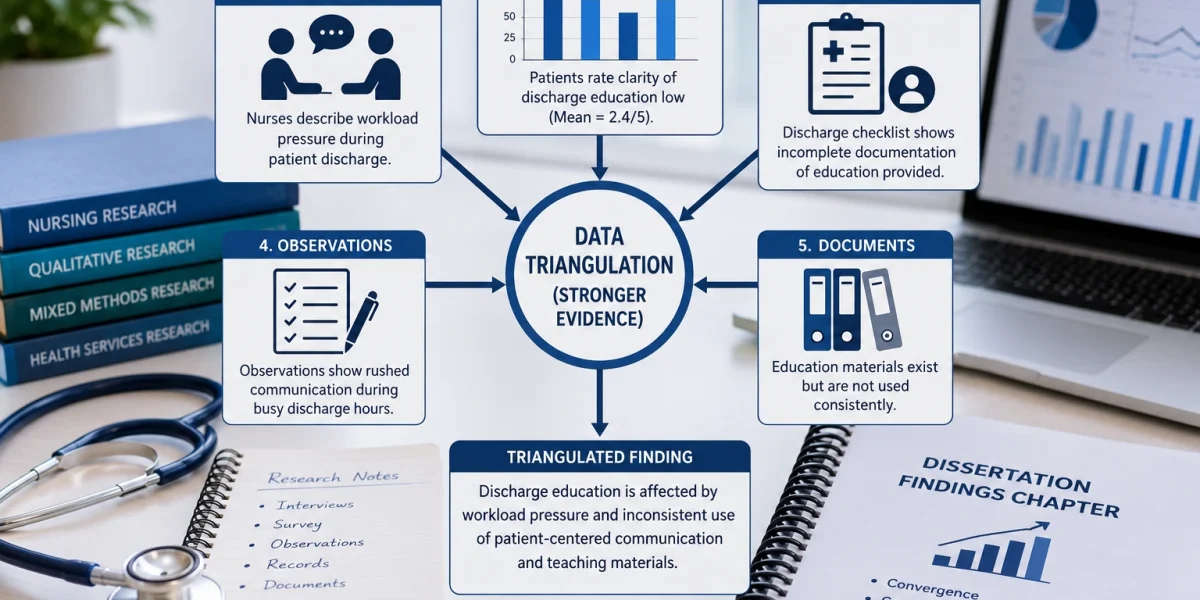
Data triangulation is one of the most useful strategies nursing students can use to strengthen a dissertation, especially when the research problem is too complex to understand from one source of evidence only. Nursing research often involves human experience, clinical judgment, patient behavior, health outcomes, documentation practices, and healthcare systems. Because of that complexity, a student may need to compare interviews, surveys, observations, focus groups, patient records, clinical documents, reflective journals, or outcome measures before making a confident interpretation.
In simple terms, data triangulation helps a nursing researcher ask: Do different evidence sources support the same conclusion? Do they explain different parts of the problem? Do they contradict each other? What does the combined evidence mean for nursing practice, patient care, or healthcare education?
This matters because nursing dissertations are judged not only by the amount of data collected but also by the quality of interpretation. Triangulation can improve credibility, trustworthiness, validity, and dissertation quality when it is planned clearly and reported honestly. In qualitative research, triangulation is commonly described as using multiple methods or data sources to develop a more complete understanding of a phenomenon (Carter et al., 2014).
What Is Data Triangulation?
Data triangulation means using more than one data source or evidence stream to understand a research problem more completely. In nursing research, this may involve comparing what patients say in interviews, what nurses report in focus groups, what appears in clinical records, and what is observed in practice.
For example, a nursing student studying medication adherence among patients with hypertension may collect:
- patient interview responses,
- medication adherence questionnaire scores,
- pharmacy refill records,
- clinic attendance records.
The study becomes stronger when the student compares these sources. Patients may say they take medication regularly, but refill records may show delayed refills. Clinic attendance may also show missed follow-up visits. Together, the data may suggest that patients intend to adhere but face barriers such as cost, forgetfulness, side effects, or limited health literacy.
Data triangulation is not the same as simply collecting more data. A dissertation does not become rigorous just because the student adds interviews, surveys, and records. The researcher must explain why each source was selected, how each source relates to the research question, how each source was analyzed, and how the sources were compared.
Why Data Triangulation Matters in Nursing Research
Data triangulation matters in nursing because patient care problems are rarely caused by one factor. A fall-prevention issue, for example, may involve patient mobility, medication side effects, staffing levels, ward layout, nurse documentation, patient education, and family involvement. One data source may reveal only one part of the issue.
Triangulation strengthens nursing research in several ways.
First, it improves credibility. If interviews, observation notes, and clinical records point toward a similar finding, the researcher has stronger support for the interpretation. Second, it reduces overreliance on one source of data. A single interview group, one survey, or one set of records may give a limited view of the problem. Third, triangulation supports richer interpretation because the researcher can compare experiences, behaviors, documents, and measurable outcomes.
This is especially important in qualitative nursing research, where trustworthiness is central. Trustworthiness is often discussed through credibility, transferability, dependability, and confirmability, following the qualitative tradition associated with Lincoln and Guba (Stahl & King, 2020).
For nursing students still planning their methodology, triangulation also helps connect the research question to the analysis plan. Students who are unsure how their evidence will be analyzed may first review types of data analysis in research before finalizing their dissertation design.
Data Triangulation vs Triangulation in Research
Students often confuse data triangulation with triangulation in research. The difference is important.
Triangulation is the broader research concept. It may involve multiple data sources, multiple methods, multiple researchers, multiple theories, or multiple analytical approaches. Data triangulation is one specific type of triangulation. It focuses mainly on comparing evidence from different data sources.
For example:
- Comparing nurse interviews, patient surveys, and incident reports is data source triangulation.
- Combining interviews and questionnaires is methodological triangulation.
- Asking two coders to review interview transcripts is investigator triangulation.
- Interpreting patient adherence through two theoretical frameworks is theory triangulation.
Denzin’s classic work is often associated with major forms of triangulation, including data, investigator, theory, and methodological triangulation. Later nursing and qualitative research sources continue to use these categories when explaining triangulation for health research (Carter et al., 2014; Noble & Heale, 2019).
Main Types of Triangulation in Nursing Research
Although this article focuses on data triangulation, nursing students should understand the main triangulation types because dissertation supervisors may ask which type was used.
Data Source Triangulation
Data source triangulation compares evidence from different people, places, times, documents, or records.
A nursing student studying patient safety culture may compare:
- nurse interview transcripts,
- patient safety incident reports,
- ward observation notes,
- hospital policy documents.
If nurses report that safety reporting is encouraged, but incident reports show underreporting, the contradiction becomes an important finding. It may suggest fear of blame, unclear reporting procedures, or poor feedback after reporting incidents.
Methodological Triangulation
Methodological triangulation uses more than one method to study the same research problem. This may include interviews, surveys, observations, chart reviews, or focus groups.
There are two common forms:
- Within-method triangulation: using variations within one method, such as interviewing nurses from different wards or conducting multiple interview rounds.
- Between-method triangulation: combining different methods, such as interviews and surveys.
For example, a student researching patient education after surgery may use a knowledge questionnaire and follow-up interviews. The questionnaire may show whether patients understood discharge instructions, while interviews may explain which parts were confusing. Students who need broader support with mixed-methods integration can read mixed methods data analysis in nursing research, but this article keeps the focus on triangulation.
Investigator Triangulation
Investigator triangulation involves more than one researcher, coder, supervisor, or reviewer examining the same data. In nursing dissertations, this is common during qualitative coding.
For example, a student may code interview transcripts on nurse burnout, then ask a supervisor or second coder to review selected transcripts. The aim is not to force identical coding. The aim is to compare interpretations, refine the codebook, reduce individual bias, and improve transparency.
This is useful when the student is also a nurse working in the same clinical area. Personal experience can enrich interpretation, but it can also introduce assumptions. Investigator triangulation helps make those assumptions visible.
Theory Triangulation
Theory triangulation uses more than one theoretical lens to interpret the same issue.
For example, a study on medication adherence may use the Health Belief Model to interpret perceived risk and benefits, while also using self-efficacy theory to interpret patient confidence in managing medication. This can help explain why a patient understands the importance of medication but still struggles to take it consistently.
Theory triangulation should be used carefully. A student should not add theories just to appear advanced. Each theory must help answer the research question.
Analysis Triangulation
Analysis triangulation compares different analytical approaches when they are relevant to the same research question.
For example, a student may use descriptive statistics to summarize patient satisfaction scores and thematic analysis to interpret open-ended patient comments. Another student may compare findings from framework analysis and document review to examine whether hospital policy aligns with nursing practice.
Students working with interviews, focus groups, or open-ended responses can also review types of data analysis in qualitative research to understand which qualitative analysis method fits their data.
Data Triangulation in Qualitative Nursing Research
Data triangulation is especially valuable in qualitative nursing research because qualitative studies often explore experience, meaning, perception, communication, barriers, and clinical culture.
For example, a qualitative study on student nurses’ clinical placement experience may include:
- student interviews,
- reflective journals,
- mentor feedback forms,
- field notes from placement settings.
Interviews may show that students felt anxious during medication rounds. Reflective journals may show how that anxiety changed over time. Mentor feedback may show whether students improved in confidence and competence. Field notes may show how supervision patterns affected learning.
This kind of triangulation supports credibility because findings are not based on one source only. It also supports confirmability because the researcher can show how interpretations were grounded in multiple evidence sources. However, triangulation is not a substitute for good qualitative practice. The study still needs appropriate sampling, ethical data collection, transparent coding, reflexivity, and careful reporting. Johnson, Adkins, and Chauvin emphasize that qualitative rigor requires attention to quality indicators from design through dissemination (Johnson et al., 2020).
Data Triangulation in Mixed Methods Nursing Research
In mixed methods nursing research, triangulation helps compare quantitative and qualitative evidence. The quantitative data may show the size, frequency, or direction of a finding, while the qualitative data explains experience, meaning, or context.
For example, a student studying discharge education may compare:
- patient knowledge scores before and after teaching,
- patient interviews after discharge,
- nurse documentation of education provided.
If knowledge scores improve and patients explain that visual teaching materials helped them understand medication instructions, the findings converge. If scores improve but interviews reveal that patients still feel unsure about side effects, the findings complement each other and if patients report satisfaction but documentation shows incomplete teaching, the findings diverge.
Important mixed-methods triangulation terms include:
- Convergence: evidence sources point toward a similar conclusion.
- Complementarity: one source adds depth or explanation to another.
- Expansion: one source extends the scope of the findings.
- Divergence: sources disagree or reveal tension.
- Contradiction: findings conflict and require explanation.
Mixed-methods scholars emphasize that integration should be intentional, not added as an afterthought (Fetters et al., 2013). Joint displays are also useful because they place quantitative and qualitative findings together so readers can see how the evidence connects (Guetterman et al., 2015).
Step-by-Step Guide: How to Use Data Triangulation in a Nursing Dissertation
1. Start With a Research Question That Needs Multiple Evidence Sources
A strong triangulation plan begins with the research question. If one source of data can answer the question well, triangulation may not be necessary.
For example, “What are nurses’ perceptions of workload in the emergency department?” may be answered through interviews. However, “How does workload affect nurse burnout and patient safety reporting?” may need interviews, burnout scores, staffing records, and incident reports.
2. Decide What Data Sources Are Needed
Choose data sources because they answer the research question, not because they are easy to collect. A study on infection prevention may need nurse interviews, hand hygiene audit data, and infection control policy documents. A study on patient education may need patient interviews, education checklists, and knowledge scores.
3. Align Triangulation With the Research Design
The triangulation strategy should fit the design. A qualitative case study may use interviews, field notes, and documents. A mixed-methods study may use survey data and interviews. A quality improvement dissertation may compare audit data, staff feedback, and implementation records.
4. Collect Data Ethically and Consistently
Nursing research often involves sensitive patient, staff, or institutional data. Students must protect confidentiality, de-identify records, obtain approval where required, and explain how data will be stored and used.
5. Analyze Each Data Source Appropriately
Each source should be analyzed using a suitable method. Interview transcripts may need thematic analysis. Survey scores may need descriptive statistics. Clinical documents may need document review or content analysis. Do not force all sources into one method.
6. Compare the Evidence
After separate analysis, compare findings across sources. Ask whether the evidence agrees, disagrees, expands the interpretation, or reveals a gap.
7. Identify Convergence, Divergence, and Complementarity
A strong dissertation does not hide disagreement. If nurses describe a policy as effective but patient records show poor outcomes, the contradiction may be one of the most important findings.
8. Explain What the Combined Evidence Means
Triangulation should lead to interpretation. Do not simply list what each source found. Explain what the sources mean together.
9. Report Triangulation Clearly in Chapter 3 and Chapter 4
Chapter 3 should explain the triangulation plan. Chapter 4 should show how evidence sources were integrated in the findings.
10. Discuss Limitations Honestly
Triangulation strengthens interpretation, but it does not remove all bias or guarantee truth. Limitations must be acknowledged.
Examples of Data Triangulation in Nursing Research
| Nursing topic | Data sources used | Type of triangulation | What triangulation helps explain |
|---|---|---|---|
| Nurse burnout | Nurse interviews, burnout scale scores, sick-leave records | Data source and methodological triangulation | Whether emotional exhaustion is supported by measurable burnout and absence patterns |
| Medication adherence | Patient interviews, adherence questionnaire, pharmacy refill records | Data source triangulation | Whether stated adherence matches refill behavior and reported barriers |
| Patient education | Pre/post knowledge test, patient interviews, discharge checklist | Methodological triangulation | Whether education improved knowledge and which teaching approaches patients understood |
| Infection prevention | Staff interviews, hand hygiene audit data, policy documents | Data source triangulation | Whether staff perceptions align with observed compliance and written protocols |
| Pain management | Patient pain scores, nurse notes, patient interviews | Data source triangulation | Whether documented pain care reflects patient experiences of relief |
| Clinical placement experience | Student focus groups, reflective journals, mentor feedback | Methodological triangulation | How supervision, confidence, and learning opportunities connect |
| Fall prevention | Fall incident reports, nurse interviews, ward observations | Data source triangulation | Whether falls relate to patient risk, staffing, layout, or education gaps |
| Telehealth satisfaction | Patient survey, interview comments, appointment completion data | Mixed-methods triangulation | Whether satisfaction scores match patient experiences and service-use behavior |
How to Report Data Triangulation in the Methodology Chapter
In Chapter 3, students should explain the type of triangulation used, the data sources selected, the reason for selecting them, how each source was analyzed, and how the sources were compared. Avoid vague statements such as, “Triangulation was used to improve validity.” That is not enough.
Sample Methodology Wording
This study used data source triangulation to strengthen the credibility and depth of the findings. Evidence was collected from semi-structured nurse interviews, patient satisfaction survey summaries, and ward incident reports. Each data source was selected because it addressed a different dimension of the research question: staff experience, patient perception, and documented clinical events. Interview transcripts were analyzed thematically, survey summaries were reviewed descriptively, and incident reports were examined for recurring patterns related to communication, staffing, and care delays. After separate analysis, findings were compared using a triangulation matrix to identify convergence, complementarity, and divergence. This approach helped determine whether participant accounts were supported, extended, or challenged by patient feedback and clinical documentation.
This wording is strong because it explains what was triangulated, why triangulation was appropriate, and how comparison occurred.
How to Present Triangulated Findings in the Results Chapter
Triangulated findings should be organized in a way that helps readers understand the relationship between evidence sources. Students can use theme-by-theme reporting, narrative integration, a joint display, or a triangulation matrix.
A weak results chapter reports interviews in one section, surveys in another section, and records in another section without explaining how they connect. A stronger results chapter organizes findings around themes or research questions and compares evidence under each theme.
Students who need broader findings-writing support can use this guide on how to present research findings.
Example Triangulation Matrix
| Theme or finding | Evidence source 1 | Evidence source 2 | Evidence source 3 | Triangulated interpretation |
|---|---|---|---|---|
| Discharge instructions were unclear | Patients reported confusion about medication timing | Survey results showed low clarity ratings for medication teaching | Discharge checklist showed incomplete documentation | Evidence converged: medication education was a weak point in discharge teaching |
| Nurses felt rushed during discharge | Nurses described workload pressure | Staffing records showed low nurse-patient ratios during peak discharge hours | Patient comments described short explanations | Evidence complemented: workload helped explain rushed education |
| Written materials existed but were not used consistently | Nurses said leaflets were available | Document review confirmed education materials existed | Patient interviews showed some never received them | Evidence diverged: resources existed, but implementation was inconsistent |
Sample Results Wording
The triangulated findings showed that discharge education was affected by both communication quality and workload pressure. Patient interviews revealed confusion about medication timing and side effects, while survey responses showed low ratings for clarity of medication instructions. These findings were supported by discharge checklist reviews, which showed inconsistent documentation of medication teaching. Together, the evidence suggests that the problem was not simply lack of written materials but inconsistent use of patient-centered teaching during high-workload discharge periods.
How to Discuss Triangulation in the Limitations Section
Triangulation should be discussed honestly in the limitations chapter. Students should not claim that triangulation proves the findings or removes all bias. It improves interpretation, but it does not fix weak sampling, poor data quality, incomplete records, or poorly designed interview questions.
Sample Limitations Wording
Although data triangulation strengthened the credibility of the findings by comparing interview data, patient survey summaries, and clinical documentation, several limitations remain. The clinical records may not have captured all care activities, and interview responses may have been influenced by recall bias or social desirability. In addition, the triangulation process identified areas of divergence between participant accounts and documentation, which required interpretive judgment. Therefore, triangulation improved the depth of analysis but did not eliminate all sources of bias or uncertainty.
This kind of wording is balanced, honest, and academically appropriate.
Common Mistakes Students Make With Data Triangulation
One common mistake is collecting multiple data sources without explaining why. For example, a student may include interviews, surveys, and records but fail to show how each source answers the research question.
A second mistake is confusing triangulation with mixed methods. Mixed methods may include triangulation, but the two are not identical. Mixed methods refers to a broader design that combines quantitative and qualitative approaches. Triangulation focuses on comparing evidence.
Another mistake is forcing findings to agree. In nursing research, disagreement can be valuable. If nurses report that patient education is always completed, but patients say they left the hospital confused, that contradiction should be analyzed rather than ignored.
Other common mistakes include:
- using weak or unrelated data sources,
- failing to explain how evidence was compared,
- reporting each method separately without integration,
- overclaiming validity,
- ignoring contradictory findings,
- failing to connect triangulation to the research question.
Data Triangulation Checklist for Nursing Students
Before submitting your dissertation, check whether:
- The research question justifies multiple evidence sources.
- Each data source has a clear purpose.
- The type of triangulation is named correctly.
- The methodology chapter explains why triangulation was used.
- Each data source was analyzed appropriately.
- The comparison process is clearly described.
- Convergence, divergence, and complementarity are reported.
- Contradictory evidence is explained, not hidden.
- The findings chapter integrates evidence rather than listing sources separately.
- The limitations section explains what triangulation could and could not achieve.
- The triangulation strategy connects back to credibility, trustworthiness, or validity.
When to Get Help With Data Triangulation
Students often need support with data triangulation when they are unsure which evidence sources to use, how to align triangulation with the research question, how to build a triangulation matrix, or how to integrate qualitative and quantitative findings.
You may also need help if your supervisor says your Chapter 3 does not justify the data sources clearly, or if your Chapter 4 reports findings separately without integration.
Need help applying data triangulation in your nursing dissertation? Our nursing dissertation experts can help you align your research question, methodology, data sources, analysis plan, and findings presentation. Request professional dissertation data analysis help today. If your study mainly uses interviews, focus groups, transcripts, or open-ended responses, you can also request qualitative data analysis help.
Conclusion
Data triangulation helps nursing students produce stronger, clearer, and more credible dissertations. It allows researchers to compare interviews, surveys, observations, records, documents, and outcome data instead of relying on one source of evidence only.
When planned well, data triangulation strengthens interpretation, improves trustworthiness, and helps explain complex nursing problems such as burnout, medication adherence, patient education, infection prevention, fall prevention, and pain management. However, triangulation must be purposeful. Students should justify their data sources, analyze each source correctly, compare evidence clearly, report agreement and disagreement honestly, and discuss limitations carefully.
If you are struggling to design, analyze, or report triangulated findings, professional nursing dissertation support can help you turn scattered evidence into a clear, defensible, and well-integrated dissertation chapter.
FAQs About Data Triangulation
What is data triangulation in research?
Data triangulation is the use of more than one data source to study the same research problem. The researcher compares the sources to identify agreement, disagreement, or complementary insight.
What is data triangulation in nursing research?
In nursing research, data triangulation may involve comparing nurse interviews, patient surveys, observation notes, clinical records, policy documents, or outcome data to understand a healthcare problem more completely.
What are the main types of triangulation?
The main types are data source triangulation, methodological triangulation, investigator triangulation, and theory triangulation. Some dissertations may also use analysis triangulation.
Is data triangulation the same as mixed methods?
No. Data triangulation focuses on comparing multiple evidence sources. Mixed methods is a broader design that combines quantitative and qualitative approaches. A mixed-methods study may use triangulation, but triangulation can also be used in qualitative research.
How does triangulation improve trustworthiness?
Triangulation improves trustworthiness by showing whether findings are supported, expanded, or challenged by different evidence sources. It strengthens credibility when the comparison process is transparent.
How do you write triangulation in a dissertation?
Write triangulation by naming the type used, explaining the data sources, justifying why they were selected, describing how each source was analyzed, and explaining how the findings were compared.
What is an example of data triangulation in nursing?
A student studying fall prevention may compare nurse interviews, fall incident reports, and ward observation notes. This helps explain whether falls are linked to patient risk, staffing, documentation, environmental hazards, or patient education gaps.
