

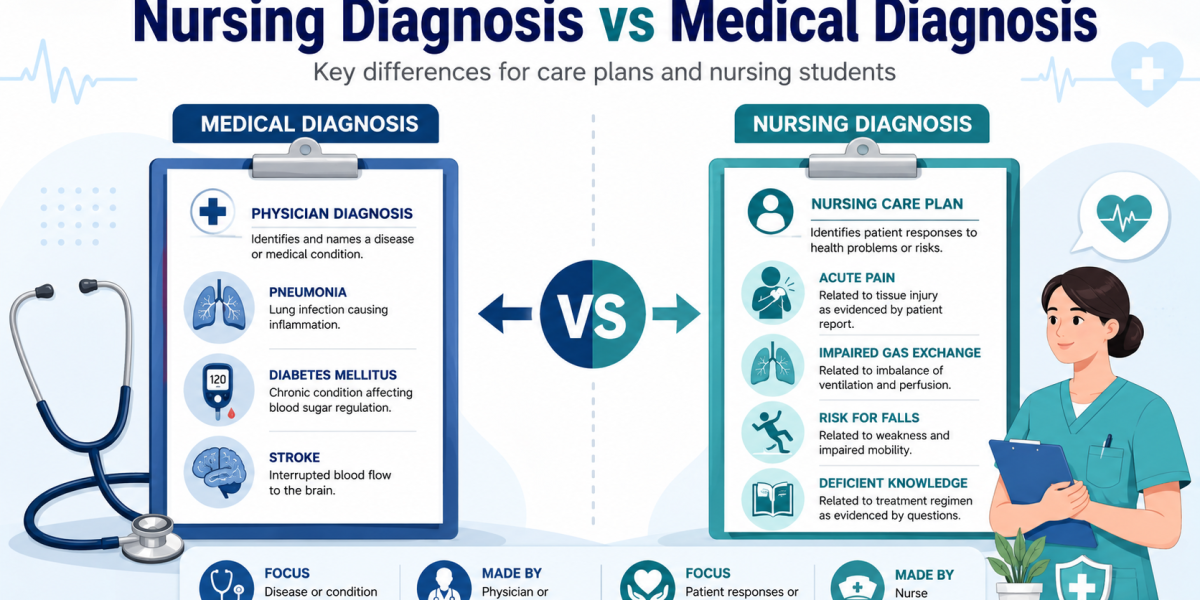
The Difference between nursing diagnosis and medical diagnosis is one of the first concepts nursing students must understand when writing care plans. Many students accidentally place a disease label, such as pneumonia or diabetes mellitus, in the nursing diagnosis section of an assignment. That mistake can weaken a care plan because nursing diagnoses and medical diagnoses serve different purposes.
A medical diagnosis identifies a disease, injury, disorder, condition, or pathology. A nursing diagnosis identifies the patient’s response to that condition, the risks the patient faces, or the care needs nurses can address. This article explains both terms, compares them, gives practical examples, shows PES format, and helps you use each correctly in care plans, case studies, concept maps, clinical reflections, and nursing assignments.
Quick Answer: Nursing Diagnosis vs Medical Diagnosis
- A medical diagnosis identifies a disease, injury, disorder, condition, or pathology.
- A nursing diagnosis identifies a patient response, risk, strength, or care need.
- Medical diagnoses guide medical treatment, such as medications, surgery, diagnostic tests, or provider-managed therapy.
- Nursing diagnoses guide nursing interventions, patient-centered goals, and care planning.
- A patient may have one medical diagnosis but several nursing diagnoses.
- Nursing students should not copy the medical diagnosis into the nursing diagnosis section of a care plan.
What Is a Medical Diagnosis?
A medical diagnosis is a clinical identification of a disease, disorder, injury, condition, or pathological process. It helps explain what disease process is occurring and guides provider-managed treatment. The diagnostic process uses patient history, physical findings, laboratory results, imaging, clinical reasoning, and sometimes specialist evaluation to determine the patient’s health problem (Balogh et al., 2015).
Medical diagnoses are made by authorized licensed clinicians within their scope of practice. Depending on the setting and jurisdiction, this may include physicians, nurse practitioners, physician associates/assistants, or other authorized clinicians. Students should always follow their local laws, school guidance, and clinical facility policy when discussing who can diagnose.
Common medical diagnosis examples include:
- Pneumonia
- Diabetes mellitus
- Heart failure
- Stroke
- Urinary tract infection
- Chronic obstructive pulmonary disease
- Hypertension
- Appendicitis
A medical diagnosis guides medical treatment. For example, pneumonia may lead to antibiotic therapy, chest imaging, sputum testing, oxygen therapy, or other provider-directed treatment decisions. Diabetes mellitus may guide glucose monitoring, medication management, lifestyle counseling, and complication screening.
Nursing students still need to understand the medical diagnosis because it provides the clinical background for care planning. However, the medical diagnosis is not the same as the nursing care plan diagnosis. In a care plan, the medical diagnosis helps you understand the disease process, while the nursing diagnosis helps you identify the patient response that nursing care can address.
What Is a Nursing Diagnosis?
A nursing diagnosis is a nurse’s clinical judgment about a patient’s response to actual or potential health conditions, life processes, risks, or care needs. The American Nurses Association explains that nursing diagnosis is based on the patient’s response and forms the basis for the nursing care plan (American Nurses Association [ANA], n.d.). The nursing process also places diagnosis after assessment and before planning, implementation, and evaluation (Toney-Butler & Thayer, 2023).
A nursing diagnosis is made by nurses using nursing assessment data and nursing judgment within the nursing scope of practice. It focuses on what nurses can assess, monitor, prevent, educate about, support, or improve through nursing interventions.
Examples of nursing diagnoses include:
- Impaired gas exchange
- Acute pain
- Risk for falls
- Ineffective airway clearance
- Deficient knowledge
- Impaired skin integrity
- Activity intolerance
These examples are educational only. If your school requires NANDA-I nursing diagnosis labels, use your assigned textbook, the current NANDA-I manual, instructor guidance, or school resources. NANDA International identifies its official publication as the definitive guide to NANDA-I nursing diagnoses, but students should avoid relying on random online lists because a label alone does not provide the full definition, diagnostic indicators, or required wording (NANDA International, n.d.).
Difference Between Nursing Diagnosis and Medical Diagnosis
The difference between nursing diagnosis and medical diagnosis is mainly about focus. A medical diagnosis names the disease or condition. A nursing diagnosis names the patient response, risk, strength, or care need that nurses can address.
| Feature | Nursing diagnosis | Medical diagnosis |
|---|---|---|
| Main focus | Patient response, risk, strength, or care need | Disease, injury, disorder, condition, or pathology |
| Who identifies it | Nurse using nursing judgment | Authorized licensed clinician within scope of practice |
| Scope of practice | Nursing scope | Medical/provider scope |
| What it describes | How the patient responds to health problems or life processes | What disease or pathological condition the patient has |
| How often it may change | May change frequently as patient status changes | Often remains stable unless new evidence changes the diagnosis |
| Purpose | Guides nursing care, goals, interventions, and evaluation | Guides medical treatment, diagnostic testing, medications, procedures, or surgery |
| Examples | Acute pain, risk for falls, impaired gas exchange | Pneumonia, stroke, diabetes mellitus, heart failure |
| Care plan role | Usually appears in the nursing diagnosis section | Usually appears in the patient profile, background, or medical diagnosis section |
| Intervention focus | Nursing interventions, education, monitoring, safety, comfort, prevention | Medical treatment, prescriptions, procedures, diagnostic workup |
| Relationship to outcomes | Links directly to measurable nursing-sensitive outcomes | Helps explain the disease process behind the patient’s condition |
The core difference is simple: a medical diagnosis names the disease or condition, while a nursing diagnosis names the patient’s response, risk, strength, or care need.
Nursing Diagnosis vs Medical Diagnosis Examples
Nursing diagnosis vs medical diagnosis examples are easiest to understand when you connect them to assessment data. A nursing diagnosis should not be chosen only because a patient has a certain disease. It must match the patient’s actual signs, symptoms, risks, priorities, and care needs.
| Patient situation | Medical diagnosis | Possible nursing diagnoses | Why the nursing diagnosis fits |
|---|---|---|---|
| Patient has fever, productive cough, low oxygen saturation, and shortness of breath | Pneumonia | Impaired gas exchange; ineffective airway clearance; activity intolerance | The patient shows breathing difficulty, oxygenation problems, and reduced tolerance for activity |
| Patient has type 2 diabetes and does not understand insulin timing | Diabetes mellitus | Deficient knowledge; risk for unstable blood glucose level | The issue is not just diabetes; the patient needs education and glucose safety planning |
| Patient has right-sided weakness after a stroke | Stroke | Impaired physical mobility; risk for falls; self-care deficit | The patient’s response includes weakness, safety risk, and reduced independence |
| Patient has edema, fatigue, and shortness of breath with exertion | Heart failure | Excess fluid volume; activity intolerance; decreased cardiac output | The patient shows fluid overload and reduced tolerance for physical activity |
| Patient reports pain 8/10 after abdominal surgery | Postoperative status | Acute pain; risk for infection; impaired physical mobility | Nursing care can address pain, wound monitoring, movement, and prevention of complications |
| Patient has burning urination, confusion, and poor fluid intake | Urinary tract infection | Acute confusion; impaired urinary elimination; deficient fluid volume risk | The nursing diagnoses focus on symptoms, hydration risk, and patient safety |
| Patient with COPD has thick secretions and difficulty coughing | Chronic obstructive pulmonary disease | Ineffective airway clearance; impaired gas exchange | The patient has airway clearance and oxygenation needs |
| Bedbound patient has poor nutrition and limited turning | Pressure injury risk | Risk for pressure injury; impaired skin integrity if breakdown is present | Nursing care focuses on skin assessment, repositioning, nutrition, and prevention |
Two patients can have the same medical diagnosis but different nursing diagnoses. For example, one patient with pneumonia may need “impaired gas exchange,” while another may need “deficient knowledge” if the main issue is misunderstanding discharge antibiotics.
Wrong vs Correct Examples of Nursing Diagnosis and Medical Diagnosis
Students often lose marks when they write the disease as the nursing diagnosis. The problem part of a nursing diagnosis should not be a medical diagnosis.
| Student’s incorrect wording | Why it is wrong | Better nursing diagnosis wording | What assessment data supports it |
|---|---|---|---|
| Pneumonia related to infection | Pneumonia is a medical diagnosis, not a nursing diagnosis | Impaired gas exchange related to ventilation-perfusion imbalance as evidenced by oxygen saturation of 88% and shortness of breath | Low oxygen saturation, dyspnea, abnormal breath sounds |
| Diabetes related to high blood sugar | Diabetes is a medical diagnosis, and “high blood sugar” is too vague | Risk for unstable blood glucose level related to inconsistent meal intake and insulin knowledge deficit | Variable glucose readings, skipped meals, incorrect insulin timing |
| Stroke related to weakness | Stroke is a medical diagnosis | Impaired physical mobility related to neuromuscular impairment as evidenced by right-sided weakness and need for assistance with transfers | Weakness, gait changes, need for mobility assistance |
| Hypertension related to high blood pressure | Hypertension and high blood pressure repeat the same medical problem | Deficient knowledge related to new medication regimen as evidenced by patient questions about antihypertensive dosing | Patient questions, missed doses, misunderstanding medication schedule |
A helpful rule is this: do not use the medical diagnosis as the nursing diagnosis problem. Instead, ask, “What patient response, risk, or care need can nursing care address?”
Why Nursing Diagnosis Is Not the Same as a Medical Diagnosis
A nursing diagnosis is not a disease label. It reflects how the patient responds to a health condition, treatment, environment, developmental stage, or life process. This matters because nursing care is patient-centered, not disease-label-centered.
For example, two patients may both have heart failure. One may have excess fluid volume, shortness of breath, and edema. Another may have anxiety, poor medication understanding, and difficulty following a low-sodium diet. Their medical diagnosis is the same, but their nursing priorities differ.
Nursing diagnoses also change as patient status changes. A patient admitted with “ineffective airway clearance” may improve after coughing, hydration, medication, and respiratory therapy. Later, the priority nursing diagnosis may shift to “deficient knowledge” before discharge.
Nursing diagnoses help students connect assessment data to nursing interventions and outcomes. They answer the question: “What can the nurse assess, prevent, teach, monitor, support, or improve?”
How Nursing Diagnosis Fits Into the Nursing Process
The nursing process is a systematic method nurses use to provide patient-centered care. It is commonly taught as assessment, diagnosis, planning, implementation, and evaluation (Toney-Butler & Thayer, 2023). Some nursing education resources also separate outcomes identification from planning, especially when discussing professional standards (Ernstmeyer & Christman, 2021).
The flow is:
Assessment data → Nursing diagnosis → Patient goals → Nursing interventions → Evaluation
Here is how it works in a care plan:
- Assessment: The nurse collects subjective and objective data, such as pain level, vital signs, oxygen saturation, lung sounds, mobility, patient statements, and lab values.
- Diagnosis: The nurse interprets the data and identifies the patient response or risk.
- Planning: The nurse writes measurable goals or outcomes.
- Implementation: The nurse performs nursing interventions.
- Evaluation: The nurse checks whether the patient met the goal and revises care if needed.
For example, if a postoperative patient reports pain 8/10, guards the incision, and refuses deep breathing because of pain, the nursing diagnosis may be acute pain. The goal may be that the patient reports pain at 3/10 or less within a set time. Nursing interventions may include pain assessment, positioning, splinting the incision, administering prescribed analgesics, and evaluating pain relief.
Types of Nursing Diagnoses Students Should Know
Nursing students commonly work with actual, risk, health promotion, and sometimes syndrome diagnoses. Your instructor may use slightly different categories or wording, so always check your course materials.
Actual Nursing Diagnosis
An actual nursing diagnosis describes a current patient problem supported by signs and symptoms.
Structure: Problem related to cause as evidenced by signs and symptoms.
Example: Acute pain related to surgical incision as evidenced by patient report of pain 8/10 and guarding.
Use an actual diagnosis when the patient already shows evidence of the problem.
Risk Nursing Diagnosis
A risk nursing diagnosis describes a problem that has not occurred but could occur if nursing care does not prevent it.
Structure: Risk for problem related to risk factors.
Example: Risk for falls related to impaired balance and sedating medication.
Use a risk diagnosis when the patient has risk factors but does not yet show signs or symptoms of the problem.
Health Promotion Nursing Diagnosis
A health promotion nursing diagnosis focuses on the patient’s readiness to improve health behaviors or well-being.
Structure: Readiness for enhanced health behavior or self-management, depending on the approved wording your school uses.
Example: Readiness for enhanced health management related to expressed desire to improve diabetes self-care.
Use this when the patient shows motivation or readiness to improve.
Syndrome Diagnosis
A syndrome diagnosis groups related nursing diagnoses that tend to occur together. Students may use this less often unless the course, textbook, or clinical setting requires it.
Example: A frail older adult with multiple risks may have a cluster of safety, mobility, nutrition, and skin integrity concerns.
Because official NANDA-I wording may vary by edition, textbook, and instructor expectations, confirm the accepted label and format before submitting your assignment.
PES Format for Nursing Diagnosis
The PES format helps students write clear nursing diagnosis statements. PES stands for:
- P: Problem
- E: Etiology or related factors
- S: Signs and symptoms or evidence
The structure is:
Problem related to Etiology as evidenced by Signs/Symptoms
Examples:
- Acute pain related to surgical incision as evidenced by patient report of pain 8/10 and guarding.
- Impaired gas exchange related to alveolar-capillary membrane changes as evidenced by oxygen saturation of 88% and shortness of breath.
For risk diagnoses, you usually do not include signs and symptoms because the problem has not occurred yet.
Example:
- Risk for falls related to impaired balance and medication side effects.
Some schools require specific NANDA-I-approved labels, related factors, and defining characteristics. Others allow modified educational wording. Follow your rubric, assigned textbook, NANDA-I manual, school resources, and instructor guidance.
How to Choose the Right Nursing Diagnosis
Choosing the right nursing diagnosis starts with assessment, not with a memorized list.
Use this method:
- Review the medical diagnosis so you understand the disease process.
- Collect assessment data from the patient, chart, labs, vital signs, physical assessment, and subjective reports.
- Identify the patient’s main problems, risks, strengths, and responses.
- Match the assessment data to an appropriate nursing diagnosis.
- Check whether the diagnosis is within nursing scope.
- Prioritize the most urgent diagnosis.
- Connect the diagnosis to measurable outcomes and nursing interventions.
Do not choose a nursing diagnosis only because it sounds related to the disease. For example, a patient with diabetes does not automatically need “deficient knowledge.” If the patient manages glucose well but has a foot wound, impaired skin integrity or risk for infection may be more appropriate.
How to Prioritize Nursing Diagnoses
Prioritizing nursing diagnoses means deciding which patient problem needs attention first. The priority should come from assessment data and patient safety, not from what seems easiest to write.
Students can use several frameworks:
- ABCs: Airway, breathing, and circulation usually come before less urgent concerns.
- Safety risks: Falls, aspiration, bleeding, infection risk, and suicide risk may require immediate attention.
- Acute vs. chronic needs: A sudden oxygen drop usually takes priority over long-term education needs.
- Unstable vs. stable conditions: A deteriorating patient comes before a stable patient.
- Maslow’s hierarchy: Physiological and safety needs often come before psychosocial needs.
- Patient priorities: Pain, fear, cultural needs, and personal goals still matter.
- Risk for harm: High-risk problems may be prioritized even before harm occurs.
- Measurable outcomes: The diagnosis should connect to clear goals.
- Instructor rubric expectations: Some assignments require specific prioritization logic.
For example, if a patient with pneumonia has oxygen saturation of 88%, shortness of breath, anxiety, and limited knowledge about antibiotics, impaired gas exchange likely comes before deficient knowledge. Education matters, but oxygenation is more urgent.
Common Mistakes Students Make With Nursing and Medical Diagnoses
Students often understand the concept but lose marks in the wording. Watch for these common mistakes:
- Using the medical diagnosis as the nursing diagnosis.
- Choosing a nursing diagnosis without assessment data.
- Writing vague related factors, such as “related to condition.”
- Ignoring the patient’s stated concerns.
- Writing interventions that treat the disease instead of the nursing response.
- Forgetting risk diagnoses when prevention is the main nursing priority.
- Using outdated or non-approved labels when the instructor requires NANDA-I.
- Confusing symptoms with diagnoses.
- Writing goals that do not match the nursing diagnosis.
- Copying examples without adapting them to patient data.
A strong care plan is specific. It does not simply say the patient has pneumonia. It shows how pneumonia affects that patient and what nursing care can do about it.
Nursing Diagnosis and Medical Diagnosis in a Care Plan
A care plan may include both diagnoses, but they appear in different places. The medical diagnosis usually appears in the patient background or medical diagnosis section. The nursing diagnosis appears in the nursing care plan section and guides goals, interventions, rationales, and evaluation.
Here is a concise example:
| Care plan section | Example |
|---|---|
| Medical diagnosis | Pneumonia |
| Assessment data | Oxygen saturation 88% on room air, respiratory rate 28/min, shortness of breath, crackles in lower lobes |
| Nursing diagnosis | Impaired gas exchange related to altered alveolar-capillary oxygen exchange as evidenced by oxygen saturation of 88% and shortness of breath |
| Goal/outcome | Patient will maintain oxygen saturation at or above the ordered target range within the shift |
| Nursing interventions | Monitor respiratory rate and oxygen saturation; position in semi-Fowler’s; encourage coughing and deep breathing; administer oxygen as prescribed; report worsening respiratory distress |
| Rationale | These interventions support oxygenation, promote ventilation, and help detect deterioration |
| Evaluation | Patient’s oxygen saturation improved to 94% on prescribed oxygen, and shortness of breath decreased |
If your assignment requires detailed care plan guidance, you can connect this concept to broader academic support such as nursing assignment help or a focused nursing case study help resource. Keep the final care plan centered on your patient data, rubric, and instructor expectations.
How Nursing Students Can Write About Diagnosis in Assignments
Nursing students use this concept in many types of academic work, including care plans, case studies, clinical reflections, discussion posts, essays, research papers, and concept maps.
For care plans, separate the medical condition from the patient response. Case studies require you to explain how the diagnosis affects assessment findings and nursing priorities. Concept maps work best when you place the medical diagnosis in the center, then branch out into symptoms, labs, nursing diagnoses, interventions, medications, and outcomes.
Possible essay topics include:
- Nursing diagnosis vs. medical diagnosis in patient-centered care
- The role of nursing assessment in selecting nursing diagnoses
- Why NANDA-I terminology matters in care planning
- How nursing diagnoses support measurable patient outcomes
- Common student errors in writing nursing care plans
Sample thesis statement:
“Understanding the difference between nursing diagnosis and medical diagnosis helps nursing students connect disease processes to patient-centered care, measurable outcomes, and appropriate nursing interventions.”
A simple paragraph structure can help:
- Start with a topic sentence.
- Define the diagnosis type.
- Use a patient or case example.
- Explain the nursing implication.
- Support the point with scholarly evidence.
For longer writing tasks, students may also use resources on nursing homework help, coursework help for nursing students, or nursing research paper help when they need academic guidance on structure, sources, or assignment expectations.
Quick Checklist: Nursing Diagnosis or Medical Diagnosis?
Use this checklist before submitting a care plan:
- Does it name a disease, injury, disorder, or condition? It is likely a medical diagnosis.
- Does it describe a patient response, risk, strength, or care need? It may be a nursing diagnosis.
- Can a nurse address it with nursing interventions?
- Is it supported by assessment data?
- Does it connect to measurable patient outcomes?
- Is it written in the required format?
- Does it follow instructor, school, or NANDA-I guidance?
FAQs About the Difference Between Nursing Diagnosis and Medical Diagnosis
1. What is the main difference between nursing diagnosis and medical diagnosis?
A medical diagnosis identifies the disease, injury, disorder, condition, or pathology. A nursing diagnosis identifies the patient response, risk, strength, or care need that nurses can address through nursing care.
2. Can a nursing diagnosis include a medical diagnosis?
A nursing diagnosis should not use the medical diagnosis as the problem statement. Some instructors may allow the medical diagnosis in the “related to” section only when phrased carefully and when school policy permits it. However, many nursing programs teach students to use related factors that nurses can address more directly, such as decreased mobility, knowledge deficit, impaired balance, or secretion retention.
3. Who can make a nursing diagnosis?
A nurse makes a nursing diagnosis using nursing assessment data, clinical judgment, and the nursing process. Nursing students practice this skill under instructor supervision and within course requirements.
4. Who can make a medical diagnosis?
Medical diagnoses are made by authorized licensed clinicians within their legal scope of practice. Depending on jurisdiction and setting, this may include physicians, nurse practitioners, physician associates/assistants, or other authorized providers.
5. Is pain a nursing diagnosis or medical diagnosis?
Pain can be part of a nursing diagnosis when written as a patient response, such as acute pain or chronic pain, depending on the patient data and required terminology. Pain can also be a symptom considered during medical diagnosis. In a nursing care plan, you must support it with assessment data such as pain rating, guarding, facial expression, limited movement, or patient report.
6. Is pneumonia a nursing diagnosis or medical diagnosis?
Pneumonia is a medical diagnosis. Related nursing diagnoses may include impaired gas exchange, ineffective airway clearance, activity intolerance, deficient knowledge, or risk for infection spread, depending on assessment data.
7. How many nursing diagnoses can one patient have?
One patient can have several nursing diagnoses. A patient with heart failure, for example, may have excess fluid volume, activity intolerance, deficient knowledge, impaired gas exchange, or risk for falls. The correct number depends on the assignment, patient data, and priority needs.
8. Why do nursing students need nursing diagnoses in care plans?
Nursing diagnoses help students connect assessment data to patient goals, nursing interventions, rationales, and evaluation. They show that the student understands not only the disease process but also the patient-centered nursing response.
Final Thoughts on the Difference Between Nursing Diagnosis and Medical Diagnosis
The main lesson is straightforward: a medical diagnosis identifies the disease, injury, disorder, or condition, while a nursing diagnosis identifies the patient response, risk, strength, or care need that nurses can address through nursing care.
For nursing students, this distinction matters in care plans, case studies, clinical reasoning, concept maps, and nursing assignments. A strong care plan does not simply repeat the medical diagnosis. It shows what is happening to the patient, what nursing care can address, which outcomes matter, and how the nurse will evaluate improvement.
Students who need help writing a care plan, case study, clinical reflection, or nursing assignment that correctly separates medical and nursing diagnoses can upload their instructions and request academic guidance.
References
American Nurses Association. (n.d.). The nursing process. https://www.nursingworld.org/practice-policy/workforce/what-is-nursing/the-nursing-process/
Balogh, E. P., Miller, B. T., & Ball, J. R. (Eds.). (2015). Improving diagnosis in health care. National Academies Press. https://www.ncbi.nlm.nih.gov/books/NBK338593/
Ernstmeyer, K., & Christman, E. (Eds.). (2021). Nursing fundamentals. Chippewa Valley Technical College. https://www.ncbi.nlm.nih.gov/books/NBK591807/
Herdman, T. H., Kamitsuru, S., & Lopes, C. T. (Eds.). (2024). NANDA International nursing diagnoses: Definitions and classification, 2024–2026 (13th ed.). Thieme.
NANDA International. (n.d.). Nursing diagnoses: Definitions and classification. https://nanda.org/publications-resources/publications/nanda-international-nursing-diagnoses/
Toney-Butler, T. J., & Thayer, J. M. (2023). Nursing process. StatPearls Publishing. https://www.ncbi.nlm.nih.gov/books/NBK499937/
