

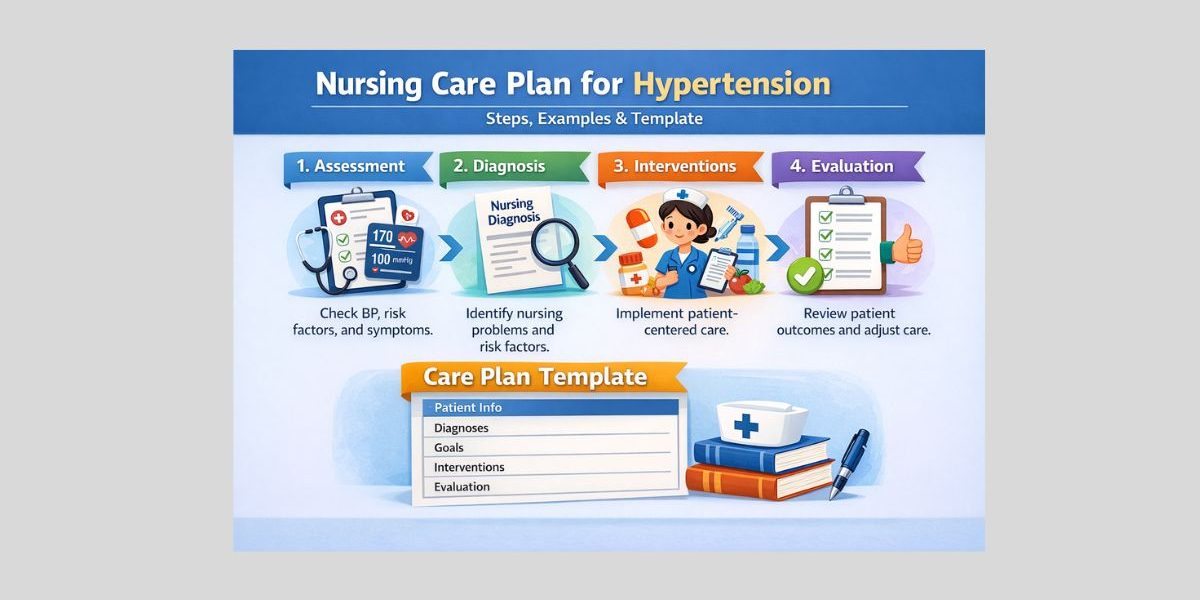
Nursing Care Plan for Hypertension – Foundations, Pathophysiology, Assessment, and Clinical Significance
Nursing Care Plan for Hypertension: Introduction and Clinical Context
A nursing care plan for hypertension is a structured, evidence-based approach used to manage patients with elevated blood pressure through assessment, diagnosis, targeted interventions, and continuous evaluation. From the outset, it is important to understand that hypertension is not just a numerical elevation in blood pressure. Instead, it is a chronic condition that significantly increases the risk of cardiovascular disease, stroke, kidney failure, and other complications.
For nursing students, mastering a hypertension nursing care plan is essential because it demonstrates the ability to connect clinical findings with appropriate nursing actions. At the same time, it reflects critical thinking, prioritization, and patient-centered care—skills that are required both in academic settings and real clinical environments.
Unlike general care planning, a care plan for hypertension patients must address long-term management. Therefore, it focuses not only on stabilizing blood pressure but also on preventing complications, improving lifestyle habits, and promoting adherence to treatment.
Understanding Hypertension in Nursing Practice
What Is Hypertension?
Hypertension, commonly referred to as high blood pressure, occurs when the force of blood against the arterial walls remains consistently elevated. Clinically, it is often defined as:
- Systolic blood pressure ≥ 140 mmHg
- Diastolic blood pressure ≥ 90 mmHg
However, modern guidelines may define lower thresholds depending on patient risk factors.
Types of Hypertension Relevant to Nursing Care
To build an effective nursing care plan for hypertension, it is important to recognize different types:
Primary (Essential) Hypertension
- Most common form
- No identifiable cause
- Linked to lifestyle and genetics
Secondary Hypertension
- Caused by underlying conditions
- Examples: kidney disease, endocrine disorders
Hypertensive Crisis
- Severe elevation (≥180/120 mmHg)
- Requires immediate intervention
Each type influences how the care plan is developed.
Pathophysiology of Hypertension (Simplified for Nursing Care)
Understanding the mechanism behind hypertension strengthens your nursing care plan writing.
Hypertension develops due to:
- Increased vascular resistance
- Excess fluid volume
- Hormonal imbalances (e.g., renin-angiotensin system)
As a result:
- Blood vessels become stiff
- The heart works harder
- Organs receive altered blood supply
Therefore, nursing interventions must focus on reducing these risks.
Clinical Importance of a Hypertension Nursing Care Plan
Prevention of Complications
One of the primary goals of a hypertension care plan is preventing complications such as:
- Stroke
- Heart failure
- Chronic kidney disease
- Retinopathy
Without proper management, these complications can develop gradually and severely affect quality of life.
Long-Term Disease Management
Unlike acute conditions, hypertension requires continuous monitoring and lifestyle adjustments. Therefore, a nursing care plan for hypertension must include long-term strategies.
Patient Education and Adherence
Another key focus is ensuring that patients understand their condition. Many patients with hypertension are asymptomatic. As a result, they may not see the need for treatment.
This makes education a central part of care planning.
Comprehensive Nursing Assessment for Hypertension
Assessment is the foundation of any hypertension nursing care plan. Without accurate data, diagnosis and interventions may be incorrect.
Subjective Assessment in Hypertension Care
Subjective data includes patient-reported information.
Examples:
- Headaches
- Dizziness
- Fatigue
- Blurred vision
- Chest discomfort
However, many patients may report no symptoms. Therefore, absence of symptoms does not rule out hypertension.
Objective Assessment in a Nursing Care Plan for Hypertension
Objective data provides measurable evidence.
Examples include:
- Blood pressure readings (multiple measurements)
- Heart rate
- Weight and BMI
- Laboratory results (lipid profile, kidney function)
Advanced Clinical Interpretation of Assessment Data
Strong students go beyond listing data and interpret findings.
Example
- BP: 160/100 mmHg → Stage 2 hypertension
- Elevated cholesterol → Increased cardiovascular risk
- Obesity → Contributing factor
This level of analysis strengthens your care plan.
Risk Factor Identification
An effective nursing care plan for hypertension must identify contributing factors:
- Smoking
- High salt intake
- Sedentary lifestyle
- Obesity
- Stress
These factors guide interventions later in the plan.
Linking Assessment to Clinical Problems
After collecting and analyzing data, the nurse must identify patterns.
Example Pattern Recognition
- High BP + obesity + poor diet → Lifestyle-related hypertension
- High BP + kidney issues → Secondary hypertension
This step prepares for accurate nursing diagnoses.
Common Challenges in Hypertension Assessment
Despite its importance, assessment is often poorly executed.
Frequent Issues
- Relying on a single BP reading
- Ignoring lifestyle factors
- Failing to assess medication adherence
- Lack of interpretation
Therefore, thorough and repeated assessment is critical.
The Role of Evidence-Based Practice in Hypertension Care
Modern nursing care plans for hypertension must align with evidence-based guidelines.
This includes:
- Monitoring BP regularly
- Encouraging lifestyle modification
- Supporting medication adherence
Evidence-based care improves outcomes and strengthens academic work.
Transition to Diagnosis and Care Planning
At this stage, you now have:
- A clear understanding of hypertension
- Comprehensive patient assessment
- Identified risk factors
- Clinical interpretation of findings
The next step is transforming this information into:
- Accurate nursing diagnoses
- Prioritized patient problems
- Clear goals and expected outcomes
Request Quotes Now
Need a detailed and high-quality nursing care plan for hypertension with proper assessment and clinical reasoning? Request quotes now for expert academic support.
Nursing Diagnoses, Prioritization, and Goal Setting in a Nursing Care Plan for Hypertension.
From Assessment to Diagnosis in a Nursing Care Plan for Hypertension
After completing a comprehensive assessment, the next step in developing a nursing care plan for hypertension is identifying accurate nursing diagnoses. This stage requires more than listing problems. Instead, it involves interpreting clinical data and determining how hypertension affects the patient.
Importantly, a strong hypertension nursing care plan reflects clear reasoning. Every diagnosis must be supported by assessment findings. Therefore, the transition from data to diagnosis must be logical and evidence-based.
Understanding Nursing Diagnosis in Hypertension Care Planning
A nursing diagnosis focuses on the patient’s response to hypertension rather than the disease itself. While the medical diagnosis identifies elevated blood pressure, the nursing diagnosis identifies the problems that nurses can manage.
Structure of a Nursing Diagnosis
A well-written diagnosis typically follows this format:
Problem + related to + evidence (as evidenced by)
Example
“Risk for decreased cardiac output related to increased vascular resistance as evidenced by elevated blood pressure readings.”
Why This Matters
This structure:
- Shows clinical reasoning
- Links assessment to action
- Strengthens academic quality
Without this clarity, a care plan for hypertension patients becomes weak and disconnected.
Common Nursing Diagnoses for Hypertension
To build a strong nursing care plan for hypertension, you must select diagnoses based on patient-specific data. However, some diagnoses appear frequently.
1. Ineffective Tissue Perfusion
This is one of the most important diagnoses in hypertension.
Related to:
- Increased vascular resistance
As evidenced by:
- Elevated blood pressure
- Organ dysfunction (if present)
Hypertension reduces blood flow efficiency, affecting organs such as the brain, heart, and kidneys.
2. Risk for Decreased Cardiac Output
Related to:
- Increased afterload
The heart must work harder, which may reduce efficiency over time.
3. Excess Fluid Volume
Related to:
- Sodium retention
- Kidney dysfunction
Fluid overload contributes to elevated blood pressure.
4. Deficient Knowledge
Related to:
- Lack of understanding of disease
- Poor adherence to treatment
Many patients are unaware of the seriousness of hypertension.
5. Risk for Non-Adherence
Related to:
- Asymptomatic nature of disease
- Complex medication regimens
Patients often stop medication when they feel “fine.”
Advanced Clinical Insight: Choosing the Right Diagnosis
Not all diagnoses apply to every patient. Therefore, a strong hypertension care plan nursing approach requires individualization.
Example
Patient A:
- High BP + obesity + poor diet
→ Imbalanced nutrition + ineffective health management
Patient B:
- High BP + kidney disease
→ Risk for fluid imbalance + impaired renal function
This level of specificity improves both grades and clinical accuracy.
Prioritization in a Nursing Care Plan for Hypertension
After identifying diagnoses, the next step is prioritization. Not all problems are equally urgent.
Using the ABC Framework
The ABC approach focuses on:
- Airway
- Breathing
- Circulation
In hypertension:
- Circulation is often the priority
Using Maslow’s Hierarchy
Maslow helps prioritize needs:
- Physiological needs
- Safety
- Psychological
Example of Prioritization
A patient presents with:
- BP 180/110 mmHg
- Headache
- Anxiety
Priority:
- Ineffective tissue perfusion
- Risk for decreased cardiac output
- Anxiety
This shows strong clinical judgment.
Clinical Reasoning in Prioritization
Prioritization is not random. Instead, it is based on risk and severity.
Ask:
- Which condition is life-threatening?
- Which requires immediate intervention?
- Which can wait?
This thinking separates strong care plans from weak ones.
Goal Setting in a Nursing Care Plan for Hypertension
After prioritizing diagnoses, the next step is setting goals. Goals define what you want to achieve.
Characteristics of Effective Goals
Goals should be:
- Specific
- Measurable
- Achievable
- Relevant
- Time-bound
Short-Term Goals
These focus on immediate outcomes.
Examples:
- Patient will maintain BP below 140/90 mmHg within 48 hours
- Patient will demonstrate correct medication use before discharge
Long-Term Goals
These focus on overall health improvement.
Examples:
- Patient will maintain controlled blood pressure over 3 months
- Patient will adopt a low-sodium diet
Linking Goals to Nursing Diagnoses
Every goal must directly address a diagnosis.
Example
- Diagnosis: Excess fluid volume
- Goal: Patient will demonstrate reduced fluid retention
Weak care plans fail because they lack this connection.
Writing Strong, Measurable Outcomes
Outcomes must be observable.
Weak:
- Patient will improve
Strong:
- Patient will maintain BP within target range and report no dizziness
Measurable outcomes make evaluation possible.
Common Mistakes in Diagnosis and Goal Setting
Even strong students make errors.
Frequent Issues
- Writing vague diagnoses
- Using medical instead of nursing diagnoses
- Failing to prioritize
- Setting unrealistic goals
- Not linking goals to diagnoses
Strengthening Your Clinical Reasoning
To improve your nursing care plan for hypertension, focus on reasoning.
Ask yourself:
- What does this data indicate?
- What is the main problem?
- What should I address first?
- What outcome do I expect?
This approach leads to stronger, more logical care plans.
Transition to Interventions and Evaluation
At this stage, you now have:
- Accurate nursing diagnoses
- Proper prioritization
- Clear goals and outcomes
The next step is implementation.
Request Quotes Now
Need a complete nursing care plan for hypertension with accurate diagnoses and SMART goals? Request quotes now for expert academic support.
Nursing Interventions, Rationales, Full Examples, Template, and Evaluation in a Nursing Care Plan for Hypertension
From Planning to Implementation in Hypertension Nursing Care
After identifying diagnoses and setting goals, the next step in a nursing care plan for hypertension is implementation. At this stage, nursing decisions are translated into actions that directly affect patient outcomes.
However, effective implementation requires more than listing tasks. Instead, each intervention must be intentional, evidence-based, and clearly linked to the patient’s condition. Therefore, a strong hypertension nursing care plan explains both what the nurse does and why it is done.
Nursing Interventions for Hypertension
What Are Nursing Interventions in Hypertension Care?
Nursing interventions are actions taken to control blood pressure, prevent complications, and improve patient well-being. Importantly, interventions should always align with identified nursing diagnoses and goals.
Key Nursing Interventions in a Nursing Care Plan for Hypertension
1. Monitor Blood Pressure Regularly
Frequent blood pressure monitoring is essential.
Rationale:
Early detection of changes allows timely intervention and prevents complications such as stroke or heart failure.
2. Administer Antihypertensive Medications as Prescribed
Medication adherence is a cornerstone of hypertension management.
Rationale:
These medications reduce vascular resistance, lower blood pressure, and decrease strain on the heart.
3. Promote a Low-Sodium Diet
Dietary modification is critical.
Rationale:
Reducing sodium intake helps decrease fluid retention and lowers blood pressure levels.
4. Encourage Regular Physical Activity
Exercise improves cardiovascular health.
Rationale:
Physical activity enhances circulation, reduces weight, and improves blood pressure control.
5. Educate the Patient on Lifestyle Changes
Education ensures long-term success.
Rationale:
Patients who understand their condition are more likely to adhere to treatment and avoid complications.
6. Monitor for Signs of Complications
Watch for:
- Chest pain
- Shortness of breath
- Vision changes
Rationale:
Early detection of complications allows prompt intervention.
7. Support Stress Management
Stress contributes to hypertension.
Rationale:
Reducing stress lowers sympathetic nervous system activity and blood pressure.
Advanced Insight: Individualizing Interventions
Not all patients require the same interventions. Therefore, a strong care plan for hypertension patients must consider:
- Age
- Comorbidities
- Lifestyle
- Socioeconomic factors
This personalization improves outcomes and strengthens academic quality.
Full Nursing Care Plan Example for Hypertension
Below is a detailed nursing care plan example for hypertension showing full integration.
Patient Profile
- Age: 60 years
- Diagnosis: Hypertension
- Symptoms: headache, fatigue
Assessment
- BP: 170/100 mmHg
- BMI: 30
- Reports high salt intake
Nursing Diagnosis
Ineffective tissue perfusion related to increased vascular resistance as evidenced by elevated BP
Goal
Patient will maintain BP below 140/90 mmHg within 72 hours
Interventions and Rationales
- Monitor BP every 4 hours
→ Ensures early detection of fluctuations - Administer antihypertensive medication
→ Controls blood pressure - Educate on low-sodium diet
→ Reduces fluid retention - Encourage daily walking
→ Improves cardiovascular health
Evaluation
BP reduced to 138/88 mmHg; patient demonstrates understanding of lifestyle changes
Second Nursing Care Plan Example (Non-Adherence Risk)
Nursing Diagnosis
Risk for non-adherence related to lack of symptoms
Goal
Patient will demonstrate adherence to medication regimen
Interventions
- Educate patient on risks of untreated hypertension
- Simplify medication schedule
- Provide written instructions
Rationale
Understanding risks improves compliance
Comprehensive Nursing Care Plan Template (Hypertension)
Use this structured hypertension nursing care plan template:
1. Patient Information
- Age:
- Diagnosis:
2. Assessment
- Subjective Data:
- Objective Data:
3. Nursing Diagnoses
- Diagnosis 1
- Diagnosis 2
4. Goals
- Short-term
- Long-term
5. Interventions and Rationales
- Intervention:
- Rationale:
6. Evaluation
- Outcome achieved
- Adjustments needed
This template ensures clarity and completeness.
Request Quotes Now
Need a professionally written nursing care plan for hypertension with examples and template included? Request quotes now for expert academic support.
Patient Education in a Hypertension Care Plan
Patient education is essential in long-term management.
Key Areas
- Medication adherence
- Diet control
- Exercise
- Stress management
Why Education Is Critical
Hypertension is often asymptomatic. Therefore, patients may underestimate its severity. Education improves adherence and reduces complications.
Evaluation in a Nursing Care Plan for Hypertension
Evaluation determines whether interventions are effective.
Key Indicators of Success
- BP within target range
- Reduced symptoms
- Improved lifestyle habits
- Patient understanding
Example of Strong Evaluation
“Patient maintained BP within normal range and demonstrated adherence to medication and dietary recommendations.”
Continuous Adjustment
If goals are not met, the care plan must be modified. Therefore, evaluation is an ongoing process.
Common Mistakes in Hypertension Care Plans
Frequent Errors
- Vague interventions
- Missing rationales
- Weak evaluation statements
- Poor linkage between sections
Avoiding these improves both academic and clinical quality.
Final Thoughts
A well-developed nursing care plan for hypertension integrates assessment, diagnosis, planning, intervention, and evaluation into a logical and patient-centered process.
More importantly, it reflects real nursing practice. Therefore, mastering this process is essential for both academic success and professional competence.
Request Quotes Now
Struggling with your nursing care plan for hypertension? Request quotes now and get high-quality, plagiarism-free academic support tailored to your needs.
FAQ Section
What is a nursing care plan for hypertension?
It is a structured approach to managing high blood pressure through assessment, interventions, and evaluation.
What are common nursing diagnoses for hypertension?
Ineffective tissue perfusion, risk for decreased cardiac output, and deficient knowledge.
What interventions are used in hypertension care?
Monitoring BP, medication administration, lifestyle changes, and patient education.
Why is patient education important in hypertension?
It improves adherence and prevents complications.
Can I get help writing a nursing care plan?
Yes, professional services can assist with structured, high-quality care plans.
