

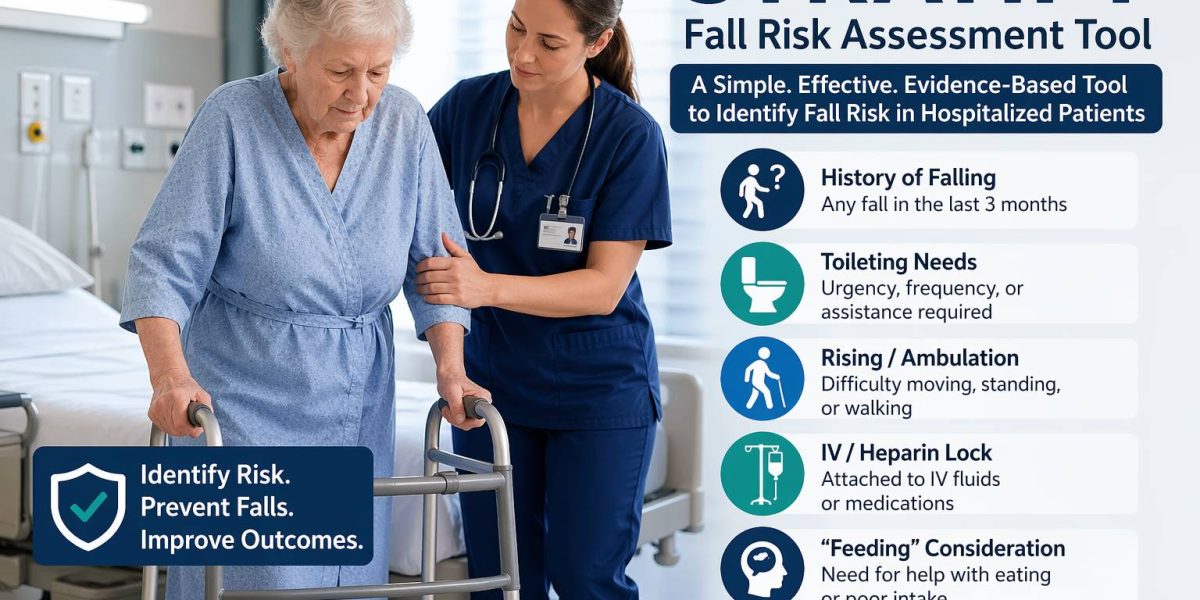
STRATIFY fall risk assessment tool searches often come from students, nurses, and researchers who need a clear answer to one urgent question: can this tool reliably identify which older inpatients are most likely to fall? That matters because fall prevention in elderly patients is not just a paperwork issue. It affects safety planning, staffing decisions, documentation quality, care outcomes, and even how confidently a nurse or student can justify a clinical recommendation.
If you are writing about fall prevention, reviewing hospital screening tools, or comparing structured scales in geriatric care, this guide helps you understand what the STRATIFY tool measures, how the item scoring system works, and what research says about its predictive accuracy in older adults. Just as importantly, it explains where the tool performs well and where clinicians should be careful not to over-rely on it.
Why the STRATIFY fall risk assessment tool still matters
The STRATIFY fall risk assessment tool remains relevant because it was designed specifically for hospital inpatients and became one of the best-known structured screening tools for inpatient falls. In simple terms, it converts common bedside observations into a quick score that can support early prevention planning. The tool uses a 0-5 scoring framework, and a score of 2 or more is commonly treated as indicating elevated fall risk (Oliver et al. 2008).
That simplicity is the main reason the tool has persisted in teaching, practice discussions, and research comparisons. Nurses can use it quickly. Students can understand it without advanced statistics. Hospitals can integrate it into broader falls protocols. However, simplicity is also its limitation. A tool can be fast yet still miss important nuances, especially in frail older adults with delirium, stroke, medication burden, or fluctuating mobility.
For that reason, many fall prevention experts now treat STRATIFY as a screening aid rather than a stand-alone clinical solution. It can flag concern, but it should not replace professional judgment, individualized assessment, or environmental review.
If you want background on how evidence-based nursing support should be structured, our About Us page explains our academic focus, while How It Works shows how we support students and researchers ethically.
STRATIFY fall risk assessment tool scoring system explained
One reason the STRATIFY fall risk assessment tool is widely taught is that its scoring method is direct. It assigns one point for each risk factor present. The final score ranges from 0 to 5. The better-known versions of the tool focus on five domains:
- Previous fall or admission after a fall
- Agitation
- Visual impairment
- Frequent toileting needs
- Transfer and mobility problems
Research summaries consistently describe STRATIFY as a five-item bedside rule using this unweighted scoring approach (Billington et al. 2012; Smith et al. 2006).
What each item is trying to capture
1. Previous falls
A recent fall often signals underlying instability, poor balance, acute illness, cognitive impairment, or unsafe movement patterns. Therefore, this item is more than a history question. It is a proxy marker for unresolved risk.
2. Agitation
Agitation matters because restless or confused patients may mobilize unsafely, ignore instructions, or misjudge their physical limits. In older patients, agitation may also point to delirium, pain, infection, or medication effects.
3. Visual impairment
Poor vision reduces environmental awareness. Patients may misjudge distances, miss hazards, or struggle in unfamiliar spaces. For elderly inpatients, visual impairment can combine with weakness and urgency to create a high-risk situation.
4. Frequent toileting
This item reflects urgency, incontinence, nocturia, or repeated need to get out of bed. Many inpatient falls happen during attempts to toilet independently, especially at night or when assistance is delayed.
5. Transfer and mobility issues
This is often the most clinically loaded domain. Patients who need help standing, turning, transferring, or walking may appear stable while seated but become unsafe during movement.
How the score is interpreted
Although local policies vary, the usual interpretation is:
| Score | Meaning |
|---|---|
| 0-1 | Lower observed fall risk |
| 2-5 | Higher observed fall risk requiring prevention planning |
Even so, a low score should never be treated as proof that a patient is safe. That is especially true in older adults whose condition changes quickly over a shift.
Challenges users face when applying the STRATIFY fall risk assessment tool
The STRATIFY fall risk assessment tool looks straightforward on paper. In practice, users run into several problems.
First, they may assume the score predicts falls with the same accuracy in every elderly population. That is not supported by the literature. Some studies found reasonable usefulness in general medical and surgical wards, but performance drops in certain subgroups, including stroke rehabilitation populations (Milisen et al. 2007; Smith et al. 2006).
Second, users often confuse a screening score with a full assessment. STRATIFY can highlight risk, but it does not fully evaluate medication side effects, orthostatic hypotension, footwear, bed height, staffing response time, or environmental design.
Third, students frequently describe the tool without critically analyzing its diagnostic limitations. That weakens assignments and care discussions. A stronger academic answer should explain not only how the tool is scored, but also why predictive validity changes across settings.
Fourth, elderly patients are clinically complex. A patient may score only 1 point at admission and still fall later due to sedation, infection, dehydration, or sudden confusion. Therefore, serial reassessment matters.
If you are writing a paper on fall tools more broadly, our guide on fall risk assessment tools used in hospitals helps position STRATIFY in relation to other frameworks.
What research says about accuracy in elderly patients
This is the most important section for anyone researching the STRATIFY fall risk assessment tool.
The evidence does not show a single universal answer. Instead, it shows that STRATIFY has mixed accuracy, especially when used across different elderly inpatient populations.
A major systematic review and meta-analysis found that STRATIFY was developed for hospital inpatients using a 0-5 score, but pooled evidence raised concerns about how well it performs as a universal predictive rule across settings (Oliver et al. 2008). Likewise, another systematic review examining tools for older adults in acute care hospitals concluded that no tool is perfect and that results vary depending on population, design, and implementation context (Matarese et al. 2015).
An important stroke rehabilitation study found that STRATIFY performed poorly as a predictor of falls in a heterogeneous stroke population (Smith et al. 2006). That finding matters because stroke patients often have unique neurological deficits, attention problems, and mobility patterns that a general rule may not capture well.
By contrast, a multicenter study reported that STRATIFY satisfactorily predicted fall risk in general medical and surgical wards and in patients younger than 75, but it did not perform as well in older subgroups and some specialty populations (Milisen et al. 2007).
What this means in real clinical terms
For elderly patients, the tool is useful when:
- it is used early after admission
- it is combined with nurse judgment
- it triggers specific prevention actions
- it is repeated when the patient’s condition changes
It is less reliable when:
- the patient population is highly specialized
- neurological impairment dominates the risk profile
- documentation is inconsistent
- staff use the score mechanically without individualized review
Therefore, the best conclusion is not that STRATIFY is useless. The better conclusion is that STRATIFY is a quick first-line screening rule with variable predictive power in elderly inpatients.
STRATIFY fall risk assessment tool in elderly patients: strengths and weaknesses
Strengths of the STRATIFY fall risk assessment tool
The STRATIFY fall risk assessment tool has several strengths that explain its longevity.
It is quick
Clinicians can complete it rapidly, which improves adoption in busy wards.
It is easy to teach
Because it uses five binary items, it works well in nurse orientation, student training, and quality improvement discussions.
It focuses on practical bedside risk markers
The items are clinically recognizable. A nurse does not need specialized equipment to identify most of them.
It supports standardization
Hospitals often want a common language for risk communication. STRATIFY gives teams a simple framework.
Weaknesses of the STRATIFY fall risk assessment tool
It may oversimplify risk
Older adults often fall because of multiple interacting causes. A five-item checklist can miss that complexity.
Accuracy is inconsistent across settings
This is a key limitation documented in validation studies and reviews (Billington et al. 2012; Matarese et al. 2015).
It can create false reassurance
A patient with a lower score may still fall, particularly if risk changes after medication, illness progression, or nighttime confusion.
It should not replace clinical reasoning
The tool supports judgment. It does not substitute for it.
Key components of good practice when using STRATIFY
If you are applying or discussing the STRATIFY fall risk assessment tool, these are the key practice steps to emphasize.
Assess on admission
Use the tool early so that obvious high-risk patients are not missed.
Reassess after change
Repeat scoring after surgery, sedation, delirium, infection, mobility decline, or transfer between units.
Pair the score with care planning
A number alone prevents nothing. The score must trigger interventions such as supervised toileting, mobility assistance, environmental adjustments, and patient education.
Document clearly
Weak documentation reduces both patient safety and research reliability.
Consider the elderly context
In older adults, polypharmacy, frailty, cognition, dehydration, vision, continence, and staffing responsiveness all shape fall risk.
Students needing help presenting clinical evidence clearly can also explore our nursing research paper help, case study help, and report writing support pages.
Benefits of using expert academic support on this topic
The topic sounds narrow, but it quickly becomes technical once you start comparing screening tools, validity measures, and geriatric outcomes. That is why many students seek structured guidance.
We help with:
- topic framing and narrowing
- literature synthesis
- Chicago-style citation support
- critical comparison of tools such as STRATIFY and Morse
- interpretation of sensitivity, specificity, and predictive usefulness
- polishing structure, argument, and readability
For broader support, you can review our nursing assignment help, nursing homework help, coursework help for nursing students, affordable coursework writing service, and do my nursing homework service resources.
For advanced projects, we also support DNP dissertation help, dissertation data analysis help, SPSS data analysis help, regression analysis help, inferential statistics help for nursing research, and qualitative data analysis help.
If your work expands into publication or clinical documentation, our clinical medical writing service and medical research paper writing service may be useful too.
How the process works if you need help with a paper on fall tools
Our process is designed for ethical academic support.
1. Share the topic
Tell us whether your focus is the STRATIFY fall risk assessment tool, general inpatient fall tools, elderly patient safety, or tool comparison.
2. Define the academic level
Diploma, bachelor’s, master’s, DNP, and PhD work require different depth and tone.
3. Build the evidence base
We identify scholarly literature, extract the strongest findings, and organize them into a defensible argument.
4. Develop the paper
We help shape a strong introduction, literature review, critical discussion, and conclusion.
5. Revise for clarity and conversion
If the piece is for a website, we improve readability, structure, SEO logic, and user trust.
You can check pricing, place an order, review our refund policy, or browse samples before getting started.
How to choose the best service for this kind of nursing topic
Not every writing service handles evidence-heavy nursing subjects well. Choose a provider that can do five things.
Understand clinical context
The writer should know why bedside fall prevention differs from simply describing a score sheet.
Use scholarly sources only
For a topic like this, weak blogs are not enough. The service should rely on peer-reviewed and academic sources.
Distinguish description from analysis
A good paper explains both how the tool works and how well it performs.
Follow ethical boundaries
Support should improve understanding, structure, and evidence use. It should not promote unsafe or dishonest practice.
Adapt to nursing education
Assignments in nursing often need practical relevance, not just abstract theory.
Ethical considerations
Ethics matter in both nursing care and academic writing.
In clinical care, it is unethical to rely on a screening score without individualized assessment. A patient is not a number. Therefore, STRATIFY should support a safer care plan, not replace judgment.
In academic work, it is unethical to misrepresent evidence. For example, saying the STRATIFY fall risk assessment tool is universally accurate in all elderly patients would oversimplify the literature. The evidence is more cautious than that.
Our role is academic guidance. We help students and researchers understand the evidence, organize arguments, and strengthen original work responsibly.
Frequently asked questions
Is the STRATIFY fall risk assessment tool only for elderly patients?
It was designed with hospitalized older adults in mind and is especially associated with elderly inpatient fall risk screening. However, some institutions have adapted or compared it in broader adult populations.
What score indicates high risk?
A score of 2 or more is commonly used as the threshold for elevated risk (Oliver et al. 2008).
Is the STRATIFY fall risk assessment tool accurate in elderly patients?
It can be useful, but accuracy is mixed. It tends to work better in some general inpatient settings than in specialized groups, and it should not be used alone (Milisen et al. 2007; Smith et al. 2006).
What are the five STRATIFY items?
They focus on previous falls, agitation, visual impairment, frequent toileting, and transfer or mobility problems (Billington et al. 2012).
Can students use this tool in assignments and case studies?
Yes. It is a strong topic for nursing assignments, geriatric care case studies, and evidence-based practice discussions, especially when you compare scoring with actual predictive performance.
What is the biggest mistake when discussing STRATIFY?
The biggest mistake is treating the score as a complete fall prevention strategy. In reality, it is a screening step, not the whole intervention plan.
Final thoughts on the STRATIFY fall risk assessment tool
The STRATIFY fall risk assessment tool remains important because it offers a fast, structured way to identify possible inpatient fall risk. Its five-item scoring system is easy to understand and easy to teach. That makes it valuable in nursing education and bedside screening.
However, the strongest evidence-based conclusion is balanced. STRATIFY is useful, but not universally reliable. Its predictive accuracy in elderly patients varies by setting and subgroup. Therefore, it works best when combined with professional judgment, repeated reassessment, and individualized prevention planning.
If you are writing about fall prevention, geriatric safety, or nursing evidence appraisal and want expert, ethical support, use our services to turn a confusing topic into a clear, credible, and well-cited paper. Whether you need help with a short assignment, a literature-based article, a complex methods section, or a dissertation chapter, we can help you produce work that is academically strong, clinically informed, and easy to follow.
References
Billington, J., M. Fahey, and A. Galvin. 2012.
“Diagnostic Accuracy of the STRATIFY Clinical Prediction Rule for Falls: A Systematic Review and Meta-Analysis.”
BMC Medicine 10 (1): 76.
https://pmc.ncbi.nlm.nih.gov/articles/PMC3460792/
Matarese, M., M. Ivziku, A. Piredda, L. De Marinis, and L. Matarese. 2015.
“Systematic Review of Fall Risk Screening Tools for Older Adults in Acute Hospital Settings.”
Journal of Advanced Nursing 71 (6): 1198–1209.
https://pubmed.ncbi.nlm.nih.gov/25287867/
Milisen, K., T. Staelens, M. Schwendimann, et al. 2007.
“Fall Prediction in Inpatients by Bedside Nurses Using the STRATIFY Instrument: A Multicenter Study.”
Journal of the American Geriatrics Society 55 (5): 725–733.
https://pubmed.ncbi.nlm.nih.gov/17493192/
Oliver, D., F. Daly, F. Martin, and S. McMurdo. 2008.
“Risk Factors and Risk Assessment Tools for Falls in Hospital In-Patients: A Systematic Review.”
Age and Ageing 37 (6): 623–630.
https://pmc.ncbi.nlm.nih.gov/articles/PMC5104555/
Smith, J., R. Forster, and A. Young. 2006.
“Use of the STRATIFY Falls Risk Assessment in Patients with Stroke.”
Age and Ageing 35 (2): 138–143.
https://academic.oup.com/ageing/article/35/2/138/28063
