

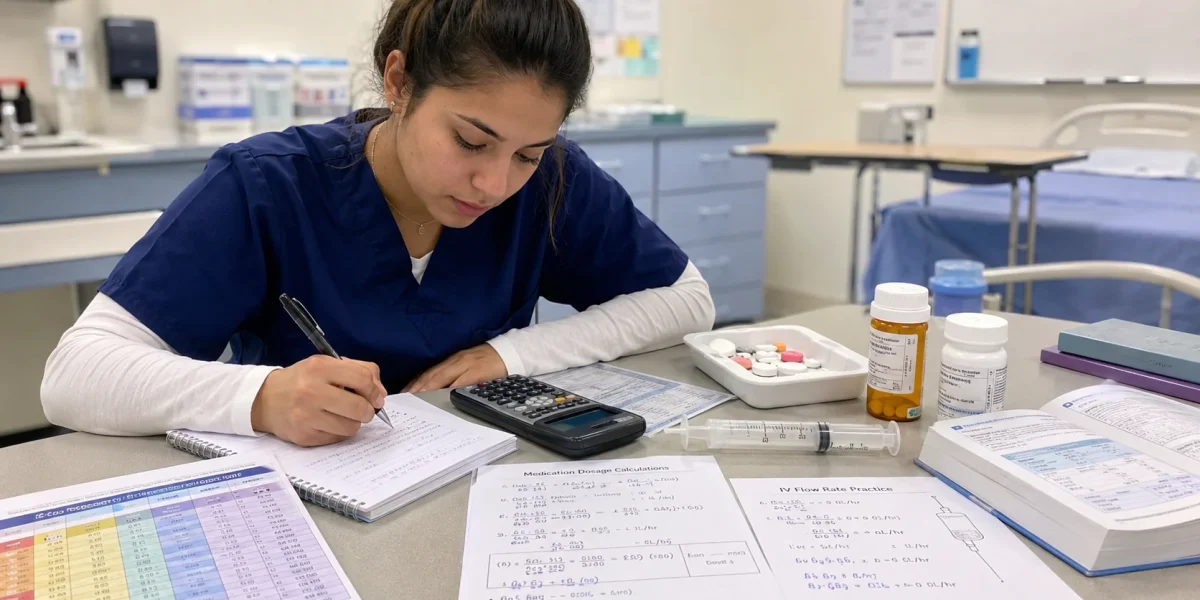
Dosage calculations help nursing students turn medication orders, labels, concentrations, body weight, and time into safe, measurable amounts. Many students understand medication safety in theory but struggle when they must convert units, choose a formula, set up the equation, round correctly, and decide whether the final answer makes sense.
This guide covers dosage calculation formulas, common unit conversions, oral tablets, liquid medication calculations, weight-based dosage calculations, pediatric dosage calculation basics, safe dose range calculations, IV flow rate calculations, drops per minute, reconstitution calculations, rounding rules, common medication calculation errors, and practice dosage calculations with worked answers.
Educational safety disclaimer: This guide is for nursing education and dosage calculation practice only. Medication administration must follow provider orders, medication labels, drug references, facility policy, instructor guidance, and scope of practice. A math answer alone is never enough to administer medication safely.
Quick Answer: What Are Dosage Calculations?
- Dosage calculations are nursing math methods used to determine the correct amount of medication to administer from a given order and available supply.
- They may involve tablets, capsules, liquids, weight-based doses, IV flow rates, drops per minute, reconstitution, or safe dose range checks.
- Common methods include desired over have, dimensional analysis, and ratio-proportion.
- Nurses must verify units, decimal placement, patient weight where required, route, frequency, medication label, and facility policy.
- A correct calculation does not replace medication safety checks, clinical judgment, provider orders, or supervision.
- Nursing students should practice calculations step by step and always check whether the answer is reasonable.
What Are Dosage Calculations in Nursing?
Dosage calculations in nursing are the math processes used to determine how much medication, solution, or fluid corresponds to a written order and an available medication supply. Nursing students learn these calculations because medication orders may not match the exact form available on the medication label.
For example, an order may state 250 mg, but the available tablet may be 125 mg per tablet. A liquid medication may be labeled 250 mg/5 mL, but the order may require 500 mg. In IV math, the order may state 1,000 mL over 8 hours, and the student must calculate the mL/hr rate.
Dosage calculations connect directly to medication administration safety. Nurses often act as the final check before medication reaches the patient, so calculation accuracy must work together with medication rights, label verification, patient identity checks, allergies, route, time, frequency, and institutional policy (Hanson & Haddad, 2023).
Dosage calculations require more than memorizing formulas. Students must know when to convert units, how to keep units consistent, how to avoid decimal errors, and how to recognize answers that look too large, too small, or mismatched with the medication form.
Why Dosage Calculations Matter for Patient Safety
Dosage calculations matter because medication errors can harm patients, and errors may occur during prescribing, dispensing, preparation, administration, or monitoring. Medication safety resources describe medication errors as a major preventable source of patient harm, which is why nurses must combine calculation skill with safe medication processes (Tariq et al., 2024).
Small errors can become serious. A misplaced decimal, a missed unit conversion, or confusion between mg and mcg can change the intended amount significantly. ISMP warns that missing leading zeros and unnecessary trailing zeros can contribute to dangerous dose misinterpretation; for example, .5 mg can be misread as 5 mg, while 5.0 mg can be misread as 50 mg (Institute for Safe Medication Practices [ISMP], n.d.).
Dosage calculations help nurses translate an order into a measurable amount. However, calculation accuracy is only one part of medication safety. Students must also verify the order, medication label, dose, unit, route, time, allergies, patient weight when required, facility policy, instructor guidance, and independent double-check requirements.
Medication Safety Checklist for Nursing Students
Before accepting a dosage calculation answer, check:
- Does the order match the medication label?
- Are the units the same before calculating?
- Did you convert pounds to kilograms when required?
- Did you avoid mixing mg, mcg, g, mL, L, hours, and minutes?
- Does the final answer include the correct unit?
- Does the amount make sense for the available form?
- Did you use a leading zero before a decimal, such as 0.5 mL?
- Did you avoid trailing zeros, such as 5.0 mg?
- Does the answer need a safe dose range check?
- Does facility policy or instructor guidance require a second check?
Dosage Calculation Formula: Core Methods Students Should Know
Nursing programs may teach different calculation methods. The most common methods are the desired over have method, dimensional analysis, and ratio-proportion. OpenStax notes that nursing drug calculations may be performed using methods such as dimensional analysis, formula method, or ratio-proportion (OpenStax, 2024a).
No method is perfect for every student. The safest method is the one you can set up correctly, explain clearly, and check consistently.
| Method | Best for | Strength | Common mistake |
|---|---|---|---|
| Desired over have | Simple tablet and liquid calculations | Easy formula for common medication dosage calculations | Forgetting to multiply by the quantity, such as 1 tablet or 5 mL |
| Dimensional analysis | Multi-step conversions, IV rates, weight-based calculations | Units cancel step by step, which helps prevent conversion errors | Setting up conversion factors upside down |
| Ratio and proportion | Students who understand equivalent ratios | Useful for simple concentration problems | Mixing units on opposite sides of the proportion |
Common Unit Conversions for Nursing Dosage Calculations
Unit conversions are a major part of nursing dosage calculations. Students should always follow their nursing program’s official conversion chart because required rounding and accepted conversion values may vary by course or facility.
| Conversion Type | Common Conversion |
|---|---|
| Pounds to kilograms | kg = lb ÷ 2.2 |
| Kilograms to pounds | lb = kg × 2.2 |
| Grams to milligrams | 1 g = 1,000 mg |
| Milligrams to grams | 1 mg = 0.001 g |
| Milligrams to micrograms | 1 mg = 1,000 mcg |
| Micrograms to milligrams | 1 mcg = 0.001 mg |
| Liters to milliliters | 1 L = 1,000 mL |
| Milliliters to liters | 1 mL = 0.001 L |
| Teaspoon to milliliters | 1 tsp = 5 mL, when used in school examples |
| Hours to minutes | 1 hour = 60 minutes |
Unit conversion matters because dosage calculation problems often give the order in one unit and the available medication in another. For example, the order may be in g, while the label is in mg. The order may use mcg, while the label uses mg. Weight-based dosage calculations may give weight in pounds, but the formula usually requires kilograms.
A safe habit is to convert before calculating. Mixed units lead to medication calculation errors because the formula may look correct while the units are wrong.
Desired Over Have Method
The desired over have method is one of the simplest dosage calculations formulas for tablets, capsules, and liquids.
Formula:
Dose to give = Desired dose ÷ Available dose × Quantity
Where:
- Desired dose = what the order asks for
- Available dose = what the medication label provides
- Quantity = the tablet, capsule, or liquid amount attached to the available dose
Example 1: Tablet Calculation
Order: 250 mg
Available: 125 mg per tablet
Set up:
250 mg ÷ 125 mg × 1 tablet
Solve:
250 ÷ 125 = 2
2 × 1 tablet = 2 tablets
Final answer: 2 tablets
Reasonableness check: Each tablet contains 125 mg. Two tablets contain 250 mg, which matches the order.
Example 2: Liquid Calculation
Order: 500 mg
Available: 250 mg/5 mL
Set up:
500 mg ÷ 250 mg × 5 mL
Solve:
500 ÷ 250 = 2
2 × 5 mL = 10 mL
Final answer: 10 mL
Reasonableness check: The available liquid gives 250 mg in 5 mL. The order is twice 250 mg, so the volume should be twice 5 mL.
Dimensional Analysis for Dosage Calculations
Dimensional analysis dosage calculations use units to guide the setup. The goal is to arrange the known information so unwanted units cancel and the desired unit remains. OpenStax describes dimensional analysis as a factor-label method that uses equivalent measurements to cancel unnecessary units until the desired answer remains (OpenStax, 2024b).
Dimensional analysis is useful when the problem has several steps, such as converting pounds to kilograms, mg to mcg, or hours to minutes. It also helps students see whether the setup makes sense.
Example 1: mg to Tablets
Order: 300 mg
Available: 150 mg per tablet
Set up:
300 mg × 1 tablet / 150 mg
Cancel units:
mg cancels with mg.
Solve:
300 ÷ 150 = 2
Final answer: 2 tablets
Reasonableness check: Two 150 mg tablets equal 300 mg.
Example 2: mg to mL
Order: 750 mg
Available: 250 mg/5 mL
Set up:
750 mg × 5 mL / 250 mg
Cancel units:
mg cancels with mg.
Solve:
750 × 5 = 3,750
3,750 ÷ 250 = 15
Final answer: 15 mL
Reasonableness check: 250 mg is in 5 mL. Since 750 mg is three times 250 mg, the answer should be three times 5 mL.
Example 3: mL/hr Calculation
Order: Infuse 1,000 mL over 8 hours.
Set up:
1,000 mL ÷ 8 hr
Solve:
1,000 ÷ 8 = 125
Final answer: 125 mL/hr
Reasonableness check: 125 mL/hr for 8 hours equals 1,000 mL.
Ratio and Proportion Method
Ratio and proportion dosage calculations compare two equal ratios. This method works well when the available dose and desired dose use the same units.
A basic setup looks like this:
Available dose / Available quantity = Desired dose / Unknown quantity
Worked Example
Order: 400 mg
Available: 200 mg/5 mL
Set up:
200 mg / 5 mL = 400 mg / x mL
Cross multiply:
200x = 400 × 5
200x = 2,000
x = 2,000 ÷ 200
x = 10
Final answer: 10 mL
Reasonableness check: The desired dose is twice the available 200 mg amount, so the volume should be twice 5 mL.
The most common ratio-proportion mistake is mixing units. Keep mg with mg and mL with mL. If the order is in grams and the label is in milligrams, convert first.
Oral Tablet and Capsule Dosage Calculations
Oral dosage calculations often involve tablets or capsules. The student must decide how many tablets or capsules correspond to the ordered dose.
For medication route context, students can review medication administration routes to understand why the route matters before calculating or administering medication.
Tablet and capsule calculations require more than division. Students must also consider whether the answer is practical and allowed. Some tablets may be scored and splittable, while others should not be split because of formulation, safety, or policy concerns. Students should never assume a tablet can be split unless the label, instructor, drug reference, or facility policy allows it.
Example 1: Whole Tablet
Order: 100 mg
Available: 50 mg per tablet
Set up:
100 mg ÷ 50 mg × 1 tablet
Solve:
100 ÷ 50 = 2
Final answer: 2 tablets
Reasonableness check: Two 50 mg tablets equal 100 mg.
Example 2: Half Tablet Scenario
Order: 75 mg
Available: 150 mg per tablet
Set up:
75 mg ÷ 150 mg × 1 tablet
Solve:
75 ÷ 150 = 0.5
Final answer: 0.5 tablet, if tablet splitting is allowed by label, policy, and instructor guidance.
Safety check: The math gives half a tablet, but the student must verify whether the tablet can be split. Do not assume all tablets are safe to split.
Liquid Medication Dosage Calculations
Liquid medication dosage calculations use a concentration, such as 125 mg/5 mL, 250 mg/5 mL, or 100 mg/mL. The final answer is usually in mL.
Students must identify the concentration before calculating. A label that says 250 mg/5 mL does not mean 250 mg per 1 mL. It means 250 mg is contained in the full 5 mL amount.
Example 1: mg per 5 mL
Order: 500 mg
Available: 250 mg/5 mL
Set up:
500 mg ÷ 250 mg × 5 mL
Solve:
500 ÷ 250 = 2
2 × 5 mL = 10 mL
Final answer: 10 mL
Reasonableness check: The order is twice the labeled dose, so the volume is twice the labeled volume.
Example 2: mg per mL
Order: 60 mg
Available: 20 mg/mL
Set up:
60 mg ÷ 20 mg × 1 mL
Solve:
60 ÷ 20 = 3
3 × 1 mL = 3 mL
Final answer: 3 mL
Reasonableness check: Each mL contains 20 mg. Three mL contains 60 mg.
Weight-Based Dosage Calculations
Weight-based dosage calculations use body weight to calculate the ordered dose. These problems may use formats such as mg/kg, mcg/kg, or mg/kg/day.
Weight-based calculations are common in pediatric dosage calculations, but they also appear in adult medication math. Students should usually convert weight to kilograms before calculating because most weight-based formulas use kg.
Example 1: Single-Dose mg/kg Calculation
Order: 5 mg/kg
Weight: 44 lb
Available: 100 mg/5 mL
Step 1: Convert lb to kg.
44 lb ÷ 2.2 = 20 kg
Step 2: Calculate the ordered dose.
5 mg/kg × 20 kg = 100 mg
Step 3: Calculate the volume.
100 mg ÷ 100 mg × 5 mL = 5 mL
Final answer: 5 mL
Reasonableness check: The calculated dose is 100 mg, and the label provides 100 mg in 5 mL.
Example 2: Daily-Dose mg/kg/day Calculation
Order: 20 mg/kg/day divided into 2 equal doses
Weight: 33 lb
Step 1: Convert lb to kg.
33 lb ÷ 2.2 = 15 kg
Step 2: Calculate total daily dose.
20 mg/kg/day × 15 kg = 300 mg/day
Step 3: Divide into 2 doses.
300 mg/day ÷ 2 = 150 mg per dose
Final answer: 150 mg per dose
Reasonableness check: The answer is per dose, not per day. Label the final answer clearly.
Pediatric Dosage Calculations: Why They Need Extra Care
Pediatric dosage calculations often use weight-based dosing and safe dose range checks. They need extra care because small calculation errors can create proportionally larger safety risks in children. Pediatric medication safety also depends on current weight, accurate units, approved references, institutional policies, and required double-checks.
This pillar article gives only a basic overview. Pediatric dosage calculations should have a dedicated supporting article because they require deeper practice with kg conversion, mg/kg/day instructions, divided doses, maximum daily limits, and safe dose range interpretation.
Simple Pediatric-Style Educational Example
Order: 10 mg/kg/day divided into 2 equal doses
Weight: 22 lb
Step 1: Convert lb to kg.
22 lb ÷ 2.2 = 10 kg
Step 2: Calculate total daily dose.
10 mg/kg/day × 10 kg = 100 mg/day
Step 3: Divide into 2 doses.
100 mg/day ÷ 2 = 50 mg per dose
Final answer: 50 mg per dose
Safety check: This is an education-only example. In real settings, students must follow the order, label, drug reference, instructor guidance, facility policy, and scope of practice.
Internal cluster note: For deeper pediatric examples and practice, create or link to a dedicated Pediatric Dosage Calculations for Nursing Students guide.
Safe Dose Range Calculations
Safe dose range calculations help students check whether an ordered dose falls within an expected range given by a drug reference, instructor example, assignment prompt, or facility-approved source.
Students should not invent safe ranges. A safe range must come from an approved reference or assignment instructions. It may be listed per dose, per day, or divided dose. Always read the wording carefully.
Example 1: Daily Safe Dose Range
Given educational safe range: 10–20 mg/kg/day
Weight: 55 lb
Order: 300 mg/day
Step 1: Convert lb to kg.
55 lb ÷ 2.2 = 25 kg
Step 2: Calculate minimum daily dose.
10 mg/kg/day × 25 kg = 250 mg/day
Step 3: Calculate maximum daily dose.
20 mg/kg/day × 25 kg = 500 mg/day
Step 4: Compare the order.
Ordered dose = 300 mg/day
Safe example range = 250–500 mg/day
Final statement: The ordered 300 mg/day appears within the example safe range.
Example 2: Divided Dose Check
Given educational safe range: 30 mg/kg/day divided into 3 doses
Weight: 66 lb
Order: 300 mg per dose, three times daily
Step 1: Convert lb to kg.
66 lb ÷ 2.2 = 30 kg
Step 2: Calculate total daily dose.
30 mg/kg/day × 30 kg = 900 mg/day
Step 3: Divide by 3 doses.
900 mg/day ÷ 3 = 300 mg per dose
Final statement: The ordered 300 mg per dose matches the example calculated dose.
Safety check: This does not prove the medication is appropriate. It only shows that the math matches the educational range provided.
IV Flow Rate Calculations: mL/hr
IV flow rate calculations may ask students to calculate how many milliliters per hour should infuse when a total volume and time are given. Nursing math texts commonly include calculations for tablets, liquid solutions, and IV infusion rates as part of medication administration preparation (Ernstmeyer & Christman, 2021).
Formula:
mL/hr = Total volume in mL ÷ Time in hours
This section focuses only on math. It does not teach IV therapy procedures, pump programming, or clinical decision-making. IV administration must follow provider orders, pump settings, facility policy, instructor guidance, and scope of practice.
Example 1: Whole Number Rate
Order: Infuse 1,000 mL over 8 hours.
Set up:
1,000 mL ÷ 8 hr
Solve:
1,000 ÷ 8 = 125
Final answer: 125 mL/hr
Reasonableness check: 125 mL/hr for 8 hours equals 1,000 mL.
Example 2: Decimal Rate
Order: Infuse 500 mL over 6 hours.
Set up:
500 mL ÷ 6 hr
Solve:
500 ÷ 6 = 83.33
Final answer: 83.3 mL/hr or 83 mL/hr, depending on instructor or facility rounding rules.
Reasonableness check: A rate slightly above 83 mL/hr over 6 hours gives about 500 mL.
Drops per Minute Calculations
Drops per minute calculations may appear in nursing dosage calculation practice, especially in gravity-flow examples. The drop factor must be provided in the problem. Do not guess it.
Formula:
gtt/min = Volume in mL × Drop factor ÷ Time in minutes
Example 1: Basic gtt/min Calculation
Order: Infuse 1,000 mL over 8 hours
Drop factor: 15 gtt/mL
Step 1: Convert hours to minutes.
8 hr × 60 min/hr = 480 min
Step 2: Set up the formula.
1,000 mL × 15 gtt/mL ÷ 480 min
Step 3: Solve.
15,000 ÷ 480 = 31.25
Final answer: 31 gtt/min, if rounding to the nearest whole drop.
Reasonableness check: Drops are usually counted as whole drops, but follow instructor or facility rounding rules.
Example 2: Smaller Volume
Order: Infuse 250 mL over 2 hours
Drop factor: 10 gtt/mL
Step 1: Convert time.
2 hr × 60 = 120 min
Step 2: Set up.
250 mL × 10 gtt/mL ÷ 120 min
Step 3: Solve.
2,500 ÷ 120 = 20.83
Final answer: 21 gtt/min, if rounding to the nearest whole drop.
Reconstitution Dosage Calculations
Reconstitution means adding a diluent to a powdered medication to create a final concentration. In nursing dosage calculation problems, the key is usually the final concentration after reconstitution.
Students must follow the medication label, reconstitution instructions, instructor guidance, drug reference, and facility policy. This section is for calculation practice only, not real medication preparation.
Simple Educational Example
Order: 250 mg
After reconstitution, available concentration: 500 mg/10 mL
Step 1: Identify concentration.
500 mg in 10 mL
Step 2: Use desired over have.
250 mg ÷ 500 mg × 10 mL
Step 3: Solve.
250 ÷ 500 = 0.5
0.5 × 10 mL = 5 mL
Final answer: 5 mL
Reasonableness check: The order is half of 500 mg, so the volume is half of 10 mL.
Rounding Rules and Decimal Safety
Rounding should follow instructor, facility, medication-specific, and device-specific guidance. Students should not round too early because early rounding can change the final answer.
ISMP recommends using a leading zero before decimal amounts less than one, such as 0.5 mL, and avoiding trailing zeros after whole numbers, such as 5.0 mg, because these formats can be misread and cause medication errors (ISMP, n.d.).
Safer Decimal Examples
| Unsafe or Risky Format | Safer Format | Why |
|---|---|---|
| .5 mL | 0.5 mL | The decimal point is easier to see |
| 5.0 mg | 5 mg | Avoids possible misreading as 50 mg |
| 2.50 mL, unless required by policy | 2.5 mL | Avoids unnecessary decimal places |
| Rounding after step 1 in a multi-step problem | Round at the end | Reduces accumulated error |
Practical Rounding Habits
- Keep extra decimals during intermediate steps.
- Round only the final answer unless instructed otherwise.
- Label the answer clearly with units.
- For drops per minute, answers are often whole numbers.
- For tablets, the answer must match what can safely and legally be given.
- For mL, rounding depends on the medication, measuring device, facility policy, and instructor guidance.
- For pediatric and weight-based calculations, rounding rules may be stricter.
Common Dosage Calculation Mistakes Students Make
Many dosage calculation errors come from setup problems rather than difficult math. The arithmetic may be simple, but the clinical consequences of a wrong setup can be serious.
| Mistake | Why It Is Risky | Safer Habit |
|---|---|---|
| Forgetting to convert units | The answer may be off by 10, 100, or 1,000 | Convert units before calculating |
| Using pounds instead of kilograms | Weight-based formulas usually require kg | Convert lb to kg first |
| Mixing mg and mcg | Creates major dose errors | Write units on every line |
| Misreading labels | The concentration may be mg/mL or mg/5 mL | Identify the full concentration |
| Placing decimals incorrectly | Can create tenfold errors | Use leading zeros and avoid trailing zeros |
| Rounding too early | Changes the final answer | Round at the end |
| Ignoring reasonableness | Wrong answers may look mathematically complete | Estimate before finalizing |
| Confusing mL and mg | mL is volume; mg is mass | Track what unit the question asks for |
| Using the wrong formula | Leads to wrong setup | Identify the calculation type first |
| Ignoring safe dose range | A calculated dose may still be outside a given range | Compare with approved safe range when required |
| Assuming tablets can be split | Some tablets should not be split | Check label, policy, and instructor guidance |
| Forgetting time conversion | IV and gtt/min answers become wrong | Convert hours to minutes when needed |
| Failing to label final answers | The answer may be unclear | Always include units |
| Treating math as the only safety check | Medication safety requires more than calculation | Verify order, label, patient factors, and policy |
Dosage Calculation Practice Problems With Worked Answers
These dosage calculation problems give practice without turning this pillar article into a full worksheet. For a full worksheet-style set, create or link to a dedicated Nursing Dosage Calculations Practice Problems article and a Printable Dosage Calculations Practice Problems PDF.
Practice Problem 1: Tablet Calculation
Problem: Order: 200 mg. Available: 100 mg per tablet. How many tablets?
Setup:
200 mg ÷ 100 mg × 1 tablet
Solve:
200 ÷ 100 = 2
Final answer: 2 tablets
Safety check: Two 100 mg tablets equal 200 mg.
Practice Problem 2: Liquid Medication Calculation
Problem: Order: 300 mg. Available: 150 mg/5 mL. How many mL?
Setup:
300 mg ÷ 150 mg × 5 mL
Solve:
300 ÷ 150 = 2
2 × 5 mL = 10 mL
Final answer: 10 mL
Safety check: The order is twice the available dose, so the volume is twice 5 mL.
Practice Problem 3: Unit Conversion
Problem: Convert 0.75 g to mg.
Setup:
1 g = 1,000 mg
0.75 g × 1,000 mg/g
Solve:
0.75 × 1,000 = 750
Final answer: 750 mg
Safety check: Grams to milligrams requires multiplying by 1,000.
Practice Problem 4: mg to mcg Conversion
Problem: Convert 0.2 mg to mcg.
Setup:
1 mg = 1,000 mcg
0.2 mg × 1,000 mcg/mg
Solve:
0.2 × 1,000 = 200
Final answer: 200 mcg
Safety check: mg to mcg requires multiplying by 1,000.
Practice Problem 5: Weight-Based Calculation
Problem: Order: 4 mg/kg. Weight: 110 lb. Calculate the dose in mg.
Step 1: Convert lb to kg.
110 lb ÷ 2.2 = 50 kg
Step 2: Calculate dose.
4 mg/kg × 50 kg = 200 mg
Final answer: 200 mg
Safety check: kg cancels, leaving mg.
Practice Problem 6: Daily Weight-Based Dose
Problem: Order: 15 mg/kg/day divided into 3 equal doses. Weight: 44 lb. Calculate each dose.
Step 1: Convert lb to kg.
44 lb ÷ 2.2 = 20 kg
Step 2: Calculate daily dose.
15 mg/kg/day × 20 kg = 300 mg/day
Step 3: Divide into 3 doses.
300 mg/day ÷ 3 = 100 mg per dose
Final answer: 100 mg per dose
Safety check: The answer is per dose, not total daily dose.
Practice Problem 7: Safe Dose Range
Problem: Example safe range: 5–10 mg/kg/day. Weight: 66 lb. Order: 200 mg/day. Is the order within the example range?
Step 1: Convert weight.
66 lb ÷ 2.2 = 30 kg
Step 2: Calculate minimum daily dose.
5 mg/kg/day × 30 kg = 150 mg/day
Step 3: Calculate maximum daily dose.
10 mg/kg/day × 30 kg = 300 mg/day
Step 4: Compare.
Order = 200 mg/day
Example range = 150–300 mg/day
Final answer: The ordered 200 mg/day appears within the example safe range.
Safety check: Safe dose ranges must come from approved references or instructor instructions.
Practice Problem 8: mL/hr Calculation
Problem: Infuse 750 mL over 10 hours. Calculate mL/hr.
Setup:
750 mL ÷ 10 hr
Solve:
750 ÷ 10 = 75
Final answer: 75 mL/hr
Safety check: 75 mL/hr for 10 hours equals 750 mL.
Practice Problem 9: Drops per Minute
Problem: Infuse 500 mL over 4 hours. Drop factor: 15 gtt/mL. Calculate gtt/min.
Step 1: Convert hours to minutes.
4 hr × 60 = 240 min
Step 2: Set up.
500 mL × 15 gtt/mL ÷ 240 min
Step 3: Solve.
7,500 ÷ 240 = 31.25
Final answer: 31 gtt/min, if rounding to the nearest whole drop.
Safety check: Follow the rounding rule given by the program or facility.
Practice Problem 10: Reconstitution Calculation
Problem: Order: 400 mg. After reconstitution, available concentration: 800 mg/10 mL. How many mL?
Setup:
400 mg ÷ 800 mg × 10 mL
Solve:
400 ÷ 800 = 0.5
0.5 × 10 mL = 5 mL
Final answer: 5 mL
Safety check: The order is half of the available 800 mg amount, so the volume is half of 10 mL.
Practice Problem 11: Dimensional Analysis
Problem: Order: 0.5 g. Available: 250 mg per tablet. How many tablets?
Step 1: Convert grams to milligrams.
0.5 g × 1,000 mg/g = 500 mg
Step 2: Calculate tablets.
500 mg × 1 tablet / 250 mg
Step 3: Solve.
500 ÷ 250 = 2
Final answer: 2 tablets
Safety check: Convert before calculating because the order is in grams and the label is in milligrams.
Practice Problem 12: Liquid Concentration
Problem: Order: 125 mg. Available: 250 mg/5 mL. How many mL?
Setup:
125 mg ÷ 250 mg × 5 mL
Solve:
125 ÷ 250 = 0.5
0.5 × 5 mL = 2.5 mL
Final answer: 2.5 mL
Safety check: 125 mg is half of 250 mg, so the volume is half of 5 mL.
How to Study Nursing Dosage Calculations
Nursing math practice works best when students build accuracy before speed. Do not rush through dosage calculation practice just because the arithmetic looks simple.
Use these habits:
- Memorize the conversions required by your nursing program’s official chart.
- Write units on every step.
- Practice one calculation type at a time.
- Convert units before using the formula.
- Check whether the answer is reasonable.
- Redo missed problems and identify the error type.
- Use dimensional analysis when units confuse you.
- Slow down with decimals.
- Keep extra decimals until the final step.
- Ask an instructor, tutor, or preceptor when uncertain.
- Never guess in clinical practice.
Students should also understand that dosage calculations are different from pharmacokinetics and pharmacodynamics. Dosage calculation focuses on math. Pharmacokinetics explains how the body absorbs, distributes, metabolizes, and eliminates drugs, while pharmacodynamics explains drug effects and responses. For a deeper distinction, review pharmacokinetics for nursing students, pharmacodynamics for nursing students, or pharmacokinetics vs pharmacodynamics.
When to Ask for Help With Nursing Dosage Calculations
Students may need help with nursing dosage calculations if they keep missing unit conversions, decimal placement, IV rates, safe dose ranges, reconstitution problems, or weight-based calculations. Repeated mistakes usually show a pattern. The goal is to identify the error type, not just get the answer.
Academic support can help students understand calculation setups, review assignment instructions, practice step-by-step nursing math, and prepare safer explanations for classwork. If you need help with dosage calculation assignments, pharmacology worksheets, or medication math practice, you can use nursing assignment help or nursing homework help for guided academic support.
FAQs About Dosage Calculations
1. What are dosage calculations in nursing?
Dosage calculations are nursing math methods used to determine how much medication, liquid, tablet, capsule, or IV fluid corresponds to a medication order and available supply.
2. What is the basic dosage calculation formula?
A common dosage calculation formula is:
Dose to give = Desired dose ÷ Available dose × Quantity
This is often called the desired over have method.
3. What is the desired over have formula?
The desired over have formula divides the ordered dose by the available dose, then multiplies by the available quantity. It is commonly used for tablet and liquid medication dosage calculations.
4. Is dimensional analysis better for dosage calculations?
Dimensional analysis is helpful because it tracks units and allows unwanted units to cancel. It may be better for students who struggle with multi-step conversions, but students should use the method required by their program or instructor.
5. How do nursing students calculate liquid medication doses?
Students identify the concentration, such as 250 mg/5 mL, then calculate how many mL provide the ordered dose. The final answer is usually in mL.
6. How do you calculate weight-based dosage?
Convert weight to kilograms when required, then multiply the ordered dose by the patient’s weight in kg. For example, mg/kg × kg = mg.
7. What are pediatric dosage calculations?
Pediatric dosage calculations are medication math problems for children. They often use weight-based dosing, safe dose range checks, and careful rounding. They require extra caution and approved references.
8. How do you calculate IV flow rate in mL/hr?
Use:
mL/hr = Total volume in mL ÷ Time in hours
For example, 1,000 mL over 8 hours equals 125 mL/hr.
9. How do you calculate drops per minute?
Use:
gtt/min = Volume in mL × Drop factor ÷ Time in minutes
The drop factor must be provided in the problem.
10. What is the best way to practice dosage calculations?
Practice one calculation type at a time, write units on every step, convert units before calculating, check reasonableness, review missed problems, and slow down with decimals.
Final Thoughts on Dosage Calculations
Dosage calculations are essential nursing math skills. Students need to understand formulas, conversions, unit setup, rounding, safe dose range checks, and medication-safety habits.
The goal is not speed alone. The goal is safe, accurate, reasoned calculation. Medication administration must always follow provider orders, medication labels, drug references, facility policy, instructor guidance, and scope of practice.
If students need help understanding dosage calculation assignments, practice problems, medication math, or nursing pharmacology coursework, they can upload their instructions, rubric, and practice questions for academic guidance.
References
Ernstmeyer, K., & Christman, E. (Eds.). (2021). Nursing skills. Open RN. NCBI Bookshelf. https://www.ncbi.nlm.nih.gov/books/NBK593207/
Gage, C. B. (2023). Dose calculation. StatPearls Publishing. https://www.ncbi.nlm.nih.gov/books/NBK430836/
Hanson, A., & Haddad, L. M. (2023). Nursing rights of medication administration. StatPearls Publishing. https://www.ncbi.nlm.nih.gov/books/NBK560654/
Institute for Safe Medication Practices. (n.d.). ISMP list of error-prone abbreviations, symbols, and dose designations. https://www.ismp.org/
OpenStax. (2024a). Clinical nursing skills: Chapter 11 summary. Rice University. https://openstax.org/books/clinical-nursing-skills/pages/11-summary
OpenStax. (2024b). Pharmacology for nurses: 2.4 Dosage calculations. Rice University. https://openstax.org/books/pharmacology/pages/2-4-dosage-calculations
OpenStax. (2024c). Clinical nursing skills: 11.2 Dosing. Rice University. https://openstax.org/books/clinical-nursing-skills/pages/11-2-dosing
Tariq, R. A., Vashisht, R., Sinha, A., & Scherbak, Y. (2024). Medication dispensing errors and prevention. StatPearls Publishing. https://www.ncbi.nlm.nih.gov/books/NBK519065/
