

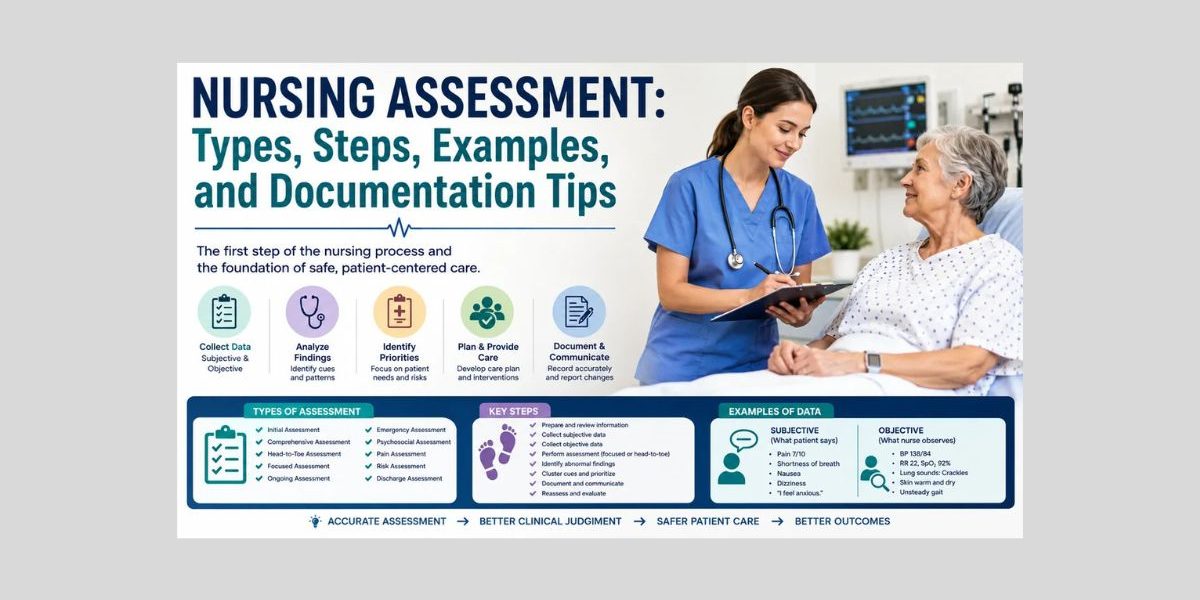
Nursing assessment is the first step of the nursing process and the foundation for safe, organized, patient-centered care. Many nursing students know assessment comes first, but they struggle with what to collect, how to organize findings, and how assessment connects to nursing diagnosis, care plans, SOAP notes, documentation, and clinical judgment.
This guide explains what assessment means in nursing, why it matters, the main types of assessment, how to collect subjective and objective data, how to cluster cues, how to prioritize findings, and how to document assessment data clearly. It also includes examples students can use when writing care plans, case studies, SOAP notes, concept maps, clinical reflections, and discussion posts.
Quick Answer: What Is Nursing Assessment?
- Nursing assessment is the systematic collection, organization, and interpretation of patient information.
- It includes subjective data from the patient and objective data from observation, measurement, and examination.
- Assessment helps nurses identify patient needs, risks, changes, priorities, and responses to care.
- It supports nursing diagnosis, care planning, intervention, evaluation, and communication.
- Assessment may be initial, comprehensive, focused, ongoing, emergency, psychosocial, or head-to-toe.
- Accurate documentation is part of safe assessment practice.
- Students should follow their school, clinical site, facility policy, and instructor assessment format.
What Is Nursing Assessment?
Nursing assessment is the process nurses use to collect and interpret information about a patient’s health status, needs, risks, concerns, and response to care. It includes subjective data, objective findings, health history, physical assessment, vital signs, psychosocial information, cultural factors, and safety risks.
In the nursing process, assessment comes before nursing diagnosis, planning, implementation, and evaluation. The nursing process provides a structured guide for client-centered care, and assessment is the first step because nurses need accurate data before they can identify priorities or plan interventions (Toney-Butler & Thayer, 2023).
Assessment is not the same as collecting random facts. A student may write down a temperature, pain score, medication list, and oxygen saturation, but those details only become useful when the student connects them to the patient’s condition and care needs.
For example, “pain 8/10” is a finding. When combined with guarding, elevated heart rate, limited movement, and recent surgery, it becomes part of a clinical pattern that may affect comfort, mobility, breathing, fall risk, and recovery.
Why Nursing Assessment Is Important
Nursing assessment is important because it guides nearly every part of nursing care.
It supports patient safety. Nurses use assessment findings to recognize risks such as falls, skin breakdown, infection, pain, respiratory changes, medication concerns, and worsening vital signs.
It helps nurses recognize changes early. A patient’s condition may shift gradually or suddenly. Comparing new findings with baseline data helps nurses notice deterioration, improvement, or unexpected responses to treatment.
It supports nursing diagnosis. A nursing diagnosis should come from assessment cues, not guesswork. The initial assessment includes collecting, organizing, documenting, and communicating patient data; this information supports care planning and clinical judgment (Toney-Butler & Unison-Pace, 2023).
It guides care planning. Assessment data helps students choose patient-centered goals, outcomes, and interventions. A care plan without assessment evidence usually becomes vague.
It improves communication. Clear assessment findings help nurses report changes to instructors, preceptors, providers, and other healthcare team members. Structured handoffs support continuity of care by transferring important information about patient status, recent changes, uncertainty, and plans (Agency for Healthcare Research and Quality [AHRQ], n.d.).
It supports evaluation. Nurses reassess to determine whether interventions worked. For example, after pain medication, the nurse reassesses pain level, sedation, respiratory status, mobility, and patient comfort according to policy.
Types of Nursing Assessment
Different situations require different assessment approaches. A stable patient in a routine clinic visit does not need the same assessment as a patient with sudden shortness of breath.
| Type of assessment | Purpose | When nurses use it | Example |
|---|---|---|---|
| Initial assessment | Establish baseline data | Admission, first visit, first clinical encounter | Collecting health history, allergies, medications, vital signs, pain score, and safety risks |
| Comprehensive assessment | Gather broad health information | Admission, annual exam, detailed case study | Reviewing all major body systems and psychosocial needs |
| Head-to-toe assessment | Assess body systems systematically | Inpatient care, skills lab, clinical checkoff | Assessing general appearance, neuro, respiratory, cardiovascular, GI, GU, skin, and mobility |
| Focused assessment | Examine a specific problem | New symptom, abnormal finding, follow-up | Respiratory assessment for shortness of breath |
| Ongoing assessment | Monitor changes over time | During a shift, after interventions, during treatment | Rechecking pain, vital signs, wound status, or mental status |
| Emergency assessment | Identify immediate threats | Rapid deterioration, trauma, severe symptoms | Assessing airway, breathing, circulation, responsiveness, bleeding |
| Psychosocial assessment | Understand emotional, social, and mental health needs | Anxiety, coping difficulty, discharge planning | Assessing mood, support system, stressors, safety, coping |
| Pain assessment | Evaluate pain characteristics and response | Acute pain, chronic pain, postoperative care | Assessing location, intensity, quality, timing, triggers, relief |
| Risk assessment | Identify potential harm | Falls, pressure injuries, aspiration, suicide risk, medication safety | Using facility-approved risk tools |
| Discharge assessment | Determine readiness and needs | Before discharge or transfer | Assessing understanding, home support, medications, mobility, follow-up needs |
The correct type depends on the patient’s condition, care setting, urgency, facility policy, nurse role, and instructor expectations. A head-to-toe assessment may reveal a new issue, but a focused assessment explores that issue in more detail.
Nursing Assessment Steps
The nursing assessment process becomes easier when students follow a consistent sequence.
1. Prepare and review available information
Before entering the room, review the chart, orders, diagnosis, allergies, medications, recent labs, previous vital signs, provider notes, nursing notes, and care plan if available. This helps you know what to assess more carefully.
2. Introduce yourself and verify patient identity
Use the required patient identifiers according to facility policy. Explain your role and what you are going to do.
3. Ensure privacy, safety, and consent where required
Close curtains or doors, provide draping, lower the bed when appropriate, check the environment, and use hand hygiene. A head-to-toe assessment guide for entry-level nurses includes preparation, hand hygiene, privacy, and systematic assessment as part of safe practice (Ernstmeyer & Christman, 2021).
4. Collect subjective data
Subjective data includes what the patient reports. Ask about symptoms, concerns, pain, history, medications, allergies, functional ability, coping, and goals.
5. Collect objective data
Objective data includes what you observe, measure, or verify. Examples include vital signs, oxygen saturation, skin appearance, lung sounds, gait, wound measurements, intake and output, and level of consciousness.
6. Perform a focused or head-to-toe assessment
Use the assessment type that fits the situation. A stable inpatient may need a routine head-to-toe assessment. A patient with chest discomfort, shortness of breath, or sudden confusion needs a focused and urgent assessment according to policy.
7. Identify abnormal findings and changes
Do not only record data. Compare findings with normal ranges, baseline data, patient history, and current symptoms.
8. Cluster cues and recognize patterns
Group related subjective and objective data. Cue clustering helps students move from scattered facts to clinical meaning.
9. Prioritize concerns
Decide which findings need attention first. Airway, breathing, circulation, safety, sudden changes, abnormal vital signs, mental status changes, severe pain, bleeding, and infection signs usually require prompt attention.
10. Document findings accurately
Use clear, objective, timely documentation. Include patient quotes when relevant.
11. Communicate urgent or significant findings
Follow facility policy and your scope. Students should notify the instructor or assigned nurse when findings are abnormal, worsening, unexpected, or urgent.
12. Reassess and evaluate changes
Assessment is continuous. Reassess after interventions, medication administration, procedures, position changes, or changes in patient status.
Subjective and Objective Data in Nursing Assessment
Subjective and objective data work together. A patient’s report explains what they feel or experience, while objective findings help the nurse verify, measure, and observe the patient’s condition.
| Data type | Meaning | Examples | Nursing use |
|---|---|---|---|
| Subjective data | What the patient reports, feels, or describes | “I feel short of breath,” pain 8/10, nausea, dizziness, anxiety | Helps identify symptoms, concerns, goals, and patient experience |
| Objective data | What the nurse observes, measures, verifies, or obtains | Temperature 38.4°C, SpO₂ 89%, wound redness, unsteady gait, abnormal breath sounds | Helps identify measurable findings, changes, risks, and care priorities |
Both types support nursing diagnosis and care planning. For example, a patient may report “I feel dizzy,” while the nurse observes unsteady gait and notes a recent sedating medication. Together, these cues may support a fall risk concern.
For a deeper guide, see subjective vs objective data in nursing if that article is available on your site.
Health History in Nursing Assessment
Health history helps nurses understand the patient beyond the immediate symptom. It includes questions about the patient’s current concern, past health problems, medications, allergies, lifestyle, support system, and goals.
A health history is part of the assessment phase and uses focused and open-ended questions to collect symptoms, perceptions, functioning, and life-process information (Ernstmeyer & Christman, 2021).
Students may collect:
- Chief concern or reason for visit
- History of present illness or current concern
- Past medical history
- Surgical history
- Medication history
- Allergies and reactions
- Family history
- Social history
- Lifestyle factors
- Functional status
- Pain history
- Mental and emotional concerns
- Patient goals, fears, and preferences
The depth of the health history depends on the assignment, patient condition, privacy rules, setting, and scope. In clinical, students should not ask unnecessary sensitive questions unless they are relevant and permitted by the clinical context.
Physical Assessment and Head-to-Toe Assessment
Physical assessment uses inspection, palpation, percussion where appropriate, and auscultation to collect objective data. A head-to-toe assessment organizes this process from general appearance through body systems.
| Body system or area | What nurses assess | Example findings |
|---|---|---|
| General appearance | Alertness, distress, hygiene, posture, speech | Alert, appears fatigued, speaking in short phrases |
| Vital signs | Temperature, pulse, respirations, blood pressure, oxygen saturation, pain | BP 150/92, RR 24, SpO₂ 91% |
| Neurological | Orientation, pupils, strength, sensation, speech | Oriented to person and place, unequal grips |
| Respiratory | Work of breathing, breath sounds, cough, oxygen use | Crackles, wheezing, productive cough |
| Cardiovascular | Heart sounds, pulses, edema, capillary refill | Bilateral ankle edema, weak pedal pulses |
| Gastrointestinal | Abdomen, bowel sounds, nausea, appetite, bowel pattern | Abdomen distended, hypoactive bowel sounds |
| Genitourinary | Urinary pattern, output, pain, catheter status | Reports burning with urination |
| Musculoskeletal | Strength, mobility, gait, range of motion | Unsteady gait, limited left shoulder movement |
| Integumentary | Skin color, temperature, wounds, pressure areas | Redness over sacrum, wound drainage |
| Psychosocial observations | Mood, anxiety, support, communication needs | Tearful before procedure, requests family present |
A head-to-toe assessment should be systematic but not robotic. Students should adapt it to the patient’s age, condition, setting, and clinical instructions.
Focused Nursing Assessment
A focused nursing assessment examines a specific concern, symptom, risk, or abnormal finding. It is narrower than a head-to-toe assessment but more detailed in the area of concern.
Nurses use focused assessment when a patient has a specific complaint, a change in status, an abnormal vital sign, a new risk, or a response that needs follow-up.
Examples include:
- Respiratory focused assessment for shortness of breath
- Pain focused assessment after surgery
- Neurological focused assessment after a fall
- Wound focused assessment during dressing change
- Fall risk focused assessment for dizziness
- Postoperative focused assessment after anesthesia or surgery
Brief scenario
A patient says, “I feel short of breath.” The nurse does not only write the quote. He/she assesses respiratory rate, oxygen saturation, lung sounds, work of breathing, skin color, position, cough, chest discomfort, anxiety, oxygen device, and recent activity. Then the nurse finally compares findings with baseline and reports significant changes according to policy.
Psychosocial, Cultural, and Communication Factors in Nursing Assessment
Patient assessment in nursing is not only physical. Psychosocial, cultural, and communication factors affect how patients describe symptoms, ask for help, follow instructions, and participate in care.
Nurses may assess:
- Patient beliefs and preferences
- Language needs
- Health literacy
- Emotional state
- Coping patterns
- Support system
- Safety concerns
- Privacy and dignity needs
- Family or caregiver involvement
- Cultural practices that affect care
- Trauma-informed needs where relevant
Cultural assessment in nursing should not rely on stereotypes. The safer approach is cultural humility: ask respectful, open-ended questions and let the patient explain what matters to them.
Communication also affects assessment accuracy. A patient who feels rushed or judged may leave out important information. Therapeutic communication helps the nurse build trust, clarify symptoms, and understand patient concerns. If you have a related article, link naturally to therapeutic communication in nursing.
How Nurses Cluster Assessment Cues
Cue clustering means grouping related assessment findings to identify patterns. It helps students move from “I collected data” to “I understand what the data may suggest.”
The NCSBN Clinical Judgment Measurement Model includes cognitive processes such as recognizing cues, analyzing cues, prioritizing hypotheses, generating solutions, taking action, and evaluating outcomes (National Council of State Boards of Nursing [NCSBN], n.d.).
Examples of cue clustering include:
Respiratory concern:
Shortness of breath + low oxygen saturation + increased respiratory rate + abnormal breath sounds may suggest a respiratory priority that needs further assessment and reporting.
Infection concern:
Chills + fever + wound redness + elevated heart rate may suggest a possible infection-related concern that requires monitoring and escalation according to policy.
Fall risk concern:
Dizziness + unsteady gait + sedating medication + recent fall may suggest increased fall risk and the need for safety interventions.
Students should avoid diagnosing too quickly. Clustering does not mean jumping to a medical diagnosis. It means organizing cues so clinical judgment becomes clearer.
How Nurses Prioritize Assessment Findings
Not all assessment data has the same urgency. Students often struggle because they collect many findings but do not know which ones matter first.
Priority assessment findings often involve:
- Airway, breathing, and circulation
- Abnormal vital signs
- Sudden changes from baseline
- Changes in mental status
- Severe or worsening pain
- Bleeding
- Signs of infection or sepsis risk
- Low oxygen saturation
- Chest discomfort
- New weakness or neurological change
- Fall risk or injury risk
- Patient’s main complaint
- Worsening trends over time
A mild chronic symptom may be important, but a sudden change in breathing, circulation, consciousness, or safety usually needs faster attention. Students should always follow facility policy, instructor guidance, and scope of practice when deciding what to report or escalate.
Nursing Assessment vs Nursing Diagnosis
Nursing assessment and nursing diagnosis are related, but they are not the same.
Assessment is the collection, organization, and interpretation of data. Nursing diagnosis is a clinical judgment based on assessment cues. Students should not choose a nursing diagnosis before collecting enough relevant data.
Simple flow:
Assessment data → Cue clustering → Nursing diagnosis → Goals → Interventions → Evaluation
For example, two patients may have the same medical diagnosis of pneumonia, but their nursing assessment findings may differ.
One patient may have low oxygen saturation, abnormal breath sounds, fatigue, and activity intolerance. Another may have anxiety, poor fluid intake, fever, and difficulty clearing secretions. The medical diagnosis may be the same, but the nursing priorities may differ.
If you already have this article, link to difference between nursing diagnosis and medical diagnosis for students who need that distinction.
Nursing Assessment in Care Plans
A nursing care plan should grow from assessment data. Students should avoid writing goals and interventions that do not match the patient’s findings.
| Assessment finding | Subjective or objective? | Possible nursing concern | Goal/outcome | Nursing intervention |
|---|---|---|---|---|
| Patient reports pain 8/10 after surgery; guarding incision | Both | Acute pain concern | Patient reports pain reduced to tolerable level within ordered reassessment period | Assess pain characteristics, administer prescribed pain medication, support incision during movement, reassess pain |
| Unsteady gait; reports dizziness when standing | Both | Fall risk concern | Patient remains free from falls during shift | Keep call bell within reach, assist with ambulation, implement fall precautions per policy |
| SpO₂ 90%, RR 26, patient reports shortness of breath | Both | Impaired oxygenation concern | Oxygen saturation improves according to ordered or facility parameters | Position upright, assess lung sounds, monitor oxygen saturation, report changes according to policy |
Assessment data gives the care plan evidence. If a student writes “risk for falls,” the care plan should show the assessment cues that support that concern.
For help organizing assessment data into assignments, students can review nursing assignment help or nursing case study help when they need academic guidance.
Nursing Assessment in SOAP Notes
SOAP notes organize patient information into four sections:
S: Subjective
What the patient reports.
O: Objective
What the nurse observes, measures, or verifies.
A: Assessment
Clinical interpretation of the subjective and objective data.
P: Plan
Next steps, interventions, education, follow-up, or reporting according to role and policy.
Concise SOAP note example
S: Patient states, “My incision hurts when I move.” Reports pain 7/10. Denies nausea.
O: BP 138/84, HR 96, RR 20, temperature 37.2°C. Incision dressing clean and dry. Patient guards abdomen when repositioning.
A: Postoperative pain affecting movement and comfort. No visible drainage on dressing at this time.
>P: Assist with repositioning, encourage splinting with pillow, administer prescribed analgesic per MAR, reassess pain according to policy, notify assigned nurse of findings.
Students should not place vital signs in the subjective section. They should not place patient quotes in the objective section. Always follow the school or clinical site’s SOAP note format.
How to Document Nursing Assessment Findings
Documentation in nursing should be clear, timely, objective, and professional. It should show what the nurse assessed, what the patient reported, what changed, what was done, and what was communicated when necessary.
Good documentation should:
- Record findings promptly.
- Use objective, professional wording.
- Include relevant patient quotes.
- Avoid judgmental language.
- Use approved abbreviations only.
- Include measurements when available.
- Protect patient privacy.
- Avoid copying forward inaccurate data.
- Correct errors according to policy.
- Report urgent findings according to protocol.
Example:
Judgmental: “Patient is lazy and refuses to walk.”
Professional: “Patient declined ambulation at 0900 and stated, ‘I feel too weak to walk right now.’”
The professional version is better because it describes what happened, includes the patient’s words, and avoids insulting or assuming the patient’s motivation.
Wrong vs Correct Nursing Assessment Examples
| Student wording | Problem | Better assessment wording | Why it is better |
|---|---|---|---|
| “Patient seems fine.” | Vague and unsupported | “Patient alert and oriented x4, respirations even, denies pain at this time.” | Gives specific findings |
| “Patient is lazy.” | Judgmental | “Patient declined ambulation and stated, ‘I feel too tired to walk.’” | Uses objective behavior and patient quote |
| “Patient is confused.” | Too broad | “Patient oriented to person only; unable to state location or date.” | Describes observable mental status |
| “Patient is in pain.” | Incomplete | “Patient reports abdominal pain 8/10, guarding incision during movement.” | Includes subjective and objective cues |
| “Patient is noncompliant.” | Judgmental and unclear | “Patient declined insulin dose after education and stated, ‘I do not want it right now.’ Assigned nurse notified.” | Documents action, quote, and communication |
Common Nursing Assessment Mistakes Students Make
Students often lose marks because their assessment is incomplete, disorganized, or poorly connected to care planning.
Common mistakes include:
- Collecting data without organizing it
- Confusing subjective and objective data
- Ignoring abnormal vital signs
- Failing to reassess after interventions
- Documenting vague statements
- Using judgmental language
- Missing patient safety risks
- Choosing nursing diagnoses without enough data
- Failing to report significant changes
- Relying only on the medical diagnosis
- Not following the assigned assessment format
- Forgetting psychosocial or cultural factors
- Writing care plan interventions that do not match assessment findings
A strong assessment shows what the student noticed, why it matters, and how it connects to nursing care.
Nursing Assessment Examples for Students
1. Postoperative patient with pain
Situation: A patient is six hours post-abdominal surgery.
>Key subjective data: “My pain is worse when I move,” pain 8/10.
Key objective data: Guarding abdomen, shallow breathing, heart rate 104, reluctant to reposition.
Possible priority concern: Pain affecting comfort, movement, and breathing pattern.
Documentation tip: Include pain score, location, patient quote, observed behavior, intervention, and reassessment.
2. Older adult at risk for falls
Situation: An older adult stands up and reports dizziness.
Key subjective data: “I feel lightheaded.”
Key objective data: Unsteady gait, uses walker, recent sedating medication, clutter near bed.
Possible priority concern: Increased fall risk.
Documentation tip: Record the patient’s report, observed gait, safety actions, and who was notified.
3. Patient with shortness of breath
Situation: A patient becomes short of breath after walking to the bathroom.
Key subjective data: “I can’t catch my breath.”
>Key objective data: Respiratory rate 28, SpO₂ 89%, using accessory muscles, speaking in short phrases.
Possible priority concern: Respiratory compromise requiring prompt assessment and reporting.
>Documentation tip: Include respiratory rate, oxygen saturation, breath sounds if assessed, activity at onset, positioning, and escalation.
4. Patient with possible infection
Situation: A patient with a wound reports chills.
Key subjective data: “I feel cold and shaky.”
Key objective data: Temperature 38.5°C, wound redness, increased drainage, heart rate 110.
Possible priority concern: Possible infection-related concern.
Documentation tip: Describe wound appearance objectively, include measurements if required, and report findings according to policy.
5. Patient with anxiety before a procedure
Situation: A patient is waiting for a procedure and appears tearful.
Key subjective data: “I’m scared something will go wrong.”
Key objective data: Tearful, restless hands, asks repeated questions, heart rate mildly elevated.
Possible priority concern: Anxiety affecting understanding and readiness.
Documentation tip: Include the patient’s words, education provided, coping support, and response.
How Nursing Students Can Write About Nursing Assessment in Assignments
Students may write about assessment in care plans, SOAP notes, case studies, clinical reflections, concept maps, discussion posts, nursing essays, and research papers.
In care plans, assessment data supports the nursing diagnosis, goals, and interventions. When it comes to SOAP notes, assessment data separates subjective reports from objective findings. For case studies, assessment helps students identify relevant cues and priorities. In concept maps, assessment findings become the branches that connect symptoms, risks, diagnoses, interventions, and outcomes.
Possible essay topics include:
- The role of assessment in patient safety
- How subjective and objective data support nursing diagnosis
- The importance of focused assessment in clinical judgment
- How cue clustering improves care planning
- The role of communication in accurate assessment
Sample thesis statement:
“Nursing assessment is essential because it helps nurses collect patient data, recognize clinical cues, prioritize care needs, support nursing diagnoses, and evaluate patient-centered interventions.”
Simple paragraph structure:
- Start with a topic sentence.
- Define the assessment concept.
- Use a patient assessment example.
- Explain how the data supports nursing judgment.
- Connect the assessment to diagnosis, intervention, or evaluation.
Students who need help developing assessment-based academic work can use nursing coursework help or nursing research paper help when the task involves essays, research papers, case studies, or clinical writing.
Quick Nursing Assessment Checklist for Students
Use this checklist before submitting a care plan, SOAP note, or clinical assignment:
- Did I verify patient identity?
- Did I collect subjective data?
- Did I collect objective data?
- Did I check vital signs?
- Did I assess the main concern?
- Did I compare findings with baseline?
- Did I consider psychosocial, cultural, and communication factors?
- Did I cluster related cues?
- Did I identify priorities?
- Did I document clearly?
- Did I report significant findings according to policy?
- Did I reassess when needed?
- Did I follow my school or clinical format?
FAQs About Nursing Assessment
1. What is nursing assessment?
Nursing assessment is the systematic collection, organization, and interpretation of patient information. It includes subjective data, objective findings, health history, physical assessment, psychosocial factors, safety risks, documentation, and communication.
2. What are the types of nursing assessment?
Common types include initial assessment, comprehensive assessment, head-to-toe assessment, focused assessment, ongoing assessment, emergency assessment, psychosocial assessment, pain assessment, risk assessment, and discharge assessment.
3. What is the difference between subjective and objective data?
Subjective data is what the patient reports, such as pain, nausea, dizziness, or anxiety. Objective data is what the nurse observes, measures, or verifies, such as vital signs, oxygen saturation, wound appearance, gait, or breath sounds.
4. What is included in a head-to-toe assessment?
A head-to-toe assessment usually includes general appearance, vital signs, neurological status, respiratory system, cardiovascular system, gastrointestinal system, genitourinary concerns, musculoskeletal function, skin, pain, safety, and psychosocial observations.
5. What is a focused nursing assessment?
A focused assessment examines a specific problem, symptom, risk, or abnormal finding. For example, a patient with shortness of breath needs a respiratory focused assessment rather than only a routine general assessment.
6. How does nursing assessment support nursing diagnosis?
Assessment provides the cues that support nursing diagnosis. Students collect subjective and objective data, cluster related findings, identify patterns, and then choose nursing diagnoses that match the patient’s needs and risks.
7. How do students document nursing assessment findings?
Students should document promptly, objectively, and professionally. They should include relevant patient quotes, measurable findings, approved abbreviations, interventions, reassessment data, and significant communication according to school and facility policy.
8. Why is nursing assessment important in care plans?
Assessment data gives the care plan its evidence. It helps students choose appropriate nursing diagnoses, set realistic goals, select patient-centered interventions, and evaluate whether care is working.
Final Thoughts on Nursing Assessment
Nursing assessment is the foundation of safe, patient-centered nursing care. It helps nurses collect data, recognize cues, identify priorities, support nursing diagnoses, document accurately, communicate concerns, and evaluate patient responses.
For students, assessment is also the foundation of strong care plans, SOAP notes, case studies, clinical reflections, concept maps, and nursing assignments. When assessment data is clear and organized, the rest of the nursing process becomes easier to explain.
If students need help writing a care plan, SOAP note, case study, clinical reflection, or nursing assignment that uses assessment correctly, they can upload their instructions and request academic guidance.
References
Agency for Healthcare Research and Quality. (n.d.). Tool: Handoff. TeamSTEPPS 3.0. https://www.ahrq.gov/teamstepps-program/curriculum/communication/tools/handoff.html
Ernstmeyer, K., & Christman, E. (Eds.). (2021). Chapter 2: Health history. In Nursing skills. Chippewa Valley Technical College. NCBI Bookshelf. https://www.ncbi.nlm.nih.gov/books/NBK593197/
Ernstmeyer, K., & Christman, E. (Eds.). (2021). Appendix C: Head-to-toe assessment checklist. In Nursing skills. Chippewa Valley Technical College. NCBI Bookshelf. https://www.ncbi.nlm.nih.gov/books/NBK593191/
National Council of State Boards of Nursing. (n.d.). Clinical Judgment Measurement Model. NCLEX. https://www.nclex.com/clinical-judgment-measurement-model.page
Toney-Butler, T. J., & Thayer, J. M. (2023). Nursing process. In StatPearls. StatPearls Publishing. https://www.ncbi.nlm.nih.gov/books/NBK499937/
Toney-Butler, T. J., & Unison-Pace, W. J. (2023). Nursing admission assessment and examination. In StatPearls. StatPearls Publishing. https://www.ncbi.nlm.nih.gov/books/NBK493211/
