

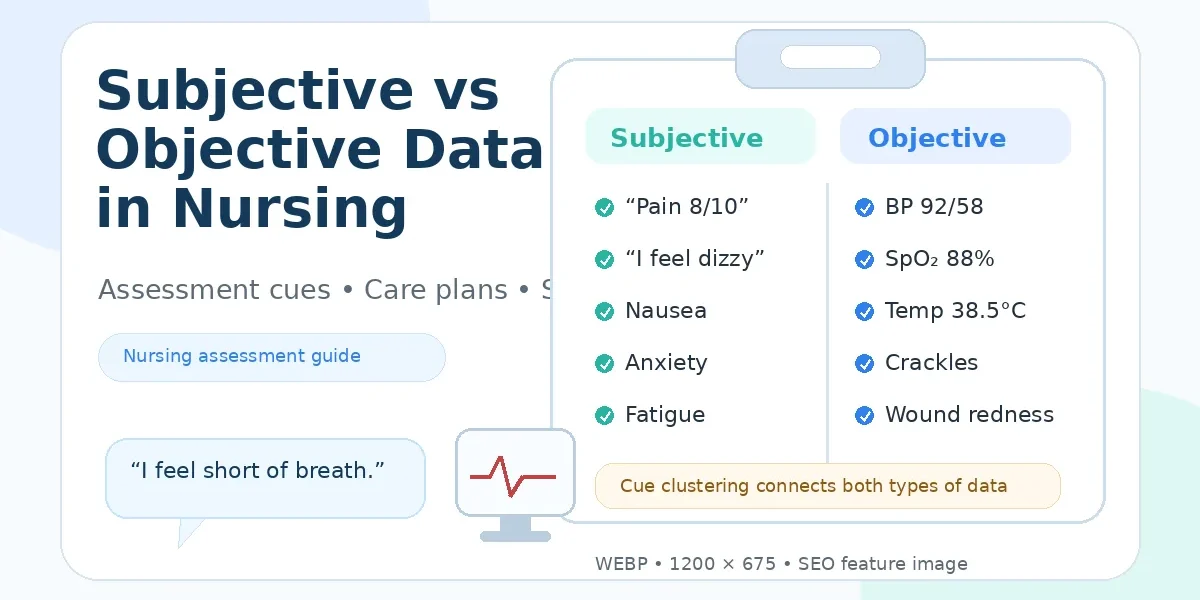
Subjective vs objective data nursing can confuse students because patient-reported symptoms often appear beside measurable assessment findings. In nursing assessment, the challenge is knowing what the patient says, feels, or describes compared with what the nurse can observe, measure, or verify.
This article explains subjective data, objective data, key differences, examples, gray areas, cue clustering, prioritization, care plans, SOAP notes, documentation, and common student mistakes. Nursing students can use these ideas when writing care plans, case studies, concept maps, clinical reflections, SOAP notes, and other assessment-based assignments.
Quick Answer: Subjective vs Objective Data in Nursing
- Subjective data is what the patient reports, feels, or describes.
- Objective data is what the nurse observes, measures, verifies, or collects through assessment.
- Pain level, nausea, dizziness, fear, fatigue, and “I feel short of breath” are usually subjective.
- Blood pressure, temperature, oxygen saturation, wound appearance, lab values, and gait observations are objective.
- Nurses need both types of nursing assessment data to understand the patient’s condition.
- Subjective and objective findings support nursing diagnoses, care plans, SOAP notes, and clinical judgment.
- Students should not list patient opinions as objective findings unless assessment, observation, or records verify them.
What Is Subjective Data in Nursing?
Subjective data in nursing is information the patient reports about their symptoms, feelings, concerns, experiences, or health history. It comes from the patient’s point of view. Nursing assessment includes both subjective and objective data collection, and subjective findings often come through the patient interview, health history, pain assessment, and review of systems (Toney-Butler & Unison-Pace, 2023).
Common subjective data examples include:
- “My pain is 8 out of 10.”
- “I feel nauseated.”
- “I feel dizzy when I stand.”
- “I have not been sleeping well.”
- “I feel anxious about surgery.”
- “I get short of breath when walking to the bathroom.”
- “I have not had much appetite.”
- “My goal is to walk without help before discharge.”
Subjective data matters because it reveals what the nurse cannot directly measure. A nurse can measure oxygen saturation, but the patient’s description of breathlessness adds context. A nurse can inspect a wound, but the patient’s report of throbbing pain or itching may help guide further assessment.
Students should document important subjective data accurately. When the patient’s exact words matter, use quotation marks. For example: Patient states, “I feel like I can’t catch my breath.” This is clearer than writing, “Patient is having breathing problems,” because it separates the patient’s report from the nurse’s interpretation.
What Is Objective Data in Nursing?
Objective data in nursing is information the nurse can observe, measure, verify, or collect through physical assessment, diagnostic results, or patient records. Objective data includes vital signs, physical examination findings, lab results, intake and output, weight, behavior, wound appearance, skin color, breath sounds, and mobility observations (Ernstmeyer & Christman, 2021).
Common objective data examples include:
- Temperature 38.5°C
- Pulse 112 beats/min
- Respiratory rate 28 breaths/min
- Blood pressure 92/58 mmHg
- Oxygen saturation 88% on room air
- Crackles heard in bilateral lower lung fields
- Moderate serosanguineous drainage on abdominal dressing
- 2+ pitting edema in both ankles
- Unsteady gait observed when transferring from bed to chair
- Capillary refill greater than 3 seconds
- Blood glucose 58 mg/dL
- Urine output 20 mL/hr
Objective findings matter because they give measurable or observable evidence. They help nurses identify abnormal findings, monitor trends, evaluate interventions, and communicate changes to the healthcare team.
Good objective documentation should be specific and professional. Instead of writing “wound looks bad,” write “wound edges reddened, moderate yellow drainage noted on dressing, surrounding skin warm to touch.” The second version gives usable assessment findings.
Subjective vs Objective Data Nursing: Key Differences
| Feature | Subjective data | Objective data |
|---|---|---|
| Source | Patient, family, caregiver, or patient’s reported experience | Nurse assessment, observation, measurement, records, lab results, diagnostic results |
| How it is collected | Interview, health history, review of systems, pain assessment, patient statements | Vital signs, physical examination, observation, chart review, diagnostic testing |
| Examples | Pain, nausea, dizziness, fear, fatigue, appetite changes, sleep problems | Temperature, pulse, respirations, blood pressure, oxygen saturation, wound drainage, gait, lab values |
| Can it be measured directly? | Usually no, although rating scales may structure the report | Usually yes, or it can be observed or verified |
| Documentation style | Often uses patient statements or quotes | Uses measurable, observable, specific findings |
| Role in nursing assessment | Shows the patient’s experience and concerns | Shows physical, behavioral, or measurable evidence |
| Role in care plans | Supports patient-centered goals and nursing diagnoses | Supports clinical priorities, baseline data, interventions, and evaluation |
| Common student mistake | Treating all patient statements as less important | Writing assumptions as if they are objective facts |
The core difference is simple: subjective data comes from the patient’s experience. Objective data comes from what the nurse can observe, measure, or verify.
Subjective and Objective Data Examples in Nursing
| Patient situation | Subjective data | Objective data | Why both matter |
|---|---|---|---|
| Patient with chest pain | “I feel pressure in my chest.” | BP 168/94 mmHg, pulse 118, pale skin, diaphoresis noted | The symptom explains the patient’s concern; objective signs help identify urgency. |
| Patient with shortness of breath | “I can’t breathe well when lying flat.” | Respiratory rate 30, SpO₂ 89%, accessory muscle use observed | The report shows distress; objective findings show respiratory compromise. |
| Patient with postoperative pain | “My incision pain is 7/10.” | Guarding abdomen, pulse 104, limited movement during repositioning | Pain report guides comfort care; observations show how pain affects function. |
| Patient with infection symptoms | “I have chills and feel weak.” | Temperature 38.6°C, heart rate 112, wound edges reddened | Subjective symptoms and objective findings form a pattern that may require escalation. |
| Patient at risk for falls | “I feel lightheaded when I stand.” | Unsteady gait, orthostatic BP change, sedating medication listed | Both types help support fall precautions and safety planning. |
| Patient with anxiety | “I feel nervous about the procedure.” | Restless movements, tearfulness, rapid speech | The patient’s words show emotional distress; observations help document behavior. |
| Patient with diabetes | “I feel shaky and sweaty.” | Blood glucose 58 mg/dL, cool clammy skin | Symptoms and measured glucose help guide timely nursing action within policy. |
| Patient with a wound | “The wound burns when I move.” | 3 cm incision, mild swelling, small amount of serous drainage | Subjective discomfort and objective wound findings guide monitoring and education. |
Signs vs Symptoms: How They Relate to Objective and Subjective Data
Symptoms are usually subjective experiences reported by the patient. Signs are usually objective findings observed, measured, or verified by clinicians. This distinction helps nursing students decide where information belongs in assessment notes, SOAP notes, and care plans.
For example, nausea is usually a symptom because the patient feels it. Fever is usually a sign because the nurse can measure temperature. Pain is a symptom when reported by the patient, but guarding or grimacing can be objective signs related to pain.
| Patient statement or finding | Sign or symptom | Subjective or objective | Explanation |
|---|---|---|---|
| “I feel dizzy.” | Symptom | Subjective | The patient reports the sensation. |
| Temperature 39°C | Sign | Objective | The nurse measures the finding. |
| Patient grimaces when moving | Sign | Objective | The nurse observes the behavior. |
| “I feel nauseated.” | Symptom | Subjective | Nausea is reported by the patient. |
| Oxygen saturation 86% | Sign | Objective | Pulse oximetry provides measurable data. |
| “My chest feels tight.” | Symptom | Subjective | The patient describes the experience. |
Gray Areas: When Data Can Seem Subjective or Objective
Some assessment findings confuse students because one patient concern can include both subjective and objective parts. The safest approach is to separate what the patient reports from what the nurse observes.
Pain is subjective when the patient reports it. However, grimacing, guarding, restlessness, sweating, and limited movement are objective observations. Anxiety is subjective when the patient says, “I feel anxious,” but pacing, trembling, crying, or rapid speech are objective observations.
Shortness of breath works the same way. “I feel short of breath” is subjective. Respiratory rate, oxygen saturation, accessory muscle use, cyanosis, and lung sounds are objective data.
Fatigue is subjective when the patient reports feeling tired. It becomes more objective when the nurse observes the patient falling asleep during conversation, needing assistance with activity, or giving delayed responses. Fatigue can be difficult to confirm objectively, so assessment usually combines patient report with physical examination and clinical context (Merck Manual Professional Edition, 2024).
Family or caregiver reports are usually subjective unless the nurse verifies them through assessment, records, or direct observation. For example, “Daughter reports patient fell twice this week” is subjective collateral history. “Bruising noted on left hip; unsteady gait observed” is objective.
| Confusing data | Subjective part | Objective part | Better documentation |
|---|---|---|---|
| Pain | “My pain is 9/10.” | Guarding incision, grimacing during movement | Patient reports incisional pain 9/10; guarding noted when repositioning. |
| Anxiety | “I feel scared.” | Pacing, trembling hands, crying | Patient states, “I feel scared”; pacing in room and trembling hands observed. |
| Shortness of breath | “I cannot catch my breath.” | RR 30, SpO₂ 88%, accessory muscle use | Patient reports shortness of breath; RR 30, SpO₂ 88% on room air, accessory muscle use noted. |
| Fatigue | “I feel exhausted.” | Falls asleep during conversation | Patient reports fatigue; fell asleep twice during 10-minute conversation. |
| Family report | “He has been confused all morning.” | Disoriented to place and time during assessment | Daughter reports confusion since morning; patient oriented to person only during assessment. |
| “Patient appears tired” | Not clearly stated | Vague observation | Patient yawning, delayed responses, and eyes closing during interview. |
How Nurses Collect Subjective and Objective Data
Nurses collect subjective and objective data throughout patient assessment. The nursing process begins with assessment, then nurses analyze data, identify relevant cues, plan care, act, and evaluate outcomes (Ernstmeyer & Christman, 2024).
Subjective data often comes from:
- Patient interview
- Health history
- Pain assessment
- Review of systems
- Patient-stated concerns
- Patient goals
- Family or caregiver reports
- Chart history when it reflects reported symptoms or background information
Objective data often comes from:
- Head-to-toe assessment
- Focused assessment
- Vital signs
- Physical examination
- Observation
- Intake and output
- Weight
- Lab values
- Diagnostic results
- Medication record
- Wound assessment
- Neurological checks
- Mobility assessment
Family or caregiver reports can be valuable, especially when the patient is a child, confused, sedated, or unable to communicate. However, students should label those reports clearly. Write “spouse reports…” or “caregiver states…” instead of presenting the information as verified fact.
Subjective vs Objective Data in a Head-to-Toe Assessment
A head-to-toe assessment includes both what the patient says and what the nurse finds. Students should organize the findings by body system so they can see patterns instead of listing unrelated details.
| Body system | Subjective data examples | Objective data examples |
|---|---|---|
| Neurological | “I feel confused,” “I have a headache,” “I feel dizzy.” | Oriented to person only, pupils equal and reactive, hand grips unequal, delayed speech |
| Respiratory | “I feel short of breath,” “I have a cough.” | RR 28, SpO₂ 90%, wheezes heard, accessory muscle use |
| Cardiovascular | “My heart feels like it is racing,” “I have chest pressure.” | Pulse 122, BP 160/92, edema, capillary refill 4 seconds |
| Gastrointestinal | “I feel nauseated,” “I have abdominal cramping.” | Abdomen distended, bowel sounds hypoactive, emesis observed |
| Genitourinary | “It burns when I urinate,” “I am urinating more often.” | Urine cloudy, intake/output imbalance, bladder distention noted |
| Musculoskeletal | “My knee hurts when I walk,” “I feel weak.” | Limited range of motion, unsteady gait, requires assistance to transfer |
| Integumentary | “My skin feels itchy,” “My wound burns.” | Redness, swelling, wound drainage, skin warm to touch |
| Psychosocial | “I feel anxious,” “I am worried about going home.” | Tearfulness, restless movement, avoids eye contact, rapid speech |
How to Cluster Subjective and Objective Cues
Subjective and objective data become more useful when students group related findings together. This process is often called cue clustering. Instead of asking, “Is this one finding subjective or objective?” students should also ask, “What pattern do these cues create?”
Clinical judgment models emphasize recognizing cues, deciding which cues matter most, analyzing what the cues may mean, and choosing appropriate nursing responses (National Council of State Boards of Nursing [NCSBN], n.d.).
Cue Cluster 1: Respiratory Concern
| Cue type | Assessment cue |
|---|---|
| Subjective | Patient reports shortness of breath. |
| Objective | SpO₂ 88% on room air. |
| Objective | Respiratory rate 28 breaths/min. |
| Objective | Crackles heard in lower lung fields. |
This cluster suggests a respiratory concern that needs priority assessment and nursing action according to clinical setting, facility policy, scope of practice, and instructor direction. The student should not simply write “shortness of breath” and stop. The stronger care plan uses the full pattern.
Cue Cluster 2: Infection Concern
| Cue type | Assessment cue |
|---|---|
| Subjective | Patient reports chills and weakness. |
| Objective | Temperature 38.5°C. |
| Objective | Heart rate 114 beats/min. |
| Objective | Wound redness and warmth noted. |
This cluster may suggest an infection concern. A student should avoid diagnosing the patient with an infection unless that is within the assignment context and supported by provider diagnosis or clinical data. A safer nursing statement is: “Assessment findings suggest possible infection risk or worsening wound status; report according to policy.”
Cue Cluster 3: Fall Risk Concern
| Cue type | Assessment cue |
|---|---|
| Subjective | Patient reports dizziness when standing. |
| Objective | Unsteady gait observed. |
| Objective | Recent fall history documented. |
| Objective | Sedating medication listed on MAR. |
This cluster supports fall risk precautions and safety-focused interventions. The student can connect the cues to a nursing diagnosis such as risk for falls if the assignment allows NANDA-style diagnoses.
Which Data Should Nurses Prioritize?
Nurses collect many data points, but not every finding has the same urgency. Students should prioritize cues that relate to immediate safety, sudden change, abnormal trends, and the patient’s main complaint.
Priority cues often include:
- Airway, breathing, and circulation concerns
- Abnormal vital signs
- Sudden changes in level of consciousness
- New confusion or altered mental status
- Severe or worsening pain
- Low oxygen saturation
- Bleeding
- New neurological symptoms
- Signs of infection or sepsis concern
- Fall risk or injury risk
- Worsening trends over time
- Findings connected to the reason for admission
- Instructor rubric requirements for the assignment
Avoid saying one type of data is always more important. A patient’s report of crushing chest pain may be subjective, but it is still urgent. A normal blood pressure may be objective, but it may not be the highest priority if the patient has new facial drooping or oxygen saturation of 84%.
Students should follow clinical instructor guidance, facility policy, escalation rules, and scope of practice when assessment data suggests risk.
How Subjective and Objective Data Support Nursing Diagnosis
Assessment data comes before nursing diagnosis. Students should not choose a nursing diagnosis first and then force the data to fit. A better approach is to gather subjective and objective cues, cluster related findings, identify the patient’s priority problem, and then choose a nursing diagnosis supported by the evidence.
Simple flow:
Subjective cues + objective cues → clinical judgment → nursing diagnosis → goals → interventions → evaluation
For example, a patient with a medical diagnosis of pneumonia may have different nursing priorities depending on the assessment findings. One patient may have impaired gas exchange cues. Another may have activity intolerance cues. Another may have deficient knowledge about medication use or home care.
Students writing care plans, case studies, or assessment-based assignments can review support options such as nursing assignment guidance or nursing case study help when they need help connecting assessment cues to nursing diagnoses without confusing medical diagnosis and nursing diagnosis.
Subjective and Objective Data in Nursing Care Plans
In a nursing care plan, subjective and objective data provide the evidence for the nursing diagnosis. Goals and interventions should connect directly to those cues.
| Patient concern | Subjective data | Objective data | Possible nursing diagnosis | Goal/outcome | Nursing intervention |
|---|---|---|---|---|---|
| Postoperative pain | “My incision hurts when I move.” Pain 8/10. | Guarding abdomen, limited ambulation, pulse 106. | Acute pain | Patient will report pain reduced to 3/10 or less after interventions. | Assess pain regularly, support incision during movement, administer prescribed analgesics as ordered, evaluate response. |
| Breathing difficulty | “I feel like I cannot get enough air.” | SpO₂ 89%, RR 30, diminished breath sounds at bases. | Impaired gas exchange or ineffective breathing pattern, depending on assignment data | Patient will maintain SpO₂ within ordered target range. | Position upright, monitor respiratory status, encourage breathing exercises if appropriate, report worsening findings according to policy. |
The strongest care plans do not list random data. They connect assessment findings to the diagnosis, goal, intervention, and evaluation.
Subjective vs Objective Data in SOAP Notes
SOAP notes organize patient information into four sections:
- S: Subjective — what the patient reports
- O: Objective — what the nurse observes, measures, or verifies
- A: Assessment — interpretation, nursing assessment summary, or clinical impression depending on school format
- P: Plan — nursing actions, education, monitoring, or next steps within nursing scope
SOAP Note Example
S: Patient states, “I feel dizzy when I stand.” Reports poor oral intake since yesterday. Denies chest pain.
O: BP 96/60 lying, 82/54 standing. Pulse 110 standing. Unsteady gait observed when transferring from bed to chair. Mucous membranes dry.
A: Dizziness with position change and unsteady gait; fall risk concern. Findings require continued monitoring and reporting per clinical policy.
P: Assist with transfers, keep call light within reach, implement fall precautions, encourage fluids if allowed, notify supervising nurse or instructor according to setting expectations.
Do not put vital signs in the subjective section. Do not put patient quotes in the objective section. SOAP notes work best when each section has a clear purpose.
Wrong vs Correct Examples of Subjective and Objective Data
| Student’s wording | Why it is wrong | Correct category | Better wording |
|---|---|---|---|
| Patient looks like they are in pain. | It is vague and mixes assumption with observation. | Subjective and objective | Patient reports pain 8/10. Grimacing noted when repositioning. |
| Patient is anxious. | It labels the patient without separating report from observation. | Subjective and objective | Patient states, “I feel nervous.” Restless movement observed. |
| Patient has a fever. | It is less specific than a measured temperature. | Objective | Temperature 38.5°C. |
| Patient is noncompliant. | It is judgmental and does not describe behavior. | Subjective and objective | Patient declined medication at 0900 and stated, “I do not want to take it before breakfast.” |
| Patient is short of breath. | It does not clarify whether this is reported or observed. | Subjective and objective | Patient reports shortness of breath. RR 28, SpO₂ 90%, accessory muscle use noted. |
Common Mistakes Students Make With Subjective and Objective Data
Students often lose marks because they know the definitions but apply them incorrectly. Common mistakes include:
- Putting vital signs under subjective data
- Putting patient quotes under objective data
- Treating assumptions as objective findings
- Using judgmental words such as “dramatic,” “lazy,” or “noncompliant”
- Confusing symptoms with signs
- Writing vague phrases like “patient seems fine”
- Ignoring patient-reported symptoms because they are subjective
- Treating subjective data as less important
- Choosing nursing diagnoses without enough supporting cues
- Copying assessment data without linking it to the care plan
- Listing unrelated findings instead of clustering cues
- Failing to explain why a cue matters
Subjective data is not weak data. It reflects the patient’s lived experience. Objective data is not automatically the priority. Nursing judgment depends on context, trends, risk, and the full assessment picture.
How to Document Subjective and Objective Data Professionally
Professional nursing documentation should be accurate, clear, timely, and relevant to patient care. The American Nurses Association identifies clear and accurate documentation as an essential part of safe, quality nursing practice (American Nurses Association, 2010).
Students should document subjective and objective data by:
- Using patient quotes when the exact wording matters
- Avoiding judgmental language
- Describing observable behavior instead of assumptions
- Using specific measurements
- Including relevant context
- Following facility policy and instructor guidance
- Protecting patient privacy
- Documenting promptly
- Using approved abbreviations only
- Maintaining EHR accuracy
- Avoiding copy-forward errors
- Correcting documentation mistakes according to school or facility policy
Judgmental vs Professional Wording
| Judgmental wording | Professional wording |
|---|---|
| Patient is dramatic. | Patient tearful and reports pain 9/10. |
| Patient refused to cooperate. | Patient declined assessment at 0900 and stated, “I want to rest.” |
| Patient is lazy and will not walk. | Patient declined ambulation and stated, “My incision hurts when I stand.” |
| Patient is confused. | Patient oriented to person only; unable to state location or date. |
| Patient looks terrible. | Skin pale, diaphoretic; patient reports dizziness. |
Professional documentation does not hide concerns. It makes concerns clearer by using facts, measurements, observations, and patient statements.
How Nursing Students Can Write About Subjective and Objective Data in Assignments
Nursing students use subjective and objective data in care plans, SOAP notes, case studies, concept maps, clinical reflections, discussion posts, and nursing essays.
In a care plan, use the data to support the nursing diagnosis. For a SOAP note, place patient-reported symptoms under S and measurable findings under O. In a case study, cluster related cues and explain what they suggest. In a clinical reflection, discuss how the data shaped your judgment, priorities, or communication.
Students who need help organizing assessment-based coursework can use nursing homework support or nursing coursework help when the assignment requires care plans, SOAP notes, reflections, or cue analysis.
Possible essay topics include:
- Why subjective and objective data both matter in nursing assessment
- How cue clustering supports clinical judgment
- The role of objective assessment findings in care planning
- How patient-reported symptoms influence nursing priorities
- Common documentation errors in nursing assessment
Sample thesis statement:
Understanding subjective and objective data helps nursing students organize assessment findings, support nursing diagnoses, and plan patient-centered interventions.
Simple paragraph structure:
- Write a topic sentence.
- Define subjective or objective data.
- Use a patient assessment example.
- Explain how the data supports nursing judgment.
- Connect the data to diagnosis, intervention, or evaluation.
For research-heavy assignments, students may also need credible sources on assessment, documentation, or clinical judgment. In that case, nursing research paper help may be relevant.
Quick Checklist: Is This Subjective or Objective Data?
Use this checklist when sorting nursing assessment cues:
- Did the patient say, feel, or describe it? It is likely subjective.
- Did I observe, measure, or verify it? It is likely objective.
- Is it a symptom reported by the patient?
- Is it a sign measured through assessment?
- Can another nurse observe the same finding?
- Did I avoid assumptions?
- Did I document quotes or measurements clearly?
- Does the data support my nursing diagnosis?
- Have I clustered related cues before choosing priorities?
FAQs About Subjective vs Objective Data Nursing
1. What is the difference between subjective and objective data in nursing?
Subjective data is what the patient reports, feels, or describes. Objective data is what the nurse observes, measures, verifies, or collects through assessment. Nursing students need both to understand patient problems and support clinical judgment.
2. Is pain subjective or objective data?
Pain is subjective when the patient reports it, such as “My pain is 8/10.” Objective pain-related observations may include grimacing, guarding, restlessness, sweating, or limited movement.
3. Are vital signs subjective or objective data?
Vital signs are objective data because the nurse measures them. Examples include temperature, pulse, respirations, blood pressure, and oxygen saturation.
4. Is anxiety subjective or objective data?
Anxiety can include both. “I feel anxious” is subjective. Pacing, trembling, crying, rapid speech, or restlessness are objective observations.
5. Is a patient quote subjective or objective data?
A patient quote is subjective data because it reports the patient’s experience, belief, symptom, or concern. Use quotation marks when the exact words are important.
6. Can family reports be subjective data?
Yes. Family or caregiver reports are usually subjective unless the nurse verifies the information through assessment, direct observation, records, or measurements.
7. How do subjective and objective data support nursing diagnosis?
Subjective and objective data provide the evidence for nursing diagnoses. Students should cluster related cues before choosing a diagnosis, then connect those cues to goals, interventions, and evaluation.
8. How do I use subjective and objective data in a care plan?
Place patient-reported symptoms under subjective data and measurable or observable findings under objective data. Then use both types of data to justify the nursing diagnosis, goal, interventions, and evaluation criteria.
Final Thoughts on Subjective vs Objective Data Nursing
Subjective data reflects the patient’s reported experience, while objective data reflects what the nurse can observe, measure, or verify. Nursing students need both to complete accurate assessments, cluster cues, identify priorities, support nursing diagnoses, document professionally, and plan safe patient-centered care.
The main skill is not memorizing a definition. The real skill is separating patient reports from assessment findings, then bringing them back together through cue clustering and clinical judgment.
Students who need help writing a care plan, SOAP note, case study, clinical reflection, or nursing assignment that correctly separates subjective and objective data can upload their instructions and request academic guidance.
References
American Nurses Association. (2010). ANA’s principles for nursing documentation: Guidance for registered nurses. American Nurses Association. https://www.nursingworld.org/globalassets/docs/ana/ethics/principles-of-nursing-documentation.pdf
Ernstmeyer, K., & Christman, E. (Eds.). (2021). Nursing skills. Chippewa Valley Technical College. https://www.ncbi.nlm.nih.gov/books/NBK593197/
Ernstmeyer, K., & Christman, E. (Eds.). (2024). Nursing fundamentals. Chippewa Valley Technical College. https://www.ncbi.nlm.nih.gov/books/NBK610818/
Merck Manual Professional Edition. (2024). Fatigue. Merck & Co., Inc. https://www.merckmanuals.com/professional/special-subjects/nonspecific-symptoms/fatigue
National Council of State Boards of Nursing. (n.d.). Clinical judgment measurement model. NCSBN. https://www.nclex.com/clinical-judgment-measurement-model.page
Toney-Butler, T. J., & Unison-Pace, W. J. (2023). Nursing admission assessment and examination. StatPearls Publishing. https://www.ncbi.nlm.nih.gov/books/NBK493211/
