

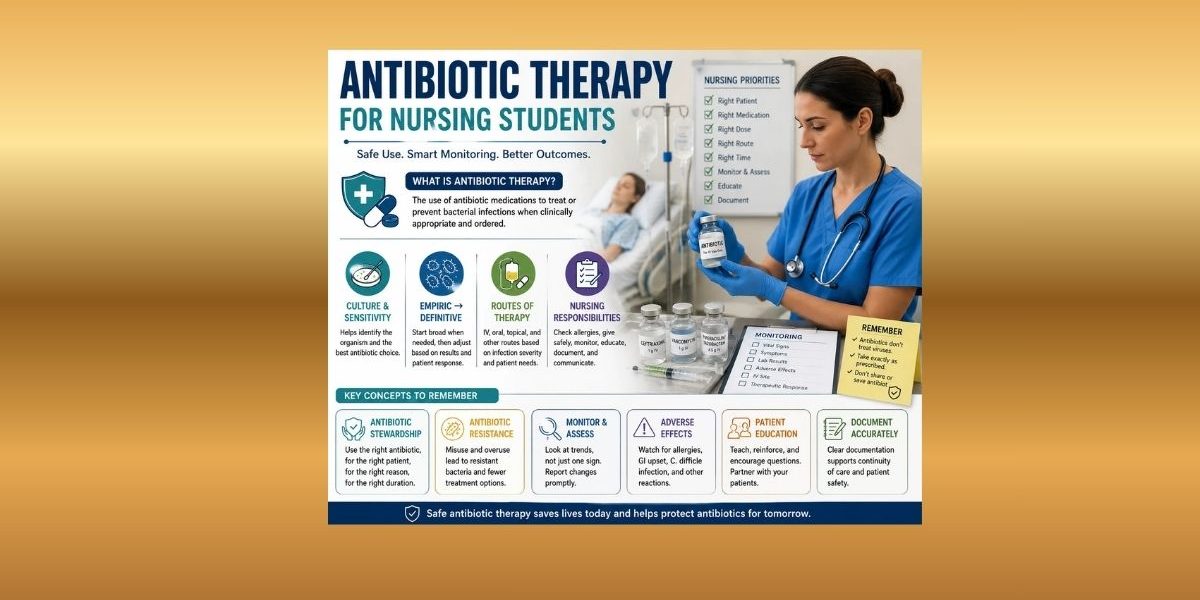
Antibiotic therapy is a core nursing pharmacology topic because students must understand more than antibiotic names, routes, and schedules. Many nursing students can memorize common antibiotic classes, yet still struggle to explain why antibiotics are ordered, how cultures guide therapy, why empiric therapy may change, what nurses monitor, how side effects are recognized, and how antibiotic stewardship affects patient care.
This guide explains antibiotic therapy basics, empiric and definitive therapy, culture and sensitivity, broad-spectrum and narrow-spectrum antibiotics, bactericidal and bacteriostatic concepts, IV and oral antibiotic therapy, monitoring response, adverse effects, allergy checks, stewardship, resistance, therapeutic drug monitoring, documentation, patient education, and common nursing student mistakes.
Educational safety disclaimer: This guide is for nursing education and pharmacology learning only. Antibiotic therapy must follow provider orders, culture results where applicable, medication labels, approved drug references, facility policy, antimicrobial stewardship guidance, instructor guidance, and scope of practice.
Quick Answer: What Is Antibiotic Therapy?
- Antibiotic therapy is the use of antibiotic medications to treat or prevent bacterial infection when clinically appropriate and ordered.
- Antibiotics do not treat viral infections unless there is a specific bacterial indication.
- Therapy may begin empirically before the organism is confirmed, then change when culture and sensitivity results are available.
- Nurses support antibiotic therapy by checking allergies, administering medications safely, monitoring response, watching for adverse effects, educating patients, and documenting care.
- Antibiotic stewardship promotes appropriate antibiotic use to reduce harm, resistance, and unnecessary exposure.
- Nursing students should never treat antibiotic selection, dosing, or duration as independent nursing decisions.
What Is Antibiotic Therapy in Nursing?
Antibiotic therapy in nursing refers to ordered pharmacologic treatment that uses antibacterial medications to treat or prevent bacterial infection when clinically appropriate. In nursing education, the focus is not on teaching students to prescribe antibiotics. The focus is on helping students understand how ordered antibiotics fit into patient assessment, medication safety, infection monitoring, patient education, and documentation.
Nurses play a major role in safe antibiotic therapy because they are often closest to the patient’s day-to-day response. They verify medication orders, assess allergy history, administer antibiotics through the ordered route, monitor vital signs and symptoms, observe adverse reactions, support specimen collection when ordered, educate patients, and document care.
Understanding antibiotic therapy is different from choosing antibiotic therapy. Antibiotic selection depends on the suspected or confirmed organism, infection site, patient-specific risks, culture and sensitivity results, local guidance, pharmacist input, provider judgment, and facility policy. Nursing students should understand the reasoning framework, but they should not assume they can independently choose, stop, switch, or adjust antibiotics.
For medication administration basics, students should connect this topic with medication administration routes because antibiotic therapy may involve oral, IV, topical, ophthalmic, otic, inhaled, or other ordered routes.
Why Antibiotic Therapy Matters for Patient Safety
Antibiotics can be lifesaving when used appropriately. They may help control bacterial infection, reduce infection-related complications, and support recovery when the drug, route, timing, and monitoring match the patient’s clinical situation.
However, antibiotics can also cause harm. The CDC explains that antibiotics can save lives, but any antibiotic use can cause side effects and contribute to antibiotic resistance (Centers for Disease Control and Prevention [CDC], 2024). Unnecessary or incorrect use may expose patients to allergic reactions, gastrointestinal effects, drug toxicity, C. difficile-associated diarrhea, treatment failure, and broader public-health risks.
Nursing assessment matters because patient response is not judged from one sign alone. A student may see a temperature drop and assume the patient is improving, but the full picture may include worsening confusion, low blood pressure, reduced urine output, abnormal labs, or a new rash. Nurses monitor trends and communicate changes.
Antibiotic stewardship also supports patient safety. The CDC defines antibiotic stewardship as efforts to measure and improve how antibiotics are prescribed and used, with the goal of improving patient safety and outcomes (CDC, 2025). Nurses support stewardship by giving ordered antibiotics safely, clarifying allergy history, helping with ordered cultures, educating patients, and reporting concerns.
Antibiotic Therapy vs Antimicrobial Therapy
Antibiotic therapy usually refers to antibacterial medications. These medications target bacteria, not viruses. Antimicrobial therapy is broader. It may include antibacterial, antiviral, antifungal, and antiparasitic medications.
This distinction matters in nursing school because students may see both terms in textbooks, lectures, drug guides, and clinical documentation. If a course or instructor uses “antimicrobial therapy,” they may be discussing several types of organisms and medication categories. If the focus is “antibiotic therapy,” the discussion usually centers on bacterial infection.
For this article, the focus remains on antibiotics used in bacterial infection education. It does not provide antiviral, antifungal, antiparasitic, prescribing, dosing, or infection-specific treatment guidance.
How Antibiotics Work: Bactericidal vs Bacteriostatic Basics
Nursing students often hear that some antibiotics are bactericidal and others are bacteriostatic. This is a useful starting point, but it should not be oversimplified.
Bactericidal antibiotics kill bacteria. Bacteriostatic antibiotics inhibit bacterial growth so the immune system can help control the infection. However, the actual effect may depend on the organism, drug concentration, infection site, immune status, and clinical context. Students should avoid assuming that bactericidal always means “stronger” or that bacteriostatic always means “weaker.”
This concept connects to pharmacodynamics, which explains how a medication affects the body or target organism. Students who need a broader foundation can review pharmacodynamics for nursing students to understand why drug effect is not the same as memorizing a dose or route.
Broad-Spectrum vs Narrow-Spectrum Antibiotics
Broad-spectrum antibiotics affect a wider range of bacteria. Narrow-spectrum antibiotics target a narrower range. This distinction is important for antibiotic stewardship because the broadest option is not automatically the best option.
Broad-spectrum therapy may be used when infection is suspected and organism details are not yet available, especially when treatment cannot wait. After culture results, susceptibility information, and clinical response are reviewed, the care team may narrow therapy when appropriate. This process helps reduce unnecessary exposure and may help limit resistance pressure.
| Type | Meaning | Nursing education focus | Stewardship note |
|---|---|---|---|
| Broad-spectrum antibiotics | Affect a wider range of bacteria | Understand why they may be used before organism details are known | Useful in selected situations, but unnecessary broad use can increase harm and resistance pressure |
| Narrow-spectrum antibiotics | Target a narrower group of bacteria | Understand why therapy may be narrowed after results | Stewardship often favors the most appropriate targeted therapy when clinically suitable |
| Empiric broad coverage | Initial therapy before full organism data | Monitor ordered therapy, cultures, response, and adverse effects | May change after culture and sensitivity results |
| Definitive targeted therapy | Therapy adjusted after organism and susceptibility data | Understand the nurse’s role in monitoring and communication | Supports appropriate antibiotic use |
Nursing students should not interpret broad-spectrum or narrow-spectrum language as permission to choose an antibiotic. Selection remains a provider/pharmacist-led decision based on clinical context and policy.
Empiric Antibiotic Therapy
Empiric antibiotic therapy may begin before culture and sensitivity results are available. It is often used when a bacterial infection is suspected and treatment cannot wait for the final organism report.
The selection of empiric therapy is a provider decision. It may depend on the likely organism, infection site, patient risk factors, severity of illness, local resistance patterns, facility policy, and antimicrobial stewardship guidance. Nurses do not independently choose empiric antibiotics.
The nursing role may include obtaining ordered cultures before antibiotic administration when required and clinically appropriate, administering ordered therapy on time, monitoring patient response, watching for adverse effects, documenting care, and reporting changes. Students must be careful with culture timing. Antibiotics should not be automatically delayed in every situation. Culture collection timing depends on provider orders, urgency, patient condition, facility policy, and clinical judgment.
A future article on empiric antibiotic therapy can explore this topic more deeply. This pillar article introduces the concept so students understand where empiric therapy fits within the larger antibiotic therapy process.
Definitive Antibiotic Therapy and Culture Results
Definitive antibiotic therapy occurs when the care team adjusts therapy based on more specific information. This may include organism identification, susceptibility results, patient response, adverse effects, and clinical status.
Culture and sensitivity results can help guide narrowing or changing antibiotic therapy. Open RN explains that patients may begin therapy based on common bacterial causes, but therapy may change after culture and sensitivity results are available; nurses monitor these results and notify the provider about concerns (Ernstmeyer & Christman, 2023).
Students should understand three common susceptibility terms:
- Susceptible or sensitive: The organism is likely to respond to the antibiotic when used appropriately.
- Intermediate: The organism may respond in certain conditions, but interpretation requires clinical judgment.
- Resistant: The organism is not likely to be effectively controlled by that antibiotic.
These terms do not mean the nurse selects the medication independently. They help nursing students understand why an antibiotic may be changed, narrowed, continued, or questioned by the care team.
Culture and Sensitivity: What Nursing Students Should Understand
Culture and sensitivity testing helps identify organisms and determine which antibiotics may be effective against them. Cultures may be collected from blood, urine, wound drainage, sputum, or other sites depending on provider orders and suspected infection.
Correct specimen collection matters. Contamination can affect results and may lead to confusion, repeat testing, unnecessary treatment, or delayed decision-making. Nursing responsibilities may include collecting the specimen according to policy, using the correct container, labeling the specimen accurately, sending it to the lab promptly, documenting collection, and reporting delays.
Timing may matter when cultures are ordered before antibiotics. However, students should avoid a rigid rule that antibiotics must always wait until cultures are collected. The correct action depends on provider orders, urgency, patient condition, facility policy, and clinical judgment. When unsure, students should ask the instructor, preceptor, assigned nurse, provider, pharmacist, or facility resource person.
Routes of Antibiotic Therapy: IV, Oral, and Other Routes
Antibiotics may be administered by several routes. Common routes include IV, oral, topical, ophthalmic, otic, inhaled, and others depending on the order and clinical context.
IV antibiotic therapy may be used when rapid or reliable delivery is needed, when oral intake is not appropriate, when absorption is a concern, or when infection severity requires close monitoring. Oral antibiotic therapy may be used when clinically appropriate and ordered.
The IV-to-oral antibiotic transition is not an independent nursing decision. It is a provider/pharmacist-led decision based on clinical status, infection type, absorption ability, medication options, lab data, and facility guidance. Nurses may observe readiness cues, support education, document response, and communicate relevant information, but they do not independently switch routes.
This topic also connects to pharmacokinetics for nursing students because absorption, distribution, metabolism, elimination, half-life, and drug exposure can affect how medication therapy is understood.
IV Antibiotic Therapy: Nursing Responsibilities and Monitoring
IV antibiotic therapy requires careful nursing attention, but this section is only a concise overview. A separate IV antibiotic therapy article can explore nursing monitoring in greater depth.
Nursing responsibilities may include verifying the order, checking patient identity, reviewing allergy history, confirming the medication label, assessing IV access, checking compatibility according to pharmacy or facility guidance, administering the medication at the ordered rate and time, monitoring the IV site, observing patient response, and documenting care.
Students should not use this article to learn IV insertion, pump programming, compatibility decision-making, or drug-specific infusion protocols. Those actions require instructor guidance, facility policy, pharmacy information, and approved clinical resources.
During IV antibiotic therapy, nurses may monitor for:
- IV site redness, pain, swelling, leaking, or infiltration concerns
- Patient discomfort during infusion
- Rash, itching, breathing difficulty, or other possible allergic symptoms
- Vital sign changes
- New gastrointestinal symptoms
- Ordered lab trends
- Missed, delayed, or interrupted doses
- Patient understanding and concerns
When a student notices a concern, the safer response is to stop guessing, reassess within scope, document according to policy, and report to the appropriate nurse, instructor, preceptor, pharmacist, or provider.
Oral Antibiotic Therapy and Patient Education
Oral antibiotic therapy still requires safe administration and patient education. Students should not assume oral therapy is less important simply because it does not involve an IV line.
Patient education should remain general, order-based, and aligned with the medication label, pharmacist counseling, provider instructions, and approved drug references. Patients may need teaching to take antibiotics exactly as prescribed, avoid sharing antibiotics, avoid saving leftovers, report concerning adverse effects, understand timing or food instructions according to the label or pharmacist, and complete follow-up if ordered.
The CDC advises patients to take antibiotics exactly as prescribed, not share them, not save them for later, and not take antibiotics prescribed for someone else (CDC, 2025). Students should also reinforce that antibiotics do not treat viral infections unless there is a specific bacterial indication.
Avoid drug-specific teaching unless it is provided in the order, label, facility resource, pharmacist counseling, or approved drug reference. For example, food, alcohol, pregnancy, lactation, contraception, and interaction instructions vary by medication and patient context.
Monitoring Response to Antibiotic Therapy
Monitoring antibiotic therapy means observing whether the patient is improving, worsening, or developing complications. Nurses monitor trends rather than relying on one isolated finding.
Therapeutic response may include improvement in symptoms, vital signs, wound appearance, pain, appetite, function, mental status, intake/output, or ordered lab values depending on the infection and patient context. Students can connect this monitoring with vital signs because fever, pulse, respiratory rate, blood pressure, oxygen saturation, and pain trends may help show clinical change.
| Monitoring area | What nurses may observe | Why it matters |
|---|---|---|
| Vital signs | Temperature, heart rate, respiratory rate, blood pressure, oxygen saturation, pain | Trends may suggest improvement, worsening infection, adverse reaction, or clinical instability |
| Symptoms | Pain, cough, urinary symptoms, wound discomfort, fatigue, appetite | Symptom trends help evaluate response in context |
| Mental status | Confusion, alertness, behavior changes | Worsening mental status may signal clinical deterioration in some patients |
| Intake and output | Oral intake, urine output, fluid balance | Hydration and renal context may matter for selected medications and illness severity |
| Wound or site findings | Redness, swelling, drainage, odor, pain | Local findings may show improvement or worsening |
| Laboratory trends | Ordered CBC, renal function, hepatic function, cultures, drug levels where applicable | Labs support clinical interpretation but should not be used alone |
| Adverse effects | Rash, diarrhea, nausea, infusion reaction, new symptoms | Early recognition supports patient safety |
Nurses do not diagnose treatment failure independently, but they do report concerning changes promptly according to policy and scope.
Common Side Effects and Adverse Reactions to Antibiotics
Antibiotics can cause side effects and adverse reactions. These vary by medication, patient factors, route, dose, duration, and clinical context.
General categories include gastrointestinal upset, diarrhea, nausea, rash, allergic reaction, yeast infection risk where appropriate, C. difficile-associated diarrhea risk, renal or hepatic concerns for selected drugs, and infusion-related reactions for some IV antibiotics.
C. difficile is an important nursing safety concept. The CDC states that most C. difficile infections occur while or soon after taking antibiotics, and C. difficile can cause diarrhea and inflammation of the colon (CDC, 2026). Students should not diagnose C. difficile from diarrhea alone, but they should recognize that significant diarrhea during or after antibiotics may require reporting according to policy.
Adverse reactions should be taken seriously. Nursing students should report concerns rather than trying to manage drug reactions independently.
Antibiotic Allergy Assessment
Allergy assessment is essential before antibiotic administration. Students should check the chart, medication record, allergy band if used, patient report, and facility documentation process.
A basic nursing distinction is that an allergy usually involves an immune-mediated reaction, while intolerance may involve non-allergic side effects such as nausea or stomach upset. However, students should not dismiss any reported reaction. All reported reactions should be clarified and documented according to policy.
Useful allergy questions may include:
- Which medication caused the reaction?
- What happened?
- When did it happen?
- How severe was it?
- Was treatment required?
- Has the patient taken related medications since then?
- Is the reaction documented in the record?
Serious symptoms such as breathing difficulty, swelling, widespread rash, or signs of severe reaction require immediate reporting according to facility policy. This article does not provide emergency treatment instructions.
Antibiotic Stewardship in Nursing
Antibiotic stewardship means using antibiotics appropriately to improve patient outcomes, reduce unnecessary exposure, and slow the development of resistance. The CDC’s Core Elements emphasize improving antibiotic use to advance patient safety and outcomes (CDC, 2025).
Nurses do not independently prescribe antibiotics, but they are important stewardship partners. Nursing actions that support antimicrobial stewardship may include:
- Giving ordered antibiotics on time
- Supporting ordered culture collection
- Clarifying allergy history
- Monitoring therapeutic response
- Watching for adverse effects
- Documenting administration and education
- Reporting missed doses, delayed specimens, or patient changes
- Teaching patients not to share or save antibiotics
- Communicating concerns to the care team
The CDC’s hospital stewardship materials also highlight the value of engaging nurses in patient education efforts (CDC, 2019). That makes nursing students’ communication skills part of safer antibiotic use.
A future article on antibiotic stewardship in nursing can explore stewardship programs, nursing advocacy, and interprofessional communication more deeply.
Antibiotic Resistance: What Nursing Students Should Know
Antibiotic resistance occurs when bacteria are no longer effectively controlled by antibiotics that previously worked. The WHO explains that antimicrobial resistance occurs when microorganisms no longer respond to antimicrobial medicines, making infections harder to treat and increasing risks of severe illness and death (World Health Organization [WHO], 2023).
For nursing students, the key point is practical: antibiotic resistance is not just a microbiology topic. It affects medication safety, infection prevention, patient education, and public health.
Inappropriate antibiotic use can contribute to resistance. Educational examples include unnecessary antibiotics, broad-spectrum overuse, incomplete therapy, poor infection prevention practices, and use of antibiotics for viral illness when there is no bacterial indication. Students should understand these concepts without turning antibiotic resistance into a full microbiology chapter.
Infection prevention nursing also matters. Hand hygiene, transmission-based precautions when ordered, proper specimen handling, wound care principles, device care, and patient education can all support safer care.
Therapeutic Drug Monitoring and Vancomycin Trough Overview
Some antibiotics require therapeutic drug monitoring. Vancomycin is a common nursing-school example because students often hear about vancomycin trough levels.
Historically, trough levels were commonly used to monitor vancomycin exposure. Current guidance for serious MRSA infections has shifted toward AUC-guided monitoring rather than relying only on trough levels. The 2020 consensus guideline from ASHP, IDSA, PIDS, and SIDP recommends AUC/MIC-guided monitoring for serious MRSA infections to support efficacy and safety (Rybak et al., 2020).
Nursing students do not need to memorize vancomycin dosing targets, nomograms, or adjustment rules for this pillar article. Instead, they should understand the nursing role:
- Coordinate ordered lab timing according to facility process.
- Monitor renal function context when ordered.
- Confirm whether levels are ordered and collected correctly.
- Communicate missed, delayed, or incorrectly timed levels.
- Report concerns to the nurse, pharmacist, provider, instructor, or preceptor.
- Never adjust vancomycin dosing independently.
A future vancomycin trough nursing guide can discuss this monitoring concept more deeply without turning it into a dosing protocol.
Renal and Hepatic Considerations in Antibiotic Therapy
Some antibiotics require caution in renal or hepatic impairment. This does not mean nursing students should calculate dose adjustments independently. It means students should understand why ordered labs, urine output, medication history, age, hydration status, and patient response may matter.
Renal considerations may include ordered creatinine, estimated kidney function, urine output, fluid balance, and signs of toxicity for selected medications. Hepatic considerations may include ordered liver enzymes, bilirubin, medication history, and symptoms that require reporting.
Pharmacists and providers guide dosing and adjustments. Nurses support safety through assessment, monitoring, communication, and documentation.
What Nurses Do Not Decide Independently in Antibiotic Therapy
Nurses support safe antibiotic therapy, but they do not independently control antibiotic prescribing decisions. Nursing students should clearly understand these boundaries.
Nurses do not independently:
- Diagnose bacterial infection
- Choose antibiotics
- Set antibiotic doses
- Determine antibiotic duration
- Change from IV to oral therapy
- Adjust vancomycin dosing
- Stop antibiotics without an order
- Interpret culture results as independent prescribing authority
- Replace provider, pharmacist, infection prevention, or facility guidance
Nurses do:
- Verify orders
- Check allergies
- Administer medications safely
- Monitor response
- Watch for adverse reactions
- Support ordered cultures
- Educate patients
- Communicate concerns
- Document care accurately
Antibiotic Therapy Documentation in Nursing
Antibiotic therapy documentation should be accurate, specific, and consistent with facility policy. Students should avoid vague notes such as “antibiotic given, patient okay” because they do not show what was assessed or communicated.
Documentation may include:
- Medication administration according to the MAR
- Route, time, and dose as ordered
- IV site assessment if applicable
- Patient response
- Adverse reactions or absence of immediate reaction
- Patient education provided
- Culture or specimen collection when relevant
- Provider, pharmacist, nurse, preceptor, or instructor notification when required
- Missed, delayed, refused, or held doses according to policy
Examples:
- “Antibiotic administered per MAR; no immediate adverse reaction observed.”
- “Blood cultures collected per order before antibiotic administration; specimens labeled and sent to lab per policy.”
- “Patient reports previous rash with antibiotic; provider notified before administration.”
- “IV site assessed before and during infusion; no redness or swelling noted.”
- “Patient educated to take antibiotic as prescribed and not share medication with others; patient verbalized understanding.”
Students should use facility-approved abbreviations only.
Patient Education for Antibiotic Therapy
Patient education for antibiotics should be clear, safe, and not overly technical. The nurse should reinforce the provider’s instructions, medication label, pharmacist counseling, and approved drug references.
General teaching may include:
- Take antibiotics exactly as prescribed.
- Do not stop early unless instructed by the provider.
- Do not share antibiotics.
- Do not use leftover antibiotics.
- Report concerning adverse effects.
- Follow label, pharmacist, or provider guidance about timing, food, interactions, and storage.
- Complete follow-up if ordered.
- Understand that antibiotics do not treat viral infections unless a bacterial indication exists.
Students should avoid drug-specific advice unless it comes from the medication label, pharmacist, provider, approved drug reference, or facility policy.
Common Antibiotic Therapy Mistakes Nursing Students Make
| Mistake | Why it matters | Safer habit |
|---|---|---|
| Assuming antibiotics treat viruses | Antibiotics target bacteria, not viral illness without bacterial indication | Ask what organism or indication is suspected and follow the care plan |
| Ignoring allergy history | Allergic reactions can be serious | Check and clarify allergies before administration |
| Confusing side effect and allergy without clarification | Mislabeling or dismissing reactions can affect safety | Ask what happened, when, and how severe it was |
| Assuming antibiotics should always be delayed until cultures are collected | Some situations require urgent therapy | Follow provider orders, urgency, patient condition, and facility policy |
| Giving antibiotics before ordered cultures when policy requires cultures first | Antibiotics may affect culture results | Check orders and clarify timing when unsure |
| Not monitoring for adverse reactions | Reactions may develop after administration | Monitor and report concerns promptly |
| Not checking renal or hepatic lab context where relevant | Some antibiotics require lab awareness | Review ordered labs and report abnormal or concerning trends |
| Not documenting patient education | Missing documentation weakens continuity of care | Document teaching clearly and specifically |
| Assuming broad-spectrum is always better | Broader therapy can increase unnecessary exposure | Understand stewardship and targeted therapy concepts |
| Not understanding empiric vs definitive therapy | Students may become confused when antibiotics change | Link changes to culture results, response, and provider decisions |
| Thinking nurses choose antibiotic therapy independently | This exceeds nursing scope | Focus on assessment, administration, monitoring, education, and documentation |
| Missing worsening signs | Delayed reporting can affect safety | Monitor trends and escalate concerns |
| Not reporting uncertainty | Guessing increases risk | Ask the instructor, preceptor, nurse, pharmacist, or provider |
Antibiotic Therapy and Nursing Clinical Judgment: Cue Clustering Examples
Example 1: Fever Trend Not Improving
Scenario: A patient has received ordered antibiotic therapy for a suspected bacterial infection.
Objective cues: Temperature remains elevated, heart rate is increasing, and ordered lab values show no improvement.
Subjective cues: The patient reports feeling weaker and more uncomfortable.
Antibiotic therapy context: The antibiotic was started empirically before final culture results.
Possible nursing concern: The patient may not be responding as expected, or the infection may be worsening.
Appropriate student action: Reassess within scope, document findings, and report to the assigned nurse, instructor, preceptor, and provider according to facility policy.
Example 2: Reported Antibiotic Allergy Before First Dose
Scenario: A student prepares to administer an ordered antibiotic.
Objective cues: The medication is listed on the MAR, but the patient’s allergy section includes a related antibiotic.
Subjective cues: The patient says, “I had a rash and swelling after an antibiotic before.”
Antibiotic therapy context: Allergy clarification is needed before administration.
Possible nursing concern: The patient may be at risk for an allergic reaction.
Appropriate student action: Hold independent action, clarify the reaction, notify the assigned nurse and instructor, and follow facility policy before administration.
Example 3: IV Site Concern During Antibiotic Infusion
Scenario: A patient is receiving IV antibiotic therapy.
Objective cues: The IV site appears swollen and the patient pulls away when the area is touched.
Subjective cues: The patient says the site burns.
Antibiotic therapy context: IV antibiotics require site assessment before and during infusion.
Possible nursing concern: IV site complication or infusion-related issue.
Appropriate student action: Stop guessing, reassess within student scope, notify the assigned nurse and instructor immediately, and document according to policy.
Example 4: Culture Result Available After Empiric Therapy
Scenario: A patient started empiric antibiotic therapy yesterday.
Objective cues: Culture and sensitivity results are now posted in the chart.
Subjective cues: The patient says symptoms are slightly improved.
Antibiotic therapy context: The provider may review results to determine whether therapy should continue, narrow, or change.
Possible nursing concern: The care team needs to know that results are available if not already reviewed.
Appropriate student action: Report result availability to the assigned nurse or preceptor and continue monitoring according to orders and policy.
When to Report Concerns During Antibiotic Therapy
Students should report concerns according to facility policy, instructor guidance, preceptor guidance, provider orders, and patient condition. When uncertain, escalation is safer than guessing.
Report concerns such as:
- New rash, itching, swelling, or breathing difficulty
- Worsening symptoms or vital sign trends
- Severe or persistent diarrhea
- IV site redness, swelling, leaking, pain, or burning
- Missed, delayed, refused, or interrupted doses
- Ordered cultures not collected or delayed
- Abnormal lab trends when relevant
- Conflicting allergy information
- Patient questions that exceed student knowledge
- Culture results that may need provider review
- Medication concerns raised by the patient or family
Documentation should include what was observed, what was reported, who was notified, and what follow-up occurred according to facility policy.
How to Study Antibiotic Therapy for Nursing School
Students often make antibiotic therapy harder by trying to memorize every drug before understanding the framework. A better approach is to learn the concepts first.
Study strategies include:
- Learn what antibiotic therapy means before memorizing drug names.
- Understand the difference between antibiotic and antimicrobial therapy.
- Know the basic meaning of bactericidal and bacteriostatic.
- Understand broad-spectrum versus narrow-spectrum therapy.
- Learn empiric versus definitive therapy.
- Practice reading culture and sensitivity results at a basic level.
- Focus on nursing responsibilities: allergies, safe administration, monitoring, adverse effects, education, and documentation.
- Connect antibiotics to pharmacokinetics and pharmacodynamics.
- Use case scenarios to practice cue clustering and clinical judgment.
- Ask your instructor which antibiotic classes, adverse effects, and monitoring points your course emphasizes.
Students should also compare pharmacokinetics vs pharmacodynamics when they need to separate how the body handles a medication from how the medication affects bacteria.
When to Ask for Help With Antibiotic Therapy Assignments
Nursing students may need help with antibiotic therapy assignments, medication cards, case studies, care plans, clinical reflections, patient education plans, or pharmacology discussion posts. The challenge is often not memorizing one antibiotic. The challenge is organizing the answer around patient safety, nursing responsibilities, monitoring, education, and documentation.
Academic support can help students explain antibiotic therapy clearly, apply medication-safety concepts, organize case-study answers, and use APA formatting correctly. If your task involves a broader written assignment, nursing assignment help may support structure and academic presentation. If your instructor gives you a patient scenario, nursing case study help may help you connect cues, risks, nursing actions, and documentation.
This support should strengthen learning and academic writing. It should not replace clinical judgment, instructor guidance, facility policy, or patient-specific care decisions.
FAQs About Antibiotic Therapy
1. What is antibiotic therapy?
Antibiotic therapy is the ordered use of antibiotic medications to treat or prevent bacterial infection when clinically appropriate. It does not refer to treatment for viral infections unless there is a specific bacterial indication.
2. What is antibiotic therapy in nursing?
Antibiotic therapy in nursing focuses on safe administration, allergy checking, monitoring response, recognizing adverse effects, supporting ordered cultures, educating patients, documenting care, and communicating concerns.
3. What is the difference between antibiotic therapy and antimicrobial therapy?
Antibiotic therapy usually refers to antibacterial medication. Antimicrobial therapy is broader and may include antibacterial, antiviral, antifungal, and antiparasitic medications.
4. What is empiric antibiotic therapy?
Empiric antibiotic therapy is treatment started before the exact organism or susceptibility results are known. It is selected by the provider based on likely causes, clinical context, patient factors, and local or facility guidance.
5. What is definitive antibiotic therapy?
Definitive antibiotic therapy is therapy adjusted or confirmed after more information is available, such as organism identification, susceptibility results, and patient response.
6. Why are cultures collected before antibiotics in some cases?
Cultures may be collected before antibiotics because antibiotic exposure can affect organism recovery and result interpretation. However, timing depends on provider orders, urgency, patient condition, facility policy, and clinical judgment.
7. What is antibiotic stewardship?
Antibiotic stewardship is the effort to improve how antibiotics are prescribed and used. It supports patient safety, reduces unnecessary exposure, and helps address antibiotic resistance.
8. What should nurses monitor during antibiotic therapy?
Nurses may monitor vital signs, symptoms, pain, mental status, intake/output, wound findings, ordered labs, culture results, IV site status, therapeutic response, and adverse reactions depending on patient context.
9. What are common antibiotic side effects?
Common categories include gastrointestinal upset, diarrhea, nausea, rash, allergic reaction, yeast infection risk where appropriate, C. difficile-associated diarrhea risk, renal or hepatic concerns for selected drugs, and infusion reactions.
10. Can nurses choose or change antibiotic therapy?
No. Nurses do not independently choose, stop, switch, or adjust antibiotic therapy. Nurses support safe therapy through assessment, administration, monitoring, communication, education, and documentation.
Final Thoughts on Antibiotic Therapy
Antibiotic therapy is an important nursing pharmacology topic because it connects medication administration, infection prevention, patient education, clinical judgment, documentation, and stewardship. Nursing students should understand why antibiotics are ordered, how cultures may guide therapy, how empiric therapy differs from definitive therapy, why broad-spectrum therapy is not always better, and how nurses monitor for response and harm.
Safe antibiotic therapy must follow provider orders, approved drug references, medication labels, facility policy, pharmacist/provider guidance, antimicrobial stewardship guidance, instructor guidance, and scope of practice.
If students need help with antibiotic therapy assignments, nursing pharmacology case studies, medication cards, clinical reflection, or care plan interpretation, they can upload their instructions and rubric for academic guidance.
References
Centers for Disease Control and Prevention. (2019). Core elements of hospital antibiotic stewardship programs. U.S. Department of Health and Human Services.
Centers for Disease Control and Prevention. (2024). Antibiotic prescribing and use. U.S. Department of Health and Human Services.
Centers for Disease Control and Prevention. (2025). Core elements of antibiotic stewardship. U.S. Department of Health and Human Services.
Centers for Disease Control and Prevention. (2025). Healthy habits: Antibiotic do’s and don’ts. U.S. Department of Health and Human Services.
Centers for Disease Control and Prevention. (2026). About C. diff. U.S. Department of Health and Human Services.
Ernstmeyer, K., & Christman, E. (Eds.). (2023). Nursing pharmacology: Chapter 3, antimicrobials. Open RN/NCBI Bookshelf.
Mada, P. K., Alam, M. U., & Clostridioides difficile infection authors. (2024). Clostridioides difficile infection. StatPearls Publishing.
Pandey, N., Cascella, M., & Beta-lactam antibiotics authors. (2023). Beta-lactam antibiotics. StatPearls Publishing.
Rybak, M. J., Le, J., Lodise, T. P., Levine, D. P., Bradley, J. S., Liu, C., Mueller, B. A., Pai, M. P., Wong-Beringer, A., Rotschafer, J. C., Rodvold, K. A., Maples, H. D., & Lomaestro, B. M. (2020). Therapeutic monitoring of vancomycin for serious methicillin-resistant Staphylococcus aureus infections: A revised consensus guideline and review. American Journal of Health-System Pharmacy, 77(11), 835–864.
World Health Organization. (2023). Antimicrobial resistance.
